
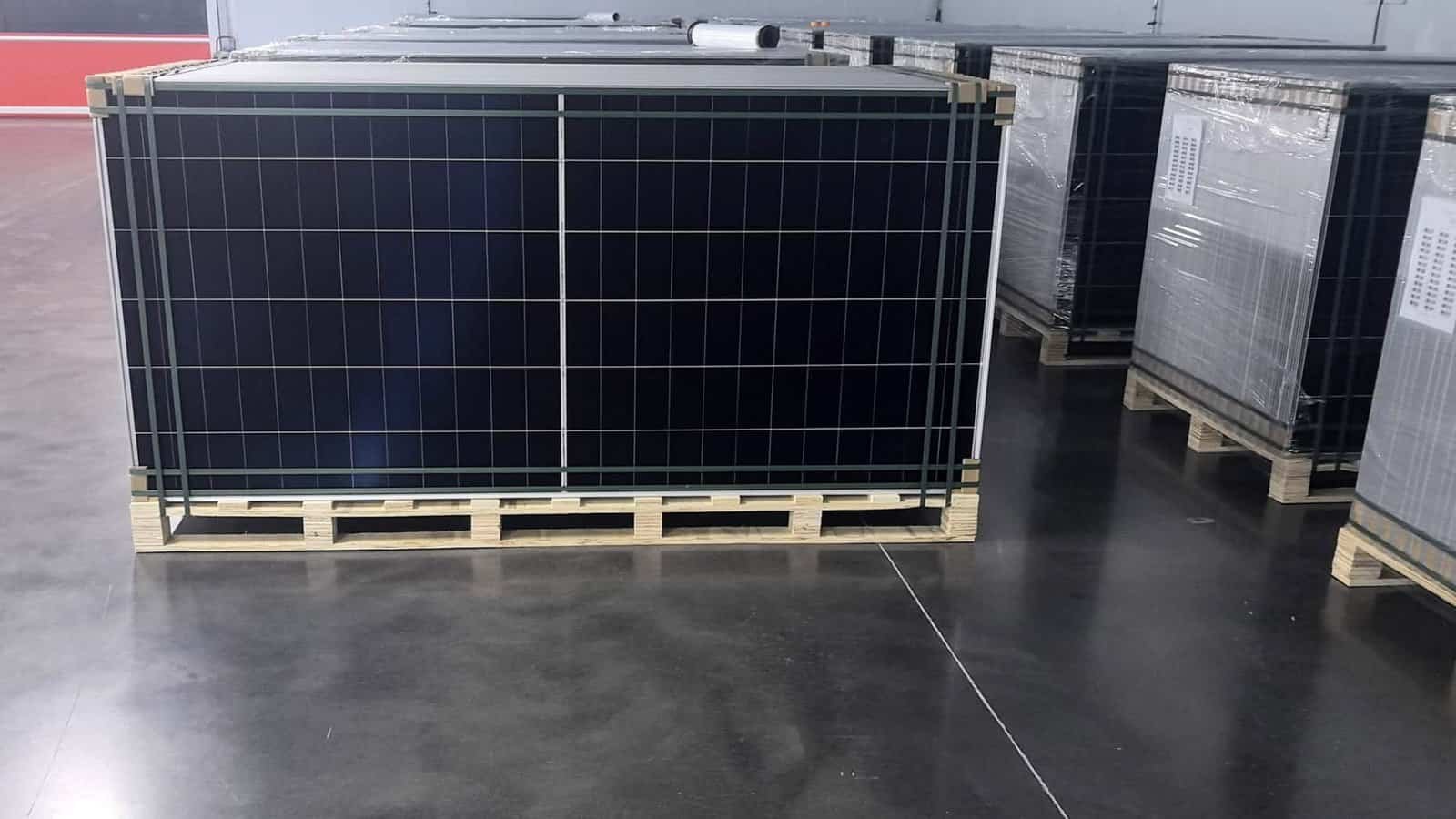
Every buyer asks how much more back-contact costs. Most answers give one number.
One number is wrong. There are at least three BC premiums running at the same time, and the gap between them is enormous.
In the commodity segments it is about nine to ten percent. In the European residential all-black segment it is around sixty-four percent. That is not a rounding difference. It decides whether a deal works.
Here are the published numbers for the week of 20 to 26 August 2026, what drives each one, and how to work out which applies to you.
The premium is set by segment, not by technology
This is the whole article in one table. Every figure is InfoLink’s published benchmark for the week of 20 to 26 August 2026.
| Segment | TOPCon | BC | Premium |
|---|---|---|---|
| China module average | RMB 0.723/W | RMB 0.790/W | +9% |
| China ground-mounted project | RMB 0.705/W | RMB 0.770/W | +9% |
| China distributed / C&I project | RMB 0.740/W | RMB 0.810/W | +9% |
| FOB China, Europe C&I | USD 0.119/W | USD 0.131/W | +10% |
| FOB China, Europe residential all-black | USD 0.119/W | USD 0.195/W | +64% |
| Bare cell | RMB 0.330/W | Not publicly indexed | +10–20% (Trina estimate) |
Read down the premium column. Four commodity segments, in two currencies, on two continents, all land within one percentage point of each other. That consistency is not a coincidence. It is what a competitive market looks like once a technology has scaled.
Then look at the highlighted row. The same technology, sold into the same continent, at more than six times the premium. Nothing about the cell changed. The segment changed.
For context on where BC sits among the n-type options, the same week put HJT modules in China at RMB 0.750/W. So the Chinese ranking runs TOPCon at 0.723, HJT at 0.750, BC at 0.790. Back contact is the most expensive mainstream n-type product on the board, and it is not close to being a commodity yet.
Where the 64% actually comes from
A residential all-black BC module and a C&I BC module can come off related production lines. The gap between USD 0.131 and USD 0.195 is not sixty-four percent of extra manufacturing.
Most of it is segment economics:
- Residential modules ship in small lots to many buyers, so distribution cost per watt is far higher than a container of C&I product.
- All-black construction genuinely costs more. Black backsheet or black-encapsulant builds run hotter and bin tighter, and cosmetic rejection rates are higher because every visual flaw shows.
- The residential buyer is not comparing per watt. They are comparing a finished roof, where the module is a minority of the installed cost.
- Supply is thin, and the brands that dominate the segment price to their brand rather than to the index.
Notice the width of that residential band. InfoLink’s range runs from USD 0.168 to USD 0.236 per watt, and the C&I BC band runs from USD 0.105 to USD 0.173. The C&I band alone spans a 65% spread.
A single index average tells you almost nothing when the underlying range is that wide. “BC module” is a category, not a product.
The European marketplace tells a different story, and both are true
InfoLink prices modules leaving China. The sun.store pv.index prices modules changing hands inside Europe. In July 2026 that index reported these averages.
| Module type | Average | Month on month |
|---|---|---|
| Full black | €0.138/Wp | +8% |
| Back contact | €0.135/Wp | +4% |
| TOPCon monofacial | €0.128/Wp | +2% |
| TOPCon bifacial | €0.11/Wp | down |
Against monofacial TOPCon, BC carried a premium of €0.007/Wp, roughly five percent. It also sold slightly below plain full black.
That looks like it contradicts the 64% figure above. It does not. The two indices are measuring different things, and the reconciliation is the useful part.
One clarification on the “full black” line. That category is dominated by all-black TOPCon, not by back contact, which is why the comparison is interesting: in July, buyers paid slightly more for an all-black TOPCon module than for a back-contact one. If your customer is buying appearance, back contact was not the expensive option that month.
The practical lesson for a distributor: if you quote a residential all-black back-contact job using a blended BC index, you will be short. If you quote a C&I job using a residential benchmark, you will lose it.
Why back-contact costs more to build
The premium is not invented. There are real process reasons behind part of it.
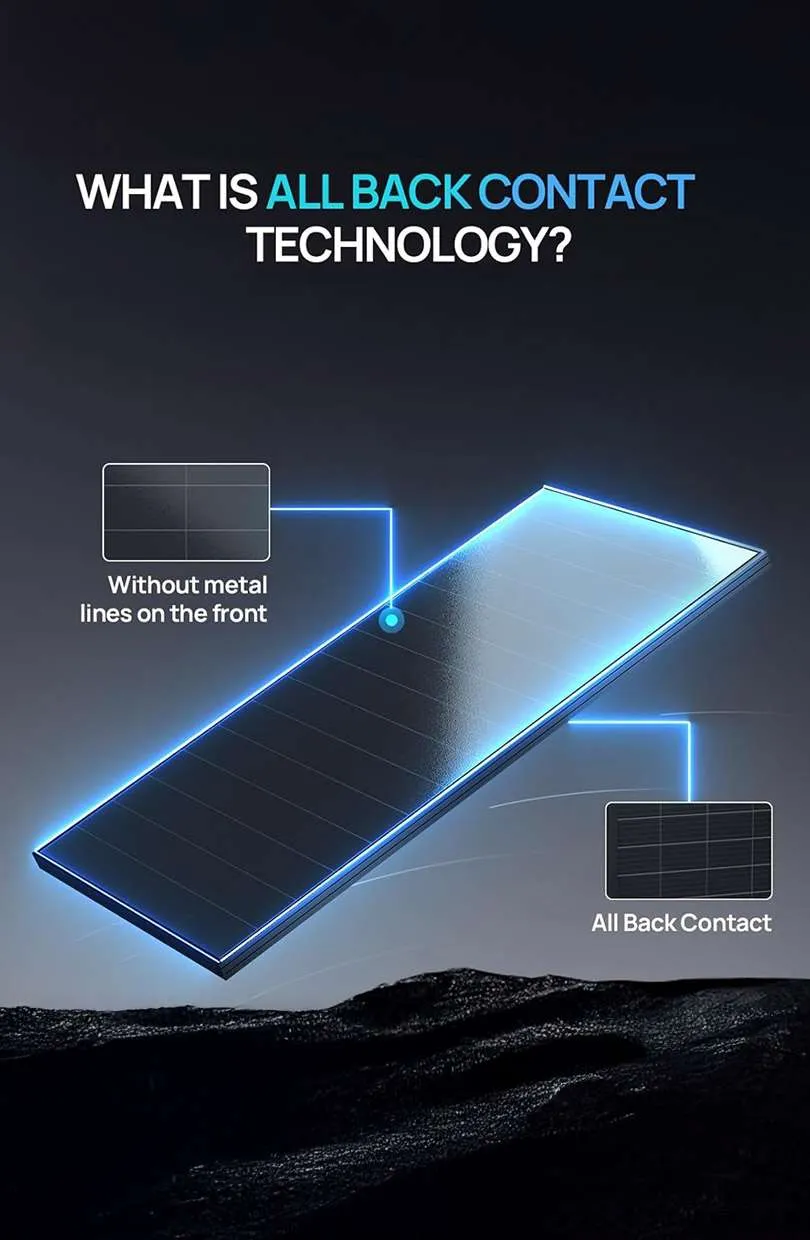
A back-contact cell puts both polarities on the rear face. The rear has to be patterned into alternating regions, kept electrically isolated, and metallized with tight alignment. Each step adds equipment, adds process control, and adds places for yield to slip.
TOPCon does none of that. It builds on an existing PERC line with a tunnel oxide layer and a doped polysilicon film. Most of the tooling was already installed and already paid for.
That last point matters more than people expect. Industry analysis assumes a six-year depreciation schedule for cell and module equipment, and puts around RMB 0.04/W of depreciation into TOPCon’s cost from 2022 to 2027. Lines built at the start of that window are close to written off. New BC capacity starts the clock again.
Against those costs, BC pushes back in four ways:
- No front gridlines, so no front-side shading loss and more watts per unit of cell area.
- Higher module power, spreading glass, frame, encapsulant and handling cost across more watts.
- Rear metallization designs that reduce or replace silver, which matters when silver prices move.
- Lower balance-of-system cost per kilowatt where usable area is genuinely capped.
Does the density gain pay the premium back? Run the numbers
This is where most BC sales arguments overreach, so it is worth doing honestly.
Take a 100 kW commercial roof. Compare a 640 W TOPCon module against a 665 W BC module in the same 2382 × 1134 mm frame, using this week’s FOB China C&I prices.
| For a 100 kW array | 640 W TOPCon | 665 W BC |
|---|---|---|
| Module efficiency | 23.7% | 24.6% |
| Modules required | 157 | 151 |
| Module area occupied | ~424 m² | ~408 m² |
| Module cost at FOB index | ~USD 11,960 | ~USD 13,150 |
| Difference | — | +USD 1,190, about 10% |
Six fewer modules. Around 16 m² less module area. Six fewer sets of clamps, lifts and connections.
Now be honest about what that is worth. Six mounting operations do not recover USD 1,190 on most C&I roofs. Against a modern 640 W TOPCon module, the density gain is 3.9%, and the price gap is 10%.
Illustrative, built from published index averages and typical module formats. Not a quotation. Module area only; row spacing, walkways and setbacks are excluded.
When the area is fixed, the arithmetic inverts — and the cell stops being the issue
Everything above assumes you can add modules until you hit your kilowatt target. Change that one assumption and the whole calculation turns over.
Take a real constrained surface: a 3.5 by 2.3 metre canopy, deck or vehicle roof. That is 8.05 m² of usable area, and there is no more of it.
Lay standard 2382 × 1134 mm modules on it. Only two fit. They cover 5.40 m², or 67% of the surface, and deliver 1,330 W. The remaining 2.65 m² is stranded, because the module is the wrong shape for the space.
Now build modules to fit the actual footprint at the same 24.6% cell-level performance. The same surface delivers roughly 1,980 W. That is 49% more power from an identical area.
Which reframes the buying question. On an open roof, ask whether BC’s density gain justifies the premium. Usually it does not. On a fixed surface, ask whether anyone will build the size you actually need, because that decision is worth several times the cell premium either way.
The case against paying the premium
We sell back-contact modules. That is exactly why this section belongs here.
Trina Solar has published the most detailed public argument that TOPCon delivers better real-world yield. Three of its points deserve a serious answer rather than a brush-off.
Bifaciality. TOPCon cells typically reach a bifaciality factor near 85%. BC cells, with the electrodes occupying the rear face, typically sit near 70%. On a ground mount over reflective ground, that gap is real and it favors TOPCon. It is also the single most important reason BC is a weaker fit for utility-scale bifacial projects than its STC efficiency suggests.
Low light. Trina reports that around 60% of daily sun-hours fall below 800 W/m² even in high-irradiance regions, and argues BC loses more fill factor there.
Shading. A Solar Energy study (Li et al., 2025) found BC’s shading advantage holds for one or two isolated shaded cells, but converges with TOPCon once a full row is shaded. That finding is correct, and the next section explains why it is compatible with the much larger shade numbers BC manufacturers publish.
Two caveats belong with that evidence, and we would want them applied to our own claims too. The shading study was co-authored by Trina researchers, which does not invalidate it but does mean it should be read alongside independent work. And Trina’s own page quotes the Kagoshima performance ratios two different ways, as 97.8% against 89.9% in one paragraph and 94.19% against 91.99% and 89.29% in another. Those cannot both be right.
The practical conclusion is not that one technology wins everywhere. A large open ground mount with clean sky and reflective ground is TOPCon’s strongest case, and the BC premium is hardest to justify there. Constrained, aesthetic, shaded or weight-sensitive installations are where BC earns its price.
The shade numbers only look contradictory because nobody states the shading geometry
You can find BC shade claims ranging from 5% to 50%, and a peer-reviewed study saying the advantage disappears entirely. All of it is published, all of it is testable, and it reads like an argument.
It is not an argument. It is one effect measured under different shadow shapes, quoted without the shadow.
| Shading condition | BC advantage over TOPCon | Measured by |
|---|---|---|
| One cell, 10% covered | About 5% | TÜV Nord flash test, AIKO |
| One cell, 50% covered | 10.15% loss vs 36.48% loss | CPVT, LONGi Hi-MO X10 |
| One cell, fully covered | About 30% | TÜV Nord flash test, AIKO |
| Point-like shading, certified | TÜV Rheinland Class A and A+ ratings issued | TÜV Rheinland |
| Dynamic site shading, daily | Over 10% | CPVT |
| Real projects, annual, shade-prone | Roughly 5–18%, wide spread | Manufacturer field data |
| Three or more adjacent cells, or a full row | Converges to roughly zero | Li et al., Solar Energy, 2025 |
| No shading, bifacial ground mount | TOPCon ahead, on bifaciality | TÜV Nord and CPVT field tests |
Now look at where the two sides place the boundary. BC manufacturers explain the mechanism by saying the bypass diode only engages once roughly four adjacent cells are shaded; below that, current shunts internally around the shaded cell. The Trina-authored study says BC’s advantage holds below roughly three shaded cells per substring and vanishes above it.
Those are the same threshold, described from opposite sides of a commercial argument. There is no disagreement about the physics. There is only a disagreement about which shadow is worth talking about.
This also explains the gap between the laboratory and the field. A 30% advantage under a fully shaded cell becomes a single-digit annual gain, because that shadow only sits on that cell for part of the day for part of the year. Both figures are true. They are simply the same effect at two different time scales.
Two cautions on the published numbers. The very large field figures, up to 50%, are instantaneous readings from heavily obstructed pilot sites and should not be read as annual yield. And most of this testing is manufacturer-commissioned, even where a certification body verified the result, so treat the direction as well established and the exact magnitude as site-specific.
Which technology for which job
Strip the argument down to a purchasing rule and it looks like this.
| Application | Usually the better buy | Deciding factor |
|---|---|---|
| Open ground mount, reflective ground | TOPCon bifacial | Higher bifaciality, and the cheapest watt on the index |
| C&I roof with spare area | TOPCon | Density gain does not recover a 10% premium |
| C&I roof with capped area | Run the numbers | Whether the kW target fits at all decides it |
| Residential all-black | Back contact | Appearance is the product, and margins follow it |
| Facade and BIPV | Back contact, custom format | Uniform surface, and the size must match the bay |
| Marine, vehicle, balcony | Custom format first, cell second | Fitting the surface is worth more than the cell premium |
Two of those rows deserve a note on margin rather than cost. In residential and architectural work, the module is a small share of the installed price, and the visible surface is what the end customer is choosing. That is why the residential back-contact premium survives at 64% while the C&I premium sits at 10%. If you sell into that segment, the premium is not a cost problem. It is the reason the segment has margin in it at all.
If you are trying to work out which row your project sits in, that is the conversation worth having before you compare quotes. Send us the constraint and we will tell you which way it goes.
Where the gap is heading
A premium driven by immature manufacturing behaves differently from a premium driven by demand. BC has been moving from the first toward the second.
Analyst consensus puts parity around 2028 to 2030. Trina, arguing the TOPCon side, cites that same window. It is contingent on BC sustaining roughly a 1.2 to 1.3 point efficiency lead, which is close to the lead in today’s mainstream products.
Patents expire around 2028. Radovan Kopecek of ISC Konstanz describes back contact as the final evolution step for crystalline silicon, and expects patent expiry to lower the barrier for more manufacturers to enter. More suppliers means less pricing power.
Upstream costs are moving against everyone right now. In the week of 20 to 26 August, Chinese polysilicon rose 27% while TOPCon cell prices fell 8.3%. Module prices barely moved. Squeezed cell margins usually resolve upward, so treat any module benchmark from this period as unusually soft.
Parity dates are forecasts, not facts. Buy on today’s numbers.
Why your quote will not match the index
Every index above describes the middle of a very large market. Your quote may sit well outside it, for reasons unrelated to cell technology.
- Volume tier. Index prices reflect project-scale orders. A few pallets is a different price.
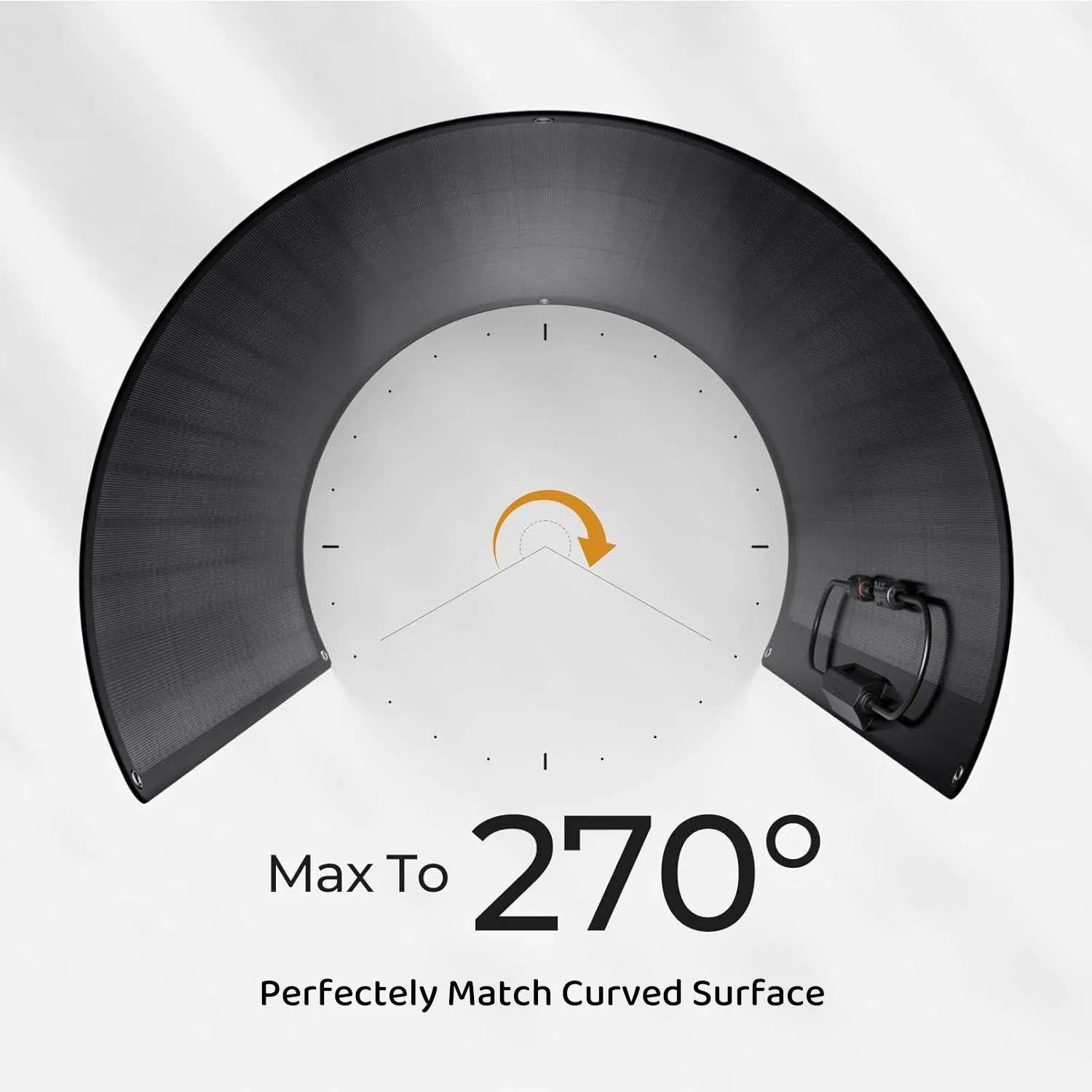
- Format. A standard utility frame is a commodity. A custom size, shape or voltage is not, and its price has little to do with the spot index.
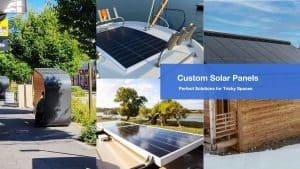
- Segment. All-black residential, marine, balcony and vehicle formats are priced as specialty products, not as commodity watts.
- Incoterm. InfoLink’s RMB figures are delivered inside China and exclude transport. The USD figures are FOB. Neither includes freight to your warehouse, duty, or local compliance cost.
- Tier. InfoLink notes its high and low bounds reflect Tier-2 makers or older projects. The average is not a Tier-1 price.
Use the index to see which way the market is moving. Do not use it as your number.
Where we fit, and where we do not
You have read a long article about module prices from a module manufacturer. Fair to tell you plainly what we do, so you can decide in ten seconds whether we are worth an email.
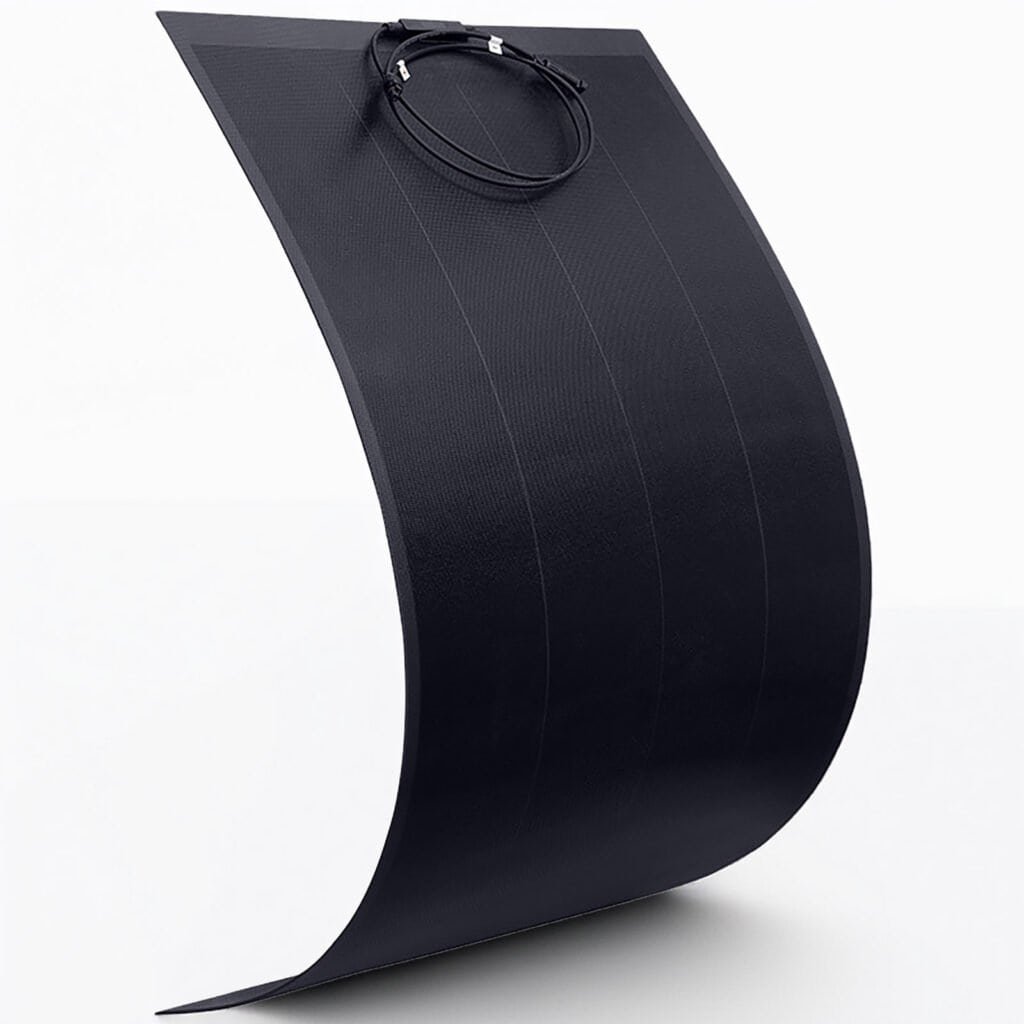
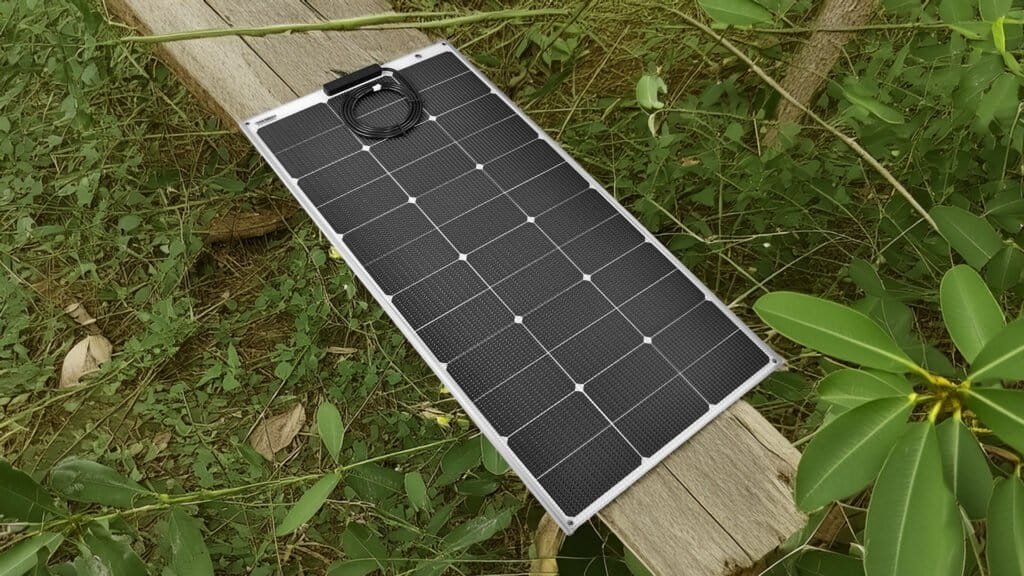
We are a custom back-contact module builder in Ningbo, China. We make flexible ETFE, semi-rigid and walkable, rigid back-contact, and dual-glass BIPV modules, in non-standard sizes, powers and shapes, under our own name or yours.
| Talk to us if | Talk to a tier-one factory if |
|---|---|
| You need a size, shape or voltage that is not in anyone’s catalogue | You need standard 2382 × 1134 mm modules by the megawatt |
| Your volume is pallets or a few containers a year | You are buying tens of MW on a framework agreement |
| The surface is a deck, roof, rail, facade, canopy or vehicle | The surface is open ground with room to spare |
| You want the product carrying your brand, not ours | You need a globally bankable warranty covenant |
| Weight, thickness or appearance is a hard constraint | Lowest cost per watt is the only criterion |
That right-hand column is not false modesty. If you are buying commodity watts at scale, a tier-one factory will beat us on price and on balance-sheet strength, and you should let them. We are not trying to win that comparison.
Our terms, so you can qualify us without an email:
| Minimum order | From two or three pallets, 36 pieces per pallet |
| Lead time | Around 15 working days |
| Branding | OEM and ODM supported; your label, your datasheet |
| Product warranty | 15 years |
| Performance warranty | 30 years |
Two of those are worth a sentence each. Seventy-two pieces is a genuinely low floor for custom work, and it exists because we tool for non-standard formats as a matter of routine rather than as an exception. Fifteen working days is a production lead time, not a shipping estimate; add freight to your own destination on top.
On the 15 and 30 year warranty terms, apply the same scepticism we asked you to apply to the shade data. A warranty is a covenant from a legal entity, and it is worth what that entity is worth in year twenty. Ask us who underwrites it and ask the same of everyone else you are considering. It is a fair question and we would rather you asked it early.
Frequently asked questions
How much more expensive is BC than TOPCon?
Around 9 to 10% in commodity module segments, in both China and FOB export. Around 64% for European residential all-black product. At cell level, roughly 10 to 20%.
Is BC permanently more expensive?
No. Today’s premium reflects tooling depreciation, thinner supply, and the fact that suppliers can charge for higher power density. None of those are permanent features of the technology. Analysts point to parity around 2028 to 2030.
Is there a public price index for HPBC or ABC specifically?
No. Public indices report a combined BC category, split by segment rather than by manufacturer platform. Cell-level price lines are published for TOPCon, not for BC. A brand-specific BC cell price requires a direct quotation.
Can I estimate a BC cell price by adding the module premium to a TOPCon cell price?
No. The module premium is diluted by higher watts per module; the cell premium is not. Request a quotation by cell format, efficiency bin, interconnection design, grade, volume and delivery week.
Does the BC premium apply to flexible and semi-rigid panels the same way?
No. In those formats the front sheet, encapsulant and backing structure carry a large share of the cost. Cell choice moves the final price less than it does in a standard glass module.
Is back contact really better in shade, or is that marketing?
Both. The effect is real, verified by TÜV Nord, TÜV Rheinland and CPVT, and it is bounded. Against small point-like shadows, a shaded back-contact cell shunts current internally instead of tripping a bypass diode, and the module keeps most of its output. Against shadows covering three or more adjacent cells, or a full row, the advantage converges to roughly nothing. Quoting the headline percentage without the shadow geometry is where the marketing starts.
Which applications justify the premium most easily?
Anywhere area is capped or appearance is part of the sale. Constrained commercial roofs, all-black residential, facades, balconies, marine decks and vehicle roofs. Open ground mount over reflective ground is the weakest case, because BC’s lower bifaciality works against it there.
How often do these prices change?
Weekly for the China and FOB benchmarks, monthly for the European marketplace index. Treat every number here as a dated snapshot and check the live source before quoting.
Sources
- InfoLink Consulting, PV spot price — live weekly benchmark; all RMB and USD figures in this article are from the 20–26 August 2026 table.
- InfoLink Consulting, weekly commentary, 26 August 2026.
- InfoLink Consulting, weekly commentary, 5 August 2026 — introduction of the overall BC module average.
- PV Tech, European module selling prices, July 2026, reporting the sun.store pv.index.
- PV Tech, European premium module prices, June 2026.
- Trina Solar EU, the real-world metric, 22 May 2026 — cell-level premium, bifaciality factors, parity window, TÜV Nord and CPVT field data, and the Li et al. shading study.
- pv magazine, independent reporting on the TÜV Nord field tests.
- AIKO Solar, partial shading Q&A — TÜV Nord flash-test figures at 10% and 100% single-cell coverage, and the TÜV Rheinland Class A certificate under standard 2 PfG 2926/01.23.
- TaiyangNews, AIKO ABC module power and efficiency — pilot-project range of 4.94% to 50% under obstruction, tree and dust shading.
- Energy Industry Review, LONGi HPBC 2.0 anti-shading certification — the CPVT single-cell 50% shading result, 10.15% loss against 36.48%, and the TÜV Rheinland A+ rating scoped to point-like shading.
- PVTIME, BC technology and PV cost structure — equipment depreciation.
- LONGi, back-contact technology and shade performance — Kopecek on terawatt-scale capacity and 2028 patent expiry.
- Couleenergy, HPBC and ABC compared and shade performance of HPBC 2.0, ABC and TOPCon.
Tell us the constraint, not the specification
Most buyers write to us with a datasheet they are trying to match. The more useful message is shorter: the surface you have, the power you need, roughly how many, and where it ships. Four lines is enough for us to tell you whether back contact is worth its premium on your job, and whether a custom format beats both options.
If the honest answer is that a standard TOPCon module from a tier-one line serves you better, we will say so. That answer costs us nothing and saves you a procurement cycle.
OEM & ODM · Low MOQ · Custom size, power & shape · Fast sampling
couleenergy.com | +1 737 702 0119 | info@couleenergy.com
 English
  Español
  Français
  Deutsch
  Русский
  العربية