
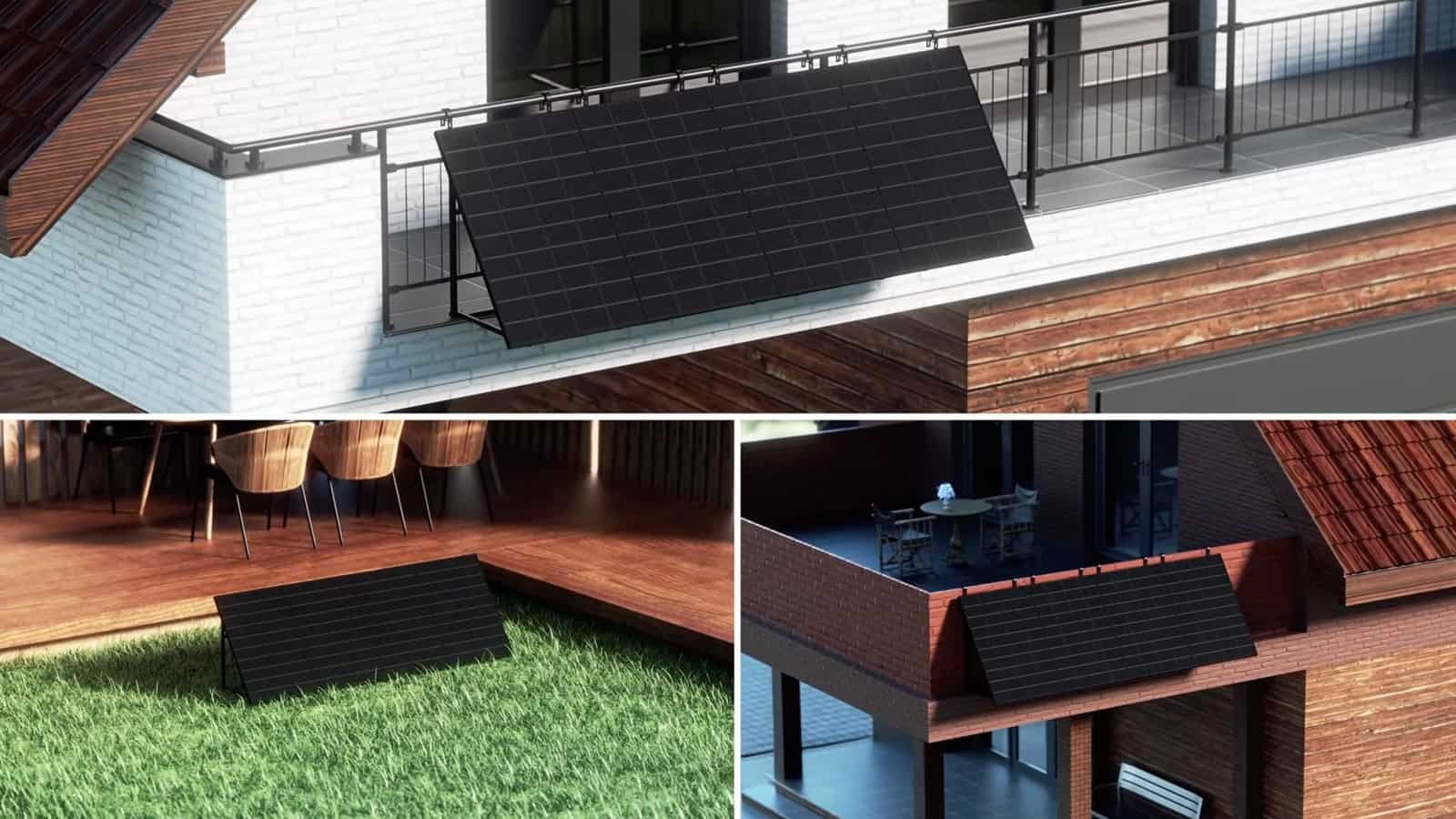
A technical buyer’s guide to the Interim Product Specification for balcony and plug-in solar in Great Britain — written for module suppliers, importers, distributors, and installers.
Checked against Interim Product Specification v2.0 (16 July 2026) and SI 2026/848. Standards and registration processes may be amended — verify against the live documents before committing a specification.
Plug-in solar becomes legal in Great Britain on 27 August 2026. Hundreds of consumer articles have covered that date. Almost none of them explain what the rules ask of the panel itself.
So we read the source document end to end. The Plug-in Solar Device Interim Product Specification, Version 2.0 is not a light-touch document. It sets hard limits on DC voltage, module fire performance, mounting hardware, plug design, and documentation.
If you make, brand, or import panels for this market, several clauses will change your product before they change your marketing. Here are the ones that matter, plus a specification checklist you can hand to a factory.
Key takeaways
- The cap is 800 VA of AC output and 3.5 A, not 800 W of panels. Up to 2,000 W of modules is allowed behind it.
- Open-circuit voltage at the inverter input must stay at or below 120 V DC. Two modules per string, four modules per device.
- The rear backing of the module must reach Euroclass B-s3,d2 under BS EN 13501-1. This is the clause most flexible panels will fail.
- The mounting system is part of the certified product, and it needs Eurocode wind and snow calculations.
- Batteries and building-integrated PV are outside the scope of this route entirely.
- Type testing alone is not compliance. The device must be registered with the ENA before it goes on sale.
What Actually Changed
Before this year, exporting power through a standard household socket was blocked. SI 2026 No. 848 removed that barrier. It amended the Plugs and Sockets etc. (Safety) Regulations 1994 and the Electricity Safety, Quality and Continuity Regulations 2002.
The instrument creates a new legal category: the plug-in microgenerator. To qualify, a device must be PV-only, run in parallel with the grid, connect through a standard plug, and comply with the Interim Product Specification. Miss any limb of that definition and you are outside the route.
A separate planning instrument lands on the same day. SI 2026/896 amends the General Permitted Development Order for England, adding definitions of “plug-in solar”, “standard plug” and “socket”. Wales, Scotland and Northern Ireland run their own planning regimes, so do not assume UK-wide permitted development.
Read that Order alongside the product specification, not instead of it. It carries its own restriction on wooden and timber-clad external surfaces. Timber therefore appears twice, in two instruments, through two mechanisms. Clearing one does not clear the other.
One geographic caveat is widely misreported. SI 2026/848 has two limbs, and they do not share the same reach. DESNZ consulted on the Plugs and Sockets amendments as a UK-wide change. The ESQCR limb, which governs whether the device may actually be connected and used, covers England, Wales and Scotland.
Northern Ireland sits outside the operating side for now. G98 applies to Great Britain only, Northern Ireland uses G98/NI, and the specification says its application there is still under consideration. Treat it as a separate market question.
The hard numbers
| Parameter | Limit | Why it exists |
|---|---|---|
| Maximum apparent power (Smax) | 800 VA | Keeps current inside safe limits on an existing ring final circuit |
| Maximum AC current | 3.5 A | Inverter tested at 0.94, 1.0 and 1.1 of nominal; current verified at roughly 0.85 |
| Total module DC power | 2,000 W | Oversizing is allowed because the inverter clips the output |
| Professional assessment trigger | Above 960 W of modules | Manufacturer must advise an electrical check. It is not a hard ceiling. |
| Voc at inverter input | 120 V DC | Reduces the risk of sustained DC arcing |
| Modules per device | 4 maximum, 2 per series string | Same voltage logic, applied to the string |
| Outdoor ingress protection | IP55 minimum | Applies to the assembly and outdoor interfaces; the type test excludes the plug itself |
| Residual DC current | 5 mA maximum | Stops the device desensitizing the household RCD |
The Limits Most Coverage Skips
Y-connectors are banned. Every module must reach the inverter through its own manufacturer-supplied cable and connector. That kills the familiar two-panels-plus-a-branch-lead build. A four-module kit needs a genuinely multi-port inverter or a factory-assembled harness.
The plug is a specified component. It must be a non-rewireable moulded plug to BS 1363-1, with half-insulated pins and a BS 1362 fuse rated no higher than 5 A. A generic cordset does not qualify. Extension leads, multi-way adaptors, travel adaptors, and RCD adaptors are all prohibited.
Anti-islanding is timed, not just declared. The test is specific. A resistance above 2,000 ohms is applied across the plug pins within 40 seconds of disconnection, which gives the inverter time to detect loss of mains. The inverter must then disconnect within 100 ms, and voltage at accessible pins must fall below 34 V in that same window. Capacitors above 100 nF must discharge to 34 V or less within one second.
One device per circuit — for now. The specification permits one plug-in device per final ring circuit. But a note makes clear that G98 Issue 2 Amendment 1 currently restricts this to one device per household. Until G98 is amended, plan your channel messaging around one per home. Two panels on separate circuits is not yet a compliant upsell.
The device may only connect to socket circuits. Lighting circuits are out. Spurs feeding fixed equipment such as a cooker or boiler are out.
One more trap for homes that already have solar. The G98 simple-notification threshold is 16 A per phase, roughly 3.68 kW, and it is assessed across the property. A household already near that ceiling with a rooftop array can be pushed into a full G99 application by adding a plug-in kit. That is a slower process. Installers selling into homes with existing PV should check the aggregate before promising a same-day install.
The Fire Clause That Redraws the Flexible-Panel BOM
Clause 6.3 says the outermost substantial layer of the module must achieve a reaction-to-fire performance equivalent to Euroclass B-s3,d2 under BS EN 13501-1, when installed on the building materials allowed in the product guidance. The type-test table names the tested item directly: the PV module rear external backing. Evidence can be a fire classification report, a test report, or equivalent technical evidence.
The definition of “substantial layer” matters. A layer counts if it is at least 1.0 kg/m² in mass or 1.0 mm thick. The specification adds a helpful note: in most cases this layer is what the industry calls the backsheet. Work through what that means by format.
| Module format | Outer rear layer | Route to B-s3,d2 |
|---|---|---|
| Glass–glass rigid module | Tempered glass | Straightforward. Glass classifies as Euroclass A1. |
| Glass front, polymer backsheet | TPT, KPF or similar | Depends on the grade. Ask for the classification report. |
| Fully flexible ETFE laminate | Polymer or composite backsheet | Needs deliberate material selection and a real test report. |
| Semi-rigid ETFE with backing plate | Fiberglass, aluminum or composite plate | Often the easier path, because the backing is already a structural, specifiable layer. |
Notice where the burden falls. AGC produces Fluon ETFE film from 12 to 250 microns. At a density near 1.7 g/cm³, even the thickest of those weighs about 0.43 kg/m². That sits below both substantial-layer thresholds, on mass and on thickness.
So the specification looks straight past the front sheet and lands on the rear stack — the layer most flexible-panel datasheets describe in one vague word.
Practical sourcing note
“Flame retardant” on a datasheet is a marketing claim. A BS EN 13501-1 classification report naming B-s3,d2 is evidence. Ask for the second one. If a supplier cannot produce it, they have not built for this market yet.
One more line in the same clause deserves attention. The methods of attachment used for the modules must be resilient in the event of fire. Plastic clips and low-temperature adhesives are hard to defend against that wording. Metal fixings with mechanical capture are much easier.
Check which version you specified against. The withdrawn June draft required the module itself to be portable, with no permanent fixing or structural attachment. Version 2 replaced that with a narrower rule: the module must come off its mount without a professional tool. Anyone who wrote a specification from the June text is working from a superseded requirement.
Mounting Hardware Is Now Part of the Certified Product
Plenty of suppliers still treat brackets as an accessory. Under this specification they are not. A mounting system must ship with the kit, and the manufacturer must produce a structural analysis proving it is safe in use.
That analysis follows the Eurocodes: wind loads from BS EN 1991-1-4 with the UK National Annex and PD 6688-1-4, snow loads from BS EN 1991-1-3. You must also declare the maximum permissible installation height above ground for each mounting type.
Several fixing methods are ruled out by name. Mounting that relies only on cable ties, rope, string, adhesive tape, bungee cords, or straps is not permitted. Every attachment must be reversible and non-permanent. It must not compromise the structural integrity, fire performance, or weatherproofing of the building.
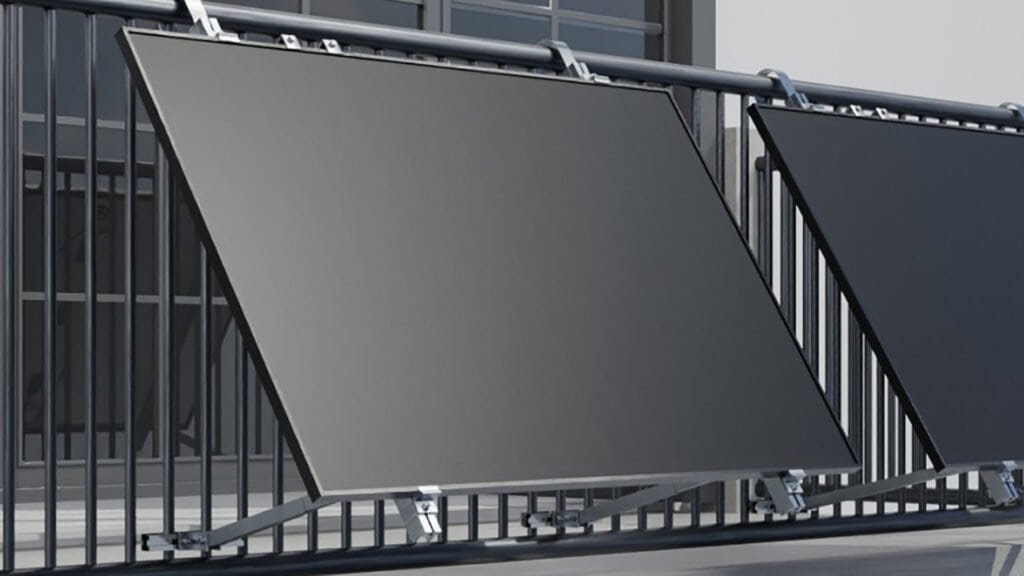
That combination is demanding. The fixing must survive UK winter gusts, come off at the end of a tenancy, and never breach a facade. In practice it points toward clamp-and-bracket systems on railings, and ballasted frames on floors.
Three further constraints sit alongside the loads:
- The module must come off its mount without a professional tool.
- Modules must not be fixed to walls forming a property boundary between dwellings.
- Where the building has a lightning protection system, the separation distance for lightning protection applies. (The specification prints this reference as “BS EN IEC 52305-3:2024”. The lightning protection standard is BS EN IEC 62305-3, so read it as a typographical slip in the published text.)
Lower module weight helps on every one of these points. Lighter panels reduce railing loads, shrink bracket sections, and make one-person removal realistic — a clear argument for lightweight back-contact construction here.
The Clearance Clause Ends the Flush-Bonded Install
Here is a quiet requirement with loud consequences. The manufacturer must specify a minimum clearance between module and mounting surface, plus minimum spacing to adjacent materials, to limit heat build-up and fire risk. Where ventilation demands it, you must instruct the user to mount at an angle to the surface.
Read that against how flexible panels are usually sold. The classic pitch is adhesive bonding straight onto a wall or deck, which has no air gap by design. A supplier would have to declare a clearance of zero and defend it — difficult, when the clause exists to manage fire risk.
The physics agrees with the regulator. A panel bonded flat to a surface loses rear convection and runs hotter. For a module with a temperature coefficient near −0.3 %/°C, roughly every 10 °C of extra cell temperature costs about 3 % of output. That is a recurring loss, not a one-off.
The honest version of that argument matters. Operating temperature is set by irradiance, ambient air, wind, and mounting together. Mounting is simply the one variable a product designer controls. For UK balcony work, the conclusion is clear: design for a standoff, not for a bond.
Semi-Flexible or Semi-Rigid ETFE? A Straight Answer
Both formats keep the ETFE advantages. The film is light, self-cleaning, and highly UV-stable — AGC’s Fluon data puts transmission above 90 % and weathering resistance beyond 16,000 hours. The difference between formats is structural, not optical.
| Factor | Semi-flexible ETFE | Semi-rigid ETFE + backing plate |
|---|---|---|
| Weight | Lowest of any format | Slightly heavier, still far below glass |
| Bracket mounting | Needs a frame or sub-panel to carry point loads | Backing plate gives you real fixing points |
| Wind-load behavior | Flutters and flexes across an open span | Stiffness resists cyclic flexing |
| Rear fire classification | Backsheet grade must be chosen and tested for it | Backing plate is already a specifiable structural layer |
| Edge protection | No cavity, so no butyl seal — relies on encapsulant flow and edge margin | A defined edge geometry allows edge banding or sealant |
| Best UK use case | Curved rails and irregular surfaces where rigidity is impossible | Standard flat and railing mounting with a ventilation standoff |
Our recommendation for the UK plug-in route is semi-rigid. The regulation itself pushes you there. It asks for structural analysis, a declared clearance, mechanical fixings, and a fire-classified rear face. A backing plate answers all four questions at once.
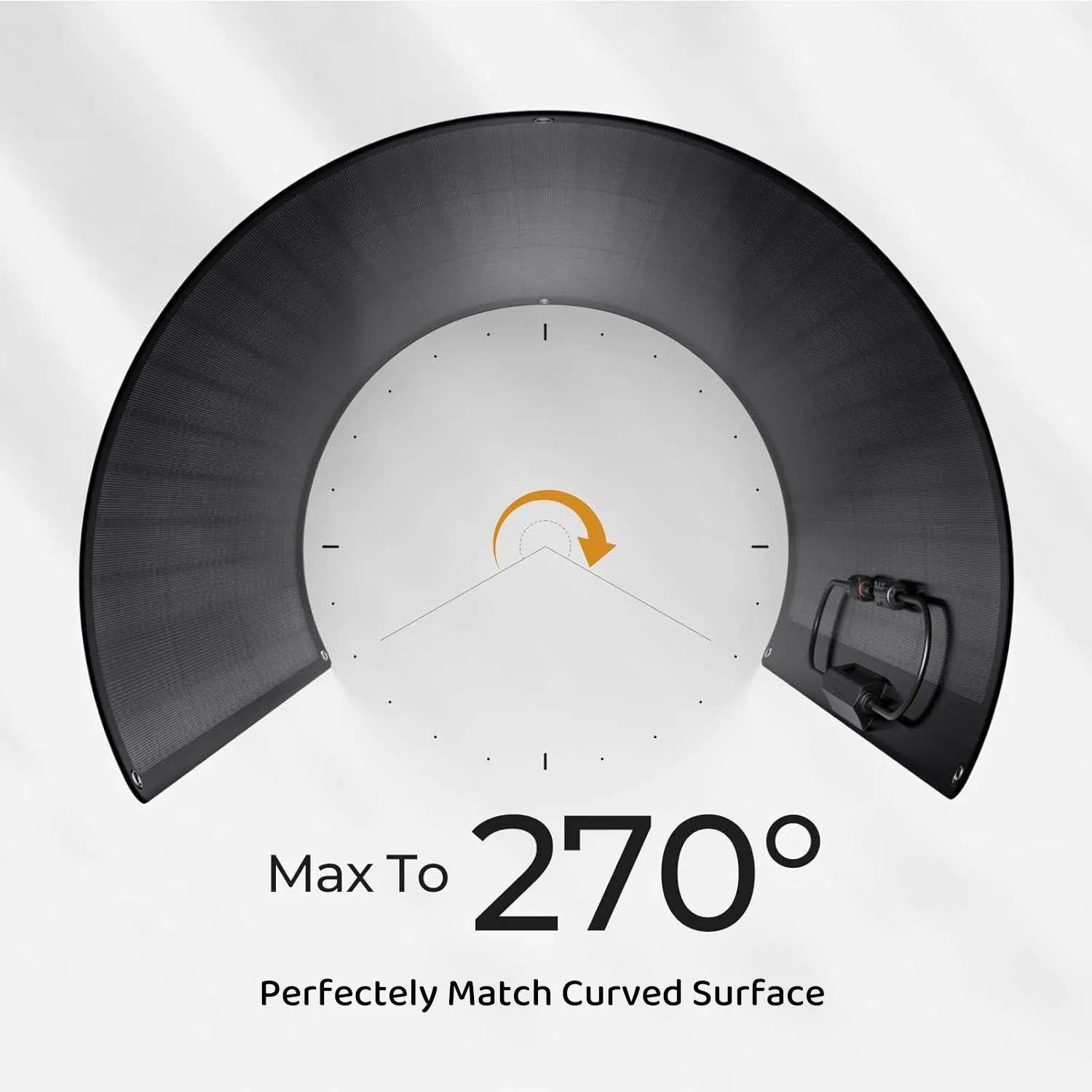
Keep fully flexible modules for the cases where they genuinely win: curved surfaces, very low weight limits, and vehicle or marine work outside this regime. More detail in our guide to semi-rigid panel construction.
Semi-rigid is not a free win, and we should say so. A rigid backing plate is point-load sensitive when the panel is not fully supported, and any mismatch in thermal expansion between plate and laminate becomes a long-term stress. Both are solvable through material choice and bracket spacing, but they need designing in.
One caveat applies to both formats. Glass-free laminates have no true moisture barrier; water vapour permeates through the face area, not just the edges. That is a design factor to manage through encapsulant selection, not a flaw to hide.
Where Back-Contact Cells Genuinely Help
Balconies are shading machines. Railings, downpipes, neighbouring buildings, and plant pots all cast partial shadows across the day. Shade tolerance is a fair question to ask of the cell architecture.
Back-contact cells do help, and the peer-reviewed evidence lets us be precise about how much. A 2026 study in Solar Energy compared BC and TOPCon modules across six shading scenarios. With one cell fully shaded, the BC module lost 12.9 % of output against 33.9 % for TOPCon.
The same study sets the boundary. BC outperforms TOPCon only when fewer than three cells within a substring are shaded. The mechanism is the BC cell’s low breakdown voltage, around −5 V, against the roughly −15 V of reverse bias needed to trigger a substring bypass diode.
Treat back-contact as a shade improvement with a ceiling, not shade immunity. A railing shadow crossing one or two cells is exactly its case. A neighbouring building shading half the panel is not.
The temperature advantage is modest. Against modern TOPCon, the gap is around 0.03 %/°C. Marketing that compares back-contact against −0.35 to −0.40 %/°C is quoting PERC-era numbers.
Field results are not one-sided. At a Kagoshima test site, TÜV Nord verified performance ratios of 94.19 % for TOPCon, 91.99 % for a p-type BC module and 89.29 % for an n-type BC module, as reported by pv magazine. Two caveats belong with those numbers: the campaign was manufacturer-run, and one month is not a year. Even discounted, it cuts against any claim that BC always wins.
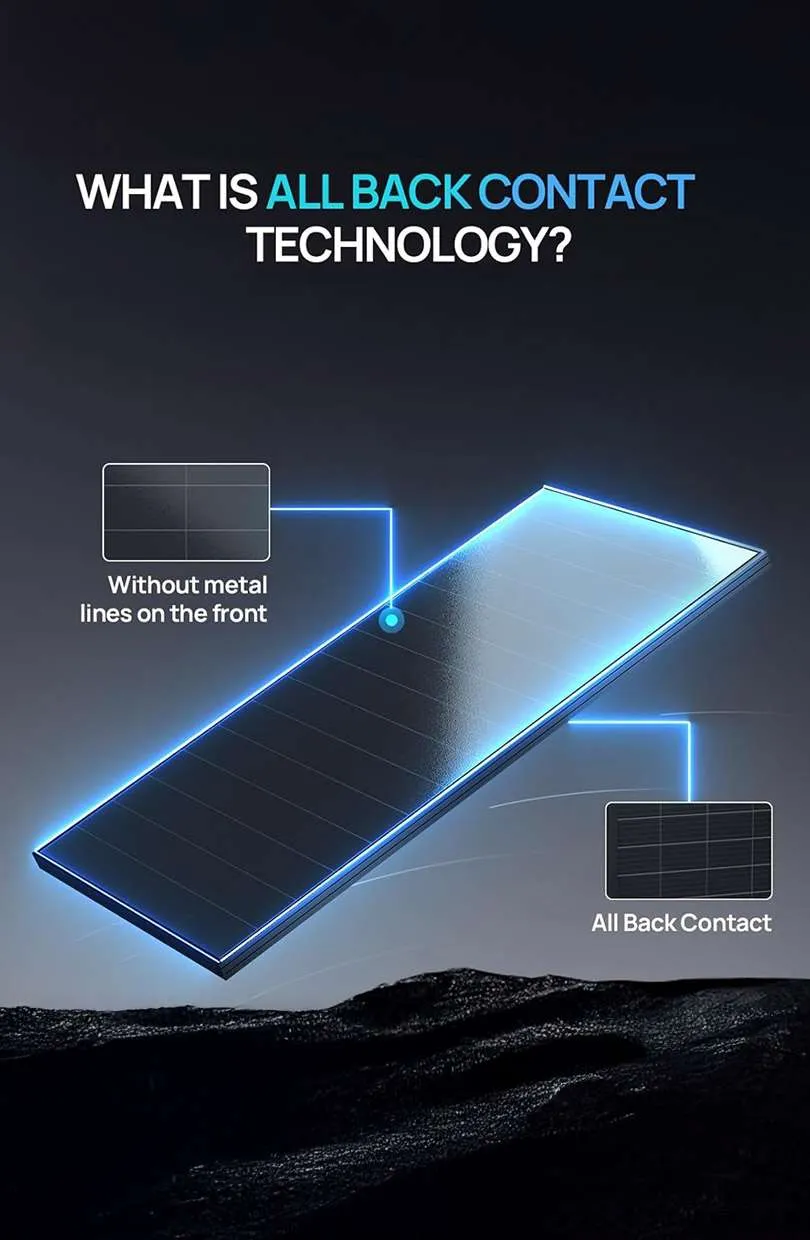
For balcony products, the aesthetic case is stronger than most engineers admit. No visible busbars means an all-black module reads as architectural rather than industrial — which matters when a freeholder is deciding whether to approve the install. Our shading comparison and our n-type selection guide cover the cell technologies side by side.
What the Rules Exclude — and Why It Shapes Roadmaps
The specification lists what it does not cover. That list is short and important:
- PV systems designed under BS 7671 Section 712
- Building-integrated PV
- Plug-in battery systems
- Plug-in solar integrated with storage
- Plug-in generation from any source other than solar PV
The BIPV exclusion is easy to miss and expensive to discover late. Integrate a module into the building envelope and you leave the plug-in route completely, landing back in conventional installation territory.
There is a second route, and it is easy to forget
Falling outside the plug-in definition does not mean falling outside the market. Amendment 4 to BS 7671, in force from 15 April 2026, updated Chapter 712 to recognise small plug-connected PV sources. A hardwired installation at or below 800 W, carried out by a registered electrician with the usual G98 notification, remains available.
That matters commercially. If a product cannot meet every limb of the plug-in specification, the hardwired route is a fallback, not a dead end. It shifts the channel from retail to trade, but keeps the product sellable.
The battery exclusion reshapes the value proposition. Without storage, generation must be consumed as it is produced. That pushes the sales conversation toward daytime base loads — refrigeration, routers, home working, hot water timers. Anyone selling on evening self-consumption is selling something the first phase does not deliver.
Five surfaces where installation is prohibited
The list is absolute. There is no case-by-case waiver in the text.
- Aluminium composite material (ACM) or metal composite material (MCM) cladding systems
- High pressure laminate (HPL) cladding systems
- Timber cladding systems
- Timber balconies
- Buildings under external wall remediation or building safety remediation restrictions
For distributors, this is a returns problem waiting to happen. Building eligibility must be settled before the sale. A short pre-purchase questionnaire on the product page pays for itself.
The Route to Market, Step by Step
- Fix the architecture and the electrical envelope. One-, two- or multi-component build; Smax at or below 800 VA, 3.5 A maximum, 120 V DC at the inverter input.
- Qualify the module. BS EN IEC 61730-1 and 61730-2, junction box to 62790, cables to 50618 or IEC 62930, connectors to 62852.
- Test the rear backing to BS EN 13501-1 and obtain the B-s3,d2 classification report.
- Run the EMC programme, and budget real time for it. Immunity to BS EN IEC 61000-6-1, emissions to 61000-6-3, at maximum power across the declared DC input range. This is the documented weak spot of the current market — see the callout below.
- Prove the mounting system with Eurocode wind and snow calculations for every declared configuration and installation height. Add salt mist (BS EN 61701) and ammonia (BS EN 62716) evidence for coastal or agricultural sites.
- Complete the documentation set. Section 8.3 is long and prescriptive. Underestimating it delays more launches than any test failure.
- Type test to G98 and register the device on the ENA register. Submission alone is not compliance — you need confirmation before placing the product on the market.
- Set up routine testing. Every production unit needs its disconnection function and capacitor discharge verified. Keep the technical file for ten years after last manufacture.
EMC is the documented failure point
DESNZ commissioned an independent study of plug-in PV on UK circuits, published in June 2026 and carried out by Arceio with Eurofins E&E UK. It bought devices on the open market and tested them. The headline finding on safety was reassuring. The finding on conformity was not: conducted EMC at maximum rated export power came in noticeably above the Class B limits that apply to domestic premises, and the report states conformity in that area cannot yet be treated as fully resolved.
If you are sourcing a microinverter, ask for the conducted emissions plot, not just a declaration.
The compliance unit is the kit, not the inverter
A UKCA mark on the microinverter proves nothing about the kit. Conformity attaches to the complete device: modules, inverter, cables, connectors, plug, mounting system, labels, and instructions. Retailers should ask for evidence at that level.
Specification Checklist for Buyers and Importers
Send these to any factory quoting a UK balcony product. The answers separate serious suppliers from opportunists quickly.
- What is the Euroclass rating of the module’s rear external backing, and can you send the BS EN 13501-1 report?
- What is the module’s protection class under BS EN IEC 61730-1?
- What are Voc and Vmp at STC, and what is the worst-case cold-morning Voc for two modules in series?
- What minimum clearance between module and mounting surface do you declare?
- Which mounting configurations are covered by structural analysis, and to what installation height?
- Can the module be removed from the mount without a professional tool?
- Are the attachment components resilient in fire, and what are they made from?
- Do you supply the moulded BS 1363-1 plug with a 5 A BS 1362 fuse and half-insulated pins?
- Is the device registered on the ENA register, and can you show confirmation?
- Who holds the technical file, and for how long?
Add one commercial question. Can the supplier adjust module dimensions, power, cell layout, and backing material? UK balcony geometry is not standard, and a panel that does not fit generates nothing.
Want a second opinion on a quote? Send us the datasheet and the mounting drawing for any UK balcony module you are considering. We will run it against this checklist and tell you which clauses it does not yet answer — whether or not you buy from us.
Frequently Asked Questions
Is the 800 W limit about panels or output?
It is about output. The cap is 800 VA of apparent power and 3.5 A of current at the socket. You may install up to 2,000 W of modules behind that inverter.
Can I put four panels in one string?
No. A device may use up to four modules, but no more than two in any series string. Open-circuit voltage at the inverter input must stay at or below 120 V DC.
Does a flexible ETFE panel qualify?
It can, but the rear backing must reach Euroclass B-s3,d2 and the mounting must provide the declared clearance. Adhesive bonding flat to a wall does not. Semi-rigid construction is usually the easier compliant path.
Is landlord or freeholder permission still needed?
In most cases, yes. The specification puts the responsibility on the user to obtain permission from the owner, landlord, freeholder, or managing agent. Approving the device does not grant a right to fix hardware to someone else’s building.
Does this apply in Northern Ireland?
Not automatically. The plug-approval limb reaches the whole UK, but the compliance duty sits with the ESQCR amendment, which covers England, Wales and Scotland. Northern Ireland follows G98/NI and remains under consideration.
Our kit does not meet every limb of the definition. Is it unsellable?
No. A hardwired install at or below 800 W by a registered electrician remains available under BS 7671 Amendment 4. You lose the self-install retail proposition, not the market.
What about BIPV and solar railings?
Building-integrated PV is explicitly out of scope. An integrated balustrade or facade element follows conventional installation rules, not the plug-in route.
The Opportunity Is Real — the Homework Is Not Optional
A large share of UK homes have no usable roof. Flats, rented terraces, and leasehold blocks were all locked out of rooftop solar. This regime finally gives them a legitimate route to generate their own power.
But the specification is written to filter. It rewards suppliers who can produce structural calculations, fire classification reports, and complete English documentation. It punishes anyone hoping to relabel a generic import.
That filter is why the shelves will not fill overnight. In the run-up to commencement, UK trade commentary reported no product yet verified against Version 2 of the specification. Testing, registration, and documentation all take time. For a manufacturer with the evidence package ready, that gap is the opportunity. For a retailer, it is a reason to ask for proof rather than a launch-date promise.
Module choice sits at the center of that filter. Weight drives the mounting design. The rear backing drives the fire classification. Clearance drives the thermal result. Those decisions are made at the factory, not in the warehouse.
Building a UK plug-in solar product?
Couleenergy builds back-contact modules in flexible ETFE, semi-rigid, and rigid formats, with custom sizes, power ratings, cell layouts, and backing materials. If you are scoping a balcony kit for the UK market, send us your target dimensions, mounting concept, and inverter selection. We will tell you honestly what is buildable and what the specification will push back on.
Email info@couleenergy.com | Call +1 737 702 0119
OEM & ODM · Low MOQ · Custom size, power & shape · Fast sampling | couleenergy.com
Primary sources
- DESNZ, Plug-in Solar Device Interim Product Specification, Version 2.0 (July 2026)
- The Plugs and Sockets etc. (Safety) Regulations 1994 and Electricity Safety, Quality and Continuity Regulations 2002 (Amendment) Regulations 2026, SI 2026/848
- DESNZ, Plug-in solar: regulatory amendment and interim product specification (consultation hub; 466 responses)
- DESNZ, Plug-in Solar: government response (July 2026)
- Energy Networks Association, connecting generation to the electricity networks (EREC G98)
- AGC Chemicals, Fluon ETFE film technical data
- DESNZ / Arceio Limited with Eurofins E&E UK, Plug-in PV Systems in the United Kingdom: Electrical Safety, Compatibility and Implementation Considerations, RAF013/2526 (June 2026)
- The Town and Country Planning (General Permitted Development) (England) (Amendment) Order 2026, SI 2026/896
- Solar Energy, Vol. 316 (2026), Article 114846, Power output performance analysis of back-contact photovoltaic module under actual field shading conditions
- BS 7671:2018+A4:2026, Requirements for Electrical Installations (IET Wiring Regulations), Chapter 712
- pv magazine, field performance comparison of TOPCon and back-contact modules
 English
  Español
  Français
  Deutsch
  Русский
  العربية