
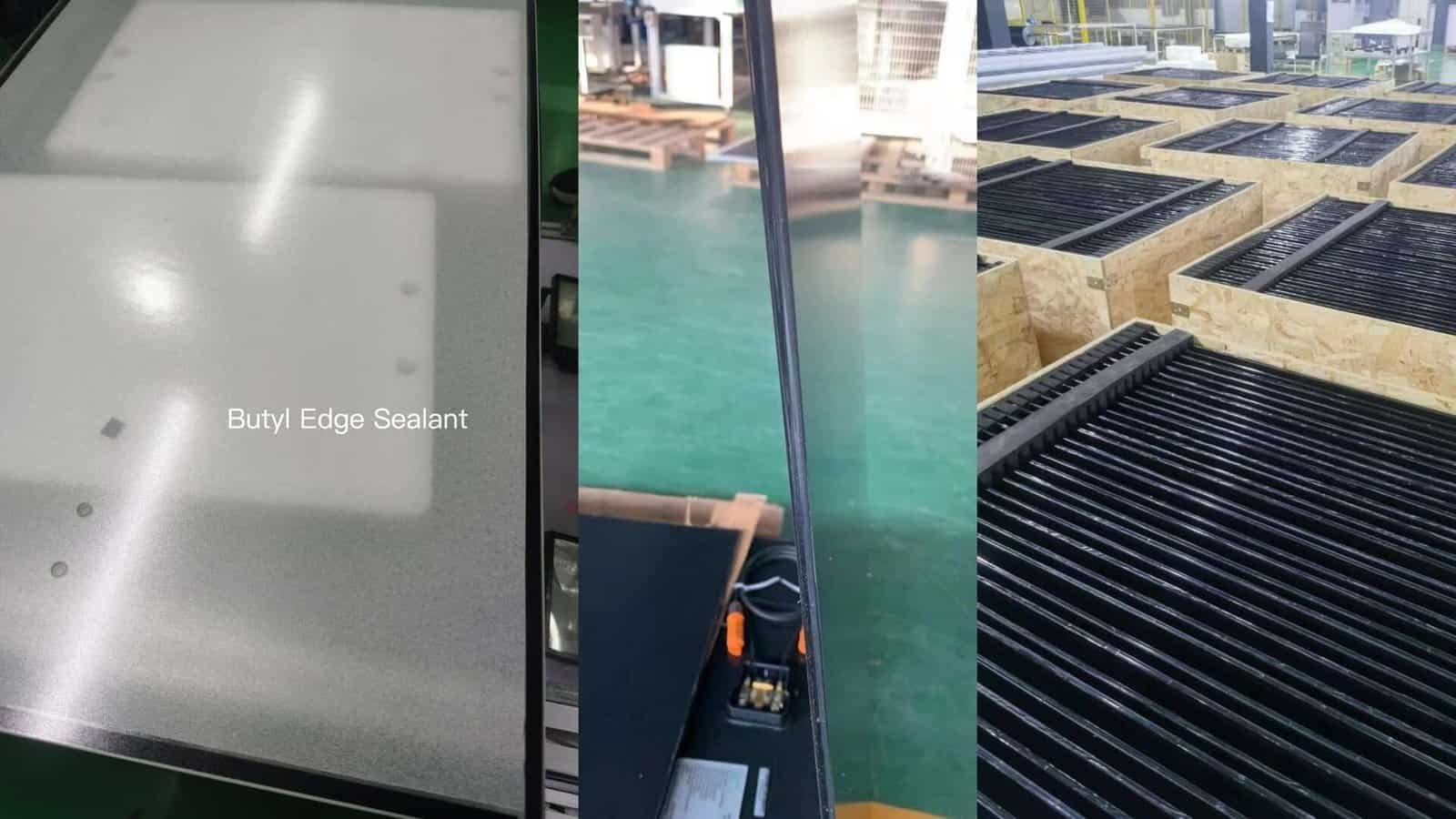
Ask five solar engineers whether a frameless module needs an edge seal, and four will answer yes without pausing. Butyl-based edge sealant has protected glass-glass panels from moisture for well over a decade, and the track record backs it up. But the question gets harder the moment ETFE flexible back-contact (BC) panels enter the room. These panels have no glass-to-glass gap. They don’t behave like a rigid dual-glass module in any structural sense. So does the same rule still apply?
Quick answer: Not automatically. The physics of keeping moisture out stays the same. The engineering path changes completely, though, once you move from rigid glass to a flexible, fully laminated ETFE stack. Butyl earns its place in specific situations — it isn’t a default add-on for every flexible panel.
This guide walks through when butyl earns its place on an ETFE panel, and when it’s dead weight. It also covers what buyers, engineers, and OEM sourcing teams should ask a supplier before “add butyl” ever shows up on a spec sheet.
Key Takeaways
- An edge seal has three jobs: block moisture, hold its adhesion over time, and keep electrical insulation intact at the panel edge.
- Butyl/PIB became the default for frameless glass-glass modules because the seam between two glass panes is a real, physical gap moisture can enter.
- ETFE flexible BC modules are fully laminated with no glass gap. A well-built encapsulant stack often does the job butyl does in a glass module.
- Marine-grade and long-service flexible panels are the exception. A thin secondary perimeter barrier is usually worth the extra step there.
- Good spec language reads “qualified moisture-barrier edge system,” not “must contain butyl.” The material is a means, not the requirement.
- Ask for damp-heat testing combined with bend cycling, not damp heat alone, before accepting any ETFE edge design.
What an Edge Seal Is Actually For
Every solar module edge is a corridor. Moisture is always trying to walk down it, looking for a way toward the cells. An edge seal’s job is to close that corridor.
IEC TS 62788-5-2 is the international guideline written specifically to evaluate edge-seal durability. Under this standard, a good edge seal does three things. It blocks water vapor from reaching the cells. It keeps its bond to the surrounding materials for the life of the panel. And it maintains electrical insulation at the panel’s outer boundary.
None of those three jobs specify a material. That distinction matters more than most spec sheets suggest. A supplier who tells you “we use butyl” hasn’t actually told you anything about performance. A supplier who can hand you moisture-ingress data, adhesion-after-aging results, and insulation-resistance numbers has.
Why Glass-Glass Modules Lean on Butyl
Picture a standard frameless dual-glass module: glass, encapsulant, cells, encapsulant, glass. The two panes meet at a thin, physical seam around the perimeter. That seam is the weak point. Water doesn’t have to fight through a laminate; it just has to find the gap.
Butyl, specifically polyisobutylene (PIB), became the standard fix for a simple reason. It has an extremely low glass-transition temperature, around -75°C, so it stays soft and workable well below freezing. Most commercial butyl/PIB sealant formulations also remain serviceable up into the 90–140°C range, depending on the exact formulation. Its raw permeability to water vapor is very low, too. Formulate it with a molecular sieve desiccant, and it actively absorbs moisture that does creep in. NREL and First Solar researchers modeled and lab-tested this exact combination. They found it capable of keeping moisture out for a module’s full 25-year design life. The method used accelerated coupon testing extrapolated with a diffusion model, rather than decades of field data — arguably a more rigorous standard than simply waiting 25 years to find out. See the published study.
But butyl isn’t the only way to close that seam. Back in the early 2010s, Fraunhofer ISE developed a frameless glass-glass design called TPedge. Its edge used a thermoplastic spacer loaded with drying silicates and silicone instead of butyl. It passed extended damp-heat and thermal-cycling qualification on that basis. Around the same time, Kuraray announced a high-modulus PVB encapsulant. It was reported to remove the need for a separate edge seal in some glass module designs, because the encapsulant itself becomes impermeable enough at the edge. Both remain useful reference points for the underlying principle, even though butyl/PIB is the more common default in today’s supply chain.
Three different materials, three different mechanisms, the same three jobs done. That’s the real lesson from the rigid-module world, and it carries directly into flexible ETFE products. Couleenergy has covered the glass-module case in more depth in a separate article on double-glass edge sealing.
Edge-Sealing Approaches at a Glance
| Approach | Moisture Protection | Best Fit |
|---|---|---|
| PIB / butyl tape or hot-melt bead | Very strong; self-reinforcing with desiccant | Frameless glass-glass, HJT/BC cells, humid climates |
| Thermoplastic spacer + silicone | Strong; engineered as a full system | High-volume frameless glass-glass production |
| High-modulus PVB encapsulant | Strong at the encapsulant level | Glass modules seeking a lighter, seal-free edge |
| Fully laminated ETFE/POE stack, no added seal | Strong if the lamination edge is well controlled | Standard-duty ETFE flexible BC panels |
| ETFE/POE stack + thin secondary perimeter seal | Strongest; adds redundancy | Marine-grade or long-service flexible panels |
| No edge protection of any kind | Weak | Not recommended for long-life outdoor panels |
Where ETFE Flexible Modules Break the Rule
An ETFE flexible BC panel doesn’t have a glass seam to protect. A typical construction runs ETFE, POE (or EVA), a composite reinforcement layer, POE again, the BC cell layer, POE, a second composite or backing layer, and a final POE bond to a TPT or composite backsheet. All of this fuses into one laminate during lamination — it isn’t stacked with a gap.
ETFE film by itself isn’t a great moisture barrier. One manufacturer’s own patent testing recorded a water vapor transmission rate of 4.9 grams per square meter per day, measured on a 0.1 mm ETFE film using the JIS Z 0208 dish method. That’s several times higher than a comparable FEP fluoropolymer film at the same thickness, and far higher than glass. On paper, that sounds like a problem.
In practice, the number matters less than the geometry — and the same patent data makes that point better than any theory could. In that manufacturer’s accelerated aging tests, the higher-permeability ETFE front sheet actually outlasted the lower-permeability FEP and glass on mean-time-to-failure. Why? A little permeability let corrosive byproducts, like acetic acid released as the encapsulant ages, escape the laminate instead of building up inside it. A lower WVTR number isn’t automatically the safer design. What matters is how the whole system — not one film in isolation — manages moisture and off-gassing together.
A glass module has to defend a discrete gap where two rigid sheets meet. A fully laminated ETFE module doesn’t have that gap. Water has to work sideways through fused polymer layers instead. The layers themselves, not a raised bead around the rim, form the primary barrier. The real risk zones shift to cut edges, trim lines, and cable or mounting-hole penetrations, not the perimeter as a whole. Worth flagging for buyers comparing patents and datasheets: not every module marketed as “flexible” is built this way. Some flexible thin-film designs instead seal a discrete air cavity between two flexible sheets. That’s structurally closer to a glass-glass module than to a fused laminate. Patent filings for that cavity-type architecture list a full-perimeter butyl-rubber-and-desiccant edge seal as one design option, for the same reason a glass module might need one. That’s a useful reminder: the “no gap, no glass-style seal needed” logic in this guide applies to fully laminated stacks like Couleenergy’s ETFE + BC construction, not to every product marketed as flexible.
Two Products, Two Different Answers
Not every ETFE flexible panel needs the same edge strategy. Two categories, two recommendations.
Standard-Duty ETFE + BC Flexible Panels (Rooftop, RV, Off-Grid, Portable)
Optimize the laminate edge before reaching for an add-on seal. That means controlling POE overhang width at the edge, trimming cleanly, and confirming ETFE-to-POE adhesion after surface treatment. Corona or plasma treatment is standard practice for improving that bond. If the finished laminate passes damp-heat and humidity-freeze testing without a secondary seal, adding butyl around the rim doesn’t buy performance. It adds weight, adds a processing step, and introduces a new adhesion interface — ETFE-to-butyl — that has to be separately validated. It can also trap dirt along the rim on a product usually marketed on being thin and clean-lined.
Marine-Grade and Long-Service ETFE + BC Flexible Panels
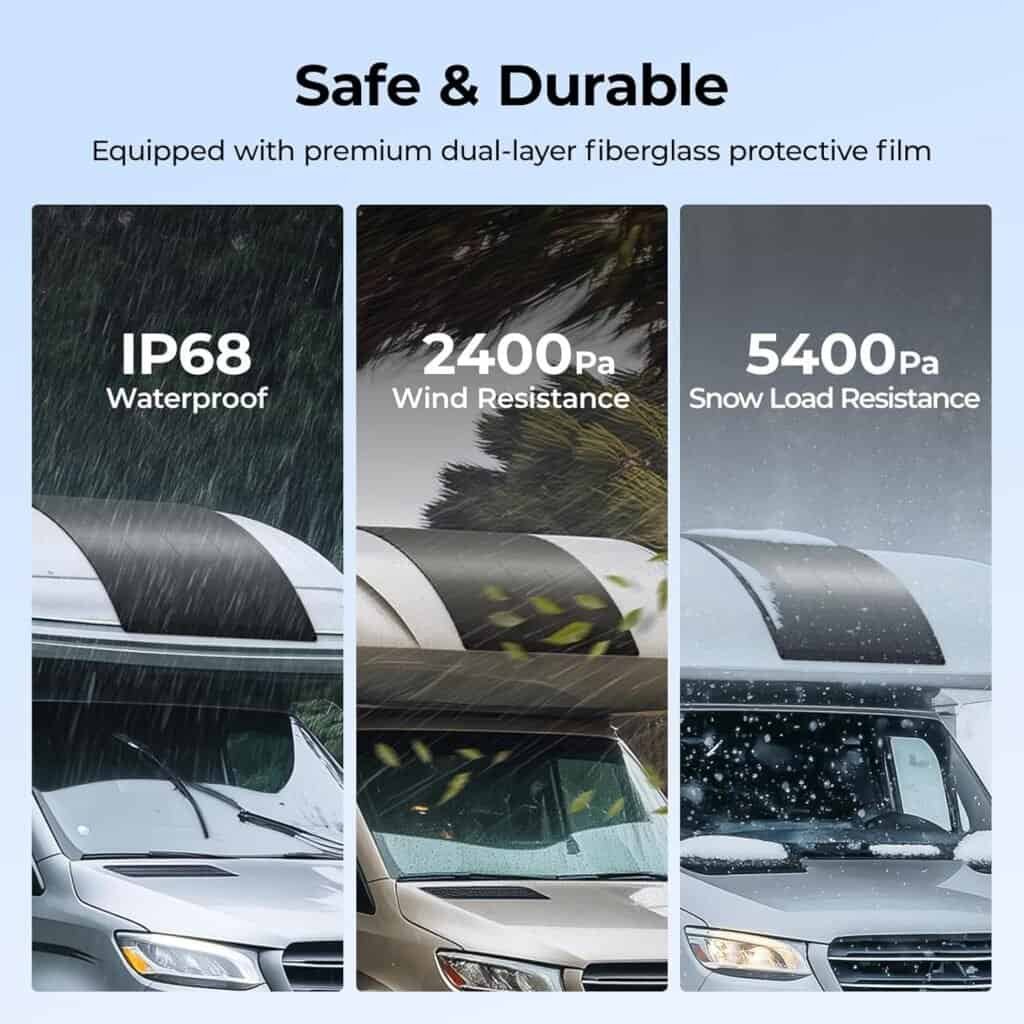
This is the category where a conservative approach pays off. Salt exposure, constant humidity, UV, vibration, and repeated bending stack up in a way rooftop use doesn’t. A thin secondary perimeter barrier is worth the added step here, as long as it’s validated for adhesion to both ETFE and the composite backsheet. Treat it as a backup to the laminate, not a replacement for it. This is also the one place where the general IEC 61215 qualification suite isn’t enough on its own. Ask for results against IEC 61701, the standard written specifically to evaluate salt mist corrosion resistance in PV modules.
A testing gap worth flagging: most published edge-seal data, including desiccant performance studies, comes from static damp-heat testing on rigid samples that never move. A flexible panel moves constantly in service. A seal that passes flat damp-heat can still crack or lose adhesion once it’s been through repeated bend cycles. Before accepting any secondary seal design on a flexible product, ask for damp-heat testing performed on samples that have already gone through mechanical bend-fatigue cycling. Don’t settle for damp heat and bend testing run as two separate, unrelated tests.
Not sure which category your project falls into? Email our engineering team with your climate, mounting method, and expected service life, and we’ll help you land on the right edge-sealing spec.
Why This Matters More During OEM Sourcing
When you’re sourcing custom ETFE flexible panels from an OEM supplier, the edge-seal question isn’t academic. It shows up in the bill of materials, the lamination process, and the finished look of the panel. A supplier who defaults to “we always add butyl” may be doing it out of habit, not because your specific laminate needs it.
On the other hand, some suppliers can’t explain how they protect cut edges and cable penetrations without an added seal. That usually means they haven’t validated their laminate edge at all. Either answer should come with test data behind it, not just a company preference. Raise this directly during technical qualification calls, before tooling and sample runs begin — it’s the kind of question a supplier engineering its own laminates, rather than reselling a catalog product, should be able to answer without hesitation.
Common Mistakes Buyers Make
- Assuming “frameless” means “no edge protection.” Frameless only means no aluminum frame. Edge protection still has to be engineered in, one way or another.
- Specifying a material name instead of a performance target. “Must contain butyl” locks out equally good solutions and doesn’t guarantee performance either.
- Applying rigid-module data to a flexible product without re-validating it. Desiccant and WVTR numbers generated on static glass samples don’t automatically transfer to something that bends.
- Skipping penetration points. Cable exits and mounting holes are common leak paths that a perimeter-only seal strategy misses entirely.
- Treating butyl as a structural adhesive. It’s a moisture barrier, not a load-bearing bond. Mounting and structural attachment need their own qualified adhesive or hardware.
Spec Checklist for Buyers and OEM Teams
- ✓Ask for edge-seal performance data — moisture-ingress rate, adhesion-after-aging — not a material name.
- ✓Confirm whether damp-heat testing was combined with mechanical bend cycling, or run separately.
- ✓Ask how cable and mounting-hole penetrations are sealed, not just the perimeter.
- ✓Request adhesion data specific to ETFE and your backsheet material, not glass-only data.
- ✓Clarify whether adding a secondary seal changes the panel’s rated bend radius or thickness.
- ✓For marine or coastal projects, ask for salt-fog or salt-spray exposure results, not damp heat alone.
What Good Edge-Seal Testing Looks Like
General module qualification follows IEC 61215. Edge-seal-specific durability is covered separately by IEC TS 62788-5-2, and marine or coastal applications add IEC 61701 for salt mist corrosion. For a flexible ETFE panel, ask your supplier for results across this list:
| Test | What It Checks |
|---|---|
| Damp heat (85°C / 85% RH) | Long-term moisture resistance under heat and humidity |
| Thermal cycling | Adhesion and seal integrity through temperature swings |
| Humidity-freeze | Combined moisture and freeze-cycle durability |
| Mechanical / dynamic bend fatigue | Whether the seal survives repeated flexing, unique to flexible panels |
| Peel adhesion after aging | Whether the seal is still bonded after weathering, not just on day one |
| Insulation resistance / wet leakage current | Electrical safety at the panel edge under wet conditions |
| EL and IV before/after aging | Whether cell-level performance holds up over time |
| Salt mist corrosion (IEC 61701) | Corrosion resistance for coastal and marine environments |
Frequently Asked Questions
Do all flexible solar panels need edge sealant?
No. A well-laminated ETFE/POE stack can act as its own moisture barrier for standard-duty applications. Added edge sealant becomes worthwhile mainly for marine-grade or very long service-life products.
Is butyl the only edge sealant option for solar panels?
No. Thermoplastic-spacer systems and high-modulus PVB encapsulants have both been used in place of butyl on glass-glass modules. Flexible modules add another wrinkle: a cavity-type flexible design may still need a full perimeter seal, much like glass does, while a fully laminated design such as Couleenergy’s ETFE + BC construction usually doesn’t need one in standard-duty use.
Does ETFE film block moisture on its own?
Not completely. ETFE film has a higher water vapor transmission rate than glass. But in a fully laminated flexible module, the fused layers — not the film alone — form the moisture barrier. That permeability isn’t purely a downside, either. It can also help release corrosive byproducts that build up inside a laminate over time.
Do marine solar panels need extra edge protection?
Usually yes. Salt exposure, constant humidity, UV, and repeated flexing combine in ways rooftop use doesn’t. That’s why a validated secondary perimeter barrier, tested against IEC 61701 salt mist requirements, is worth the extra step for marine-grade panels.
Can butyl sealant structurally bond a solar panel to a surface?
No. Butyl is a moisture barrier, not a structural adhesive. Mounting and load-bearing attachment should use a separately qualified adhesive or hardware system.
Does adding a secondary edge seal affect a flexible panel’s weight or flexibility?
Yes, slightly. A perimeter bead adds a small amount of weight and can stiffen the very edge of the panel. For standard-duty products this is usually not worth the tradeoff. For marine-grade panels, the added protection is normally judged worth a minor reduction in bend radius.
How can I verify a supplier’s edge-seal claims before ordering?
Ask for moisture-ingress data, adhesion-after-aging results, and — for flexible panels — damp-heat testing performed after bend-fatigue cycling, not as a separate, unrelated test.
The Bottom Line
Edge sealing isn’t a checkbox. It’s an engineering decision that depends on your module’s structure, your climate, and how the panel will actually be used. Whether you’re specifying a standard rooftop ETFE + BC panel, or a marine-grade panel built to survive years of salt spray and flexing, the right answer starts with performance data. Not a material name.
Couleenergy is an ETFE flexible solar panel manufacturer and rigid BC module supplier, engineering both to order for OEM and project-specific requirements — including custom edge-sealing and lamination specs.
For help reviewing your spec or matching an edge-sealing approach to your application, reach out to info@couleenergy.com or call +1 737 702 0119.




 English
  Español
  Français
  Deutsch
  Русский
  العربية