
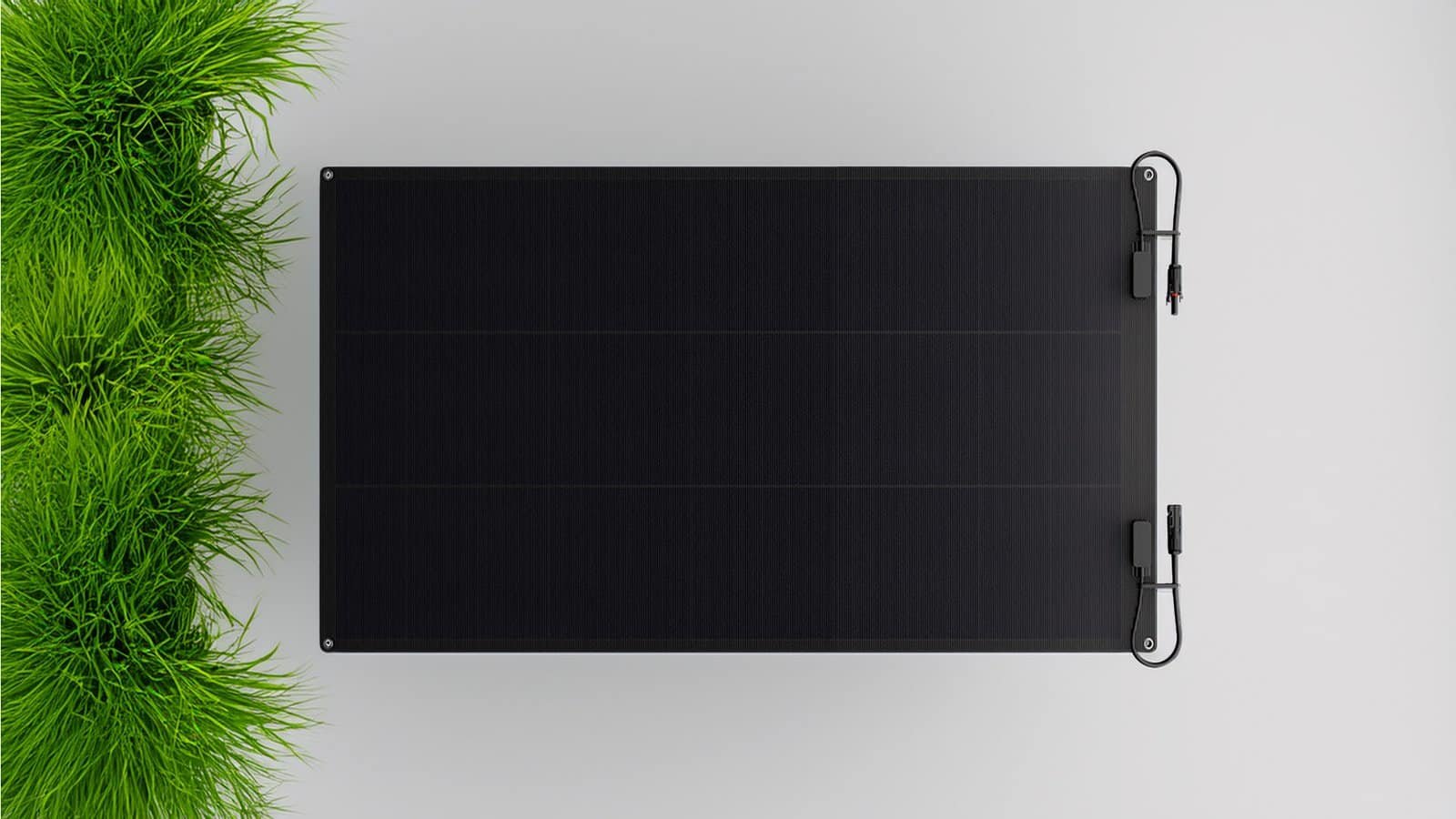
The CLM-130MF is Couleenergy’s 130W flexible solar panel, built around Back Contact (BC) cells and finished with a durable ETFE laminate. It bends to follow curved roofs and tight spaces, and its cell layout is specifically designed to hold onto more power when part of the panel falls into shade — a common headache for anyone running solar on an RV, a boat, or a mobile setup. Order it as shown below, or work with Couleenergy’s OEM and ODM team to adapt it to your own product line.
Why Back Contact Technology Matters
Conventional solar cells run their metal contacts across the front surface. Those contacts do two things buyers don’t love: they shade part of the active cell area, cutting into usable output, and they add extra points where stress can build up over years of thermal cycling and handling. Back Contact cells move every connection to the rear of the cell instead. The front stays clear, more light reaches the active silicon, and the finished panel has a clean, uniform black surface with no visible grid lines.
The CLM-130MF uses HPBC (standard) cells as its production baseline, with ABC (advanced back contact) available as an optional upgrade for buyers chasing higher efficiency in the same panel footprint. Couleenergy is also tracking TBC (tunnel back contact), a newer architecture still moving from lab research toward volume production across the industry — it isn’t a shipping option on this panel yet, but our technical team is happy to discuss it for forward-looking development programs.
Shading tolerance is where this design choice really pays off. Independent lab testing puts a number on it: when a single cell is fully shaded, a BC module loses roughly 13% of its power, compared with about 34% for a similar TOPCon module.1 That gap is real, but it’s also specific — the same research found the BC advantage holds under mild shading, up to around three shaded cells per string, and narrows as more of the panel goes dark. In practice, that’s exactly the kind of shading an RV awning, a boat mast, or a coil of rope tends to cause: a cell or two, not the whole array.
BC vs. PERC vs. TOPCon Flexible Solar Panels, at a Glance
Buyers comparing flexible PV panel technologies are usually weighing the same three things: front-surface appearance, shading behavior, and how the panel fits their application. Here’s how the main cell types stack up.
| Technology | Front Surface | Mild Shading Behavior | Typical Fit |
|---|---|---|---|
| PERC (flexible) | Visible front grid lines | Standard bypass-diode losses | Budget-focused installs |
| TOPCon (flexible) | Front contacts visible | Improved over PERC, still front-contact losses | General-purpose use |
| BC / HPBC (CLM-130MF) | Clean, uniform black surface | Strong tolerance for 1-3 shaded cells1 | RV, marine, and OEM applications where appearance and shading resilience both matter |
ETFE + BC Flexible Construction
On top of the BC cell layout, the CLM-130MF uses an ETFE front sheet built for demanding outdoor and marine environments — not just a budget PET film. ETFE lets more light through to the cells, sheds dirt and grime on its own thanks to a low-friction surface, and resists the UV yellowing that shortens the working life of cheaper laminates. On the back, a rear-contact cell design reduces front-side metallization stress, which helps the PV panel hold up better through repeated flexing, shipping, and vibration than a front-contact flexible solar panel would.
The CLM-130MF is available in two laminate builds, so buyers can match durability to the application rather than over- or under-building:
| Build | Thickness | Weight | Recommended For |
|---|---|---|---|
| 5-layer laminate | 2.7 mm | 2.4 kg | RV roofs, portable and lightweight setups |
| 9-layer laminate | 3.3 mm | 2.7 kg | Marine decks and harsher outdoor exposure |
Either build weighs a fraction of a comparably sized rigid glass solar panel, which is why this lightweight flexible PV panel shows up so often on curved RV roofs, sailboat decks, canopy tops, and portable frames that simply can’t carry the load of a rigid module.
Specifications
| Electrical Characteristics — STC | |
|---|---|
| Maximum Power (Pmax) | 130 W |
| Max Power Voltage (Vmp) | 20.13 V |
| Max Power Current (Imp) | 6.46 A |
| Open Circuit Voltage (Voc) | 23.45 V |
| Short Circuit Current (Isc) | 6.77 A |
| Mechanical | |
|---|---|
| Cell Type | Back Contact, HPBC standard / ABC optional |
| Dimensions (L×W×H) | 1090 × 590 × 2.7 mm (5-layer) / 3.3 mm (9-layer) |
| Net Weight | 2.4 kg (5-layer) / 2.7 kg (9-layer) |
| Front Sheet | ETFE, self-cleaning surface |
| Connectors | MC4, length customizable |
| Certifications | |
|---|---|
| Design Qualification | IEC 61215:2021 |
| Safety Qualification | IEC 61730:2023 |
| Quality System | ISO 9001:2015 |
IEC 61215:2021 was the first edition to add dedicated test methods for flexible modules, including a bending test — earlier editions covered rigid modules only. Values measured at STC (irradiance 1000 W/m², AM1.5 spectrum, cell temperature 25°C). Specifications subject to change — confirm at time of order.
Where This Flexible Solar Panel Fits
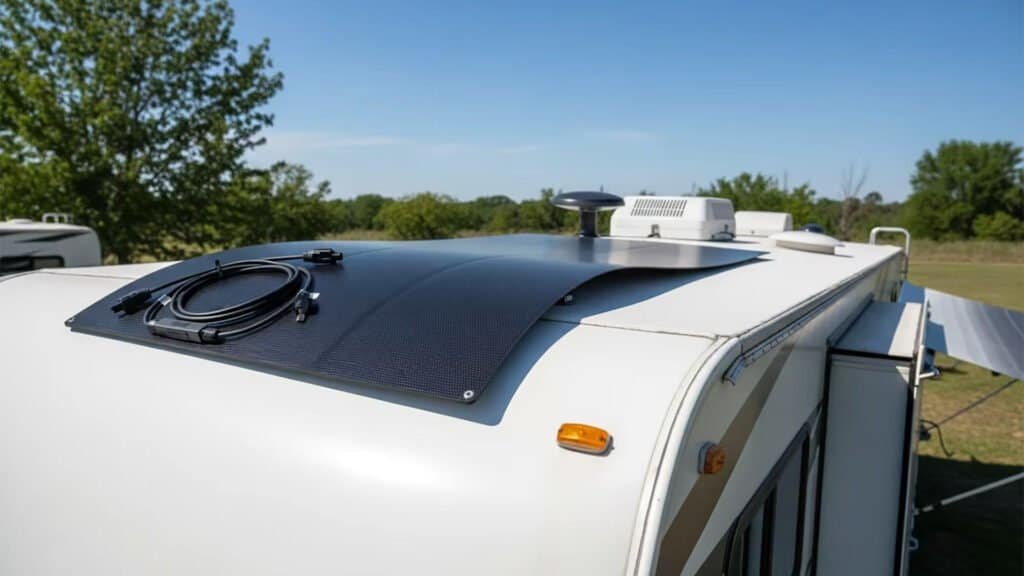
- RVs and caravans: A flexible solar panel for RV roofs with limited load capacity, curved profiles, or both.
- Boats and yachts: A corrosion-resistant marine solar panel for decks and cabin tops. Confirm foot-traffic rating with Couleenergy before specifying a walkable install.
- Off-grid cabins and trailers: Steadier output than a standard panel when part of the array falls into shade.
- Outdoor equipment and portable power: A slim, lightweight build suited to solar backpacks, mobile charging kits, and other specialty electronics where every gram counts.
OEM and ODM: Built Around Your Specification
Few off-the-shelf solar panels fit every product line exactly, which is why Couleenergy runs a dedicated OEM and ODM program alongside its standard catalog. As a custom flexible solar panel manufacturer, we can adapt the CLM-130MF to match an existing product family or help design something new, with minimum order quantities low enough to make a real test run practical rather than a leap of faith.
- Cell layout and BC tier: HPBC standard, ABC optional
- Panel dimensions and laminate thickness
- Frame-free or framed builds
- Backsheet color, including all-black options
- Cable length and connector type
- Private-label packaging and branding
- Low-MOQ trial orders for new market testing
Every OEM flexible solar panel order goes through a dedicated technical sales contact who works with you on cell selection, layout, and final approval, so the panel that ships matches what your application actually needs — not a generic catalog spec. Whether you’re an ODM solar module supplier sourcing for your own brand or an integrator specifying panels for a single project, that direct technical relationship is what keeps the process fast.
Flexible Solar Panel FAQ
Does a flexible PV panel produce less power than a rigid panel of the same wattage?
Rated power (130 W here) is measured the same way for both panel types. The real-world difference comes from mounting: a flexible panel usually sits closer to the roof or deck than a racked rigid solar panel, which can raise cell temperature and limit airflow underneath. Leaving even a small air gap under the panel helps offset that.
Is a BC flexible solar panel a better choice than a PERC or TOPCon flexible panel for an RV or boat?
For applications where occasional partial shading is likely — a mast, an awning, a vent — BC’s shading tolerance under mild conditions is a genuine practical advantage.1 If your install sees little to no shading, the gap between technologies matters less, and other factors like laminate build and price may drive the decision instead.
Can the CLM-130MF be walked on?
Standard flexible laminates, including this one, aren’t rated for regular foot traffic. Buyers who need a walkable deck panel should ask Couleenergy about a reinforced build.
How tightly can it bend?
Minimum bend radius varies between the 5-layer and 9-layer builds. Confirm the figure for your specific mounting surface with Couleenergy’s technical team before finalizing a curved-surface install.
Request a Custom Quote
Whether you need 130 W flexible PV panels or a fully customized BC solar solution, Couleenergy can help optimize the cell layout, laminate structure, and electrical design for your application. Send us your target power, dimensions, and preferred BC tier, and our technical sales team will come back with a build recommendation and lead time.
Email: info@couleenergy.com | Tel: +1 737 702 0119 | Web: couleenergy.com
1. TÜV NORD comparative simulation of BC and TOPCon modules under partial shading, published in Solar Energy and reported by pv magazine, July 8, 2026. The study found the BC advantage holds under mild shading (three or fewer shaded cells per string) and narrows to roughly equal losses (~50%) once shading covers four or more cells.



 English
  Español
  Français
  Deutsch
  Русский
  العربية
One comment
[…] Couleenergy — Why BC Cells Improve Flexible Solar Panels for RV and Marine Use: couleenergy.com […]