
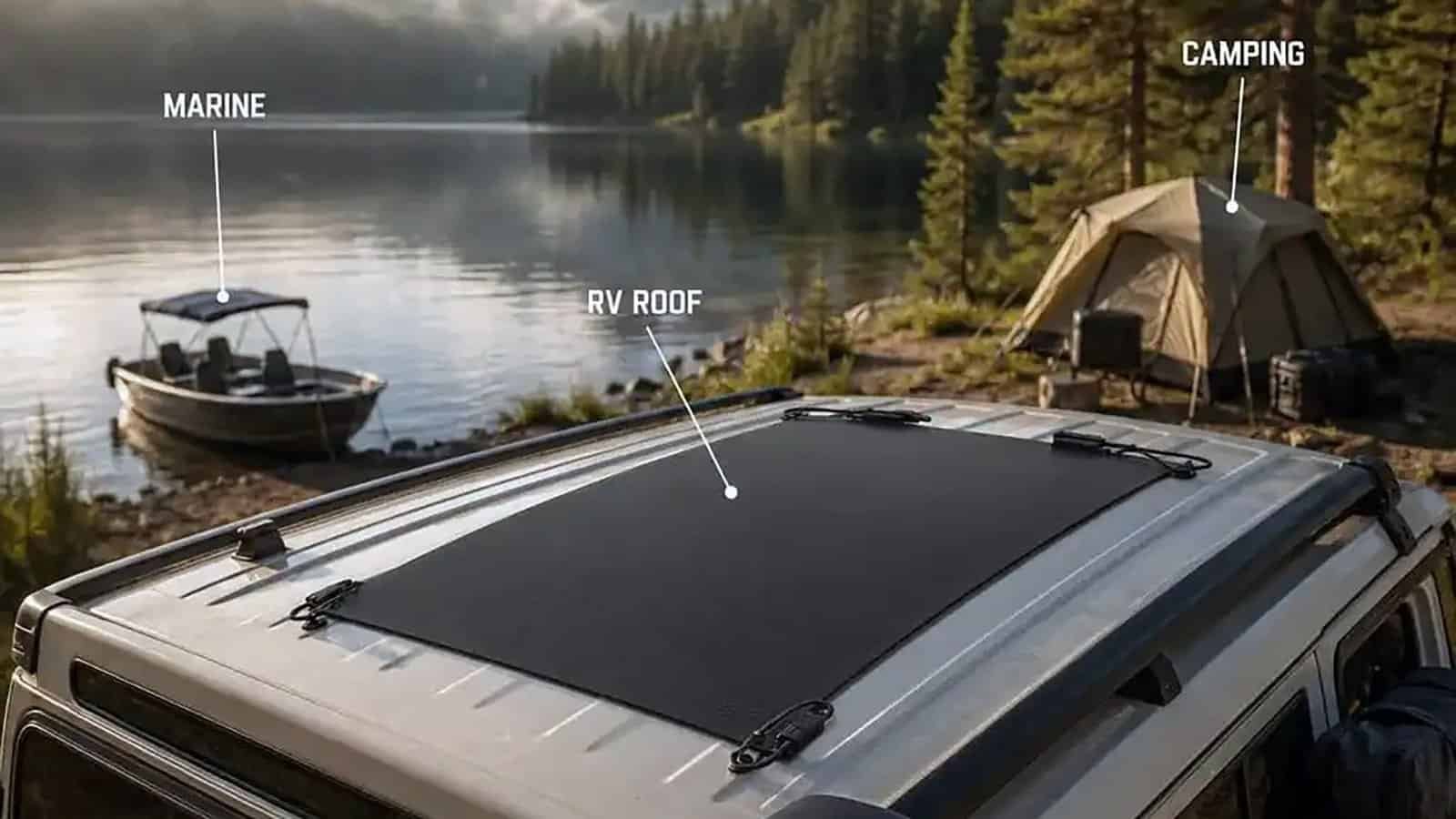
A major RV brand just launched a back-contact panel line, confirming the technology has gone mainstream. Here’s the engineering case for why OEM buyers, boat builders, and RV manufacturers still need a custom-built panel instead of a catalogue part.
Short answer: Back-contact (BC) solar cells are moving fast from rooftop arrays into RVs, boats, and mobile power products, and off-the-shelf panels are following. But a catalogue panel is still built to a fixed size, a fixed voltage, and someone else’s roof. For OEM buyers, RV manufacturers, marine equipment makers, and mobile power brands, a custom back-contact solar panel engineered around your exact roof outline, system voltage, and shading pattern will almost always outperform a stock panel rated at the same wattage. The panel should be designed around the product. The product should never be redesigned around the panel.
In late August 2026, at the Caravan Salon show in Düsseldorf, Dometic introduced BlackSolarPro. It is a new solar panel line built on back-contact cell technology, finished in solid black. Dometic says the panels keep producing power reliably even under a cloudy sky. That pitch is aimed straight at RV and boat owners who camp in mixed weather, not in a lab.1
Dometic’s own materials point to four buyer problems. Anyone who has tried to fit a panel to a camper roof will recognize them: partial shade, limited installation space, an all-black appearance, and 12-volt charging for typical mobile setups.1 One small clue hints at the wattage range. The product imagery released for the launch is filed under the code BSP240, which suggests a 240 W model sits at the top of the initial back-contact lineup — well above the 115 Wp all-black panel already sold in Dometic’s existing, PERC-based Blacksolar catalogue, where the top model runs a rated 19.5% cell efficiency.2 BlackSolarPro is, in other words, the company’s first back-contact product for this market, layered on top of a catalogue that has run on conventional front-contact cells until now.
Partial-shade performance is the headline benefit Dometic is marketing around this launch, and that’s worth taking seriously — back-contact cells really do behave differently under shade, for reasons we get into below. But no independent, publicly verifiable test figure for this specific product was available to check at the time of writing, so we won’t repeat an unverified shading percentage here. How much of any such claim survives on a real roof depends on cell architecture, string wiring, and bypass-diode placement, not on the technology name alone — we unpack those variables further down. For now, the more useful question isn’t which off-the-shelf panel claims the highest wattage. A mainstream consumer brand adding a back-contact tier above its own catalogue is a real market signal, but for an OEM buyer, a fleet builder, or a product engineer, what matters is whether a panel can be designed around your product in the first place.
Why RV and Marine Solar Panels Can’t Just Copy Rooftop Solar
A residential roof is mostly one open, flat plane. An RV roof or a boat deck almost never is. Usable area is broken up by hardware the vehicle needs to run.
| RV Roof Obstructions | Boat Deck Obstructions |
|---|---|
| Roof-mounted air conditioner | Mast and standing rigging |
| Roof vents and skylights | Hatches and deck fittings |
| Antennas and satellite domes | Handrails and grab rails |
| Roof rails and ladders | Davits, antennas, radar arches |
| Curved or crowned roof sections | Curved cabin tops and gunwales |
Because of this, available solar area is rarely a clean rectangle. Shading is not a rare event caused by a passing cloud. It is a fixed, repeating shadow cast by the vent, the mast, or the AC unit every single day.
Back-Contact vs. Front-Contact Solar Cells: What Actually Changes
A conventional solar cell runs thin metal fingers and busbars across its front face to collect current. Those fingers work, but they also sit on top of the active silicon and block a slice of the light that could otherwise become electricity.
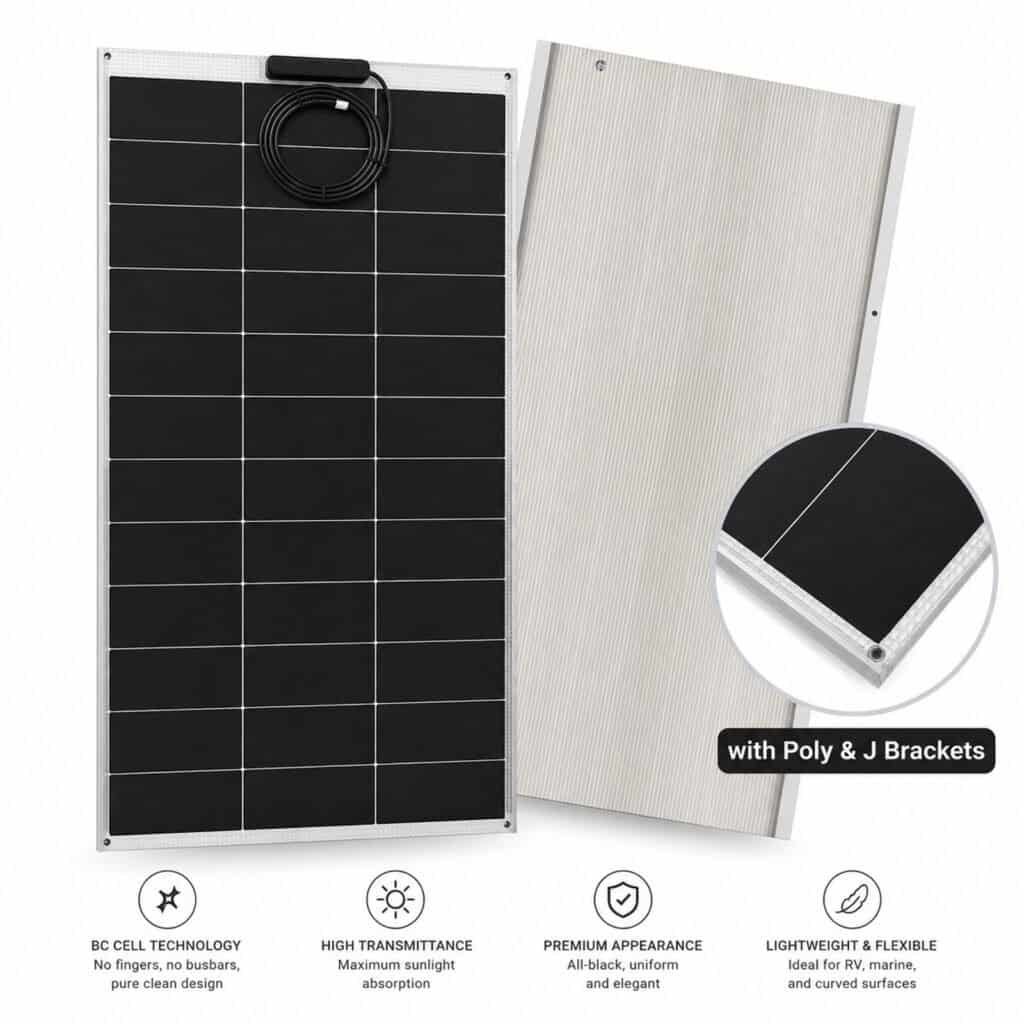
Back-contact (BC) cells move every electrical connection to the rear of the cell instead. The front surface stays clear, so more of the incoming light reaches active silicon. The payoff shows up twice: a cleaner electrical path and a finished panel that reads as a uniform black, with no metal grid breaking up the surface. There’s a shading story here too, and it comes down to cell-level physics rather than clever wiring — worth its own section, coming up shortly.
One honest note on paperwork. Most flexible and semi-rigid back-contact panels for RV and marine use are custom-built, not pulled from a fixed catalogue. Because of that, they are usually engineered to meet or exceed standards like IEC 61215-1:2021, rather than individually certified like a stock retail panel.3 That 2021 edition added a dedicated bending test for flexible modules, called MQT 22. If flex performance matters for your application, ask your supplier for bend-test data and EL images on your actual construction. A certificate number alone will not tell you that.
Have a roof outline, deck cutout, or product enclosure that does not match anything on a spec sheet? Couleenergy’s engineering team builds back-contact panels around the space you actually have.
Request a Custom Quote »The Off-the-Shelf Problem: When the Panel Simply Doesn’t Fit
Picture an RV manufacturer with a usable roof section of 1,050 × 550 mm between the AC unit and the front cap. A popular 150 W stock panel measures 1,160 × 580 mm. It does not fit. No amount of wattage on the label changes that.
At that point, there are really only three paths forward.
| Option | What It Means | Trade-Off |
|---|---|---|
| Redesign the roof layout | Move the AC, vent, or antenna to clear space | Touches tooling and other systems; rarely worth it for one panel |
| Drop to a smaller stock panel | Accept whatever size actually clears the space | Rated power falls, sometimes by 20% or more, for no electrical reason |
| Customize the module | Build a panel to the exact 1,050 × 550 mm outline | Requires an OEM supplier and a short sampling round |
That third option is where custom back-contact manufacturing earns its keep. It is also where most buyers underestimate how much power a well-designed outline can actually recover.
Flexible, Semi-Rigid, or Rigid: Choosing the Right Back-Contact Format
Customization doesn’t start with cell layout. It starts one step earlier, with the panel’s construction format — and this is where a lot of RFQs go sideways, because buyers pick a format based on habit rather than the load path it actually needs to survive.
| Format | Typical Build | Best Fit | Watch Out For |
|---|---|---|---|
| Flexible ETFE | ~2.6–3.3 mm laminate, no glass, ~3.7–4.2 kg/m² | Curved roofs, weight-sensitive mounts, portable products | Not rated for foot traffic; runs hotter when bonded flat |
| Semi-Rigid (backing plate) | Fiberglass, aluminum, or carbon-fiber backing plate under the laminate | Walkable decks, narrow footprints, moderate curvature | Walkability is not a defined IEC spec — confirm it by construction, not by claim |
| Rigid (framed or dual-glass) | ~30–35 mm dual-glass, or thinner framed mono-facial; ~10–12.5 kg/m² | Flat roof sections with load capacity to spare; fixed installs | Heaviest option; zero flex tolerance for curved surfaces |
None of these formats is objectively “better.” They trade weight, flex, walkability, and durability against each other, and the right answer depends entirely on the surface and load path the panel has to survive — which is exactly why this decision belongs early in the RFQ, not after a sample has already been built.
Geometry Decides the Watts, Not the Number on the Box
A quick worked example makes the point concrete. Take two roof cutouts of exactly the same area: 0.60 m² each. Both use a standard 15 mm border and 2 mm cell gaps, tiled with 182 mm cells at a mainstream 24% conversion efficiency — call it 7.95 W per cell. A 1,000 × 600 mm outline fits fifteen full cells, for about 119 W of combined cell output. A 1,200 × 500 mm outline — same area, different shape — fits only twelve, for about 95 W.
Same square footage. Twenty percent apart in power. Nothing about the cell technology changed; only the shape the cells had to tile into did.
One technical caveat worth flagging: those two figures are cell-level sums, added up before lamination. A finished module’s rated output will typically land a little below that sum. Not every optical gain a bare cell enjoys on a test bench carries through into the laminate — the exact size of that discount depends on the front-sheet material and how much stray light the encapsulant recycles back onto the cells.4 That’s a separate conversation from the one here. What matters for this comparison is that the roughly 20% gap between the two outlines survives the translation into finished module wattage just the same, whichever discount factor applies.
Half-cut cells fix the narrow outline. Cut each 182 mm cell in half, and both rectangles fit around thirty half-cells — restoring the narrow layout to roughly the same cell-level output as the wide one. This is exactly how a custom manufacturer defeats a bad outline: not with a different cell chemistry, but with a layout designed for the space instead.
“Two roofs, identical area, 20% apart in power — before anyone even discusses cell efficiency.”
Partial Shading: What Back-Contact Buys You, and Where It Stops
Back-contact’s real shading advantage comes down to one electrical property: reverse breakdown voltage. A shaded BC cell breaks down at roughly 5V, a much softer threshold than a shaded TOPCon cell resists. A bypass diode needs about 15V of reverse bias before it fires and reroutes current around a shaded section. Do the math and it takes about three fully shaded BC cells in a string to reach that threshold, while far fewer shaded TOPCon cells get there. That’s the physical reason a BC panel can keep producing through a shadow that would already have tripped a diode, and shut off that whole section, on a conventional module.
A 2026 TÜV NORD simulation study, published in the peer-reviewed journal Solar Energy, put hard numbers behind this. With a single cell fully shaded, tested BC modules lost about 13% of their power, against roughly 34% for a matched TOPCon module built the same way.5 But that advantage has a hard edge. It holds while three or fewer cells across different substrings are shaded. Push past four shaded cells in a string, and both technologies converge to losing about half their output — the diode has fired on both by then, so the underlying cell physics stops mattering.
A simple rule follows for any spec conversation. If the obstruction is smaller than the panel — a vent pipe, a stay wire, a dropped line — back-contact is genuinely worth paying for. If it’s bigger than the panel — a full cabin shadow, a sail, a wall — no cell technology saves you; move the panel or split the array instead.
This is also why a headline claim like “cuts shading loss by 70%” deserves a second look before you repeat it in a spec sheet. The real result depends on how many cells are shaded, how the strings and bypass diodes are laid out, and the exact shading pattern — not on back-contact technology in isolation. Ask any supplier, Couleenergy included, to state a shading claim against a specific test geometry. A bare percentage, on its own, tells you very little.
Bend Radius Is a Spec. Bend Angle Is Marketing.
Curved roofs and cabin tops are common in both markets, and flexible panel listings love to advertise a maximum bend angle. That number means far less than it looks like. Offgridtec’s PCB-ETFE 200W panel, for instance, lists a maximum bend of 18 degrees along its length.6 Renogy’s flexible monocrystalline panels, at comparable and even smaller sizes, publish 248 degrees.7 Same general product category. A fourteen-fold spread.
An angle without a stated panel length tells you almost nothing about the tightest curve the panel can actually follow. Ask instead for the minimum bend radius in millimeters and the bending axis. If the panel will flex repeatedly rather than sit in one fixed curve, ask for flex-cycle data too, from a test like IEC 61215-1’s MQT 22.3 Those numbers are what actually tell you whether a panel will survive your roofline.
What Can Actually Be Customized in a Back-Contact Solar Panel
This is the part most buyers do not realize is negotiable. A custom flexible or semi-rigid back-contact program can adjust far more than the size.
| Parameter | Why It Matters |
|---|---|
| Dimensions | Fits the actual available surface, not the nearest catalogue size |
| Shape | Matches irregular corners or curved sections |
| Cell layout and cut format | Full, half-cut, or quarter-cut cells change how much power a narrow outline can hold |
| System voltage | Matches the charge controller — PWM and MPPT need different Vmp targets |
| Target power | Set by the energy budget, not guessed from the space alone |
| Laminate — ETFE film, layer count | Balances weight, flex durability, and long-term UV and saltwater exposure |
| Cable length and connector | Simplifies installation and matches the existing wiring run |
| Mounting holes or adhesive zones | Matches the product’s own structure and fastening method |
| Appearance and frame color | Matches the vehicle, hull, or product design language |
| Branding and packaging | Supports OEM and private-label product lines |
Power Density: What “More Watts” Really Means per Square Meter
Once a panel’s outline is fixed, the fairest comparison between products is watts per square meter, not the wattage printed on the label. Even within one back-contact flexible product family, that figure moves quite a bit. A small panel loses proportionally more area to its own border than a large one does.
| Model | Rated Power | Dimensions (mm) | W/m² |
|---|---|---|---|
| CLM-050M | 50 W | 670 × 405 | 184.3 |
| CLM-105M | 105 W | 1280 × 405 | 202.5 |
| CLM-120M | 120 W | 990 × 590 | 205.4 |
| CLM-160M | 160 W | 1265 × 590 | 214.4 |
| CLM-200M | 200 W | 1175 × 775 | 219.6 |
That is roughly a 19% spread inside one product family, on the same cells and the same laminate. Never judge a small custom panel against a large stock panel using watts alone. Border overhead alone can make an efficient design look weak on paper.
How Much Power Can Actually Fit on a Vehicle Roof
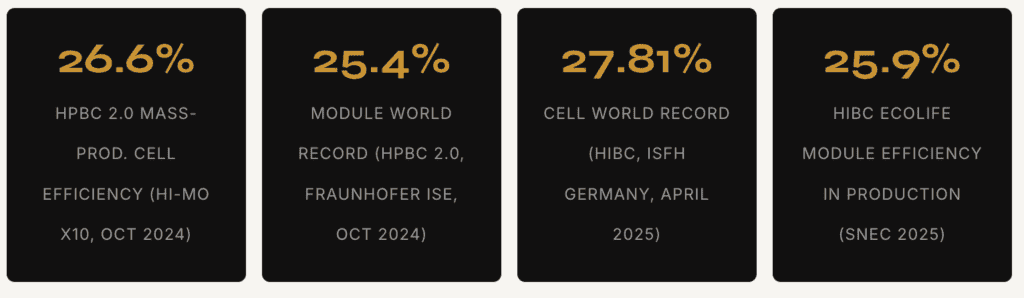
The scale changes, but the principle holds all the way up. Fraunhofer ISE’s SolarMoves project analyzed 23 vehicle types across 1.3 million km of driving data. It found that integrated solar can extend an electric truck’s daily range by up to 15%. Solar-equipped trailers generated up to 55 kWh a day from rooftop modules alone in summer conditions. Adding side-wall modules pushed that up to 90–110 kWh a day.8
That result did not come from a bigger stock panel. It came from engineering solar into every usable surface on the vehicle, not just the flattest, easiest rectangle. An RV roof or a boat deck is smaller. The same logic still applies: every irregular square meter is worth designing for, not working around.
Common Mistakes When Specifying a Custom Back-Contact Solar Panel
Most of the RFQs that stall or end up with the wrong panel share the same handful of root causes. Here’s what to check before you send a spec sheet out for quote.
- Leading with wattage instead of space. A target wattage without a confirmed outline is a guess, not a spec — see the geometry section above for why identical footprints can differ by 20% in output.
- Accepting a bend angle with no stated panel length. As covered above, an angle alone is close to meaningless. Insist on a minimum bend radius in millimeters and a bending axis.
- Defaulting to full cells on a narrow outline. If the available space is long and narrow, full cells waste area at the ends of every row. Half-cut or quarter-cut layouts usually recover it.
- Taking a single shading percentage at face value. A “70% less shading loss” or “34% more output” claim means little without the shading pattern, cell count, and diode layout it was tested against.
- Ignoring what the mounting method does to operating temperature. This one surprises a lot of buyers. Bonding a panel flush to a roof with no airflow behind it runs meaningfully hotter than leaving even a small vented gap. Modeled at 900 W/m² and 30°C ambient using the Sandia Array Performance Model’s “open rack” versus “insulated back” cases, the difference works out to roughly 25°C — 56°C versus 82°C.9 At a typical −0.29%/°C temperature coefficient for n-type cells, that’s on the order of 7% more power lost to heat, with nothing wrong with the panel itself. A flexible or semi-rigid panel bonded flat to an RV roof or a boat deck is exactly the “insulated back” case this model describes. Specify a vented or standoff mount wherever the application allows one.
- Approving a supplier on datasheet claims alone. A certificate number confirms a test was run on some construction, not necessarily the one you’re ordering. Ask for EL images and flash-test data on your actual layout before committing to a production run.
What to Verify Before You Choose a Custom Solar Panel Manufacturer
Correct engineering doesn’t guarantee a supplier can execute at production scale. Before placing an order with any custom back-contact manufacturer — this one included — get plain, written answers on four things this article deliberately hasn’t invented numbers for: warranty terms specific to the construction you’re ordering (flexible and semi-rigid laminates commonly carry different warranty structures than rigid-glass modules, so ask for the terms that apply to your product, not a generic catalogue figure), sample and production lead times in writing rather than “to be confirmed,” the facility and quality-control process behind the panel, and traceability documentation if the modules are crossing into the US or EU. A supplier that answers all four clearly, before you’ve placed an order, is behaving the way a manufacturing partner should.
Couleenergy (Ningbo Coulee Tech Co., Ltd.) is a Zhejiang, China–based manufacturer of custom back-contact flexible, semi-rigid, and rigid solar modules, serving OEM buyers, distributors, and project developers across North America and Europe. The technical reasoning in this article — including the corrections and honest limits noted throughout — reflects how its engineering team approaches an RFQ. Ask the same of any supplier you’re evaluating.
Need a Custom Panel? Send These Five Things First
A custom quote moves faster when it starts with real numbers instead of a wattage guess. It also lands closer to the right design on the first try.
- Available dimensions — length, width, and any curve or bend, in millimeters.
- Target wattage — a number if you have one, or “as high as the space allows” if you don’t.
- System voltage and controller type — 12 V, 24 V, 48 V, and whether it’s PWM or MPPT.
- Known obstructions — size and position of anything that will cast a shadow.
- Mounting method and expected environment — bonded flat, framed, walkable, saltwater exposure, and so on.
Photos or a CAD drawing of the installation surface help even more than a written description. A quote built on real measurements gets your OEM team past guesswork and into a design that actually fits.
Key Takeaways
- A major RV brand adding back-contact panels to its lineup confirms the technology is moving into mainstream mobile solar.
- Wattage is an output of good design, not a starting input — an off-the-shelf panel that doesn’t fit the space is not a better answer just because the label reads higher.
- Flexible, semi-rigid, and rigid formats trade weight, walkability, and flex tolerance against each other — pick the format from the load path, not from habit.
- Identical roof area can produce power outputs 20% apart depending on outline shape alone; half-cut cells usually close that gap.
- Back-contact’s shading advantage is real but bounded — it holds while three or fewer cells are shaded, and fades past that point.
- A bend angle without a stated panel length is not a usable spec; ask for a minimum bend radius in millimeters instead.
- Compare panels on watts per square meter, not label wattage, especially across different sizes in the same product family.
- Mounting method changes operating temperature as much as climate does — a flush-bonded panel can run roughly 25°C hotter than a vented one under identical sun.
- Correct engineering claims are necessary but not sufficient — verify warranty terms, lead times, facility, and import documentation in writing before ordering, from any supplier.
- Five measurements — dimensions, target wattage, voltage, obstructions, and mounting environment — are enough to start a real custom quote.
Sources
- Dometic — Caravan Salon 2026, BlackSolarPro launch: dometic.com/de-at/aktivitaeten/caravan-salon
- Dometic NDS Blacksolar BS230 product listing (existing PERC baseline, 19.5% efficiency): dometic.com — BLACKSOLAR BS230
- IEC 61215-1:2021, including the MQT 22 flexible-module bending test: webstore.iec.ch/en/publication/61345
- TaiyangNews — cell-to-module (CTM) gains and losses at the module level, citing ITRPV and Fraunhofer ISE’s SmartCalc.Module: taiyangnews.info
- pv magazine — TÜV NORD study on back-contact shading performance: pv-magazine.com, July 2026 — see also Couleenergy’s own breakdown of the same study, BC vs. TOPCon Shading in 2026
- Offgridtec — PCB-ETFE 200W flexible panel specification (18° maximum bend): offgridtec.com
- Renogy — 50W flexible monocrystalline panel specification (248° maximum bend): renogy.com
- TaiyangNews — coverage of Fraunhofer ISE’s SolarMoves project (23 vehicle types, 1.3 million km of driving data): taiyangnews.info
- pvlib / Sandia Array Performance Model — mounting-condition temperature coefficients (open rack vs. insulated back): pvlib-python.readthedocs.io
- Couleenergy — Why BC Cells Improve Flexible Solar Panels for RV and Marine Use: couleenergy.com
Need a Back-Contact Solar Panel Designed Around Your Product?
Send Couleenergy your available dimensions, target wattage, system voltage, installation surface, and any photos or CAD drawings. Our engineering team will help work out the cell layout, electrical configuration, laminate structure, and mounting approach before you order a single sample.
Request a Custom Solar Panel »Email info@couleenergy.com or call +1 737 702 0119 to talk through a project directly.


 English
  Español
  Français
  Deutsch
  Русский
  العربية