
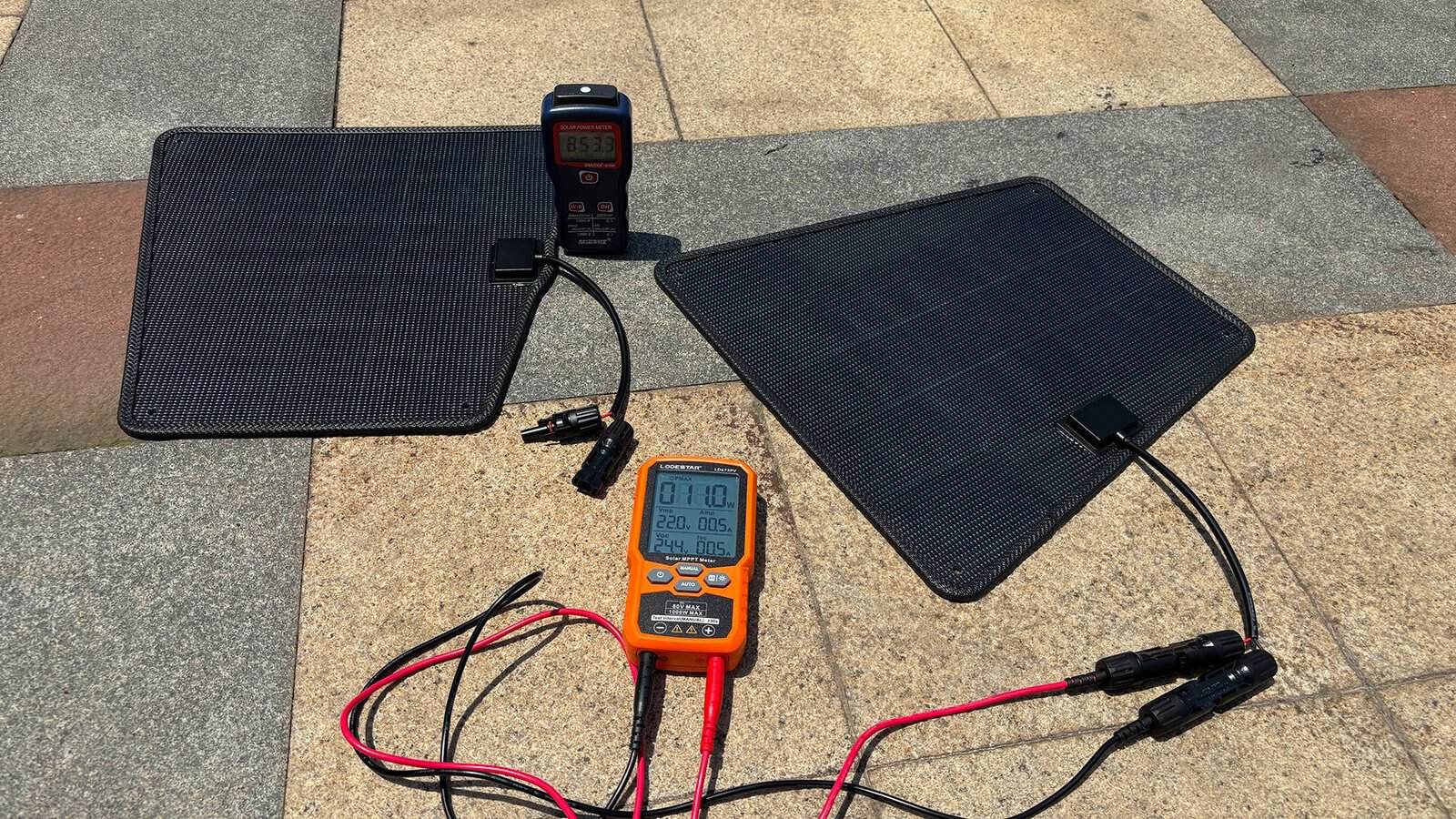
Standard solar panels solve most problems. A 400 W monocrystalline module on a flat commercial roof? Easy. But what about a compact BIPV façade tile, a curved RV rooftop, or a branded balcony product constrained by local railing regulations? Off-the-shelf panels fall short here. That’s exactly where custom solar panel design steps in.
Custom design flips the process. Instead of fitting your project around a catalog panel, you build the panel around your project. You define the physical size, target voltage, power output, material structure, and branding. The factory manufactures to your specification.
This guide walks through every key decision in logical order. It explains the underlying engineering without overcomplicating it — so you can source with confidence, whether you’re placing your first custom order or refining your fifth.
Start with the Application, Not the Wattage
Most buyers open a conversation with “I need a 150 W panel.” That’s understandable — but it’s backwards.
Two panels with identical wattage can require completely different designs. A 150 W panel for a marine buoy and a 150 W panel for a BIPV façade tile need different glass, different cell layouts, different junction box positions, and different mechanical structures. Treating them as equivalent is how costly design mistakes happen.
Before specifying any electrical parameter, answer these questions:
- Where exactly will the panel be installed, and what surface shape is available?
- What voltage system does it connect to — 12 V, 24 V, 48 V, or a specific inverter input range?
- What environmental stresses will it face — heat, humidity, vibration, salt spray?
- Does visual appearance matter for the end product or installation context?
- How many units do you need now, and what is your 12-month forecast?
Once these answers are clear, the right design often reveals itself. Skipping this step leads to panels that work on a datasheet but underperform or fail in real conditions.
Define the Physical Size
Size is the first hard constraint. Pin it down before touching any electrical parameter.
Why standard panel dimensions often fail
Mainstream residential panels today typically measure around 1,700–1,800 × 1,000–1,130 mm — driven by the M10 (182 mm cell) format that now dominates global production. That works for an open rooftop field. It doesn’t work for a narrow boat deck, an L-shaped roofline segment, or a balcony product constrained by local railing standards. Forcing a non-fitting panel into a space wastes usable surface — and therefore output.
Custom sizing solves this directly. Fitting the right dimensions into an irregular space routinely recovers 10–15% of lost generation compared to compromising with the nearest standard size.
Design to the active cell layout, not the outside dimension
The outer panel dimension is not the active cell area. You must account for:
- Cell-to-cell spacing gaps
- Edge margins and border sealing zones
- Junction box footprint on the rear surface
- Busbar and interconnect routing space (for front-contact cell technologies)
Practical rule: Design the active cell layout first, then derive the outer panel dimensions from it. Working backward — from outside dimensions inward — often leads to electrical configurations that don’t achieve the intended voltage or power.
What size range is actually achievable?
| Format | Typical Dimensions | Common Applications |
|---|---|---|
| Micro / IoT | 52 × 52 mm – 300 × 400 mm | Asset trackers, sensors, wearables |
| Compact custom | 680 × 680 mm – 1,200 × 800 mm | Balcony solar, RV, marine, BIPV tiles |
| Full residential | ~1,700 × 1,000 mm (M10 format) | Standard rooftop PV |
| Oversized / BIPV | Up to 2,400 × 1,200 mm | Façades, curtain walls, skylights |
| Non-rectangular | Triangular, trapezoidal, L-shaped | BIPV, complex rooflines — requires R&D capability |
Most OEM factories work up to a laminator bed of 2,400 × 1,200 mm. Any rectangular dimension within that range is routinely achievable. Non-rectangular shapes require dedicated engineering capability and carry higher minimum order quantities.
Configure the Voltage
Voltage is the most technically critical parameter — and the most commonly misspecified one. Getting this wrong can cause system trips, inverter faults, and wasted production runs.
How cells generate voltage
A single commercial crystalline silicon cell has an open-circuit voltage (Voc) of approximately 0.60–0.75 V, depending on cell technology.[1] Standard PERC cells typically measure around 0.66–0.68 V; N-type TOPCon cells reach 0.70–0.72 V; and HJT cells deliver 0.73–0.75 V. The operating voltage at maximum power (Vmp) runs approximately 15–25% below the Voc figure, depending on the cell’s fill factor.[2]
Wire cells in series — positive terminal of one to the negative of the next — and voltages stack. A 36-cell panel using standard PERC cells produces a module Voc in the range of 23–25 V, which charges a 12 V battery system through a charge controller. A 72-cell configuration with the same cells delivers roughly 46–50 V, suited to 24–36 V system architectures or MPPT string inverter inputs.
Series and parallel strings — choosing the right layout
Inside a module, cell strings use a series-parallel architecture:
- Series connections increase voltage; current stays constant. Good for matching MPPT inverter input windows.
- Parallel connections increase current; voltage stays constant. Useful for low-voltage, high-current applications.
- Hybrid layouts combine both, enabling precise Vmp and current targets simultaneously.
The right layout depends on your charge controller or inverter model. A poor voltage match wastes energy or causes the system to trip under load or in cold weather when Voc rises further above its rated value.
Critical clarification — Vmp vs. Voc: Voc (open-circuit voltage) is what the panel measures with no load connected. It is always higher than operating voltage — typically by 15–25% for modern silicon panels. Vmp (voltage at maximum power point) is what the panel actually delivers under load. Always specify your target Vmp when ordering custom panels. Confirm both Vmp and Voc appear on the engineering drawing and the STC flash test report before production begins. In cold climates, Voc rises further still — a critical sizing consideration for charge controllers and inverters.
Set the Power Output
Once size and voltage are fixed, power becomes a calculated result — not a free choice. This surprises many first-time custom buyers.
The basic calculation
Module power = active cell area × cell efficiency × cell-to-module (CTM) factor.
The CTM factor accounts for losses that occur during lamination: encapsulant light absorption, cell gaps, ribbon or interconnect shading, edge inactivity, and glass reflectance.[6] These losses are real and unavoidable. A cell rated at 24% efficiency (for example, a back-contact IBC cell) typically yields a finished module at 22–24% module efficiency, depending on laminate design and inactive area. All efficiency figures are measured under Standard Test Conditions (STC: 1,000 W/m² irradiance, 25°C cell temperature, AM1.5 spectrum). Real-world output is typically lower because modules run hotter than 25°C under field conditions.
Understanding this gap prevents unrealistic power expectations. When a factory claims module efficiency equal to cell efficiency, always ask for the STC flash test report — not just the datasheet headline figure.
Choosing the right cell technology
Module efficiency ranges based on TaiyangNews TOP SOLAR MODULES data (December 2025) and commercial product specifications.[3]
| Cell Technology | Commercial Module Efficiency | Best Custom Applications |
|---|---|---|
| Mono PERC Declining market share | 19–21.7% | Cost-sensitive residential, off-grid, standard OEM |
| N-type TOPCon Now mainstream (>65% market share) | 21–23.7% | Premium residential, all-black BIPV, glass-glass modules |
| HJT (Heterojunction) | 22–23.5% | Best temperature coefficient (approx. −0.26%/°C); excellent low-light performance; ideal for hot climates |
| IBC / Back-contact Top benchmark: 24.8% (2025)[4] | 22–24.5%+ | Premium BIPV, VIPV, all-black aesthetics — no front busbars |
| ETFE flexible with crystalline cells (PERC / BC) | 19–22% | Curved surfaces, RV, marine, VIPV — lightweight, no glass frame |
| True thin-film (CIGS / a-Si) | 10–18% | Large-area substrates, ultra-low weight, non-structural flexible use cases |
Back-contact cells — including IBC, HPBC, and ABC variants — are gaining significant share in custom designs. Eliminating front-side metal busbars raises light capture and enables a fully clean all-black appearance. This makes them especially attractive for BIPV tiles, vehicle-integrated panels, and premium branded products. TOPCon has overtaken PERC as the mainstream production technology — accounting for approximately 65% of global silicon cell production as of 2024,[5] while offering near-PERC pricing for OEM buyers. PERC, once the industry standard, has declined to roughly 20% of production share.
An important distinction: ETFE flexible panels use crystalline silicon cells — the same cell technologies above — encapsulated in a lightweight ETFE front film instead of glass. They are not thin-film modules. Their efficiency is governed by the crystalline cells inside, not the packaging material. True thin-film technologies (CIGS, amorphous silicon) use a different physical structure entirely and have lower efficiency. HJT deserves a separate note here: its temperature coefficient of approximately −0.26%/°C is the best of any mass-produced silicon technology, meaning it retains proportionally more of its rated power on hot days than PERC (typically −0.34 to −0.35%/°C) or TOPCon (typically −0.30 to −0.32%/°C). For VIPV and BIPV in hot climates, this advantage compounds meaningfully over the system lifetime.
Choose the Right Structure
The laminate stack determines durability, weight, aesthetics, and application suitability. Don’t treat it as an afterthought after the electrical design is done.
Three main structural options
Glass-backsheet (standard rigid) — the classic structure: front tempered glass, encapsulant, solar cells, encapsulant, polymer backsheet. Cost-efficient and widely certified under IEC 61215-1:2021 and IEC 61730-1:2023.[9] Best suited for most residential rooftop, off-grid, and commercial ground-mount applications.
Glass-glass (dual-glass) — both faces are tempered glass. No polymer backsheet. Stronger, more moisture-resistant, and far better suited for BIPV where panels bear structural loads or face weather from both sides. Heavier than glass-backsheet, but for façade tiles and solar skylights, the rigidity and long-term moisture protection justify it.
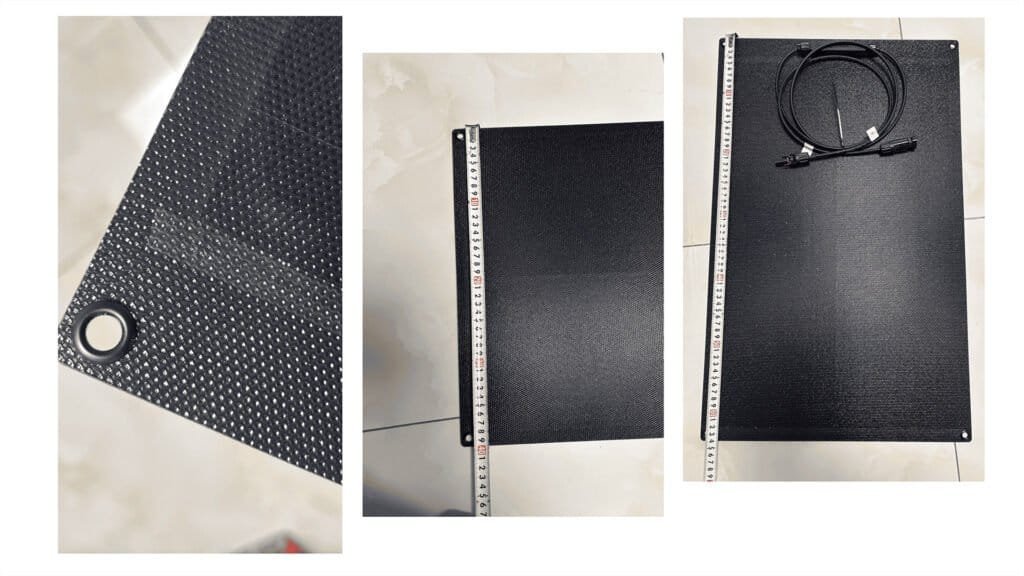
Flexible ETFE — the front face is ETFE (ethylene tetrafluoroethylene) film instead of glass. No rigid frame. Weight drops to approximately 2.5–5 kg per square metre depending on cell type and layer count — compared to 10–12 kg/m² for a standard glass-backsheet module. The panel conforms to curved surfaces and installs with adhesive or clip systems. ETFE is the preferred front film over PET for demanding outdoor applications because of its superior UV stability, higher light transmittance (~95% vs. ~85% for PET),[7] and long-term weathering resistance. These panels use standard crystalline silicon cells and achieve module efficiencies comparable to their rigid counterparts.
Encapsulant selection matters more than most buyers realize
EVA (ethylene vinyl acetate) has been the industry encapsulant standard for decades. POE (polyolefin elastomer) is increasingly specified for glass-glass and bifacial designs because it transmits less water vapor, resists potential-induced degradation (PID) better,[8] and maintains adhesion across a wider temperature range. For custom panels destined for marine, high-humidity, or BIPV environments, POE is worth the specification discussion with your manufacturer.
Junction box and cable placement
Junction box position is fully customizable. For rigid panels, centered rear placement is standard. For flexible panels, the box height and cable exit direction matter more — a protruding junction box on a flexible laminate creates stress concentration at the panel edge during bending or mounting on an uneven surface. Define cable length, exit direction, connector type (MC4 is standard; custom waterproof plugs are available), and IP rating before finalizing the structural drawing — not after samples arrive.
Understand MOQ — and What Drives It
Minimum Order Quantity exists for real manufacturing reasons. Understanding those reasons helps you negotiate honestly and avoid wasting time on factories that aren’t genuinely set up for small runs.
Why MOQ is a manufacturing reality, not just a sales policy
Every custom specification requires: custom glass or ETFE cutting, new cell stringing layout, flash tester reprogramming, EL imaging setup, junction box repositioning, new BOM and engineering drawings, and custom packaging design. Switching a production line from one custom spec to another costs hours of lost output. Material suppliers sell encapsulant film and backsheet in bulk rolls — partial rolls leave material waste. Each of these costs goes somewhere. They go into the MOQ.
Typical MOQ ranges by panel type
| Panel Configuration | Typical MOQ Range | Lead Time |
|---|---|---|
| OEM branding on standard specs | 200–500 pcs | 15–25 days |
| Custom size, PERC cells | 100–200 pcs | 20–30 days |
| Custom size, N-type TOPCon | 200–500 pcs | 4–6 weeks |
| Back-contact (IBC / HPBC / ABC) | 50–200 pcs | 2–4 weeks |
| Flexible ETFE custom (crystalline cells) | 100 pcs and up | 4–6 weeks |
| Dual-glass BIPV custom | 200 pcs and up | 6–8 weeks |
Some specialized OEM/ODM factories accept orders starting at 50–100 pieces for flexible ETFE and back-contact configurations. Smaller runs carry higher per-unit overhead — but they offer a legitimate way to validate market demand before committing to container volumes.
How to verify a low-MOQ manufacturer is genuine
“Low MOQ” appears on many factory websites. It doesn’t always reflect real capability. Three practical checks:
- Request pricing at 100, 300, and 1,000 units. A genuinely small-run factory shows a reasonable premium at lower quantities. A huge price gap signals the factory is not actually set up for small orders.
- Ask for the IEC test report — not just the certificate. IEC 61215-1:2021 covers design qualification and type approval; IEC 61730-1:2023 covers safety qualification. The test report lists the specific dimensions and electrical parameters tested. Confirm your custom spec falls within that scope, or ask for delta test documentation if it differs.
- Request EL imaging and flash test reports for your sample order. Factories serious about quality provide both, regardless of order size.
Where Custom Panels Create Real Value
These are the application segments where standard catalog panels genuinely fall short — and where custom design delivers measurable returns.
BIPV (Building-Integrated Photovoltaics) — Panels replace conventional building materials: roof tiles, façade cladding, curtain walls, skylights. Non-standard dimensions are the norm. Glass-glass lamination supports structural load requirements. Architectural color options and fire classification certifications (referenced in IEC 61730-1:2023 and local building codes) are essential in this segment.
VIPV (Vehicle-Integrated Photovoltaics) — Ultra-lightweight ETFE flexible panels using high-efficiency back-contact cells. Adhesive mounting kits rated for vibration and thermal cycling. Bending radius and panel weight per square metre are critical specification points — along with temperature cycling durability for the encapsulant system.
Marine and RV — Similar requirements to VIPV on weight and flexibility. Add salt mist resistance for marine applications: IEC 61701:2020 is the international standard for salt mist corrosion testing of PV modules,[10] with Severity Level 6 as the benchmark for marine-grade certification. Custom cable exit positions matter for clean, watertight installation on curved or irregular surfaces.
Off-Grid and IoT — Compact modules with precise voltage matching to battery chemistry. IP67+ junction boxes. Often the most accessible MOQ entry point in the custom panel market.
OEM Branded Products — Custom backsheet printing, specific connector types, compact all-black formats, retail packaging. This is where small-MOQ OEM capability matters most: a 50–100 piece test run validates market demand before any container commitment.
Common Design Mistakes to Avoid
- Specifying Voc instead of Vmp. Always provide your target Vmp. Confirm both figures — and their temperature coefficients — on the engineering drawing before production starts.
- Treating cell efficiency and module efficiency as equal. Module efficiency is always lower due to CTM losses. Ask for confirmed module-level Wp under STC on the official flash test report — not just the datasheet cell headline.
- Assuming proportional power from custom-cut cells. When cells are laser-cut to custom shapes, the actual output depends on cut geometry and passivation quality. For a straight half-cut with optimized laser parameters, power loss is typically less than 1% relative.[11] For more complex cuts or smaller fragments, edge recombination increases with the edge-to-area ratio. Always verify from flash test data — don’t rely purely on area scaling.
- Confusing ETFE flexible panels with thin-film technology. ETFE flexible panels use crystalline silicon cells and deliver crystalline-level efficiency (19–22%+). True thin-film panels (CIGS, a-Si) use a different physical structure and operate at lower efficiency (10–18%). The packaging front material does not determine the cell technology.
- Choosing structure for aesthetics alone. A flexible ETFE panel mounted with rigid bolted fixings through the laminate defeats the design intent and introduces delamination risk. Always match structure to installation method.
- Underestimating total logistics cost for small orders. Small custom runs often ship LCL (less-than-container load), which raises per-panel freight cost significantly compared to FCL pricing.
Pre-Quotation Checklist
Before requesting a quotation from any manufacturer, have clear answers to these items:
- ✓Application — RV, marine, BIPV, IoT, off-grid, VIPV, portable, or branded retail?
- ✓Size — Outer dimensions, active cell area target, thickness tolerance, corner radius
- ✓Power — Target wattage and acceptable Wp range at module level (from STC flash test)
- ✓Voltage — Target Vmp, Voc, system voltage, and controller or inverter model
- ✓Cell technology — Mono PERC, TOPCon, HJT, IBC, HPBC, or ABC back-contact
- ✓Structure — Glass-backsheet, glass-glass, or flexible ETFE with crystalline cells
- ✓Appearance — All-black, white backsheet, semi-transparent, custom color, OEM logo
- ✓Junction box — Position, cable length, connector type, IP rating, bypass diode requirement
- ✓Environment — Temperature range, humidity, vibration, salt exposure (IEC 61701 if marine), wind/snow load
- ✓Testing — EL inspection, flash test, IEC 61215 / IEC 61730 coverage scope
- ✓Quantity — Sample order size, pilot run forecast, and 12-month volume projection
Conclusion
Designing a custom solar panel is a logical, step-by-step process. Fix the physical size first. Configure the cell series-parallel layout for your target voltage. Calculate wattage from the active cell area and module efficiency — not just cell efficiency. Choose the structural laminate stack for your environment and installation method. Then approach MOQ with realistic expectations about quality documentation, lead time, and per-unit overhead at lower volumes.
The best custom panel is not always the highest-wattage option. It is the design that fits the application precisely, survives the real operating environment, integrates cleanly with the electrical system around it, and can be manufactured consistently at a volume that makes commercial sense.
For BIPV tiles, VIPV builds, marine installations, or branded OEM products, technologies like back-contact cells, flexible ETFE structures, and dual-glass laminates create real, measurable value — when selected for the right reasons and specified with accurate electrical and structural parameters.
Start Your Custom Panel Design with Couleenergy
Our technical team works with OEM buyers, system integrators, BIPV developers, and specialty product brands on custom panel configurations — from 100-piece flexible ETFE runs with back-contact cells to large-volume BIPV glass-glass modules. Send your project specifications and we will respond with a structured engineering proposal.
Footnotes
-
[1]
Cell open-circuit voltage (Voc). Commercial crystalline silicon cells typically exhibit Voc around 690 mV under one sun / AM1.5; high-quality single-crystal material can reach up to 764 mV. Source: PVEducation.org — Open-Circuit Voltage.
https://www.pveducation.org/pvcdrom/solar-cell-operation/open-circuit-voltage -
[2]
Fill factor and the Vmp / Voc relationship. Fill factor (FF) defines how “square” the I–V curve is; typical commercial Si modules achieve FF of 0.78–0.83, placing Vmp at approximately 80–85% of Voc. Source: PVEducation.org — Fill Factor.
https://www.pveducation.org/pvcdrom/solar-cell-operation/fill-factor -
[3]
Commercial module efficiency benchmarks by technology. TaiyangNews publishes a monthly TOP SOLAR MODULES listing of the 50 highest-efficiency commercially available modules from leading manufacturers. Source: TaiyangNews — TOP SOLAR MODULES Listing, April 2025.
https://taiyangnews.info/topmodules/top-solar-modules-listing-april-2025 -
[4]
IBC / Back-contact top module efficiency benchmark (24.8%, December 2025). TaiyangNews tracks the highest commercially available module efficiency by cell technology monthly. AIKO’s ABC series reached 24.8% in December 2025. Source: TaiyangNews — Top Efficiency By Cell Technology.
https://taiyangnews.info/amp/story/technology/top-efficiency-by-cell-technology -
[5]
TOPCon at approximately 65% of global silicon solar cell production (2024). According to the Fraunhofer ISE Photovoltaics Report 2025, TOPCon accounted for approximately 65% of global silicon solar cell production by 2024, up from roughly 20% in 2022, while PERC declined to ~20% and HJT held ~8%. Source: Fraunhofer ISE — Photovoltaics Report, 2025.
https://www.ise.fraunhofer.de/en/publications/studies/photovoltaics-report.html -
[6]
Cell-to-module (CTM) efficiency losses. The Solar Cell Efficiency Tables (Green et al., Progress in Photovoltaics) provide certified module efficiency records and note the systematic gap between cell and module efficiency caused by optical and electrical lamination losses. Version 66, May 2025.
https://onlinelibrary.wiley.com/doi/10.1002/pip.3919 -
[7]
ETFE vs. PET optical transmittance and durability. Peer-reviewed study comparing polymer front cover materials (ETFE, PET, and others) for flexible crystalline silicon modules; confirms ETFE’s superior UV transmittance and weathering durability. Source: Papargyri et al., Solar Energy Materials and Solar Cells, 2023.
https://www.sciencedirect.com/science/article/abs/pii/S0927024823000806 -
[8]
POE encapsulant: lower moisture permeability and PID resistance vs. EVA. The ITRPV (International Technology Roadmap for Photovoltaics) annual report tracks encapsulant adoption trends; the 2025 edition documents the industry shift toward POE for glass-glass and high-voltage module designs. Source: VDMA — ITRPV 2025.
https://itrpv.vdma.org/ -
[9]
IEC 61215-1:2021 (design qualification) and IEC 61730-1:2023 (safety qualification). IEC 61215-1:2021 lays down design qualification requirements for terrestrial PV modules for long-term open-air operation; IEC 61730-1:2023 specifies construction requirements to ensure safe electrical and mechanical operation. Sources: IEC Webstore — IEC 61215-1:2021 & IEC 61730-1:2023.
webstore.iec.ch/en/publication/61345 · webstore.iec.ch/en/publication/59803 -
[10]
IEC 61701:2020 — PV Module Salt Mist Corrosion Testing. Third edition (2020) defines test sequences to determine PV module resistance to salt mist (NaCl, MgCl₂); harmonized with IEC 60068-2-52. Severity Level 6 is the industry benchmark for marine-grade certification. Source: IEC Webstore.
https://webstore.iec.ch/en/publication/59588 -
[11]
Half-cell laser cut loss typically below 1% relative. Research examining laser scribe-and-break parameters for half-cell separation found that optimized processes limit the per-cell power loss to less than 0.71% relative. Source: Hutchins, M. — Laser Optimization for Half-Cut Solar Cells, PV Magazine, July 2023.
https://www.pv-magazine.com/2023/07/31/laser-optimization-for-half-cut-solar-cells/


 English
  Español
  Français
  Deutsch
  Русский
  العربية