
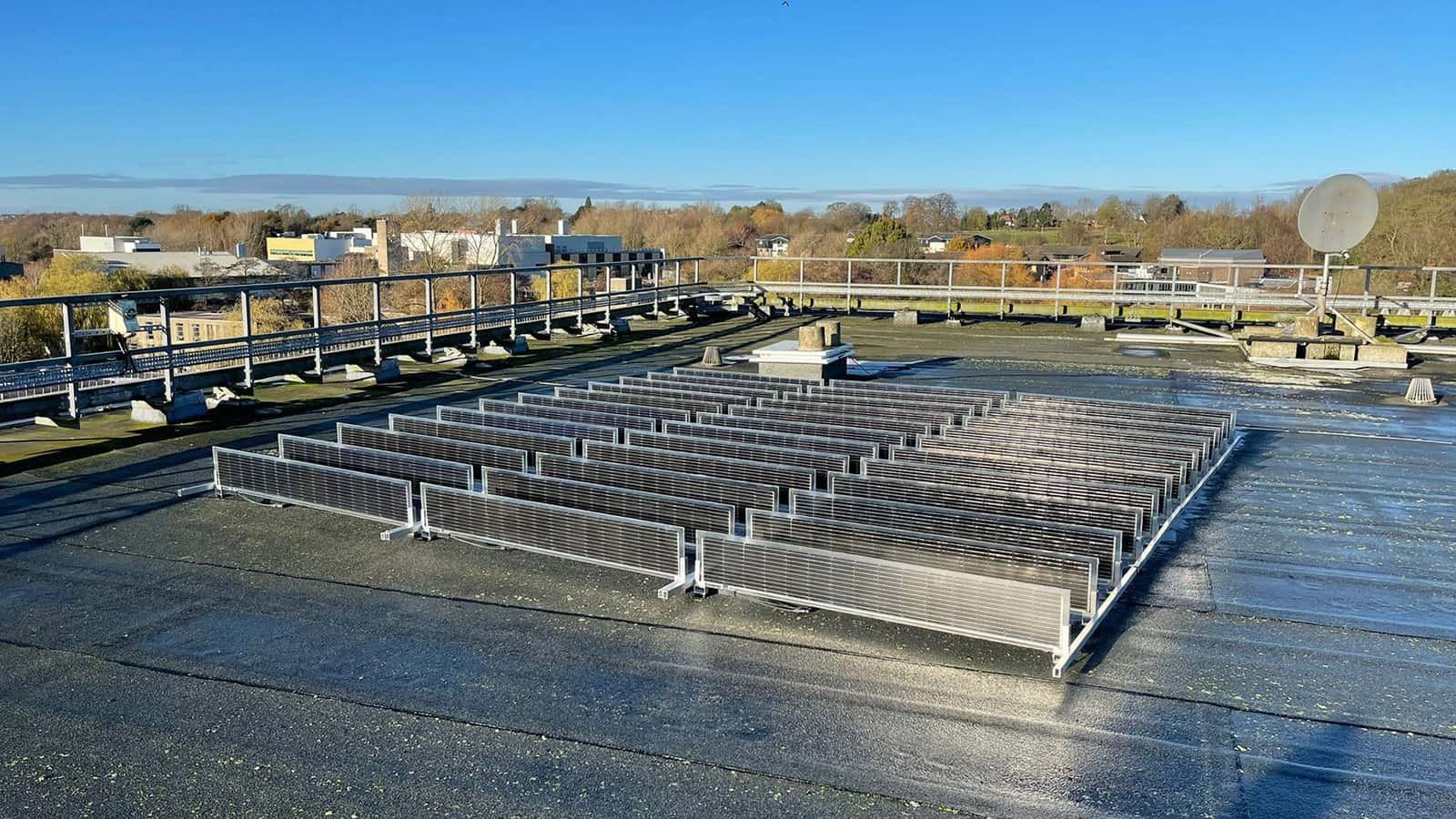
Most solar installations tilt south and aim for midday peak output. But a growing body of peer-reviewed research shows that vertical bifacial panels — mounted upright, facing east and west — outperform traditional tilted systems in specific and important conditions. Here is what the data actually shows, and when each approach makes sense.
First, What Are We Comparing?
Traditional solar panels are mounted at an angle, typically facing south in the northern hemisphere, to capture as much direct sunlight as possible around midday. This is known as a tilted monofacial system, and it has been the industry standard for decades.
A vertical bifacial system takes a completely different approach. The panels stand upright — at exactly 90 degrees — and face east and west simultaneously. They capture morning light on one side and evening light on the other. Because the panels are bifacial, they generate power from both faces at once.[1]
The comparison matters because these two system types do not just look different. They produce energy at different times of day, respond differently to weather, and suit fundamentally different site conditions.
What the Research Actually Shows
In 2023, researchers Ghadeer Badran and Mahmoud Dhimish at the University of York conducted the first full-year empirical study of a commercial vertical bifacial system in a British climate, published in Scientific Reports in August 2024.[2] Three systems were monitored side-by-side on the same rooftop from February 2023 to January 2024:
| System | Configuration | Technology |
|---|---|---|
| VBPV | Vertical, bifacial | HJT cells, 22.5% efficiency, white gravel reflector |
| VMPV | Vertical, monofacial | Standard monocrystalline silicon, vertically mounted |
| TMPV | Tilted, monofacial | Traditional angled rooftop installation |
Against the tilted system, the vertical bifacial setup delivered measurably stronger output across every season and time window tested.[2]
| Metric | VBPV vs Tilted (TMPV) |
|---|---|
| Morning output (05:30–09:00) | +26.91% |
| Evening output (17:00–20:30) | +22.88% |
| Winter seasonal gain | +24.52% |
| Autumn seasonal gain | +20.27% |
| Spring seasonal gain | +19.32% |
| Summer seasonal gain | +14.77% |
On one high-performance day in May, the vertical bifacial system produced 4.92 kWh — approximately 25.38% more than the tilted system across that single day.[3] CFD modelling confirmed negligible lift forces at 27.2 m/s (~98 km/h).[2]
Why Vertical Bifacial Works Better at High Latitudes
🌅 The Sun Angle Problem
The UK sits between 50°N and 60°N latitude. In winter, the sun rises low — often just 10–20 degrees above the horizon. A south-facing tilted solar panel is designed to catch high midday sun, but in British winters that midday sun is weak. A vertical east-west panel is geometrically better aligned to capture low-angle morning and afternoon light. That is why the winter advantage is the largest seasonal gain in the data.[2]
☁️ Diffuse Light Is the UK Norm
The UK averages only around 1,000 to 1,200 sunshine hours per year.[4] Overcast and diffuse conditions dominate. Under those conditions, the University of York study found vertical bifacial systems maintained approximately 60% of peak output, while conventional solar panels dropped to around 35%.[2]
⚡ The Double Peak Grid Advantage
Traditional tilted panels produce one energy peak at solar noon — when the grid has plenty of supply and prices are often lowest. Vertical east-west bifacial systems produce two peaks: one in the morning (05:30–09:00) and one in the evening (17:00–20:30). These align with household demand for heating, cooking, and EV charging.[5]
Research from the Leipzig University of Applied Sciences (HTWK Leipzig) confirmed that this shifted generation profile reduces the need for gas-fired peaker plants and lowers required electricity storage capacity, based on energy system modelling for Germany’s 2030 grid.[5]
💡 Key economic point: UK analysis estimated additional annual savings of approximately GBP 1,221 per 1,500 kWh baseline, using a GBP 0.28/kWh tariff assumption — driven primarily by the vertical system’s alignment with higher-value morning and evening generation periods.[6]
Where Vertical Bifacial PV Delivers the Most Value
🏭 Scenario 1: High-Latitude Commercial Rooftops
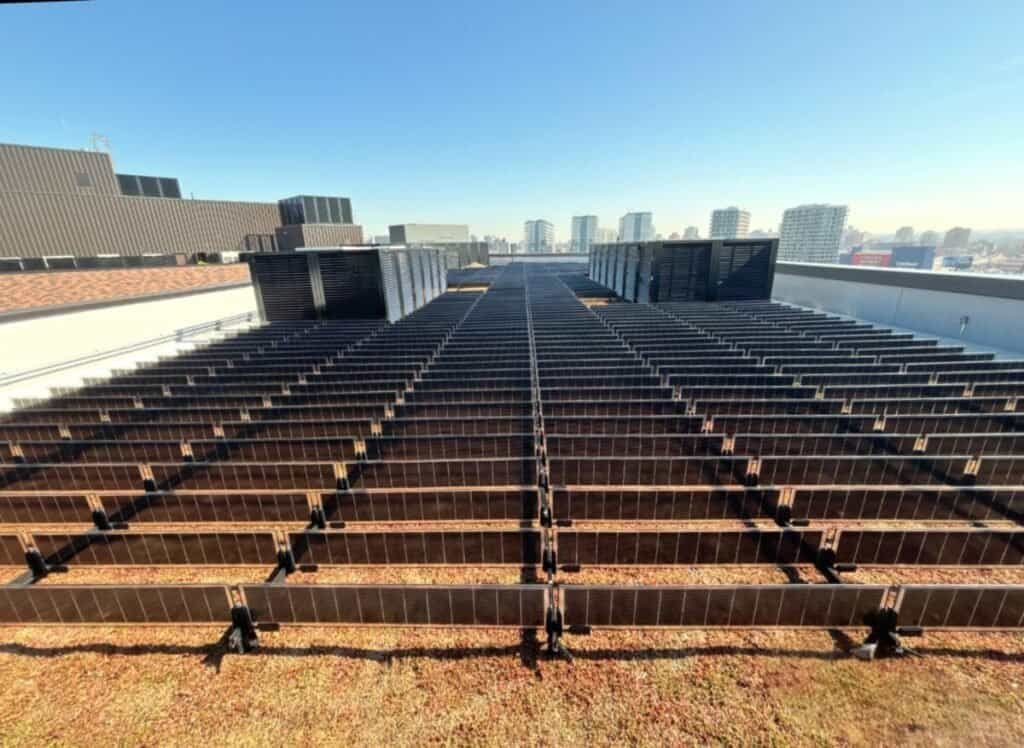
UK, Ireland, Norway, and Scotland are the strongest markets. Low winter sun angles and frequent overcast conditions favour vertical bifacial geometry. White gravel or white membrane roofing beneath the solar panels maximises rear-side reflectance and amplifies bifacial gain.[3]
🌿 Scenario 2: Flat Roofs with Green Roof Requirements
Vertical spar panels do not block rainfall or vegetation. Over Easy Solar’s first US commercial installation — 100 kW, Queens, New York, April 2026 — was switched from a tilted layout to vertical to meet NYC’s Department of Environmental Protection priorities for green roof performance. Expected annual yield: approximately 120,000 kWh.[7]
🌾 Scenario 3: Agrivoltaic Systems
East-west vertical rows allow standard farming equipment to pass freely between panels. The 2025 Aarhus University study (Energy Nexus) confirmed vertical bifacial panels generate electricity without reducing crop yields, with panels covering only ~10% of field area.[8]
- Wheat and grass-clover yields were comparable to open-field results
- Panels act as effective windbreaks, reducing evaporation and protecting crops
- 18–26% less land needed vs separate solar and farming operations
- Compatible with standard combine harvesters and tractors
❄️ Scenario 4: Snow-Prone and Cold Climates
Snow slides off vertical panels naturally — no buried arrays, no lost winter yield. NREL research indicates bifacial panels on highly reflective snow surfaces can increase annual energy production by 11 to 27%.[9] Nordic countries, Canada, and alpine Europe benefit most.
🏗️ Scenario 5: Sound Barriers and BIPV Facades
Vertical bifacial panels function as noise barriers and power generators simultaneously. The IEA-PVPS Task 13 notes bifacial panels near the ends of barrier-style arrays benefit from additional edge gain due to unobstructed rear-face exposure.[10] For building facades, research documents approximately 25% higher annual power generation compared to equivalent monofacial installations.[11]
Agrivoltaics: A Closer Look
Agrivoltaics — combining solar power generation with active food production — is one of the fastest-growing applications for vertical bifacial technology. Panel rows run parallel to crop rows, and standard farm machinery can pass between them without obstruction.
The Aarhus University study found that wheat and grass-clover mixtures grown between vertical panels produced yields comparable to open-field crops. Although the vertical configuration generates roughly 13% less total annual electricity than a tilted system, its generation profile better matches demand, with peaks in the morning and evening.[8]
IEEE Journal of Photovoltaics modelling using weather data from Merced, Houston, Denver, and Miami found that a south-facing vertical bifacial system with a ground reflector achieves 112 to 121% of the annual output of a standard 20° tilted monofacial system. Without a reflector, output falls to 82–94%.[13]
The University of Vermont is running a 50 kW vertical bifacial agrivoltaic trial at its Horticultural Research and Education Center in South Burlington — among the first US-scale field studies of this configuration for vegetable crops.[14]
Upfront Cost vs Long-Term Return
| Item | Vertical Bifacial (VBPV) | Traditional Tilted (TMPV) |
|---|---|---|
| Installed cost (UK commercial estimate) | ~£1,200/kW | ~£900/kW |
| Estimated additional annual savings | +GBP 1,221/year (per 1,500 kWh) | Baseline |
| Winter yield advantage vs TMPV | +24.52% | — |
| 5-year maintenance cost | ~30% lower | Higher (soiling, tilt hardware) |
Cost estimates based on University of York study supplementary analysis. UK commercial solar typically £800–£1,200/kW.[15]
That cost gap narrows when you account for three factors:
- Reduced maintenance costs — vertical panels self-clean in rain, resist soiling, and require no tilt-adjustment hardware. Five-year costs reported ~30% lower than tilted equivalents.[3]
- Higher-value generation — morning and evening electricity commands premium rates under time-of-use tariffs. Each kWh may be worth more, not just more kWh produced.
- Dual land use — in agrivoltaic or green roof applications, the same area generates both agricultural and energy value simultaneously.
When Tilted Systems Still Win
Vertical bifacial panels are not the right answer everywhere. Here is when traditional tilted systems remain the better choice:
- 🌞 Low-latitude, high-irradiance regions (southern Spain, MENA, sub-Saharan Africa) — single-axis trackers or tilted fixed arrays deliver superior annual yield where midday DNI dominates.[17]
- 🏠 South-facing sloped roofs — the roof already provides optimal solar orientation; vertical mounting requires structural modification and typically produces less total energy.
- 💰 Budget-constrained residential projects in warmer UK regions — the ~33% cost premium is harder to recover without time-of-use tariffs.
- 🌑 Sites with poor ground albedo — bare soil (albedo 0.15–0.25) is insufficient to fully leverage bifacial rear-face gain.[16]
How Independent Bodies Evaluate the Evidence
- 📋 IEA-PVPS Task 13 identifies east-west vertical arrays as “especially suited to bifacial PV technologies,” citing load-profile matching, low soiling rates, and land co-use advantages.[10]
- 📊 IEEE Journal of Photovoltaics modelling confirms south-facing vertical bifacial + reflector systems match or exceed tilted monofacial output across multiple US climates (112–121%).[13]
- 🌾 Aarhus University (2025) provides real-world temperate-climate field validation: no crop yield loss, better demand-matching generation profile.[8]
- 🔬 HTWK Leipzig modelling confirms up to 10.2 million tonnes/year CO₂ reduction potential in Germany from widespread vertical bifacial adoption.[5]

The Bottom Line for B2B Buyers and System Designers
Vertical bifacial PV is not a niche novelty. It is a genuinely different energy generation strategy — optimised for demand-matching rather than peak output, for diffuse light rather than direct sun, and for multi-use land deployment rather than single-purpose arrays.
The strongest case exists where three conditions overlap: a high-latitude site (50°N and above), a need for morning and evening generation, and a reflective ground or roof surface. When all three are present, the performance data is compelling and the economic case holds up.
For solar businesses, architects, and project developers targeting the UK, Ireland, Scandinavia, northern Europe, or Canada — and especially for agrivoltaic, BIPV, or urban commercial flat-roof projects — vertical bifacial deserves a serious place in the design conversation.
References & Notes
- Bifacial solar modules generate power from both front and rear cell surfaces. In vertical east-west orientation, the front face captures morning irradiance while the rear face captures afternoon irradiance simultaneously.
- Badran, G., & Dhimish, M. (2024). “Comprehensive study on the efficiency of vertical bifacial photovoltaic systems: a UK case study.” Scientific Reports 14, 18380. DOI: 10.1038/s41598-024-68018-1. nature.com | York Research Database
- pv magazine (15 April 2026). pv-magazine.com. 5-year maintenance cost reduction (~30%) from supplementary data associated with [2].
- UK annual sunshine hours: Met Office UK climate statistics. metoffice.gov.uk
- Reker, S. et al. (2022). “Integration of vertical solar power plants into a future German energy system.” Smart Energy 7, 100069. HTWK Leipzig. DOI: 10.1016/j.segy.2022.100069. sciencedirect.com
- Economic analysis from University of York study [2] supplementary modelling. GBP 0.28/kWh tariff and 1,500 kWh baseline are illustrative. Actual savings vary by local tariff and albedo.
- Over Easy Solar NYC (Queens, Willets Point), April 2026. pv magazine USA. pv-magazine-usa.com
- Victoria, M. et al. (2025). “Vertical agrivoltaics in a temperate climate.” Energy Nexus 19, 100526. DOI: 10.1016/j.nexus.2025.100526. pure.au.dk
- NREL bifacial snow performance research (2020). nrel.gov
- IEA-PVPS Task 13 (2021). “Bifacial Photovoltaic Modules and Systems.” iea-pvps.org (PDF)
- Bifacial facade annual power gain ~25% vs monofacial: Soria et al. (2015), cited in Li, Z. et al. (2021). Solar Energy 227. DOI: 10.1016/j.solener.2021.07.082. sciencedirect.com
- Riaz, M.H. et al. (2021). “The optimization of vertical bifacial photovoltaic farms for efficient agrivoltaic systems.” Solar Energy 230, 1004–1012. agrisolarclearinghouse.org
- Reagan & Kurtz. “Energetic Comparison of Vertical Bifacial to Tilted Monofacial Solar.” IEEE J. Photovoltaics. Note: 112–121% refers to south-facing vertical + ground reflector, not east-west. PDF via AgriSolar Clearinghouse
- University of Vermont agrivoltaic trial (NE SARE, Project LNE22-454R). site.uvm.edu/agrivoltaics
- UK commercial solar costs: £800–£1,200/kW. nu.energy. The ~33% vertical bifacial premium is an estimate from University of York study supplementary analysis.
- Ground albedo values: Marion, B. (2021). Solar Energy 215, 321–327. DOI: 10.1016/j.solener.2020.12.067.
- Rodríguez-Gallegos, C.D. et al. (2020). “Global techno-economic performance of bifacial and tracking photovoltaic systems.” Joule 4(7), 1514–1541. DOI: 10.1016/j.joule.2020.05.005.

 English
  Español
  Français
  Deutsch
  Русский
  العربية