
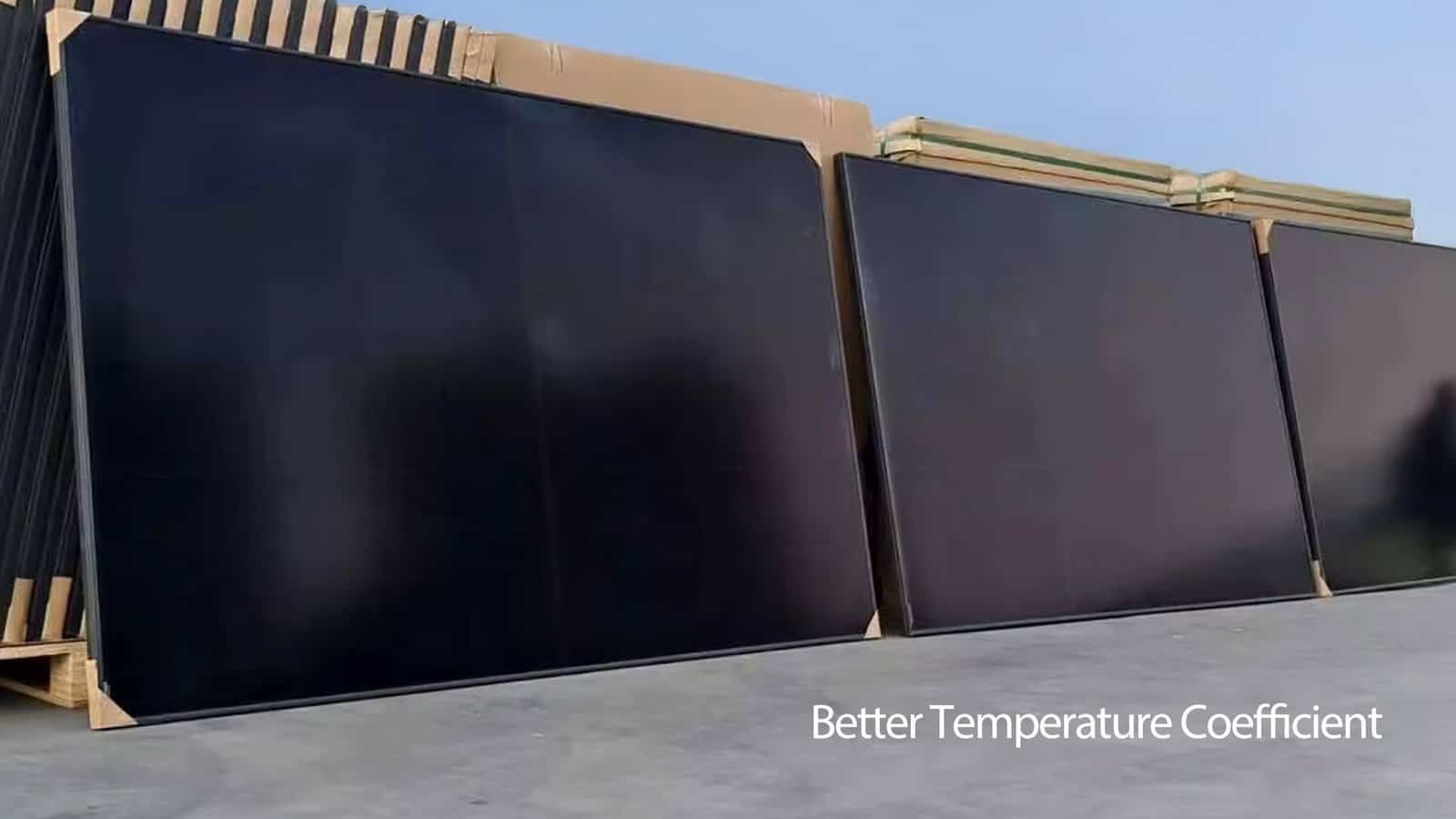
Solar panels look simple. Flat, dark, sitting on a roof. But the technology inside has changed dramatically in recent years — and the market is catching up fast. Rooftops in Phoenix, RV parks in Australia, marine decks in the Mediterranean, and BIPV facades in Dubai all have one thing in common: heat. Panels get hot. Output falls. And for premium applications where every watt per square metre counts, the choice of cell architecture matters more than the nameplate label.
Back contact solar technology is one of the clearest answers the industry has found. Adopted by leading manufacturers including LONGi, AIKO, and Huasun, it is no longer a premium novelty — BC modules accounted for an estimated 120 GW of production in 2025 alone, with projections pointing toward 1 terawatt of manufacturing capacity by 2030.[12] For specialised and flexible module applications, the technology’s thermal and aesthetic advantages make it the logical first choice.
What “Back Contact” Actually Means
In a conventional solar cell, metal busbars and gridlines run across the front surface. These lines collect electricity generated by the cell, but they also block a small portion of incoming sunlight. They cannot be moved out of the way. They are part of the design.
Back contact cells solve this differently. All the electrical contacts — the conductors, the connections — move to the rear side of the cell. The front is completely open. No gridlines. No shading from metal fingers. More of the incoming light reaches the active semiconductor area.
The result is a cleaner front surface and a noticeably different appearance. Back contact modules are often described as “full black” because there are no visible silver lines to break up the surface. For architects, vehicle designers, boat builders, and premium product manufacturers, this matters as much as efficiency. A frameless, all-black BC module blends into a roofline, a vehicle skin, or a building facade in a way no conventional gridline panel can.
There is a thermal benefit too. Eliminating front-side metal contact recombination raises the cell’s open-circuit voltage (Voc) — and as we will see below, higher Voc is one of the key reasons BC cells lose less power to heat.
Why Solar Panels Lose Power in Heat
Here is a question many installers have heard: “If solar panels need sunshine, why do hot days sometimes produce less electricity?”
The answer lies inside the semiconductor.
A solar cell is a p-n junction. Sunlight knocks electrons loose and drives them through the external circuit to produce electricity. But as the cell heats up, a critical parameter falls: the open-circuit voltage (Voc). Higher temperatures increase the junction’s dark saturation current (I₀), which progressively erodes the voltage available at the output terminals. Short-circuit current does increase slightly with temperature — the bandgap narrows slightly, letting marginally more photons generate charge — but this gain is always smaller than the voltage loss. Since output power equals voltage multiplied by current, the net result is a measurable fall in power, even under constant sunlight.
Solar panels are rated at Standard Test Conditions (STC): 25°C cell temperature, 1,000 W/m² irradiance, AM 1.5G spectrum.[1] In the real world, rooftop arrays routinely reach 60–75°C in summer[2] — sometimes higher on dark surfaces with no airflow. Module datasheets also list NMOT (Nominal Module Operating Temperature), defined under IEC 61215:2016 as the cell temperature under 800 W/m² at 20°C ambient and 1 m/s wind. A typical NMOT of 42–46°C gives engineers a more realistic operating estimate than STC alone.
That gap between lab conditions and real-world operation is where the losses occur — and where the temperature coefficient becomes the most important number on the datasheet.
The Temperature Coefficient Explained
The temperature coefficient of power (Pmax tempco) tells you how much a panel’s rated output changes for every degree Celsius above 25°C.[3] It is always a negative number for power — heat hurts output in silicon PV.
A coefficient of −0.35%/°C means every extra degree above 25°C reduces rated power by 0.35%. Every degree below 25°C adds it back. Smaller absolute values are better: −0.26%/°C means less heat-induced loss than −0.40%/°C.
A practical example makes the stakes clear. Two 400 W modules, side by side, cell temperature at 65°C — that is 40°C above STC. The module rated at −0.35%/°C loses roughly 14% of its output; the one at −0.40%/°C loses around 16%.[4] Same nameplate, same irradiance — meaningfully different energy in the bank by end of the day.
Compounded across 1,500–2,000 peak sun hours per year in hot markets — MENA, Southeast Asia, the US Southwest, Australia — even a 2-point tempco difference between two products becomes significant in lifetime kWh/kWp.
Back Contact Cells and Temperature Performance
This is where back contact technology earns a verified technical advantage over competing cell architectures.
Back contact panels achieve temperature coefficients in the range of −0.24 to −0.29%/°C. LONGi’s HPBC 2.0, independently reported by pv‑magazine, is confirmed at −0.26%/°C — a verified improvement of 0.03%/°C over TOPCon, which typically runs at −0.28% to −0.32%/°C. Conventional PERC modules, now in a managed phase-out across major manufacturers as n-type technology takes over, carry coefficients of −0.34% to −0.40%/°C.[5]
Temperature Coefficient at a Glance — 65°C Operating Temperature
| Technology | Pmax Tempco | Output at 65°C | Loss vs. STC |
|---|---|---|---|
| BC (HPBC 2.0) | −0.26%/°C | ~89.6% | −10.4% |
| TOPCon (typical) | −0.29%/°C | ~88.4% | −11.6% |
| PERC (typical) | −0.35% to −0.40%/°C | ~84–86% | −14–16% |
Sources: LONGi official press release (Oct 2024), pv‑magazine, SurgePV tempco guide (2026). Output calculated as % remaining at ΔT = 40°C above STC.
At field temperatures of 65–70°C, the difference between back contact and PERC translates to approximately 4–8% more actual output from the BC panel[6] — an advantage that compounds across thousands of operating hours in hot climates.
The physics behind this advantage is well-documented. By eliminating front-side contact recombination, BC cells achieve higher open-circuit voltage — and, as PVeducation.org notes, “the temperature sensitivity of a solar cell depends on the open-circuit voltage: higher Voc cells are less affected by temperature.”[2] It is not marketing language. It is diode physics.
For semi-flexible panels bonded directly to a vehicle roof or marine deck with no ventilation gap, operating temperatures run higher still. In those applications, the temperature coefficient is not a secondary consideration. It is the first number to confirm.
Hot Climate Installations: More Than Just the Cell
A good temperature coefficient is necessary, but it does not do the job alone. A complete hot-climate module solution requires the right engineering at every layer.
Cell technology sets the baseline temperature performance, as described above. N-type back contact architecture is the current ceiling for silicon-based tempco performance.
Encapsulant choice matters for long-term stability under heat cycling. ETFE (ethylene tetrafluoroethylene) laminate on the front surface resists UV degradation, maintains optical transmittance over years of field exposure, and handles thermal cycling better than lower-cost PET alternatives. Combined with POE (polyolefin elastomer) as the inner encapsulant, the module structure maintains both optical and adhesive performance even after repeated high-low temperature cycles.
Mounting and ventilation can make a substantial difference to operating cell temperature. Studies show that increasing the air gap between panel and roof from 2 cm to 20 cm reduces panel operating temperature by up to 10°C.[7] Applied to a module with a −0.26%/°C coefficient, that recovers roughly 2.6% of rated output — continuously, across every operating hour in summer. Panels without any ventilation gap can run 20–40°F above their rated operating temperature,[8] compressing both short-term output and long-term module life.
Module colour and surface are relevant too. Full-black modules look exceptional, but dark surfaces absorb more radiant heat. In flush-mount applications — vehicle roofs, low-pitch BIPV, bonded marine surfaces — where no gap is possible, the temperature coefficient of the cell becomes even more critical. The design cannot compensate for a weaker tempco through ventilation, so the cell architecture must carry that burden.
Why Customisation Is the Right Approach for Premium Applications
Most buyers start with a size, a wattage, and a colour. That is a reasonable brief for a standard rooftop. For applications outside that context, module design needs to go deeper.
The environments where back contact flexible panels are being specified today could not be more different from one another. Each demands its own engineering logic.
An RV roof is curved, weight-limited, and shadowed intermittently by antennas, vents, and air-conditioning units as the vehicle moves. A module designed for this needs a defined minimum bending radius, a waterproof UV-stable front sheet, an IP68-rated junction box, and a cell string layout engineered around the expected shadow pattern.
A marine installation faces salt mist, vibration, high open-water UV intensity, and the constant risk of moisture ingress at every cable penetration. The lamination, sealing, cable entry, and connector selection must all be engineered for that environment from day one. IEC 61701 salt-mist certification is a minimum requirement, not a safety margin.[9]
A vehicle-integrated photovoltaic (VIPV) system on a commercial truck, bus, or refrigerated trailer introduces road vibration, aerodynamic stress, and temperature swings from crossing climate zones. The full-black, frameless surface of BC panels also offers a documented advantage here: the absence of a frame-to-glass joint means less dust accumulation at module edges — a meaningful gain in output stability for panels operating in the dusty corridors where commercial fleets run.
BIPV modules in facades, roof tiles, and canopies must integrate with the building envelope, not just sit on top of it. Panel dimensions, colour uniformity, edge sealing, junction box height, and fixing method all need to match construction tolerances and architectural intent. A standard catalogue panel rarely does.
In every one of these contexts, the encapsulant stack, cell interconnect layout, junction box position, cable routing, and connector type should all be determined by the installation environment — not inherited from a product that was designed for a different application.
Shading Performance and Cell Layout
Partial shading is a separate challenge — and one where back contact module design offers meaningful flexibility over conventional wiring approaches.
In a series-connected conventional string, one shaded cell limits the entire string. Bypass diodes help, but they operate in coarse blocks. Fine-grained shading from an antenna, a sail fitting, a roof vent, or a chimney can cause disproportionate losses if the cell layout is not designed around the specific shading pattern expected in that installation.
Back contact cell designs allow more flexibility in how cells are interconnected and how sub-strings are segmented. When a module is custom-engineered for a specific application, the string layout can be optimised around the real expected shade pattern. This is a design task, not an off-the-shelf solution — which is precisely why customisation and product selection are not the same thing.
What to Ask Before You Specify
When qualifying back contact modules for a specialised application, these questions cut through datasheets and marketing materials quickly.
Temperature coefficient of Pmax: Confirm from the official datasheet. For current BC cells, −0.26%/°C or better is achievable and independently verified. Also check NMOT — lower NMOT indicates the module structure runs cooler under real operating conditions.
Front sheet material: ETFE offers significantly longer field life than PET, particularly under sustained UV and thermal cycling. For marine and VIPV applications, ETFE should be the baseline, not the upgrade.
Inner encapsulant: POE (polyolefin elastomer) offers better moisture resistance and long-term adhesion performance than conventional EVA formulations. In marine or high-humidity environments, this affects module lifetime materially.
Junction box IP rating: IP68 is the appropriate minimum for marine and VIPV applications — not IP65 or IP67. The difference between IP67 and IP68 is continuous submersion resistance, which matters on a boat deck.
Certifications: IEC 61215 covers module durability and performance, including bending tests for flexible constructions under Part 1-1:2021.[1] IEC 61730 covers electrical and fire safety qualification.[10] IEC 61701 is specific to salt-mist corrosion resistance.[9] IEC TS 62782 defines cyclic mechanical load testing for rigid-mount configurations.[11]
Actual module efficiency: For flexible back contact modules, 20–22% module efficiency in a lightweight form factor represents the current high end of volume production. Verify the figure is module efficiency, not cell efficiency — the gap between the two matters for area calculations.
📋 Have a Specific Application in Mind?
If you already have dimensions, a target wattage, or environmental requirements, our engineering team can review your specification and propose a suitable module configuration. Contact us at info@couleenergy.com or +1 737 702 0119.
Frequently Asked Questions
Do back contact solar panels actually perform better than TOPCon in heat?
Yes, measurably. LONGi’s HPBC 2.0 BC cells carry a confirmed Pmax tempco of −0.26%/°C, verified 0.03%/°C better than TOPCon by pv‑magazine. At 65°C cell temperature, BC outputs ~89.6% of its STC rating; typical TOPCon outputs ~88.4%. The gap widens against PERC. In flexible flush-mounted applications — where operating temperatures are consistently higher — the advantage accumulates more quickly.
What temperature coefficient should I specify for a hot-climate installation?
For installations where cell temperatures regularly exceed 55°C — rooftop in MENA, VIPV in the US Southwest, marine applications in the Mediterranean — look for −0.30%/°C or better. Current-generation BC panels achieve −0.24% to −0.29%/°C. Always confirm the Pmax tempco from the official dated datasheet, not a product landing page; manufacturers have been improving N-type coefficients across production runs since 2024.
What is the difference between HPBC, ABC, and IBC back contact architectures?
All three move electrical contacts to the rear of the cell, but the passivation and contact formation differ. HPBC (Hybrid Passivated Back Contact, LONGi’s implementation) uses a hybrid bipolar passivation approach that raises Voc to ~745 mV. ABC (All Back Contact, used by AIKO and others) and IBC (Interdigitated Back Contact, SunPower’s original architecture) differ in contact geometry. For module buyers, the practical distinctions are the confirmed tempco, efficiency at module level, and the manufacturing scale available for OEM programmes. All three architectures produce the characteristic full-black, gridline-free front appearance.
Are ETFE flexible solar panels suitable for permanent marine installation?
ETFE-encapsulated flexible panels are a strong choice for marine use, provided the module carries IEC 61701 salt-mist certification and uses an IP68-rated junction box with properly sealed cable exits. ETFE outperforms PET in UV resistance and sustains high optical transmission over years of open-water UV exposure. POE inner encapsulant is preferable to conventional EVA in salt-air environments due to its lower moisture permeability. For permanent installation, confirm the manufacturer’s warranty covers marine/salt-air exposure explicitly.
Does flush-mounting a flexible solar panel reduce its output significantly?
Yes. Without an air gap, cell temperature rises by 20–40°F (11–22°C) above panels with ventilated clearance. On a BC panel with a −0.26%/°C coefficient, that additional 11–22°C costs approximately 2.9–5.7% of rated output — continuously, for as long as irradiance is high. For permanently bonded VIPV and marine applications, this makes the choice of cell architecture — and particularly its temperature coefficient — even more consequential than for a ventilated rooftop array.
The Right Partner Makes the Difference
Back contact technology has moved decisively from premium novelty to mainstream manufacturing scale. Production reached an estimated 120 GW in 2025, and leading researchers at ISC Konstanz project manufacturing capacity could reach 1 terawatt by 2030 — a pace suggesting BC will define the next decade’s premium module landscape, not merely occupy a corner of it.[12]
The right manufacturing partner for specialised BC module projects is not one that selects a standard product from a catalogue and ships it. It is one that understands the engineering requirements of the final application — from cell layout and string configuration through lamination structure, encapsulant selection, and junction box placement — and builds to those requirements from the start.
For projects where heat management, limited space, long-term outdoor durability, and visual integration all matter simultaneously, customised back contact modules offer a performance advantage that catalogue products cannot match. They are no longer the premium exception. For serious applications, they are becoming the baseline expectation.
Interested in back contact flexible modules or custom OEM solar solutions for your specific application? Reach out directly at info@couleenergy.com or call +1 737 702 0119. Our engineering team works with B2B buyers across RV, marine, VIPV, and BIPV sectors to develop module solutions that fit real installation requirements.
Footnotes
-
IEC 61215:2021 — Terrestrial PV Modules: Design Qualification and Type Approval. Defines STC as 25°C cell temperature, 1,000 W/m², AM 1.5G spectrum. Also defines NMOT (Nominal Module Operating Temperature) under IEC 61215:2016 as cell temperature at 800 W/m², 20°C ambient, 1 m/s wind. Part 1-1:2021 includes MQT 22 bending test series for flexible-type module constructions.
webstore.iec.ch/en/publication/61215 -
Effect of temperature on solar cell operation (PVeducation.org). Authoritative academic reference (Honsberg & Bowden, UNSW / Arizona State): documents Voc reduction with temperature due to increased dark saturation current I₀; confirms short-circuit current increases slightly; notes that “higher Voc cells are less affected by temperature” — directly explaining the BC tempco advantage.
pveducation.org — Effect of Temperature on Solar Cell Operation -
Temperature coefficient of power (Pmax tempco) — definition. Standard industry definition: expresses the percentage change in maximum power output per °C above 25°C STC. Applied universally across manufacturer datasheets and IEC certification laboratories.
winaico.com.au — Temperature Coefficients Explained and Why They Matter in the Field -
Tempco loss calculation. Formula: power loss (%) = |tempco| × ΔT above 25°C. At ΔT = 40°C: 0.35 × 40 = 14%; 0.40 × 40 = 16%. Standard arithmetic verified across industry sources.
bostonsolar.us — How Do Temperature and Shade Affect Solar Panel Efficiency? -
Technology tempco comparison: BC, TOPCon, PERC. LONGi HPBC 2.0 confirmed at −0.26%/°C (“improving by 0.03%/°C over TOPCon”) by pv‑magazine, Oct 2024. TOPCon typically −0.28%–0.32%/°C per SurgePV engineering guide (2026); PERC typically −0.34%–0.40%/°C per A1 SolarStore and manufacturer datasheets.
pv‑magazine.com — LONGi introduces 665 W HPBC photovoltaic modules (Oct 2024) -
4–8% output advantage: BC vs. PERC at field temperatures. Calculated from confirmed tempco values at ΔT = 40–45°C (65–70°C cell temp): BC (−0.26%/°C) delivers 89.6% of STC at 65°C; PERC (−0.35%) delivers 86.0%; PERC (−0.40%) delivers 84.0% — a relative BC advantage of 4.2–7.7%. Confirmed against LONGi Hi-MO X10 official launch data.
longi.com — LONGi Hi-MO X10 HPBC 2.0 Official Launch (Oct 2024) -
Air gap ventilation study. Increasing the clearance gap between module and mounting surface from 2 cm to 20 cm reduces panel operating temperature by up to 10°C, improving both output and module longevity.
8msolar.com — Solar Panel Efficiency vs. Temperature -
Flush-mount overheat risk. Panels mounted without a ventilation gap can run 20–40°F above rated operating temperature. Most manufacturers specify a minimum 1–2 inch clearance to protect output and warranty conditions.
solarpanelsnetwork.com — Do Flexible Solar Panels Need an Air Gap? -
IEC 61701 — Salt Mist Corrosion Testing of Photovoltaic (PV) Modules. Standardised test procedures for assessing module corrosion resistance in marine, coastal, and high-humidity salt-air environments. Level 6 is the most stringent classification.
webstore.iec.ch/en/publication/61701 -
IEC 61730 — Photovoltaic (PV) Module Safety Qualification. Two-part standard covering materials assessment (Part 1) and testing requirements (Part 2) for electrical safety, mechanical integrity, and fire resistance. Updated 2023 edition with October 2024 amendments improving fire test criteria and new front/backsheet material requirements.
webstore.iec.ch/en/publication/61730 -
IEC TS 62782 — Cyclic (Dynamic) Mechanical Load Testing for Photovoltaic Modules. Applies a uniform perpendicular load cycled in alternating directions on supported rigid-mount modules. Per the standard’s own scope: “This technical specification has historically been applied to rigid modules. It cannot be applied to flexible modules unless they are designed to be mounted in a rigid manner.” Flexible module bending qualification uses IEC 61215-1-1:2021 (MQT 22 bending test series).
webstore.iec.ch/en/publication/62782 -
BC manufacturing scale and 2030 capacity outlook. BC module production estimated at approximately 120 GW in 2025 (Global Info Research). pv‑magazine quoting ISC Konstanz researcher Radovan Kopecek (Feb 2025): manufacturing capacity could reach 1 TW by 2030 — “a scenario that may even materialise in 2027,” according to LONGi and AIKO projections cited in the same report. ITRPV 2025 edition confirms BC technology gaining share and commercial modules approaching 25% efficiency by 2026.
pv‑magazine.com — Back contact solar module manufacturing capacity may reach 1 TW by 2030 (Feb 2025)




 English
  Español
  Français
  Deutsch
  Русский
  العربية