
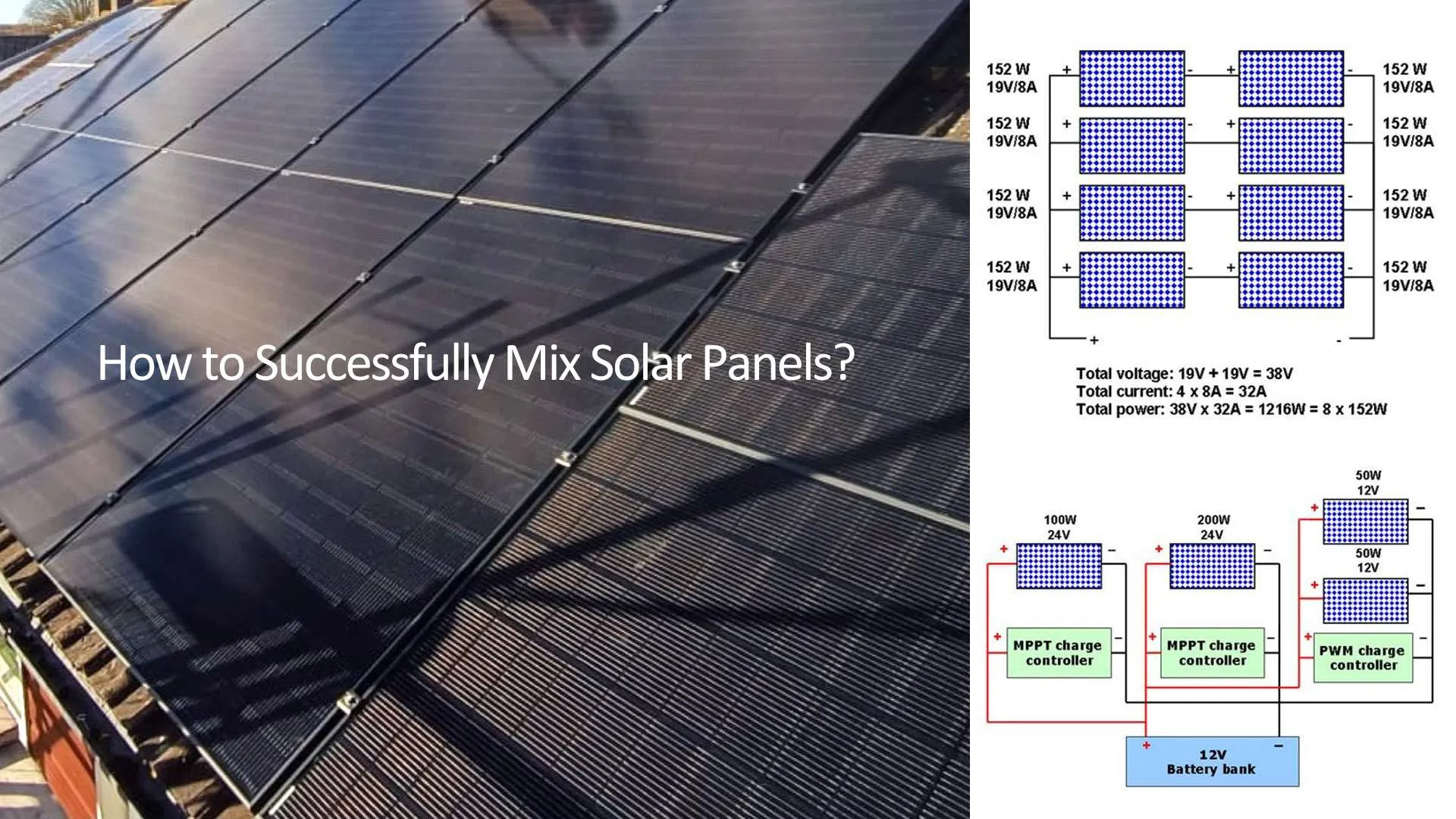
Ever wondered if you can mix and match solar panels like you mix clothes in your wardrobe? Maybe you need to expand your existing solar setup but can’t find the same panels anymore. Or perhaps you got a great deal on some PV panels that don’t match your current ones.
At Couleenergy, we hear these questions all the time from our customers around the world. Let’s break down everything you need to know about mixing solar panels with different wattages in plain, easy-to-understand terms.
The Basics: What Happens When You Mix Different Solar Panels?
Think of solar panels like team members. Ideally, you want everyone on your team to have similar strengths so they can work well together. The same goes for solar panels.
When we talk about solar panels, three main electrical values matter:
- Voltage – the electrical “pressure” (like water pressure in a pipe)
- Current – how much electricity flows (like the amount of water flowing)
- Wattage – the total power (voltage multiplied by current)
Mixing panels with different wattages is like having team members who work at different speeds. It’s possible, but you need the right strategy to make it work efficiently.
Can You Actually Mix Different Wattage Panels? The Simple Answer
Yes, you can mix solar panels with different wattages – but there’s a catch. How well they work together depends on how you connect them.
The Two Ways to Connect Solar Panels
There are two main ways to connect solar panels:
1. Series Connection (Like Christmas Lights)
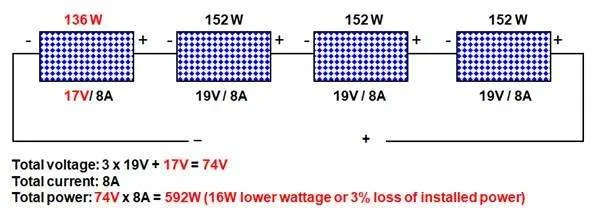
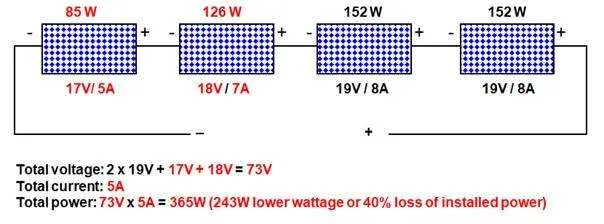
With series connections, you connect panels end-to-end (positive to negative), just like old-fashioned Christmas lights. Here’s what happens:
- The voltages add up
- The current stays the same as the lowest panel
- The system is limited by the panel with the lowest current
For example, if you connect a 100W panel and a 200W panel in series, and they have the same current, you’ll get good results. But if their currents differ, the higher-wattage panel won’t perform to its full ability.
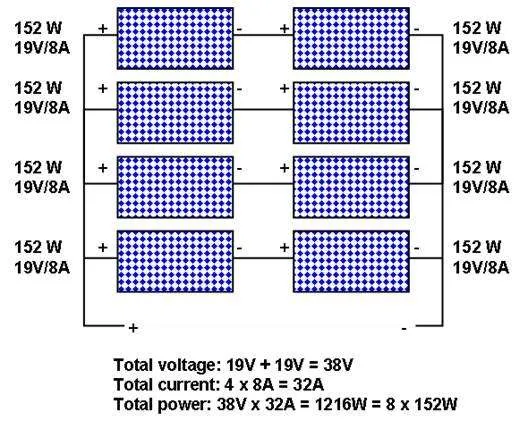
2. Parallel Connection (Like Multiple Lanes on a Highway)
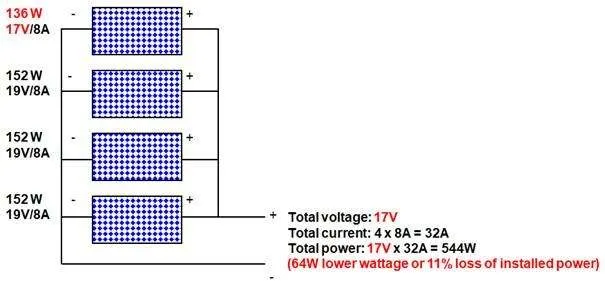
With parallel connections, you connect all positives together and all negatives together, like adding more lanes to a highway:
- The currents add up
- The voltage stays the same as the lowest panel
- The system is limited by the panel with the lowest voltage
This often works better for mixed panels, as long as their voltages are similar.
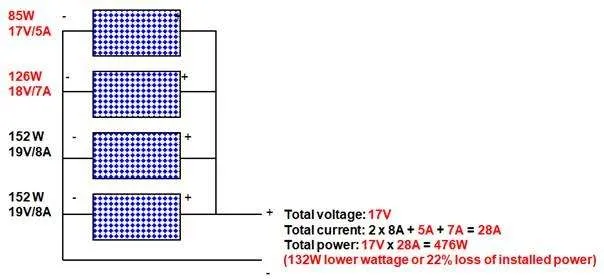
What Happens When You Mix Different Panels? Real Talk
Let’s be honest about what happens when you mix panels:
1. Your System Might Not Work at Full Power
When you mix solar panels, your system probably won’t produce as much power as it could if all solar panels matched. Higher-wattage panels get held back by lower-wattage ones. According to a study by Solar Energy Materials and Solar Cells, this mismatch can reduce efficiency by 10-40% depending on how extreme the differences are.¹
2. Your Equipment Might Wear Out Faster
Mixed solar panels can create uneven electricity flow, which puts extra stress on your system. This can cause more heat and wear, shortening the life of your equipment. Research from the National Renewable Energy Laboratory (NREL) confirms that PV panel mismatch can accelerate degradation rates.²
3. More Complicated Setup and Maintenance
You’ll need to pay more attention to how everything is connected and monitor performance more carefully.
| Connection Type | Best When | Efficiency Impact |
|---|---|---|
| Series | Panels have same current (amps) | Medium to High |
| Parallel | Panels have same voltage (volts) | Low to Medium |
| Series + Parallel | Mixed panel specifications | Low |
When Mixing Panels Actually Makes Sense
Are there times when mixing panels works well? Absolutely! Here are some situations where it makes sense:
- Adding to an existing system when you can’t find the original panels
- Working with a tight budget by mixing new and quality used panels
- Dealing with limited space where you need to maximize every inch
- Handling supply shortages when you can’t get all the same panels
Follow us on Facebook for the latest updates on solar panel availability and compatibility!
“We’ve helped hundreds of businesses successfully integrate different solar panel types by using the right technology and connection strategies. The key is understanding the electrical relationship between panels and using appropriate power optimization devices.”
— James Chen, Chief Engineer at Couleenergy
The Secret Weapon: Technology That Makes Mixing Panels Work Better
The good news? Modern technology can help solve many mixing problems:
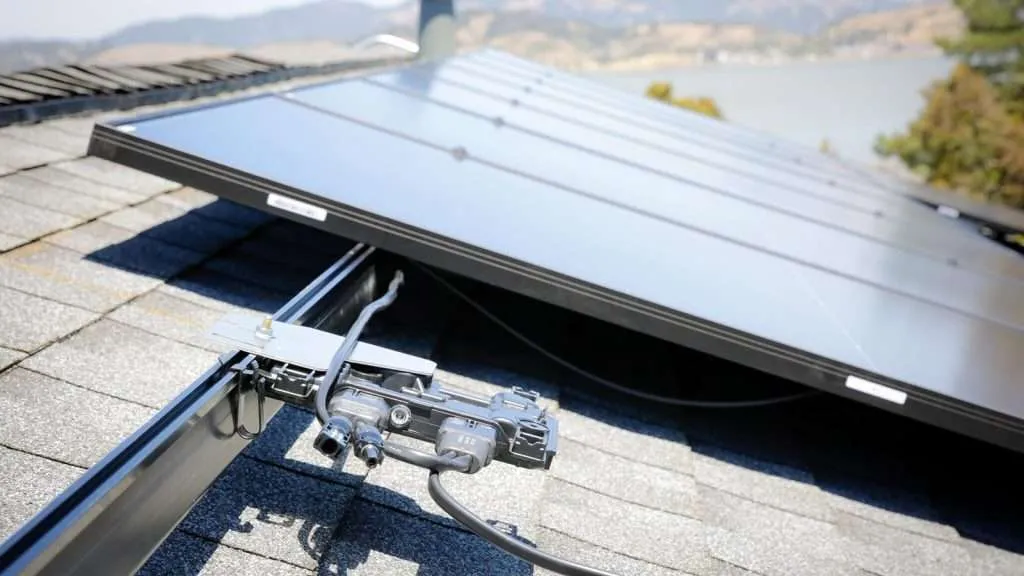
Microinverters: Your Panel Independence Solution
Microinverters are small devices that attach to each individual panel. They let each panel work independently at its best performance, regardless of what other panels are doing.
Our Couleenergy microinverter solutions can improve mixed-panel system performance by up to 25%!
According to EnergySage’s comprehensive analysis, microinverters provide superior performance for systems with panels facing different directions or with varying specifications.³
Power Optimizers: The Middle-Ground Option
Power optimizers work similarly but are often less expensive. They adjust each panel’s output before sending power to a central inverter.
A 2021 study in IEEE Journal of Photovoltaics found that power optimizers can recover up to 75% of the energy lost due to panel mismatch.⁴
Real-Life Example: How We Solved a Tricky Mixed-Panel Problem
In 2023, one of our business customers in Southeast Asia needed to expand their 50kW solar system. The original panels weren’t available anymore, so we had to get creative.
Here’s what we did:
- We separated the new 430W panels from the existing 320W panels
- We installed power optimizers on all panels
- We created separate strings based on wattage
- We connected everything to a compatible string inverter
The result? Their system now produces 96% of what would be possible with perfectly matched panels. That’s way better than the 75-80% they would have gotten without our solution!
Smart Tips for Buying and Using Mixed Solar Panels
If you’re thinking about mixing solar panels, here are some practical tips:
- Try to match voltage when connecting in parallel
When panels have different wattages but the same voltage, they work much better together in parallel. - Try to match current when connecting in series
For series connections, panels with the same current (even if wattages differ) work best together. - Group similar panels together
Connect similar panels in the same string before connecting different strings together. - Consider using microinverters or power optimizers
These technologies make a huge difference in mixed-panel systems. - Ask for detailed specifications
Don’t just look at wattage – voltage and current matter too!
According to the U.S. Department of Energy’s Solar Energy Technologies Office, using power electronics like microinverters can improve energy yield by up to 20% in partially shaded or mixed-panel conditions.⁵
How Couleenergy Can Help You
At Couleenergy, we understand that real-world solar installations sometimes require practical compromises. Our team specializes in:
- Analyzing your specific situation to find the best connection strategy
- Recommending the right equipment to optimize mixed-panel performance
- Designing systems that work well now and can expand in the future
- Testing everything thoroughly before installation
- Providing ongoing support to ensure your system keeps performing well
The Bottom Line on Mixing Solar Panels
Is using identical solar panels ideal? Yes.
Is mixing panels sometimes necessary and practical? Also yes!
With the right connection strategy and modern optimization technology, you can achieve excellent performance even with varied panel specifications. The key is working with knowledgeable partners (like us!) who understand both the challenges and solutions.
Have questions about your specific solar needs? Our team is just a click away. Let’s make your solar dreams a reality – even if it means getting creative with different panels!
References:
1. Mishra, S., & Sharma, V. (2023). “Performance analysis of photovoltaic arrays with mixed module technologies.” Solar Energy Materials and Solar Cells, 248, 112033
2. National Renewable Energy Laboratory (2022). “Photovoltaic Degradation Rates — An Analytical Review.” NREL Technical Report
3. EnergySage (2024). “Microinverters: What You Need To Know.” EnergySage Solar Guide
4. Hanson, A. J., & Deline, C. A. (2021). “Performance comparison of module-level power electronics in partial shading scenarios.” IEEE Journal of Photovoltaics, 11(2), 491-498
5. U.S. Department of Energy (2023). “Solar Photovoltaic System Design Basics.” Solar Energy Technologies Office



 English
  Español
  Français
  Deutsch
  Русский
  العربية