
A complete guide for installers, distributors, project developers, and OEM brands sourcing all-black back-contact solar modules in 2026.
Key Takeaways
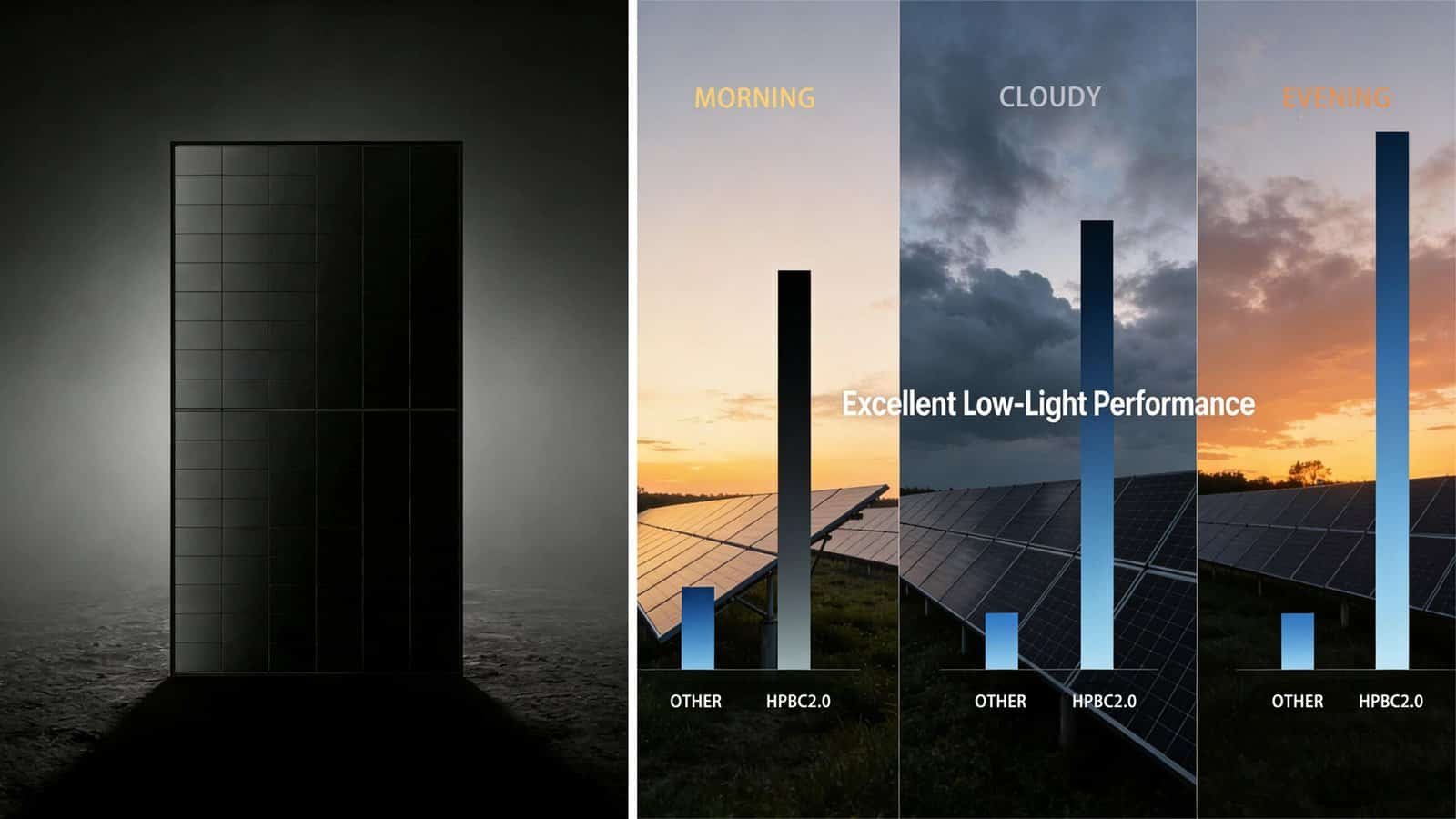
- All-black panels with BC cell technology are more efficient than standard panels — not less. Up to 25% module efficiency for ABC Gen 3.
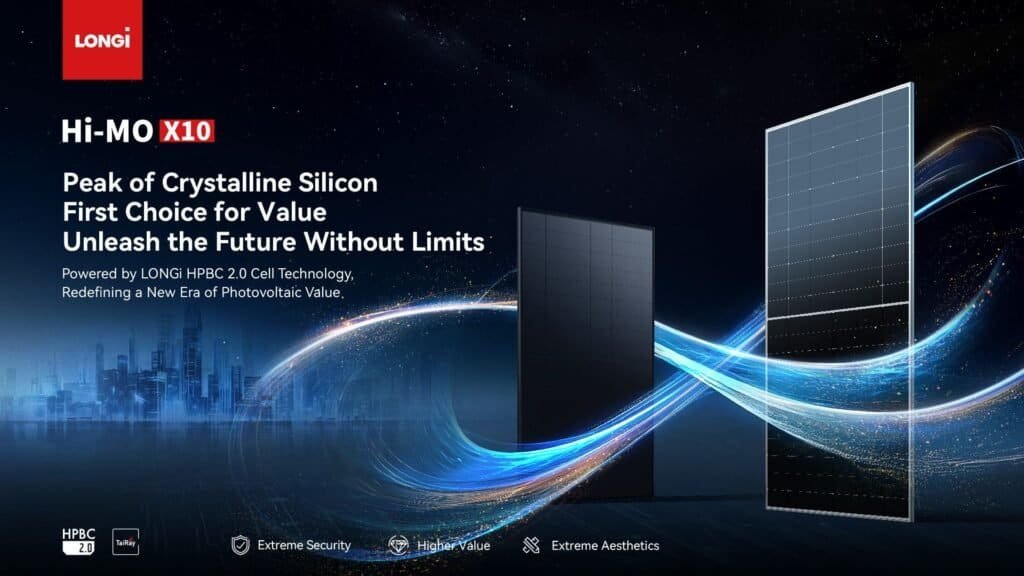
- LONGi’s dedicated all-black residential module (EcoLife series, launched June 2025) achieves 24.0–24.7% in 54-cell format. The C&I Hi-MO X10 (670W, 24.8%) is a different, larger product.
- Both HPBC 2.0 and ABC Gen 3 deliver −0.26%/°C temperature coefficient and ≤0.35%/yr annual degradation.
- The EU EPBD Article 10 is already active in 2026: new large non-residential buildings over 1,000 m² must now optimise solar generation.
- The global BIPV market is projected to grow from $17.1B (2024) to $42B by 2029 at 19.7% CAGR (BCC Research, 2025).
- BC modules held over 50% market share in Switzerland’s residential market in 2025 — the EU’s leading BC adoption indicator.
Solar energy has come a long way. It is no longer just about saving money on electricity. Today, buyers want solar panels that work and look good. That is exactly why all-black solar panels are taking over rooftops across Europe and North America — and why demand for back-contact (BC) technology is accelerating fast.
This guide covers everything you need to know: what makes a panel truly “all-black,” why aesthetics matter, how BIPV is changing construction, what to look for when you buy, and how to find a reliable supplier — even if your order is small.
What Makes a Solar Panel “All-Black”?
Not every dark-colored solar panel qualifies. A genuine all-black module requires three components working together:
- Black solar cells — monocrystalline, with a dark surface that absorbs light efficiently
- Black backsheet or rear glass — replaces the standard white backsheet for a uniform look
- Black anodized aluminum frame — eliminates the silver border that disrupts roofline harmony
Standard solar panels have silver frames, white backsheets, and metallic busbars running across the cell surface. They get the job done. But they create a high-contrast, industrial appearance that clashes with most residential architecture.
All-black panels solve this completely. The result is a seamless, deep-black surface that sits quietly on the roof. No glare. No silver lines. Just a clean, low-profile look.
Quick Comparison: All-Black BC Module vs Standard Panel
| Feature | All-Black BC Module | Standard Panel (TOPCon) |
|---|---|---|
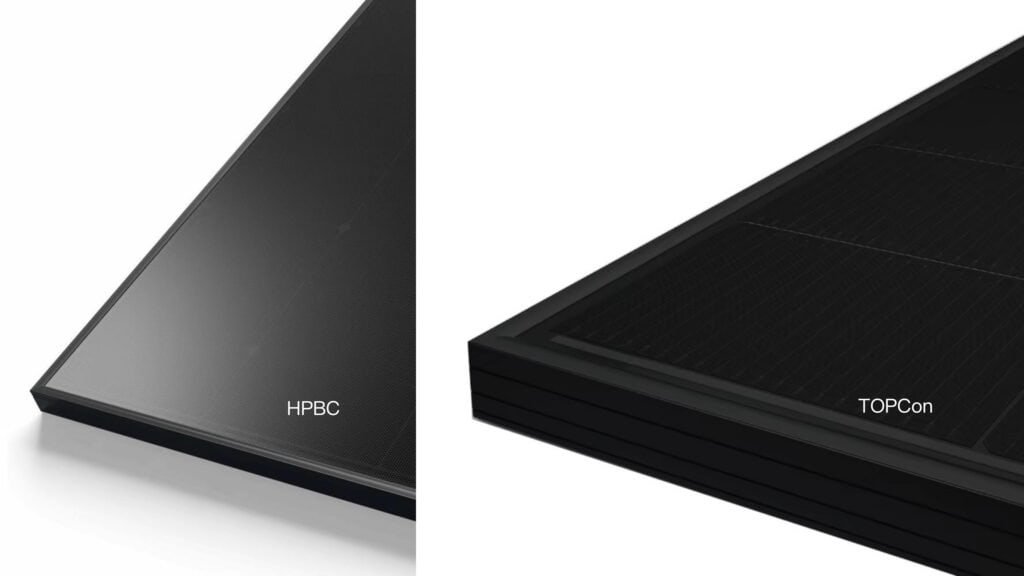
| Front appearance | Seamless black, zero busbars | Silver busbars + gridlines visible |
| Module efficiency | 24.0–25.0% (HPBC 2.0 / ABC Gen 3) | Typically 21–22% |
| Temperature coefficient | −0.26%/°C | −0.29%/°C (typical) |
| Annual degradation | ≤0.35%/yr[2] | ~0.40%/yr (IEC warranty standard)[11] |
| Bifaciality factor | ~70% (where available); most residential formats monofacial | ~85–90% (bifacial TOPCon) |
| BIPV suitability | Excellent — planning-approved | Poor — aesthetic rejection risk |
| HOA / heritage approval | Straightforward | Often challenged |
| Partial shading tolerance | Superior (soft-breakdown cell) | Standard |
| Snow shedding (cold climates) | Faster warm-up, faster shed | Slower |
Note on bifaciality: All-black BC modules are typically monofacial or carry a ~70% bifaciality factor — lower than bifacial TOPCon (~85–90%). For installations where rear-side irradiance matters (white membrane flat roofs, elevated ground mounts), verify the specific product datasheet before specifying.
Why Solar Panel Aesthetics Directly Affect Project Approvals and Property Value
Curb appeal has real financial value. This is not a soft preference — it affects whether a project gets approved, whether a property sells, and whether an HOA signs off.
- HOAs in many U.S. neighborhoods actively prefer or require low-visibility solar installations
- European architects designing near heritage sites face planning restrictions on rack-mounted panels
- Buyers in premium real estate markets apply a visible premium to homes with integrated-looking solar systems
All-black solar panels blend with dark asphalt shingles, metal roofing, and slate tiles better than any other module type. On an urban roofline, they are nearly invisible.
There is also a practical cold-climate advantage. Black surfaces absorb more solar radiation than lighter surfaces. All-black panels warm up faster when sunlight appears. On a winter morning after light snowfall, that faster surface warming helps shed snow and recover output more quickly than a standard white-backsheet module. This is established thermodynamic physics, not a marketing claim.
Back-Contact Technology: Why All-Black Panels Are Also More Efficient
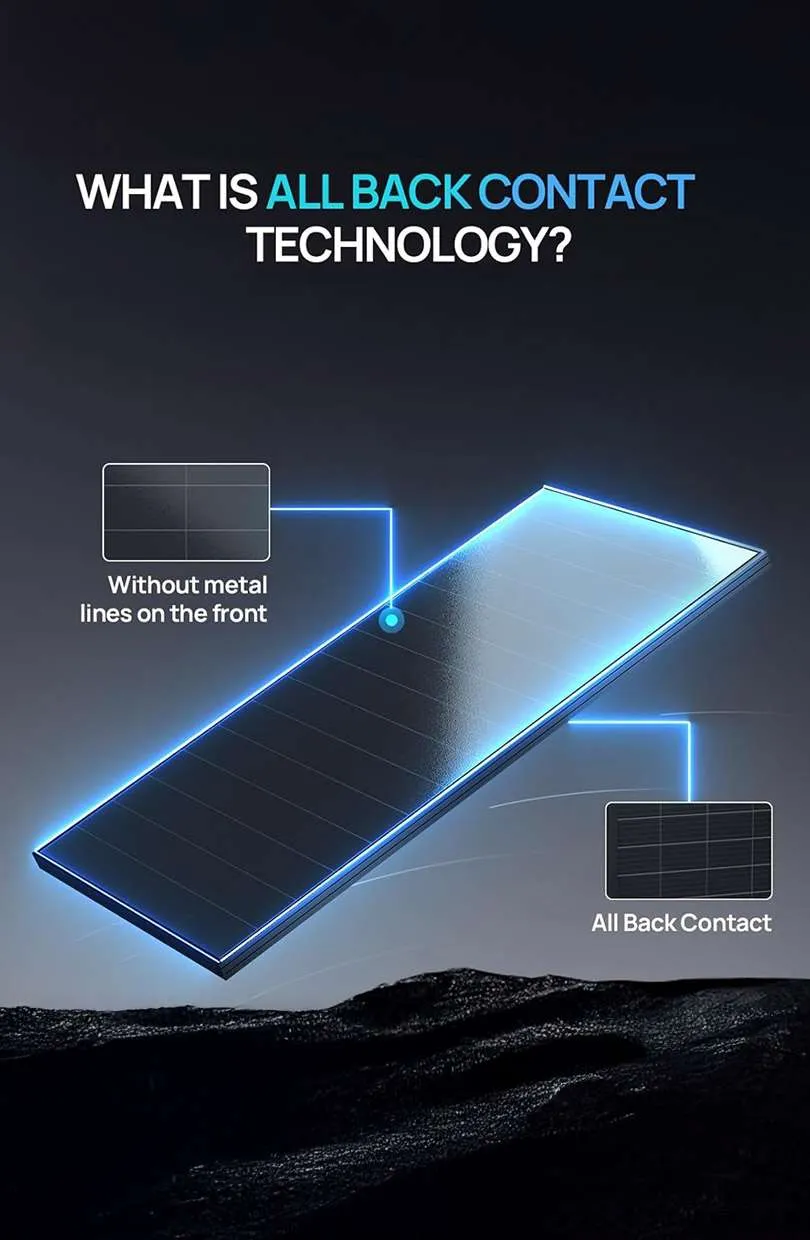
In a standard panel, metal gridlines run across the front surface to collect electrical current. They work — but they also block incoming light. That shading loss is a structural limitation of all front-contact designs, including PERC and TOPCon.[1]
Back-contact technology solves this. All electrical connections move to the rear of the cell. The front surface is completely clear. More light enters. More electricity is generated. The result is a genuinely all-black front face with no visible gridlines — not a cosmetic workaround, but a fundamental efficiency architecture.
HPBC 2.0 vs ABC Gen 3: Which BC Technology for Your Application?
HPBC 2.0 (LONGi) vs ABC Gen 3 (Aiko Solar) — Verified Specifications
| Specification | HPBC 2.0 — LONGi Hi-MO X10 | ABC Gen 3 — Aiko Infinite / Neostar |
|---|---|---|
| Cell architecture | Hybrid passivated back contact | All back contact (true IBC) |
| C&I module efficiency | 24.8% (72-cell, 670W)[2] | Up to 25.0% (Infinite C&I)[3] |
| Full-black residential efficiency | 24.0–24.7% (EcoLife Artist, 54-cell)[13] | Up to 25.0% (Neostar residential)[3] |
| Temperature coefficient | −0.26%/°C[2] | −0.26%/°C[4] |
| Annual degradation | ≤0.35%/yr | ≤0.35%/yr |
| Front surface | 0BB (zero busbar) | 0BB (zero busbar) |
| Shading loss reduction vs TOPCon† | Up to 70% less power loss[9] | Up to 30% more energy output[4] |
| Best fit | Large C&I rooftop, full-black residential | Premium residential, BIPV, compact rooftop |
| IEC certification | IEC 61215 / 61730[11] | IEC 61215 / 61730[11] |
† Shading metrics use different test conditions: HPBC 2.0’s 70% figure measures power loss reduction vs TOPCon under partial shading. ABC’s 30% figure measures energy output when a full cell is completely shaded (TÜV NORD validated). Both are genuine advantages but not directly comparable across test methods.
LONGi EcoLife Series — The Dedicated All-Black Residential BC Line: June 2025 Launched at Intersolar Munich 2025 and winner of the Smarter E Award 2025. The Hi-MO X10 Artist (EcoLife series) is LONGi’s consumer-facing all-black BC residential module: 54-cell, 480–505W, 24.0–24.7% efficiency depending on variant. The EcoLife Pro (Hi-MO S10 HIBC) goes further, combining HJT + BC technology for up to 25.0% efficiency and 510W. Separately, the Hi-MO X10 set a 25.4% module efficiency record on the NREL Champion Chart in October 2024 — making LONGi the first Chinese company to achieve a world module efficiency record since records began in 1988.[13]
Market signal: In 2025, Aiko Solar and LONGi together held more than 50% of the Swiss residential solar module market — up from near zero BC share in 2023, per the Photovoltaik Barometer 2026 (Bern University of Applied Sciences / Eturnity, March 2026).[5] LONGi targeted approximately 50 GW of HPBC 2.0 production capacity by end of 2025.[12] Supply at scale is confirmed.
BIPV Solar Panel Advantages: When the Panel Becomes the Building
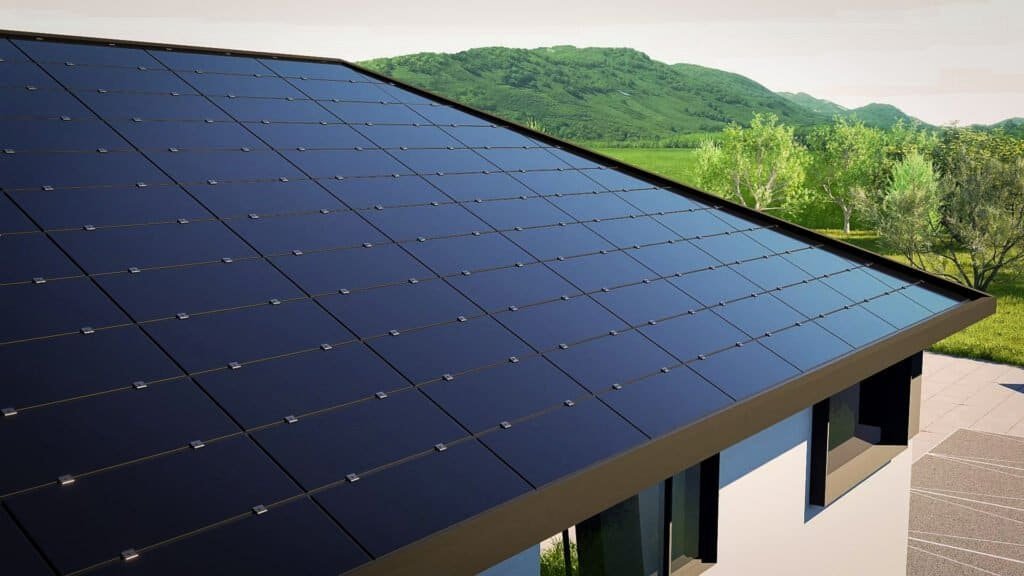
Building-Integrated Photovoltaics (BIPV) takes the “invisible solar” concept to its logical conclusion. Instead of mounting panels on top of a roof or wall, BIPV modules replace the building material itself.[6]
Think solar roof tiles instead of clay tiles. Glass facades that generate power. Skylights that are also solar panels. Curtain walls that double as energy generators.
All-black BC modules are the natural fit for BIPV. Their clean front surfaces match architectural materials without color inconsistency. There are no visible gridlines, no silver reflections, no visual mismatch with adjacent building elements. In applications requiring architectural review or planning approval, BC’s busbar-free front surface is often a formal qualification requirement.
The EPBD Mandate Is Already Active — BIPV Is the Compliance Path
The EU’s revised Energy Performance of Buildings Directive (EPBD, EU 2024/1275), which entered into force in May 2024, establishes a progressive solar mandate:[7]
- From 2026 (now active): New large public and non-residential buildings over 1,000 m² must be designed to optimise solar energy generation potential
- From 2027: Solar requirements extend to all new non-residential buildings over 250 m² and to existing non-residential buildings undergoing major renovation
- From 2028: New public-authority residential buildings must comply
- From 2030: All new residential buildings must meet solar requirements
This staggered timeline creates a compounding, decade-long demand wave. Where planning constraints prevent conventional rack-mounted arrays — listed buildings, heritage districts, dense urban cores — BIPV is the only compliant path. Planning authorities across the UK, France, and Germany routinely refuse rack-mounted systems on listed buildings. BIPV resolves this without compromise.
According to BCC Research, the global BIPV market is projected to grow from $17.1 billion in 2024 to $42 billion by 2029, at a compound annual growth rate of 19.7%.[8] Note: market size estimates vary across research providers (from $12B to $25B as a 2024 base) depending on whether building-applied PV and utility-scale projects are included — BCC Research’s methodology focuses on commercially deployed BIPV in construction and renovation only. Regardless of definition, the growth trajectory is unambiguous.
Key BIPV Applications for All-Black BC Modules
| Application | What It Replaces | Best Panel Type |
|---|---|---|
| Solar roof tiles | Clay, concrete, or slate tiles | All-black BC modules (e.g. LONGi EcoLife, Aiko Neostar) |
| Facade cladding | Traditional curtain wall panels | Frameless or custom glass BC |
| Skylights and canopies | Standard glazing | Semi-transparent BC glass |
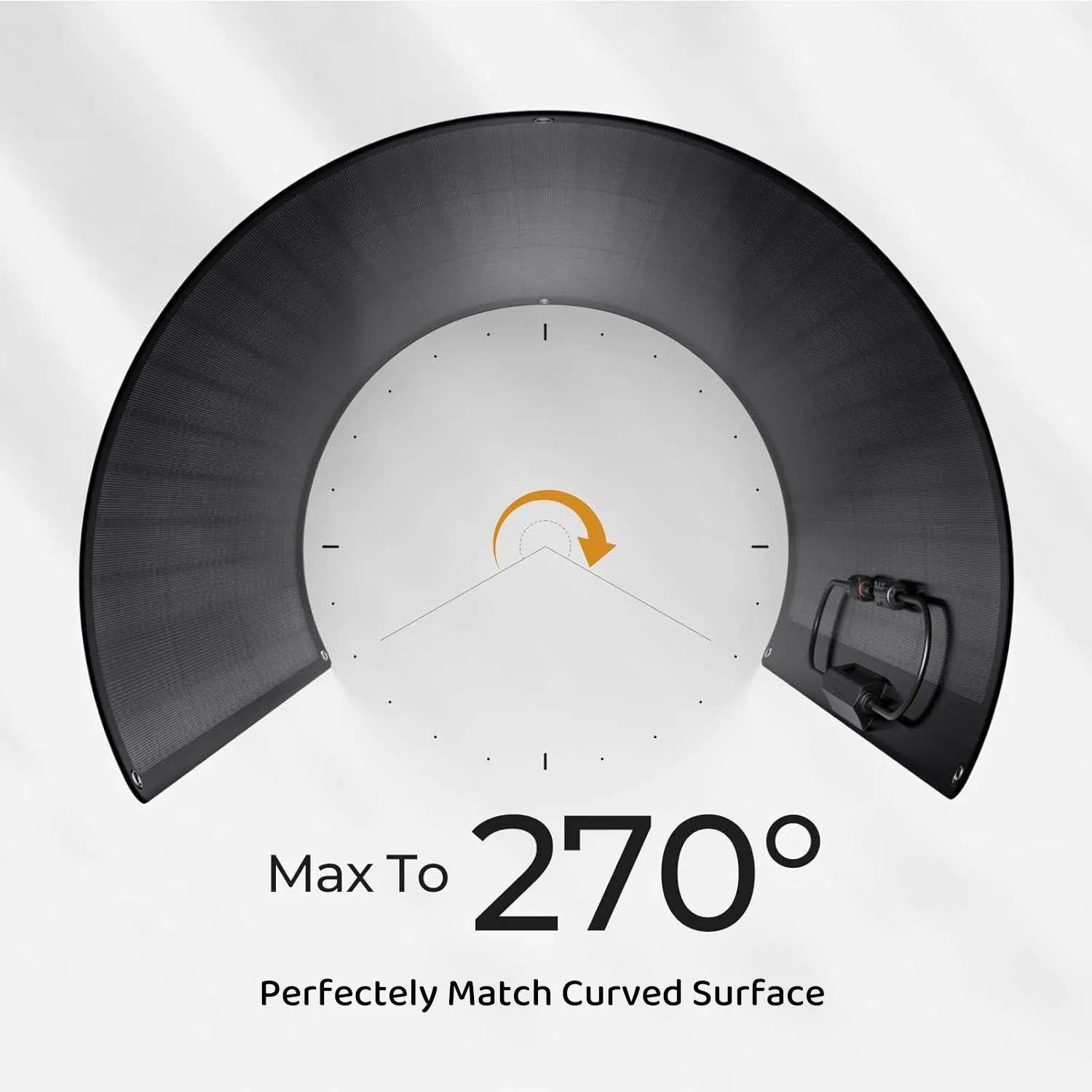
| Commercial flat roofs | Standard membrane | Flush-integrated flexible panels |
Planning a BIPV project or building EU market inventory ahead of the 2027 non-residential deadline? Couleenergy supplies non-standard all-black BC modules — including BIPV and custom formats — with OEM options from 100 units. Email info@couleenergy.com or call +1 737 702 0119 for a specification sheet and sample request.
Who Benefits from All-Black BC Solar Panels?
Solar Installers & EPC Contractors
Pain: HOA rejections, aesthetic complaints, shade-related performance disputes.
All-black BC passes HOA review faster. BC’s soft-breakdown architecture reduces partial-shading disputes on urban rooftops. Higher-margin projects in design-sensitive neighborhoods where standard silver-frame systems lose bids.
Distributors & Wholesalers
Pain: Differentiating in a commoditized market where standard TOPCon races to the lowest price.
BC is the fastest-growing premium segment in EU residential. Switzerland’s 2025 BC majority is a leading indicator. EPBD-driven demand creates forward inventory visibility. Small MOQ allows range testing before volume commitment.
Architects & Property Developers
Pain: Planning authorities reject rack-mounted panels on design-sensitive or listed buildings.
All-black BC BIPV replaces — not adds to — building materials. The EPBD 2027 non-residential mandate creates compliance urgency. Roof tile and facade formats satisfy energy and planning requirements simultaneously.
OEM Brands & Private Label
Pain: Technology commodity perception erodes brand differentiation.
BC delivers verifiable spec advantages (−0.26%/°C, ≤0.35%/yr, 0BB) that support credible warranty claims. IEC-certified manufacturers with traceable cell supply chains available for custom configurations from 100 units.
Rooftop Solar Installation Design Options for All-Black Panels
Flush On-Roof Mounting is the most common residential choice. Panels attach to rails fixed parallel to the roof pitch. With all-black panels and matching black anodized racking, this creates a clean, integrated appearance best for pitched roofs with asphalt, tile, or metal surfaces.
Flat Roof Ballast Systems use angled frames weighted without drilling through the membrane. Common on commercial flat roofs. The panels are more visible from ground level — making the all-black aesthetic even more important here. Note that a white or highly reflective membrane can improve rear-side irradiance for bifacial configurations.
BIPV Integration replaces the roofing material entirely. Best for new construction or major renovation where replacing the roof is already in scope. The economics calculate differently because you are displacing the cost of conventional roofing materials you would have purchased regardless.
Facade and Curtain Wall BIPV brings solar to vertical surfaces. South-facing commercial facades in dense urban settings are often the only available solar surface. All-black BC modules satisfy the architectural standards these applications require.
Installation Details That Protect the All-Black Aesthetic
- Black anodized mounting rails and end caps — silver racking undermines the effect immediately; black hardware is a modest upgrade with major visual impact
- Clean cable management — route wiring under panels or through conduit; visible cable runs break visual coherence
- Shade-aware layout — BC panels handle partial shading far better than standard designs due to their soft-breakdown cell architecture, which contains shading loss to the affected area rather than pulling down the entire string[9]
Buy All-Black Solar Panels: What to Look for Before You Order
Quality Indicators for All-Black BC Modules
Cell technology: HPBC 2.0 and ABC/IBC cells deliver the zero-busbar front surface that genuine all-black requires. TOPCon can produce a dark appearance too, but front-side busbars remain visible under certain light angles — a meaningful difference in design-sensitive or BIPV applications.
Encapsulant choice: Premium all-black modules use POE (polyolefin elastomer) encapsulant film. POE provides strong resistance to moisture ingress and potential-induced degradation (PID)[10] — critical for coastal and high-humidity climates. It outperforms older EVA encapsulants in demanding environments.
Double-glass vs glass-foil: Many premium BC modules offer both dual-glass and glass-foil configurations. Dual-glass adds mechanical durability and eliminates backsheet degradation but increases weight. Glass-foil (single glass) is lighter and typically preferred for residential pitches where load limits apply. The LONGi EcoLife Artist standard version is glass-foil; bifacial EcoLife variants use dual glass.
Certifications: IEC 61215 and IEC 61730 are the non-negotiable baseline.[11] Additionally require MCS (UK), CEC (Australia), or EU-specific certifications for relevant markets. Request the actual certificate document with the specific module model name and certificate number — not just a verbal claim.
Bifaciality consideration: Most all-black residential BC modules are monofacial or ~70% bifacial. If rear-side irradiance is relevant to your project (white roof membrane, elevated mount), confirm bifaciality in the datasheet before specifying.
Small MOQ Back-Contact Solar Panel Orders: What Is Realistic
Many buyers assume large minimum order quantities (MOQs) are unavoidable with Chinese manufacturers. That is not always the case.
Several BC manufacturers accept orders from as low as one pallet — for in-stock all-black configurations. This is sufficient for a residential project or for sampling a product line before committing to volume. Custom power ratings and OEM branding require larger volumes, but are available from manufacturers specialising in small-batch production.
For BIPV custom panels — specific dimensions, transparency levels, or frameless glass — work with manufacturers who have dedicated BIPV product lines and verifiable project references, not general-purpose factories claiming BIPV capability without evidence.
Seven Questions to Ask Before Placing a Back-Contact Solar Panel Order
- What cell technology is used, and which specific cell supplier provides them?
- Can you provide the IEC certificate number, module model name, and issuing lab for your IEC 61215 and IEC 61730 certifications?
- What annual degradation rate is guaranteed in the binding warranty document?
- Can you provide third-party test reports from an IEC-accredited independent lab?
- What is the lead time from order confirmation to shipment, and which Incoterms apply?
- Do you offer OEM labeling, and what is the minimum volume for branded orders?
- Can you provide references from EU or North American customers who have received shipments?
A manufacturer who answers these questions clearly — without deflecting — is worth pursuing. Vagueness on cell sourcing or inability to produce accredited third-party test data is a risk, regardless of the quoted price.
Frequently Asked Questions
Are all-black solar panels less efficient than standard panels?
No — when all-black design is paired with back-contact cell technology, the opposite is true. HPBC 2.0 achieves up to 24.8% (C&I) or 24.0–24.7% (full-black residential EcoLife format). Aiko ABC Gen 3 reaches up to 25.0%. Standard TOPCon typically delivers 21–22% module efficiency. The zero-busbar front surface eliminates gridline shading, turning an aesthetic feature into a genuine efficiency advantage.[1][2][3]
What is the difference between HPBC 2.0 and ABC (IBC) technology?
Both are back-contact architectures with clean, busbar-free front surfaces. HPBC 2.0 (LONGi) uses a hybrid passivated BC structure optimised for large-format C&I applications (up to 670W). Its dedicated all-black residential format is the EcoLife Artist / Hi-MO X10 54-cell series (480–505W). ABC/IBC (Aiko Solar) uses a true all-back-contact design reaching 25% module efficiency, available in both C&I (Infinite) and residential (Neostar) formats.[2][3][13]
Are all-black BC panels bifacial?
Most all-black residential BC modules are monofacial (single glass with opaque backsheet). Where bifacial versions exist (e.g. LONGi EcoLife dual-glass), the bifaciality factor is approximately 70%, compared to ~85–90% for standard bifacial TOPCon. For rooftop residential installations, this has minimal practical impact — rear-side irradiance on pitched roofs is typically low. For flat roofs with reflective white membranes, verify the specific bifaciality factor in the datasheet before specifying.
Do all-black solar panels qualify for BIPV applications?
Yes — they are the preferred specification for BIPV. The clean, busbar-free front surface matches architectural materials without the color inconsistency or visible metallic lines that cause planning rejections on design-sensitive buildings. Frameless all-black BC glass modules are available for facade and skylight applications.[6]
Can I order all-black BC solar panels with a small MOQ from a Chinese manufacturer?
Yes. Several IEC-certified BC module manufacturers accept orders from as few as one pallet for standard in-stock all-black configurations. Custom OEM and BIPV formats require larger volumes. For standard residential all-black BC panels, small MOQ sourcing from Zhejiang and Jiangsu is practical. Contact Couleenergy directly for current availability and lead times.
How does the EU EPBD affect demand for all-black and BIPV solar panels?
The EPBD Article 10 solar mandate is already active in 2026. New large non-residential buildings over 1,000 m² must now be designed to optimise solar generation. From 2027, this extends to all new non-residential buildings over 250 m². From 2030, all new residential buildings must comply.[7] Where planning constraints rule out rack-mounted systems — listed buildings, heritage districts — all-black BC BIPV is the only viable compliance path. This creates a compounding, multi-year demand wave that is already underway.
Couleenergy · Ningbo Coulee Tech Co., Ltd.
We manufacture HPBC 2.0 and Aiko ABC Gen 3 all-black modules for distributors, installers, EPC contractors, and OEM brands across Europe and North America, especailly for non-standard designs and solutions.
OEM from 100 Units
Custom branding, custom power ratings, and private label with traceable BC cell supply chain (LONGi HPBC 2.0 / Aiko ABC Gen 3).
BIPV & Custom Formats
Non-standard dimensions, frameless glass, custom wattage, ETFE flexible variants, and BIPV facade formats available with lead time.
Contact us for a specification sheet and quote:
- Email: info@couleenergy.com
- Phone / WhatsApp: +1 737 702 0119
- Website: couleenergy.com
We respond to all serious inquiries within one business day. References from EU and North American customers are available upon request.
Summary: Is All-Black BC Solar the Right Choice?
All-black back-contact solar panels make the most sense when:
- The installation is visible and curb appeal matters to the buyer or building owner
- The project is in a design-sensitive area — HOA communities, heritage zones, or urban districts with planning restrictions
- BIPV integration into roof, facade, or canopy is required or preferred
- High efficiency in a compact footprint is a priority (up to 25% vs 21–22% for standard TOPCon)
- The buyer needs the best available temperature performance (−0.26%/°C) in hot or high-irradiance climates
- Forward supply chain positioning ahead of EPBD-driven demand is commercially important
They carry a modest premium over standard panels. That premium is justified by measurable advantages in efficiency, aesthetics, degradation performance, and durability — and by a regulatory environment that is actively mandating this type of integration across the EU’s new building stock.
The technology is verified by primary manufacturer sources, independent test labs, and market data. The question that remains is whether your supplier can deliver what they promise — and that is where business license verification, IEC certificate confirmation, and asking the right questions makes all the difference.
Footnotes & Sources
- Back-contact (BC) solar cells relocate all electrical contacts to the cell rear, eliminating front-side gridline shading losses — a structural limitation of PERC, TOPCon, and all conventional front-contact designs. The IBC architecture has achieved the highest silicon wafer-based solar cell efficiencies recorded to date.pv-manufacturing.org — All Back-Contact Solar Cells
- LONGi Hi-MO X10 (HPBC 2.0) standard C&I specs: 670W, 24.8% module efficiency, 26.6% cell efficiency, −0.26%/°C temperature coefficient, 0BB structure, ≤1% first-year degradation, ≤0.35%/yr linear degradation, 30-year power warranty. European availability from Q1 2025.LONGi — Hi-MO X10 Introduction Europe (Official)
- Aiko Solar Gen 3 ABC Infinite 500 W (C&I): 25% module efficiency, −0.26%/°C, 1,762×1,134 mm. Confirmed at Solar Solutions Amsterdam, March 12, 2025. Aiko Neostar residential series: up to 25% efficiency. ABC Gen 3 Comet 3N: 24.8% in mass production (confirmed TÜV Nord, December 2025).pv-magazine — Aiko 500 W C&I BC Module, 25% Efficiency (March 2025)
- Aiko ABC Gen 3 temperature coefficient: −0.26%/°C vs. standard TOPCon −0.29%/°C — a verified 0.03%/°C improvement. ABC delivers up to 30% more energy output vs TOPCon when a complete cell is fully shaded (TÜV NORD validated test condition). HPBC 2.0’s 70% shading loss reduction uses a different measurement basis (differential power loss under partial shading).TaiyangNews — AIKO’s ABC Module: Making the Most of Each Electron
- Photovoltaik Barometer 2026 (Eturnity / Bern University of Applied Sciences, March 2026): Aiko Solar and LONGi together held >50% combined share of the Swiss residential solar module market in 2025, with Aiko holding a slightly larger share. Up from near zero BC presence in 2023.pv-magazine — Is Switzerland Going Back Contact? (March 16, 2026)
- BIPV defined by IEA PVPS Task 15 as PV materials integrated into the building envelope — roof, facade, glazing, canopy — to simultaneously generate electricity and serve as building skin, replacing conventional construction materials.IEA PVPS Task 15 — Building Integrated Photovoltaics
- EPBD recast (EU 2024/1275) entered into force 28 May 2024. Article 10 mandates progressive solar installation: 2026 (new non-residential >1,000 m²); 2027 (new non-residential >250 m², major renovation of existing); 2028 (new public-authority residential); 2030 (all new residential).EUR-Lex — EPBD Summary (EU 2024/1275)
- BCC Research (June 2025): BIPV market projected to grow from $17.1 billion in 2024 to $42.0 billion by 2029 at 19.7% CAGR. Note: market size estimates vary widely across research providers ($12B–$25B as a 2024 base) due to differing scope definitions (BIPV vs. BAPV; utility-scale inclusion or exclusion). BCC Research’s methodology covers commercially deployed BIPV in construction and renovation, excluding utility-scale power grid projects.GlobeNewswire — BCC Research: BIPV CAGR 19.7% (June 2025)
- LONGi HPBC 2.0 shading data: Hi-MO X10 reduces shading power loss by up to 70% vs standard TOPCon under partial shading via soft-breakdown cell architecture. “In Germany, where solar systems are predominantly installed on rooftops, the shading optimizer technology reduces power loss by over 70%” (LONGi DACH Regional Manager, longi.com). Independently corroborated by Trinasolar/Nanchang University peer-reviewed partial-shading study (pv-magazine, August 2025).LONGi — Hi-MO X10 DACH Launch (Shading Performance Data)
- PID (Potential-Induced Degradation): IEC TS 62804-1 defines the standard test methodology. POE (polyolefin elastomer) encapsulant has significantly higher volume resistivity than EVA, substantially reducing PID susceptibility in high-voltage and high-humidity installations.IEC TS 62804-1 — PID Test Methods for PV Modules
- IEC 61215 (design qualification and type approval) and IEC 61730 (safety qualification) are the foundational IEC standards required for CE marking in the EU and for market entry in North America and Australia. Standard TOPCon module warranty degradation benchmark: ≤0.40%/yr (IEC 61215 performance durability framework).IEC TC82 — Solar PV Energy Systems Standards Portal
- LONGi targeted approximately 50 GW of HPBC 2.0 production capacity by end of 2025 — confirmed across multiple EU regional launch announcements. LONGi’s Hi-MO X10 also set a 25.4% module efficiency record on the NREL Champion Photovoltaic Module Efficiency Chart in October 2024, making LONGi the first Chinese company to achieve a world module efficiency record since records began in 1988.LONGi — Hi-MO X10 EU Launch (50 GW Capacity + Production Specs)
- LONGi Hi-MO X10 Artist (EcoLife series), launched Intersolar Munich, June 2025. Winner of Smarter E Award 2025. Full-black residential all-black HPBC 2.0 module: 54-cell, 480–505W, 24.0–24.7% efficiency (monofacial and bifacial variants). EcoLife Pro (Hi-MO S10, HIBC/HJT+BC technology): up to 510W, 25.0% efficiency. Designed specifically for consumer-facing all-black residential applications.LONGi EU Blog — Hi-MO X10 Artist Full-Black Residential Module

 English
  Español
  Français
  Deutsch
  Русский
  العربية