
The commercial case for flexible solar panels is routinely oversimplified. Most product pages lead with weight savings and stop there. The question that determines whether a flexible panel installation succeeds over a 10–15 year horizon is not how light the panel is. It is what it is made of, how the cells are configured, whether the structure withstands cyclic mechanical stress in the target environment, and whether the supplier’s certification documentation is verifiable. This guide covers all of these.
Technology Baseline: What Separates Commercial-Grade From Consumer-Grade Flexible Panels
The term “flexible solar panel” covers at least three distinct technology categories — CIGS thin-film, front-contact PERC/TOPCon on polymer substrate, and back-contact (BC) monocrystalline on polymer substrate — with materially different performance, durability, and cost profiles over a 10-year service horizon. Understanding the difference is the first prerequisite for commercial procurement.
Back-contact (BC) cell architecture: why it matters for mechanical cycling
Standard flexible panels use front-contact cell designs — typically PERC or multi-busbar — where busbars and solder interconnects run across the light-facing surface. Under repeated flex cycles (installation movement, thermal expansion, wind-induced surface deflection), those front-side contacts experience cyclic tensile and compressive stress. Micro-crack formation at front-contact solder points is the primary degradation mechanism in flexible panels subjected to mechanical cycling — and it accelerates with each flex event.
Back-contact (BC) cells place all electrical contacts on the rear surface. The front face is entirely active silicon — no busbar shading, no front-side solder joints to crack. BC architecture delivers two compounding advantages: up to 22.5% module efficiency (vs. 18–20% for typical flexible PERC modules) and significantly better mechanical fatigue resistance. For marine, transport, UAV, and BIPV applications, BC architecture is not a premium option — it is the technically correct specification.
Specifier note: Confirm cell type in writing — BC monocrystalline, front-contact PERC, or CIGS thin-film. All three are sold under the label “flexible solar panel.” Indicative module efficiency by type: CIGS 14–17%; front-contact PERC flexible 18–22%; BC monocrystalline flexible up to 22.5%. Suppliers quoting cell efficiency instead of module efficiency should be asked to clarify the distinction in writing.
ETFE vs. PET front sheet: the single most important longevity decision
Two front sheet materials dominate the flexible panel market. This specification decision affects outdoor longevity more than almost any other variable — and it cannot be determined by visual inspection. Note: the cost premium below refers to ETFE vs. PET on flexible modules of the same cell type. The overall cost premium of flexible panels relative to rigid panels is substantially higher (see pricing note in the TCO section below).
| Property | ETFE (Ethylene Tetrafluoroethylene) | PET (Polyethylene Terephthalate) |
|---|---|---|
| UV transmittance | >95% stable across solar spectrum for 20+ years | Adequate at installation; degrades under prolonged UV |
| UV yellowing | No measurable yellowing in 20+ year field data | Visible yellowing at 3–5 years; measurable output loss from year 3 |
| Operating temperature | −200°C to +150°C; no embrittlement | Embrittles below −20°C; limited performance in Nordic climates |
| Hydrolysis / salt resistance | Chemically inert; suitable for marine and coastal | Hydrolyses in humid and saline environments over time |
| Flexibility retention after cycling | Retains flexibility after thermal cycling | Increases brittleness after repeated freeze-thaw cycles |
| Cost premium vs. PET (same cell type) | 15–25% additional at module level | — |
| Appropriate outdoor service life | 10–20+ years in outdoor applications | Indoor or <5-year service life only |
For any outdoor installation with a service life exceeding five years — which includes all seven applications in this guide — ETFE is the correct specification. The module-level premium is recovered within 2–3 years through avoided output degradation from UV yellowing alone.
Sourcing check: Request front sheet material specification in writing on the product datasheet. “ETFE laminated” must be explicitly stated. “Flexible,” “polymer front sheet,” or “TPT/TPE encapsulated” are not equivalent. ETFE and PET are visually indistinguishable at delivery inspection.
Flexible vs. rigid: engineering comparison for commercial procurement
| Factor | Flexible — BC / ETFE (Couleenergy) | Rigid — Mono PERC / Tempered Glass |
|---|---|---|
| Weight | ✅ ~3.5 kg/m² | 11–15 kg/m² |
| Thickness | ✅ ~3.3 mm | 35–40 mm |
| Bend capability | ✅ Up to 240° | None — glass fractures under flex |
| Front sheet | ✅ ETFE — 20+ yr UV stability, marine-grade | Tempered glass — UV stable; heavy |
| Module efficiency | Up to 22.5% (BC mono) | ✅ Up to 23%+ (TOPCon/HJT) |
| Power-to-weight ratio | ✅ ~64 W/kg (22.5% ÷ 3.5 kg/m²) | ~15–18 W/kg |
| Install method | ✅ Adhesive bond — no racking or penetrations | Racking + ballast or roof penetrations required |
| Permanent structural load | ✅ ~0.035 kN/m² | ~0.15–0.20 kN/m² (with racking) |
| EU vehicle type-approval | ✅ Typically “minor modification” | Often requires structural re-certification |
| Service lifespan | 10–15 years (BC / ETFE) | ✅ 25–30 years |
| Right choice when | ✅ Curved, weight-critical, or structurally constrained | Flat, structurally sound rooftop or ground mount |
✅ All Couleenergy flexible solar panels are manufactured to meet or exceed international quality, performance, and safety standards for EU and North American market access.
When flexible panels are NOT the right choice
⚠️ Choose rigid panels instead when
- The installation surface is flat, structurally sound, and load-bearing — rigid panels deliver ~4× lower module cost per watt and longer warranted lifespan
- Required service life exceeds 20 years — rigid panels with 25–30 year performance warranties provide better levelised cost
- Module efficiency above 22.5% is required — premium TOPCon and HJT rigid solar panels currently lead at around 24%
- Project green finance frameworks require performance warranties longer than 15 years — most flexible panel manufacturers do not currently offer these
- Large ground-mount or utility-scale project — cost per watt dominates; installation geometry is not a constraint
10-year total cost of ownership: flexible vs. rigid on a constrained industrial rooftop (100 kWp)
The ~4× module cost premium for flexible panels over rigid (€0.40/Wp vs. €0.10/Wp) is the most-cited objection in procurement evaluation. The TCO comparison below shows when structural cost savings close and reverse that gap — and when they do not.
| Cost category | Rigid panels (with structural reinforcement) | Flexible BC / ETFE panels |
|---|---|---|
| Module cost (100 kWp at indicative $/Wp) | ✅ ~€10,000 (at ~€0.10/Wp) | ~€40,000 (at ~€0.40/Wp) |
| Structural engineering survey | €3,000–8,000 | ✅ Not required in most cases — €0 |
| Structural reinforcement works | €15,000–60,000 (where required) | ✅ €0 |
| Racking & mounting hardware | €6,000–12,000 | ✅ €800–1,500 (adhesive only) |
| Installation labour | €8,000–14,000 | ✅ €3,000–6,000 |
| Project possible without reinforcement? | ❌ No (on constrained roof) | ✅ Yes |
| Indicative 10-yr TCO — constrained roof | €42,000–104,000 | ✅ €43,800–47,500 |
Pricing note: Module price estimates are indicative for 2025–2026 commercial volumes. Rigid: standard mono PERC/TOPCon, ex-works landed EU, ~€0.10/Wp. Flexible BC/ETFE: premium commercial grade, ~€0.40/Wp. Installed system costs vary by location, contractor, and project complexity.
TCO crossover: Flexible solar panels have a TCO advantage on constrained rooftops when structural reinforcement costs exceed approximately €5,000–8,000. Where reinforcement is minimal or not required, the €30,000 module cost premium for flexible over rigid typically does not recover within a 10-year horizon — rigid panels remain the better economic choice.
APPLICATION 01
🌊 Marine & Boating: Solar That Fits the Hull
The actual failure mode of rigid marine solar installations
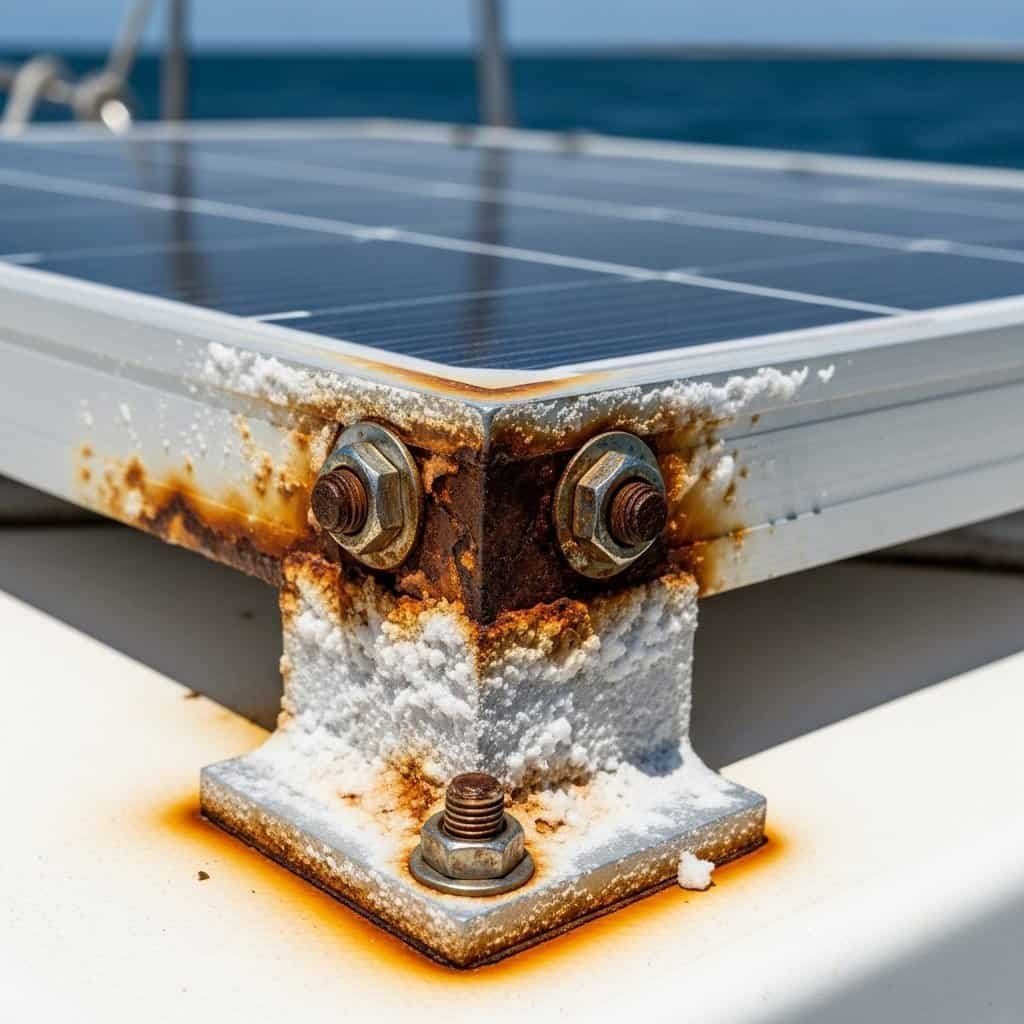
The leading failure mode of rigid solar on marine vessels is frame corrosion, not photovoltaic cell degradation. Aluminium alloy frames corrode at panel edges and mounting interface points in saltwater environments within 3–7 years, regardless of panel quality. The consequence is structural failure of the mounting system — creating safety hazards and requiring full panel removal and replacement.
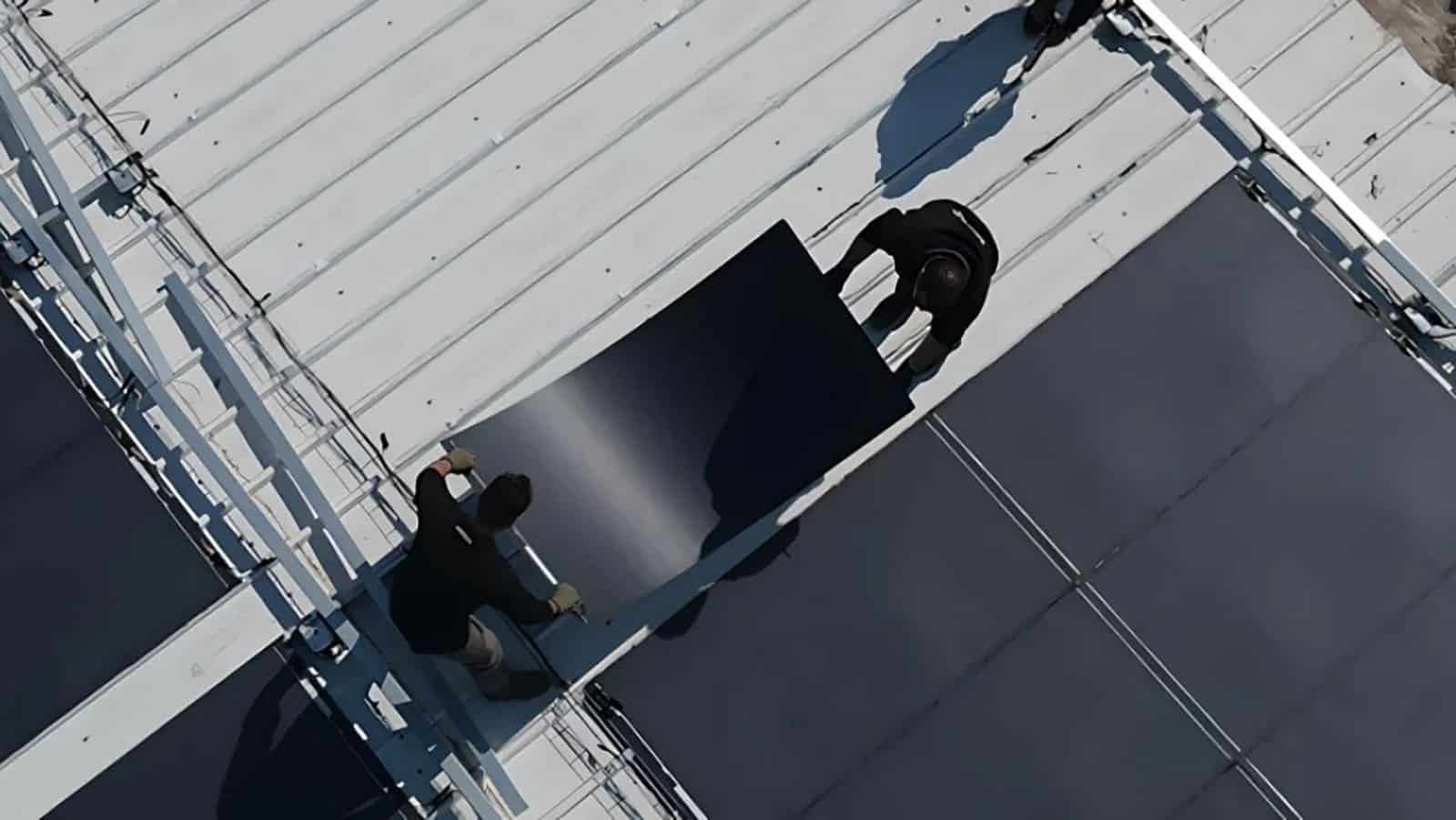
Flexible BC panels with ETFE front sheets eliminate the aluminium frame entirely. The panel bonds directly to deck or hull surfaces using marine-grade structural adhesive, forming a waterproof seal with no through-hull penetrations. With up to 240° bend radius, curved cabin tops, transom surfaces, and asymmetric deck sections that are geometrically inaccessible to rigid panels become viable solar area.
ROI calculation for commercial fleet operators
For commercial fleet operators — ferries, charter vessels, workboats, pilot boats — the primary ROI driver is generator displacement. In northern European waters (Norway to Netherlands: approximately 1,000–1,200 kWh/m²/year global horizontal irradiation), a 500W (0.5 kWp) flexible array at a specific yield of approximately 850 kWh/kWp/year generates roughly 430 kWh/year — approximately 1.2 kWh/day annual average, with substantially higher output during the active summer sailing season (2–3 kWh/day in June–August).
At a diesel generator efficiency of approximately 0.75 L/kWh, this annual output displaces approximately 320 litres of marine diesel per year per 500W array. At EU marine diesel prices (~€1.50–2.00/L), annual fuel cost avoidance is approximately €480–640 per 500W array, producing payback periods of 2–4 years on a modest adhesive-bonded installation — without structural modification to the vessel.
- 240° bend accommodates curved hulls, cabin tops, and asymmetric transom surfaces
- Frameless construction eliminates the aluminium corrosion failure mode entirely
- ETFE front sheet: chemically inert, IEC 61701-equivalent salt-spray resistant, UV-stable
- ~3.5 kg/m² — no measurable impact on vessel trim, GVW, or stability calculations
- EU FuelEU Maritime Regulation (effective January 2025) creates regulatory cost for diesel generator dependency on commercial vessels1
💼 B2B value: ~2–4 year payback on modest installations without structural modification. Lower total maintenance cost over vessel life. Alignment with FuelEU Maritime regulation. Product differentiation argument for premium marine OEM builds.
Procurement note: For marine applications, require documented salt spray resistance equivalent to IEC 61701 test protocol (specifically: salt mist test, Category C5-M equivalent). Request the specific test report and certificate reference — not a blanket “marine grade” claim — before finalising any order.
APPLICATION 02
🚐 RVs & Commercial Vehicles: Rooftop Solar Without the Racking
The regulatory constraint that makes rigid panels the wrong choice on vehicles
EU Directive 2018/858 on vehicle type approval governs what constitutes a “major modification” requiring re-certification. Modifications affecting structural integrity, gross vehicle weight (GVW), or aerodynamic profile require formal re-approval — a process costing €3,000–15,000 and 4–12 weeks. Adhesive-bonded flexible panels at ~3.5 kg/m² and ~3.3 mm thickness typically fall within the “minor modification” threshold for most vehicle classes, avoiding re-approval entirely.
Rigid solar panel installations require roof penetrations for mounting brackets, which void the manufacturer’s waterproofing warranties on commercial vehicle rooftops and affect resale value. A fleet of 100 vehicles with voided roof warranties represents a material liability that flexible adhesive installation avoids.
Fleet fuel savings: the arithmetic
A 400W (0.4 kWp) flexible array on a panel van in central Europe (Germany, Netherlands, Belgium: ~1,050–1,150 kWh/m²/year irradiation) at a realistic specific yield of ~850 kWh/kWp/year generates approximately 340 kWh/year — ~0.9–1.2 kWh/day annual average. At a diesel generator conversion efficiency of 0.75 L/kWh, this offsets approximately 255 litres of diesel per van per year, or roughly 0.5–0.8 generator-hours per day on average across the full year (higher in summer, lower in winter).
Scaled to a fleet of 50 vehicles over 220 operational days: the directly attributable generator displacement is approximately 5,000–8,000 litres of diesel per year. At EU diesel prices (~€1.50–1.80/L), this produces annual fleet fuel savings of approximately €7,500–14,400 — contractually quantifiable for fleet procurement justification.
- Bonds to curved rooflines — no racking, no roof penetrations, no aerodynamic penalty
- ~3.3 mm thickness — typically within EU “minor modification” type-approval threshold
- Preserves factory roof waterproofing warranty — material for fleet insurance and resale value
- ~5,000–8,000 L/year diesel saving at 50-vehicle fleet scale (based on ~850 kWh/kWp/yr specific yield)
💼 B2B value: Quantifiable fuel cost reduction, vehicle warranty preservation, Directive 2018/858 compliance without re-approval cost, and a premium eco-trim specification for OEM product lines targeting EU fleet operators.
APPLICATION 03
🏭 BIPV & Commercial Rooftops: Solar Where the Structure Said No
The Eurocode structural load constraint — and the numbers that matter
European industrial warehouse construction from 1970–2000 typically specifies imposed load allowances (outside snow and wind loads) of 0.25–0.50 kN/m² for maintenance access. A conventional rigid solar installation — panel, racking, fixings — at 15–20 kg/m² generates a permanent structural load of approximately 0.15–0.20 kN/m². After applying the Eurocode EN 1990 safety factor of 1.35 for permanent loads, this demand frequently approaches or exceeds the available structural reserve on pre-2000 industrial buildings. The result: structural reinforcement costing €15,000–60,000 for a typical 100 kWp installation, or project cancellation.
Flexible panels at ~3.5 kg/m² generate a permanent structural load of approximately 0.035 kN/m² — one-fifth of the equivalent rigid system. This is within the maintenance load reserve of virtually all European industrial rooftops without structural intervention, converting previously ineligible buildings into viable solar assets.
EU policy driver: EPBD 2024 and the EU Taxonomy Regulation
The EU’s recast Energy Performance of Buildings Directive (Directive (EU) 2024/1275, published in the Official Journal May 2024) introduces progressive solar-ready obligations on commercial buildings.2 Flexible panels are positioned to satisfy this requirement on the large proportion of existing EU commercial stock where rigid installation is structurally or economically impractical.
For institutional property owners (REITs, logistics park operators, cold storage networks) accessing green finance under the EU Taxonomy Regulation, BIPV installations that support a building’s energy performance improvement may contribute to “climate change mitigation” substantial contribution criteria — a consideration for procurement teams working with sustainability officers on compliance documentation.
Project benchmark: 150,000 m² and 21% above forecast
A flagship BIPV project in Shanghai’s G60 Science Corridor installed 150,000 m² of flexible BC panels across curved commercial rooftops and generated 21% above initial annual yield projections.3 Three contributing factors: curved surfaces self-orient across solar angles during the day (reducing installation-angle losses vs. fixed flat arrays), the thin adhesive-bonded configuration reduces cell operating temperature compared to air-gap racked systems, and elimination of inter-row shading losses inherent in rack-mounted arrays.
- ~0.035 kN/m² structural load — within imposed load reserve of most pre-2000 EU industrial rooftops without reinforcement
- No racking, ballast, or penetrations — no structural survey typically required
- 240° bend radius handles curved, barrel-vault, and corrugated commercial roof profiles
- Satisfies EPBD 2024 solar obligations on buildings where rigid installation is structurally impractical
- Eligible for EU Taxonomy Regulation sustainability documentation for institutional green finance
💼 B2B value: Converts structurally ineligible rooftops into productive solar assets. TCO advantage on constrained rooftops when reinforcement costs exceed €5,000–8,000 (see TCO table above). Aligns with EPBD 2024 and EU Taxonomy Regulation compliance requirements.
🏗️ Working on a BIPV, commercial rooftop, or marine project?
Request a Couleenergy product datasheet, free sample evaluation, or OEM pricing — typically returned within one business day.
APPLICATION 04
🚁 Aerospace & UAVs: When Every Gram Is a Business Decision
Power-to-weight ratio: the correct figure for commercial BC flexible modules
At 22.5% module efficiency and ~3.5 kg/m², Couleenergy BC flexible panels deliver approximately ~64 W/kg — roughly 3.5–4× better than commercial rigid glass panels (15–18 W/kg). This is the correct figure for production-grade BC flexible modules — significantly more conservative than laboratory research benchmarks (MIT’s December 2022 demonstration of ultra-thin fabric-integrated cells reported 18× more power per kilogram compared to conventional glass panels,4 a figure applicable to experimental cells operating under ideal lab conditions, not commercial modules). The ~64 W/kg ratio for commercial BC flexible panels is still the highest available in any production-grade solar module.
Fixed-wing UAV integration: engineering specifics
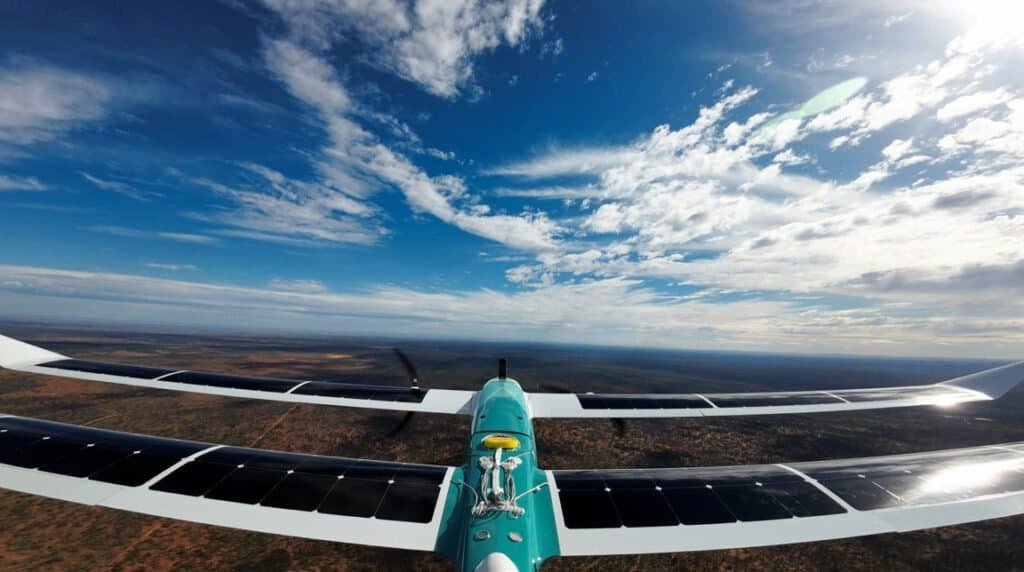
Fixed-wing endurance UAVs require conformal solar coverage on wing upper surfaces — cambered airfoil sections with chord widths of 0.3–1.5 m. At 3.3 mm thickness and 240° bend capability, flexible panels laminate directly onto wing skin without affecting aerodynamic profile. A fixed-wing UAV with 3 m² of usable wing area can integrate approximately 200–240W of solar capacity at a structural weight penalty of ~10.5 kg — within payload budgets for most commercial-class fixed-wing systems.
For commercial drone fleets running 500+ inspection missions per year, 25–40% extended flight endurance translates directly into fewer battery swaps, shorter recharge windows, and lower per-mission cost — a capital investment case, not a feature specification.
- ~64 W/kg power-to-weight — 3.5–4× better than rigid glass panels; highest available in production-grade solar modules
- 3.3 mm thickness laminates to wing skin without aerodynamic disruption
- 240° bend handles complex airframe curvature including cambered wing profiles
- Enables extended endurance applications physically impossible with rigid alternatives
💼 B2B value: Extended mission endurance, measurably lower per-mission cost at fleet scale, and hardware differentiation for commercial UAV platform developers targeting EU infrastructure inspection markets.
APPLICATION 05
🌿 Agrivoltaics & Greenhouses: Energy and Crops on the Same Land
The agronomic evidence base for EU installations
The Fraunhofer ISE APV-RESOLA research programme and subsequent replications in France and the Netherlands have established a consistent agronomic finding: partial panel shading reduces crop evapotranspiration on warm days, compensating for reduced direct irradiance — particularly for shade-tolerant crops including leafy vegetables, berry fruits, and herbs.5 Net annual yield under optimised configurations is neutral to marginally positive (+2–5%) for these crops, while electricity generation is fully additive to the land’s revenue profile. For cereal crops and sunflowers, partial shading causes proportional yield reduction — agrivoltaics requires elevated panel mounting (>4 m) or different crop selection for these species.
Tariff-supported EU agrivoltaic markets: Germany, Netherlands, France
EU agrivoltaic installed capacity has grown significantly since 2022, driven by specific policy support: Germany’s EEG 2023 includes tender provisions for agrivoltaics (Agri-PV Ausschreibungen), the Netherlands’ SDE++ programme has incorporated agrivoltaics categories, and France’s CRE tender framework includes agrivoltaics as an eligible technology.6 For distributors serving the agricultural sector, these three markets represent near-term volume demand backed by feed-in tariffs and project finance availability.
Flexible panels specifically suit EU agrivoltaic installations because rigid panels require concrete foundations that disrupt soil and constrain crop rotation. Flexible panels tension across existing HDPE polytunnel frames, drape over greenhouse profiles, or bond to shade netting infrastructure — without new foundations and within the load capacity of most existing agricultural support structures.
- Tensionable over existing greenhouse and polytunnel frames — no new foundations required
- Semi-transparent options allow partial light transmission to crops below
- ~3.5 kg/m² within load rating of standard EU agricultural support structures
- Eligible for Agri-PV tender support under EEG 2023 (DE), SDE++ (NL), and CRE tender (FR)
💼 B2B value: Additive dual land revenue, direct reduction in electricity input costs for climate and pump systems, and access to growing tariff-supported EU agrivoltaic markets in Germany, Netherlands, and France.
APPLICATION 06
📡 Off-Grid & Remote Infrastructure: Reliable Power Where the Grid Cannot Go
Logistics cost differential — the economic argument rigid panels cannot answer
| Deployment cost item | Rigid panel system | Flexible panel system |
|---|---|---|
| Panel weight (4× 400W) | ~88 kg | ✅ ~28 kg |
| Racking / mounting hardware | 40–60 kg | ✅ None required |
| Foundation / ballast | 200–400 kg (concrete or sandbag) | ✅ None — adhesive bond to surface |
| Deployment team | 4–6 persons + crane-capable vehicle | ✅ 2 persons + standard 4WD |
| Indicative transport & install cost per site | €2,000–4,000 | ✅ €400–800 |
The flexible panel module cost premium (~€0.40/Wp vs. ~€0.10/Wp for rigid) is approximately €1,200 for 4× 400W. The logistics saving of €1,500–3,200 per site recovers the panel cost premium within one to two site deployments. For operators managing 100 remote sites, this represents €150,000–320,000 in avoided logistics cost — the dominant procurement variable, overriding module cost per watt entirely.
Commercial applications: rural telecoms relay towers (northern Scandinavia, Alpine regions), mining and exploration site monitoring, mobile command infrastructure for emergency preparedness agencies.
- Rollable and foldable — deploys from standard field bags; no specialist equipment
- Operational within minutes — no foundations, racking, or specialist installation crew
- Module cost premium recovered within 1–2 site deployments via logistics savings
- €150,000–320,000 logistics saving at 100-site portfolio scale (indicative)
💼 B2B value: 60–80% lower logistics cost per remote site vs. rigid systems. Zero grid dependency. Deployable by a 2-person team without specialist equipment, foundations, or structural work.

APPLICATION 07
🚛 EV & Commercial Transport: Solar That Earns Its Place on the Road
Refrigerated trailer solar: corrected energy and ROI figures
A 13.6 m refrigerated trailer running at −18°C requires 4–6 kW of continuous refrigeration power. A 10 m² flexible solar array on the trailer roof (2.25 kWp at 22.5% efficiency) generates approximately 1,500–1,750 kWh/year per trailer at a specific yield of ~700 kWh/kWp/year (accounting for suboptimal trailer orientation, partial shading during docking, and system losses). This equates to a daily average of ~4–5 kWh, with seasonal variation between ~1–2 kWh/day in winter and ~8–10 kWh/day in peak summer.
At fleet scale: 100 trailers × ~1,650 kWh/year = ~165,000 kWh/year displaced. At EU diesel equivalent pricing (~€0.18–0.22/kWh), annual fuel cost avoidance is approximately €29,700–36,300 per year for a 100-trailer fleet.
Installation cost: 2.25 kWp at ~€0.40/Wp = ~€900 in panels per trailer, plus ~€400–600 for adhesive and installation labour. Total per trailer: ~€1,300–1,500. For 100 trailers: ~€130,000–150,000. Payback: approximately 3.5–5 years on a 100-trailer fleet — without structural modification to any vehicle.
Aerodynamic and type-approval constraints — why flexible is the only practical option
Rigid panels on commercial vehicle rooftops add 80–150 mm height, increase drag coefficient (Cx) by 2–5%, and require re-certification under Directive 2018/858. For pantograph-charging electric buses and height-regulated freight corridors, added roof height triggers route restrictions. Flexible panels at ~3.3 mm with adhesive bond add no measurable aerodynamic penalty and stay within “minor modification” thresholds for all EU commercial vehicle classes.
- ~3.3 mm profile — zero aerodynamic impact; no route height restrictions triggered
- ~3.5 kg/m² — within GVW limits for all EU commercial vehicle classes
- 240° bend capability fits curved van, bus, and refrigerated trailer roof profiles
- ~165,000 kWh/year displaced at 100-trailer scale; ~€30,000–36,000/year fuel saving
- ~3.5–5 year payback on installation cost at 100-trailer fleet scale
- Aligned with EU CO₂ fleet reduction targets for heavy commercial vehicles through 2030
💼 B2B value: ~3.5–5 year payback on refrigerated fleet installation. Quantifiable fuel cost reduction. DGU servicing reduction. No re-certification under Directive 2018/858. Growing OEM integration demand as EU fleet CO₂ targets tighten through 2030.
⚠️ Sourcing Mistakes That Cost EU Buyers Time and Money
These errors occur consistently in flexible panel procurement cycles. Each is avoidable with the due diligence items listed.
MISTAKE 01
Confusing cell efficiency with module efficiency
Most supplier claims of “23% efficiency” for a flexible panel quote the cell efficiency of the BC monocrystalline cell — not the module efficiency. Module efficiency accounts for inactive cell area, electrical connection losses, and encapsulant transmission losses. For premium BC flexible panels, module efficiency is 20–22.5%. Any claim of module efficiency above 23% for a current commercial flexible module should be verified against the test report, which must explicitly state “module efficiency at STC” with test laboratory name and report date.
✅ Action: Request both cell and module efficiency in writing, explicitly labelled, at STC. Verify against test report — not marketing datasheet.
MISTAKE 02
Accepting PET-encapsulated panels as ETFE-grade
ETFE and PET front sheets are visually indistinguishable at delivery. For outdoor installations with service life >5 years, PET is not an acceptable specification. The performance divergence begins from year 3, accelerates from year 5, and is irreversible. If the product datasheet does not explicitly state “ETFE front sheet,” it may be PET. The 15–25% module-level premium for ETFE over PET is small relative to the long-term performance difference — it should be made a contractual condition of supply, not merely a datasheet preference.
✅ Action: Require “ETFE front sheet” explicitly on the product specification document as a contractual supply condition. Not “polymer front sheet,” “TPT,” or “flexible laminate.”
MISTAKE 03
Taking bend radius claims at face value without fatigue test data
“Bends up to 240°” describes a static capability under controlled test conditions. The engineering questions that matter operationally are: (a) what is the minimum bend radius before micro-crack initiation in the cells, and (b) what is the power retention after 1,000 flex cycles to the intended installation angle? IEC 62788-2-1 covers mechanical stress testing for PV modules including bending tests. Suppliers who cannot provide flex fatigue test data are not testing to this parameter — a material specification gap for any application involving installation flex or service cycling.
✅ Action: Request IEC 62788 or equivalent flex fatigue test data with power retention after cycling to your installation angle. Treat absence of this data as disqualifying for cycling-sensitive applications.
MISTAKE 04
Missing the power tolerance clause in purchase contracts
Flexible panels sold with −5% negative power tolerance can legally ship at 95W as a “100W” product. For a 100 kWp installation, this is a 5 kWp output shortfall from day one — with no contractual recourse unless power tolerance is specified in the purchase agreement. EU commercial procurement standard is ±3% or positive tolerance only. This specification must appear on the product test report — not just the marketing datasheet, which frequently differs.
✅ Action: Specify ≥0% (positive only) or ±3% maximum as a contractual purchase requirement. Verify against product test report — not datasheet.
Quick Reference: 7 Applications and Key Specifications
| Application | Core Problem Solved | Key Engineering Metric | Primary EU Regulatory Driver |
|---|---|---|---|
| 🌊 Marine & Boating | Curved hull, frame corrosion | 240° bend; ETFE salt-spray inert; 64 W/kg; 2–4 yr payback | FuelEU Maritime (from Jan 2025) |
| 🚐 RVs & Vehicles | Curved rooflines, GVW, roof warranty | No penetrations; ~3.3 mm; ~5,000–8,000 L/yr diesel (50 vans) | Directive 2018/858 type approval |
| 🏭 BIPV & Rooftops | Eurocode structural load limit | 0.035 vs 0.15–0.20 kN/m²; TCO advantage when reinforcement >€5–8k | EPBD 2024 / EU Taxonomy Regulation |
| 🚁 Aerospace & UAVs | Weight: only viable option | ~64 W/kg vs 15–18 W/kg rigid (3.5–4× better) | EASA UAS Regulation (EU) 2019/945 |
| 🌿 Agrivoltaics | No foundations; no soil disruption | Fits existing structures; semi-transparent options available | EEG 2023 (DE); SDE++ (NL); CRE AO (FR) |
| 📡 Off-Grid Infrastructure | No grid; logistics cost dominates | €400–800 vs €2,000–4,000 per site; premium recovered in 1–2 deployments | EU rural connectivity targets |
| 🚛 EV & Transport | Curved roofs; drag; CO₂ mandates | ~165,000 kWh/yr at 100 trailers; ~3.5–5 yr payback | EU HGV CO₂ Regulation; Directive 2018/858 |
The Common Thread
The seven applications above share a structural constraint: the installation environment is geometrically, mechanically, or weight-limited in ways that physically exclude rigid glass panels. Flexible BC panels with ETFE front sheets resolve each constraint through material properties — not engineering compromise, and not a performance trade-off that must be accepted. The ~4× module cost premium over rigid is real and should not be obscured. But on the installation surfaces described above, it is consistently recovered through avoided structural works, logistics savings, or regulatory compliance costs that rigid panels generate.
The flexible solar segment is projected to grow at a compound annual rate exceeding 13% through 2032, led by BIPV, marine, and transport applications in Europe and Asia-Pacific.7 At up to 22.5% module efficiency and ~64 W/kg, the technology now competes directly with rigid alternatives on performance metrics — while retaining installation advantages that rigid panels cannot replicate on constrained surfaces at any price.
For procurement managers, EPC contractors, and OEM product developers, the strategic question is whether the supplier’s cell architecture, front sheet specification, certifications, OEM capability, and lead time match the project specification — and whether a supply relationship can be established before demand in your sector outpaces certified volume from qualified manufacturers.
📋 Pre-Order Sourcing Checklist — Flexible Solar Panels (EU / NA Markets)
- Cell type confirmed in writing: BC monocrystalline, front-contact PERC, or CIGS thin-film
- Module efficiency at STC explicitly stated (not cell efficiency) — with test laboratory name and report date
- Front sheet confirmed as ETFE (not PET, TPT, or “polymer”) — stated on product specification document
- Bend radius: minimum radius before micro-cracking, and power retention after 1,000 cycles to installation angle (IEC 62788 or equivalent)
- Power tolerance: ≥0% or ±3% maximum confirmed on test report (not marketing datasheet)
- Certifications: certificate number + issuing body verified in public database (certipedia.com / iq.ul.com)
- Salt spray resistance documented (IEC 61701 equivalent) — required for marine and coastal applications
- Sample unit available for independent mechanical, thermal, and electrical testing before bulk order
- OEM capability: custom dimensions, wattage, connector type, and branding — MOQ and lead time in writing
- EU Taxonomy or green finance compliance documentation available if required by project financing framework
Working with Couleenergy — supplier qualification reference
- 📦 Available wattage range: 50W – 535W per module (BC flexible and ETFE series)
- 🔬 Free sample evaluation: Available for qualified distributors and OEM buyers
- 📋 Sample order minimum: From 10 units for independent buyer qualification and testing
- 📦 Bulk order minimum: From 100 units; OEM / custom from 200 units
- ⏱️ Standard lead time: 15–20 days (standard); 30–45 days (OEM / custom)
- ✅ Standards: Manufactured to meet or exceed international quality and safety standards for EU and North American market access
- 🌍 Export markets: Europe (DE, NL, FR, NO, IT, ES, UK) and North America (US, CA)
Frequently Asked Questions
What are commercial flexible solar panels actually used for?
Commercial BC flexible panels are used where rigid glass is geometrically or structurally incompatible: curved marine hulls, vehicle and trailer rooftops, structurally load-limited industrial rooftops, fixed-wing UAV airframes, greenhouse and polytunnel structures, off-grid remote infrastructure, and refrigerated commercial transport. The 240° bend radius and ~3.5 kg/m² weight class qualify them for surfaces that exclude rigid panels regardless of cost.
What is the realistic service lifespan of a flexible solar panel?
Lifespan varies substantially by construction quality. Premium 9-layer BC flexible panels with ETFE front sheets carry a service lifespan of 10–15 years with annual output degradation of approximately 0.5–0.8%. PET-laminated panels typically last 5–10 years outdoors due to UV yellowing and hydrolytic degradation — the performance divergence is measurable from year 3. The front sheet material is the single most reliable lifespan predictor at the point of procurement.
Is a free sample evaluation available?
Yes. Free sample evaluation is available for qualified distributors and OEM buyers.
Email info@couleenergy.com with your application type and target market. Standard sample orders of 10+ units for independent mechanical and electrical testing are also available. Most enquiries receive a product datasheet and indicative pricing within one business day.
Can flexible panels be installed on EU industrial rooftops that failed structural surveys for rigid panels?
In many cases, yes. Rigid systems generate a permanent structural load of ~0.15–0.20 kN/m² including racking and Eurocode safety factors. Flexible panels at ~3.5 kg/m² generate ~0.035 kN/m² — within the standard imposed load reserve on most pre-2000 EU industrial rooftops without structural reinforcement. Each building must be independently assessed by a structural engineer.
What wattage ranges and OEM options are available?
BC flexible modules range from 50W to 535W per module. Custom dimensions, wattages, connector specifications, and OEM private-label supply are available from 100 units. Standard lead time: 15–20 days; OEM/custom: 30–45 days from confirmed specification. Contact inquiry@couleenergy.com for current pricing and datasheet.
References & Notes
1 Regulation (EU) 2023/1805 on the use of renewable and low-carbon fuels in maritime transport (FuelEU Maritime), entered into force September 2023, applicable from 1 January 2025. Official Journal of the EU: eur-lex.europa.eu — Regulation (EU) 2023/1805
2 Directive (EU) 2024/1275 of the European Parliament and of the Council of 24 April 2024 on the energy performance of buildings (recast), published in the Official Journal of the EU, Series L, 8 May 2024: eur-lex.europa.eu — Directive 2024/1275
3 Shanghai G60 Science Corridor flexible BIPV project data as reported by project developers and covered in Chinese PV industry press. Energy yield outperformance attributed to curved-surface angular gain, lower cell operating temperature in the adhesive-bonded configuration, and elimination of inter-row shading. Independent third-party verification not available at time of publication.
4 MIT News Office, “Ultrathin solar cells that could be worn on the body or applied to surfaces,” 9 December 2022. The “18 times more energy per kilogram” figure compares experimental ultra-thin fabric-integrated cells fabricated in laboratory conditions to conventional glass-encased PV panels by weight — a research-stage benchmark not applicable to commercial modules: news.mit.edu
5 Fraunhofer ISE, APV-RESOLA research programme: agrophotovoltaics crop yield and evapotranspiration findings. Published results available via Fraunhofer ISE research publications database. General overview: ise.fraunhofer.de — Agrivoltaics research. Crop suitability findings are specific to tested crop types; generalisation requires site-specific agronomic assessment.
6 EU agrivoltaic policy references: Germany — EEG 2023 Agri-PV tender provisions (Besondere Solaranlagen, §37 Sonderausschreibungen); Netherlands — SDE++ programme including agrivoltaics category; France — CRE appels d’offres agrivoltaïsme. Market capacity data: Solar Power Europe, “EU Market Outlook for Solar Power 2024–2028”: solarpowereurope.org
7 Acumen Research and Consulting, “Global Flexible Solar Panels Market,” November 2025, as reported by AltEnergyMag. CAGR >13% through 2032, base year 2024: altenergymag.com



 English
  Español
  Français
  Deutsch
  Русский
  العربية