
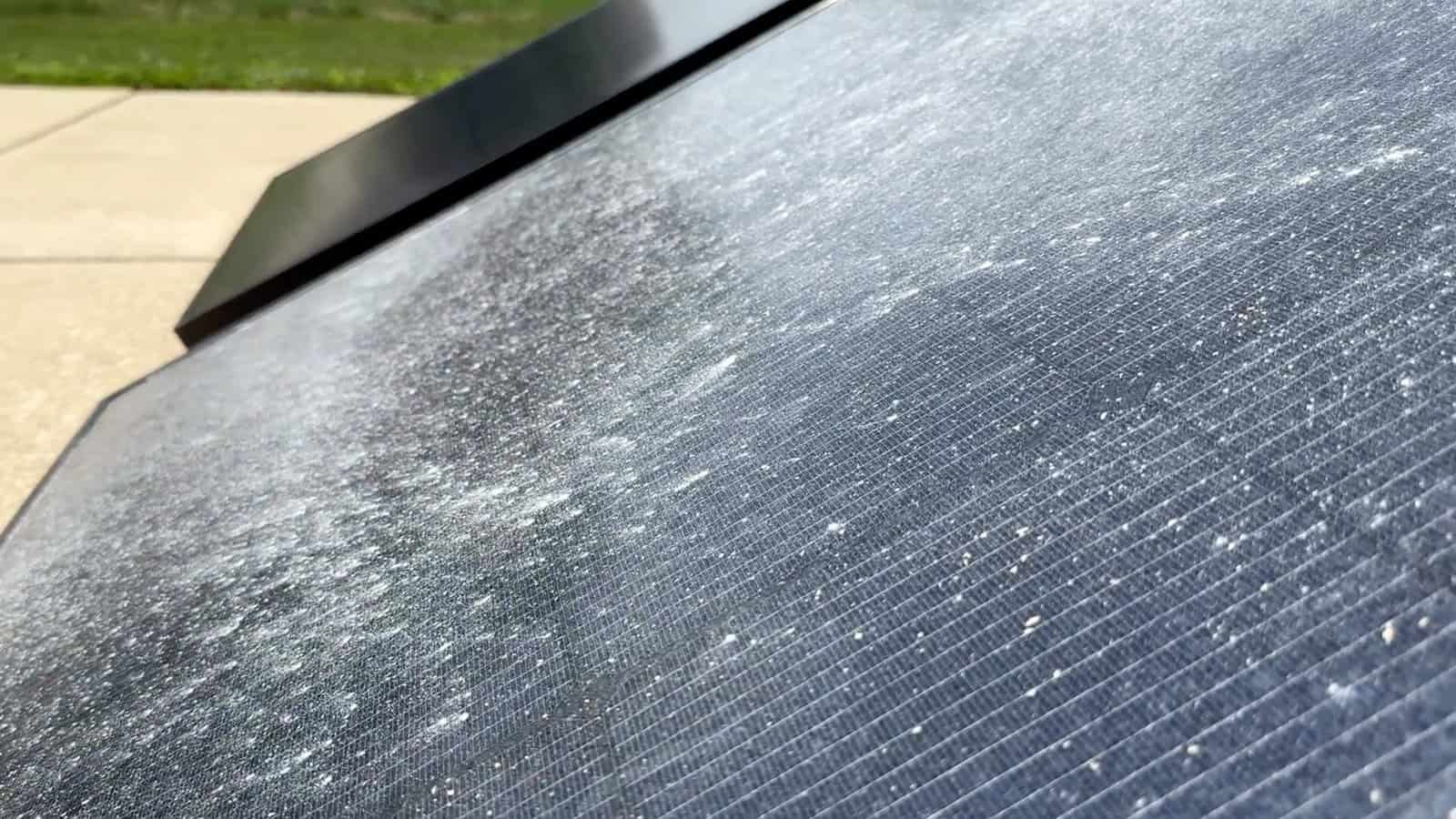
A technical buyer’s guide to soiling losses, anti-soiling surfaces, low-tilt installations, and cleaning that does not destroy the module. Written and reviewed by the Couleenergy engineering team.
Short answer
Soiling costs most PV systems 2–7% of annual energy, and far more in dry or dusty regions. You cannot prevent it, because dew cements dust onto the surface faster than rain removes it. What you can control is tilt, front-surface choice, bypass diode zoning, cleaning access, and cleaning method. Specify those four things correctly and soiling becomes a managed cost instead of a surprise.
Every module has one job: let light reach the cells. That puts a large optical surface outdoors for 25 years, exposed to wind, dust, pollen, salt and dew. Soiling is therefore not a defect. It is an exposure condition, and no coating cancels it permanently.
Most articles on this topic stop at “clean your panels regularly.” That is useless to anyone actually buying modules. This guide covers the decisions made before installation, while tilt, surface, layout and mounting are still on the table — including the case almost nobody researches, which is what happens when the panel sits nearly flat.
On this page
Why soiling never stops · How much energy it costs · Four loss mechanisms · The low-tilt blind spot · Glass vs ETFE surfaces · The metric that matters · Cleaning methods · Six costly mistakes · Writing honest claims · RFQ checklist · FAQKey takeaways
- After irradiance, soiling is the largest single factor on PV yield, and it restarts the moment a panel is clean.
- Dew cements dust in place. Once that happens, rain stops working as a reset button.
- Tilt is the cheapest anti-soiling tool there is. Flat installations give it up entirely.
- Hydrophobic does not automatically mean low-soiling. Lab results are encouraging; field results are mixed.
- Judge a surface on power recovered after cleaning, not on water contact angle.
- Qualify the module and its cleaning method together, to IEC 62788-7-3. Brushes kill coatings quietly.
Why solar panel soiling never really stops
Three physical facts drive the entire problem.
The front surface must stay open. Light has to get in, so dust gets in too. There is no sealed-enclosure option.
The best solar resources sit in dusty places. High irradiance comes with dry air, low rainfall and airborne particles. Awkward, but that is the geography of solar.
Dust does not stay loose. Panels cool at night and collect dew. That moisture dissolves minerals in the dust, which then dry. NREL researchers call the result cementation, and they report that once it sets in, even a strong rain may not remove the layer.
So “it rained last night” is a weak assumption. Light rain can make things worse, wetting dust into streaks that dry as mineral spots. In humid climates, biology piles on: the same NREL work notes that fungal growth binds dust to glass and shrugs off ordinary cleaning.
From the field: the worst-looking modules are rarely the dirtiest by mass. They are the ones that cycled wet and dry for months without a proper wash. Cementation, not dust volume, is what turns a nuisance into a yield problem.
How much energy do dirty solar panels lose?
Start with the consensus. IEA PVPS Task 13 concludes that, after irradiance itself, soiling is the single most influential factor on PV system yield, and puts the global average annual loss at roughly 3–5%. The newer IEA PVPS fact sheet places it at 4–7%.
Design tools are more conservative. NREL’s PVWatts uses a 2% default soiling loss and warns that losses run higher where traffic and pollution are high and rain is infrequent. Treat 2% as a clean-site placeholder, not a forecast.
Field data shows how wide the spread gets. Twelve months of measurements across the Atacama Desert found annual losses peaking near 39% on the northern coast, but 3% or less at high-altitude sites. Same desert, completely different answers.
The extreme end is genuinely extreme. In a year-long Jeddah study, uncleaned test modules that went 183 days without rain lost 80.4%, 75.6% and 60.2% of output at 0°, 15° and 25° tilt. Read that carefully: small test modules, zero cleaning, one of the world’s worst soiling zones. It is a boundary case, not a typical figure. It still proves two things. Losses scale with time since the last wash, and tilt changes the slope.
Table 1 — Soiling exposure classes and the design response each one demands
| Class | Typical setting | Does rain reset it? | Design response |
|---|---|---|---|
| A — Low | Temperate, regular rain, tilt above 20°, clean air | Mostly | Annual or seasonal wash. No special surface needed. |
| B — Moderate | Agricultural, coastal, urban traffic, pollen season | Partly | Two to four washes a year. Track performance ratio. |
| C — High | Arid, dusty, industrial, unpaved roads nearby | Rarely | Scheduled cleaning plus soiling monitoring. Coatings worth testing. |
| D — Severe or flat | Desert, dust storms, or any near-horizontal mounting | No | Cleaning access becomes a design requirement, not an option. |
Classify the site before you choose the module. The class changes the surface, the tilt, and the O&M plan — in that order.
Four ways dust steals power, not one
Most buyers picture a single mechanism. There are four, and the last two are the ones that generate arguments later.
1. Optical loss. Particles absorb, scatter, and reflect light before it reaches the cell. This is the loss every yield model already includes.
2. Mismatch loss from uneven soiling. Dust rarely lands evenly. Bird droppings, leaf litter, and the dirt line along a lower frame edge behave like hard shading. One badly fouled cell can pull down an entire string, so 5% surface coverage can cost considerably more than 5% of output.
3. Thermal effects, which are real but secondary. Most field studies find soiled modules running slightly warmer than clean ones, often by a few degrees, and localized deposits such as bird droppings have produced roughly 10 °C rises on affected cells. Some studies find no significant thermal effect at all. Treat it as a minor contributor next to optical loss, and do not accept a coating sold on the temperature argument alone.
4. Corrupted performance data. Soiling drags the performance ratio down gradually, and gradual soiling looks a lot like module degradation on a monitoring dashboard. Owners then open a warranty claim when what they needed was a wash. We have watched that conversation happen more than once.
An architecture point most soiling guides miss
Bypass diode count decides how much uneven soiling actually hurts. A small module with one diode drops out completely when a single region is fouled. Split it into two or three protected zones and a dirty corner costs a fraction instead. On low-tilt installations, where dirt collects in predictable bands along the low edge, diode zoning is worth raising at the quotation stage — not after the first summer.
The low-tilt blind spot: RV, marine, balcony and flat-roof solar
Nearly all published soiling research studies framed glass modules on tilted racks. Meanwhile, the fastest-growing module formats sit almost flat.
Van roofs. Boat decks. Balcony rails. Carport canopies. Facade spandrels. Low-slope commercial roofs. None behave like a 30° array in a soiling model, and none come with a rack you can walk between.
Tilt is the cheapest anti-soiling technology in existence, and these installations give it away. A soiling station in Mesa, Arizona measured nine tilt angles and found 2.02% soiling loss at 0°, against close to 1% at 23° and 33°. Roughly double the loss, for free, just from lying flat.
So a flat module is not only a mounting decision. It is a maintenance commitment. If nobody can reach the surface easily, you have designed in a loss that will never be recovered.
Table 2 — Mounting format, tilt, and what natural cleaning actually delivers
| Application | Typical tilt | Rain cleaning | What to plan for |
|---|---|---|---|
| Ground-mount or rooftop rack | 20–35° | Good | Seasonal washing; soiling sensors on larger sites |
| Balcony and railing systems | 70–90° | Good, but streaks | Vertical surfaces catch less dust, yet show run marks |
| RV and van roof | 0–5° | Poor | Road film and pollen; confirm wipe access before bonding |
| Marine deck or bimini | 0–10° | Poor | Salt crust and bird waste; build in a freshwater rinse routine |
| Flat commercial roof | 5–10° | Weak | Ponding lines and edge dirt bands; plan walkways early |
| Curved or vehicle-integrated | Mixed | Uneven | Uneven soiling bands; zone with diodes where possible |
One consequence worth stating plainly: for flexible and semi-rigid modules, cleanability matters more than soiling rate. The panel will get dirty. The question is how easily, and how safely, it comes clean.
Does the front surface matter? Glass, AR coatings and ETFE compared
Dust adhesion depends on surface energy, roughness and particle chemistry, so the front sheet does matter — just not as simply as the marketing suggests.
ETFE is the interesting case. It is a fluoropolymer with very low surface energy, roughly 18–28 mJ/m², and published water contact angles for untreated film sit around 94° to 104°. Soda-lime glass is far more wettable. AGC also describes its Fluon ETFE film as having anti-stick and stain-resistant characteristics with long outdoor weatherability.
Laboratory evidence supports the concept. Under controlled dew-dust-dry cycling, hydrophobic coated glass showed 42% lower soiling rates than hydrophilic glass, with more than 99% of transmittance restored using water alone. On low-energy surfaces, dew “herds” dust into discrete piles instead of spreading a uniform film — which is also why a low-soiling panel can look blotchy rather than evenly grey.
Now the caution we give every OEM buyer. Lab and field results do not always agree. Researchers say so plainly: adhesion is consistently lower on clean hydrophobic surfaces in the laboratory, but outdoor comparisons have been mixed. Weather, dust mineralogy and surface aging all move the outcome.
Anti-reflective glass makes the same point from the opposite direction. Standard porous AR coatings are hydrophilic, near a 20° contact angle, and reviewers note that in some locations the extra soiling outweighs the optical gain from the coating. A better surface on the datasheet can be a worse one on the roof.
Honest summary: ETFE is a promising starting surface, not a guaranteed advantage. The opportunity lies in engineering that surface and validating it where it will actually live.
Table 3 — Front surface options for PV modules
| Front surface | Soiling tendency | Cleanability | Scratch resistance | Best fit |
|---|---|---|---|---|
| Plain tempered glass | Baseline | Good | Excellent | Racked arrays cleaned by brush or robot |
| AR-coated glass | Can be higher (hydrophilic) | Good, but the coating wears | Coating is the weak layer | Utility sites with gentle wash regimes |
| Standard ETFE film | Low adhesion for many contaminants | Very good with water and soft cloth | Softer than glass | Flexible, curved, marine, RV, portable |
| Textured or embossed ETFE | Visible texture holds fine dust | Needs more wiping | Softer than glass | Walkable and anti-glare surfaces |
| PET front sheet | Higher (more wettable) | Degrades as the surface yellows | Poor over time | Short-life or price-driven products only |
The texture row needs a caveat, because roughness is not simply bad. At micro and nano scale, roughness sharply cuts the force holding dust to a surface — that is precisely how engineered superhydrophobic finishes work. At the visible scale of an embossed pattern the effect flips, and the texture holds fine particles that take more effort to remove. Embossing still improves grip and reduces glare on walkable semi-rigid panels, so treat it as a deliberate trade, not a free upgrade.
Stop asking for contact angle. Ask for recovery.
Contact angle is easy to measure and easy to market. It tells you very little about lifetime yield.
The number that matters is recovery ratio: how much lost power comes back after a normal cleaning, and whether that recovery survives years of cleaning cycles.
An illustrative example, using round numbers rather than measured ones. Panel A falls to 94% of clean output over a cycle and returns to 99% after a wash. Panel B falls to 96% and returns to 99.5%. Panel B wins twice, and only the second win shows up in year ten. That is a testable claim, and one most suppliers have never been asked to support.
Table 4 — A soiling test protocol you can put in an RFQ
| Step | What is measured | Why it matters |
|---|---|---|
| 1. Baseline | Initial transmittance and flash-test power | Everything else is relative to this |
| 2. Exposure | Soiling ratio at 7, 14 and 30 days | Shows deposition speed, not just an endpoint |
| 3. Dew cycling | Adhesion after repeated wet-dry cycles | Reproduces cementation, the real villain |
| 4. Water clean | Power recovered by rinsing alone | Predicts how much rain will do for you |
| 5. Dry wipe | Power recovered by soft-cloth wiping | Matches how RV and marine owners really clean |
| 6. Abrasion | Haze, contact angle and transmittance after cycles | Reveals whether cleaning is destroying the surface |
| 7. Aging | UV and damp heat, then repeat steps 2–6 | A new surface tells you nothing about year 12 |
Run it as an A/B/C ladder using coupons from the same laminate, comparing your candidate surface against plain glass and your current product. Relative results beat absolute ones.
You do not have to invent the methods either. IEC 62788-7-3:2022, amended in 2024, defines abrasion test methods for PV module external surfaces, including front sheets, glass and coatings. It covers linear brush, rotary brush, falling sand and forced sand impingement, and references ISO 12103-1 Arizona test dust and VDI 3956 for dust soiling behaviour. Module qualification still runs to IEC 61215 and IEC 61730; system monitoring to IEC 61724-1. Naming these in a specification is what separates a real test programme from a marketing sheet.
Cleaning method is part of the module specification
Here is the sentence we wish more buyers heard early: the cleaning method is a durability requirement, not an afterthought.
The evidence is blunt. NREL’s abrasion work behind the IEC standard found that contact angle and surface roughness usually degrade before transmittance does, with indicated longevity for several tested coatings falling somewhere between 50 and 200 brush cycles. The same work found dry dust more damaging than a wet slurry at similar deposition rates. In plain terms: the anti-soiling function dies quietly, long before anyone notices an optical change.
Coating lifetime data points the same way. Reviews of AR coatings report useful field lifetimes of around eight years or less, well short of a 25-year module warranty, and recent work on hydrophobic anti-soiling coatings confirms that abrasive cleaning degrades the optical and the anti-soiling function together.
So a “self-cleaning” module scrubbed with a stiff dry brush is a module you are slowly polishing away. That matters doubly for polymer front sheets, since ETFE is tougher than glass in flex but softer in hardness.
Table 5 — Solar panel cleaning methods, benefits and risks
| Method | Works best on | Main risk | Verdict for polymer front sheets |
|---|---|---|---|
| Rain only | Tilted arrays in wet climates | Leaves cemented film and streaks | Insufficient below about 10° tilt |
| Soft rinse plus microfibre | Small systems, RV, marine, balcony | Labour time | Recommended default |
| Deionised water pole system | Commercial rooftops | Water logistics | Good; avoids mineral spotting |
| Dry robotic brushing | Large desert plants | Abrasion and coating wear | Not advised without qualification testing |
| High-pressure washing | Only within stated pressure limits | Seal, edge and laminate damage | Avoid unless the manufacturer states a limit |
| Solvents or abrasive pads | Nothing | Permanent hazing | Avoid |
One practical rule for flexible and semi-rigid modules: clean when the surface is cool and already wet. Dragging dry grit across a polymer face is how scratches happen, and scratches are permanent.
Six specification mistakes that quietly cost energy
These come up repeatedly in projects we are asked to review — usually after commissioning, when they are expensive to fix.
1. Carrying a 2% soiling assumption into a Class C or D site. A default is not a forecast. If the site is arid, dusty, industrial or flat, model it that way and size the array accordingly. Nobody enjoys explaining a yield shortfall that was visible in the site photos.
2. Bonding a flat module down with no cleaning access. Adhesive mounting is fine. Adhesive mounting where you cannot reach the middle of the panel is a permanent loss. Decide the cleaning route before the adhesive comes out.
3. Buying an anti-soiling coating without an abrasion result. Ask for cycle counts and post-abrasion contact angle, ideally to IEC 62788-7-3. If the supplier only offers an initial contact angle, they have measured the easy number.
4. Specifying a single bypass diode on a module that will soil unevenly. This is cheap to change at quotation and impossible to change afterwards. On low-tilt installations it is the difference between losing a corner and losing the panel.
5. Letting the cleaning crew choose the tools. Contract cleaners default to what is fast. Fast usually means dry brushes. Put approved and prohibited methods in the O&M scope, in writing, and hand the crew a one-page procedure.
6. Reading soiling as degradation. Before you file a warranty claim on a drifting performance ratio, wash a reference module and compare. It is a one-hour test that has saved several long, unproductive email threads.
From fixed schedules to evidence-based cleaning
“Clean every three months” is a habit, not a strategy. Sites vary far too much for one interval. A better sequence works at any scale:
- Measure the soiling ratio — with a sensor on large sites, or a clean reference module on small ones.
- Convert that ratio into lost energy since the last wash.
- Weigh the lost energy against the effort and access required to clean.
- Clean when the recovered energy clearly justifies the intervention.
- Log the recovery every time, so you learn your own site’s soiling rate.
People skip that last step, and it is the one that pays. After three or four cycles you stop guessing, because you have local data. EPC and O&M teams increasingly treat soiling as a design input, since tilt, ground clearance and tracker choice are all shaped by expected soiling. The same logic scales down to one boat or camper: watch charge controller output on a clear day, and rinse when peak current sags against a known good reading.
How to write anti-soiling claims that survive scrutiny
Distributors and OEM brand owners have to describe these products in their own catalogues. Overclaiming there creates warranty arguments two years later, and the brand owner absorbs them, not the factory. Here is the language we recommend, and what you need behind it.
| Avoid this claim | Use this instead | Evidence you need |
|---|---|---|
| “Self-cleaning panel” | “Low-soiling surface, easier rain and rinse cleaning” | Side-by-side soiling ratio data |
| “Dust-proof” | “Reduced dust adhesion versus our standard surface” | Adhesion test after dew cycling |
| “Never needs cleaning” | “Designed for simple rinse-and-wipe maintenance” | A published cleaning procedure |
| “Hydrophobic, so less soiling” | “Low surface energy front sheet for easier cleaning” | Recovery-after-cleaning results |
The second column is not weaker. It is more specific, and specific claims win technical tenders.
Soiling checklist for your next module RFQ
Put these ten questions to any module supplier, ourselves included.
- What exactly is the front surface — film type, thickness, and any texture?
- Is there a surface treatment or coating, and what is its expected service life?
- Which cleaning methods are approved, and which void the warranty?
- Has the surface been abrasion tested with the intended cleaning tool, to IEC 62788-7-3?
- What soiling data exists, and at what tilt was it collected?
- How much power returns after a standard rinse and wipe?
- How many bypass diodes are fitted, and how is the module zoned?
- Is the mounting method compatible with periodic surface access?
- How does the surface behave after UV and damp-heat aging?
- Can you supply a written cleaning procedure for the end user?
Question three separates serious suppliers from catalogue resellers. If nobody can tell you how to clean the product safely, nobody has tested it.
Six field rules for installers
- Add tilt wherever you can. Even 10° beats zero, and the gain costs nothing.
- Leave a cleaning path. A panel nobody can reach is a panel nobody maintains.
- Watch the lower edge. Frames and trims collect dirt bands that shade the bottom cell row.
- Never wipe dry grit. Rinse first, then wipe with a soft cloth in one direction.
- Clean early in the day. Cool surfaces avoid thermal shock and drying spots.
- Record a clean-day benchmark. One good reference reading makes future soiling obvious.
Solar panel soiling FAQ
Does rain clean solar panels?
Partly. Heavy rain on a well-tilted panel removes plenty of loose dust. Once minerals cement dust to the surface, rain alone often fails, so periodic manual washing is still needed.
How much power do dirty solar panels lose?
It depends heavily on the site. IEA PVPS puts the global average annual loss in the 3–7% band, and NREL’s PVWatts uses a 2% default for typical systems. Dusty and arid sites run far higher, and one Saudi study recorded above 80% loss on horizontal test modules after 183 days with no rain and no cleaning. That last figure is a worst case, not a norm.
Are ETFE flexible panels harder to keep clean than glass?
Not usually, though the field evidence is thinner than for glass. ETFE has low surface energy, so many contaminants release easily with water. The bigger practical challenge is that flexible panels are often mounted flat, where natural rain cleaning barely works, and ETFE is softer than glass so abrasive cleaning does more harm.
Can I use a pressure washer on solar panels?
Only if your manufacturer states a pressure limit, and most do not. High pressure stresses seals, edges and junction boxes. A garden hose and a soft cloth are safer and usually just as effective.
Do anti-soiling coatings actually work?
Sometimes, and site conditions decide. Laboratory testing is encouraging, with hydrophobic surfaces showing around 42% lower soiling rates under dew cycling. Field results are more mixed, and durability is the weak point, because cleaning wears coatings down long before the module reaches end of life. Ask how the coating was aged and abrasion tested, ideally to IEC 62788-7-3.
How often should I clean an RV or marine solar panel?
Base it on output, not the calendar. A monthly rinse suits most touring use. Salt spray, pollen season and dusty roads justify more.
Is a small dirty spot really a problem?
It can be. Concentrated soiling such as bird droppings acts like hard shading, so the loss can exceed the shaded area. Bypass diode layout decides how much of the module goes down with it.
Should soiling change which module I buy?
Yes, in four specific ways: the front surface, the tilt strategy, the diode zoning, and the mounting method that decides cleaning access.
The realistic conclusion
No single technology solves soiling. Coatings help sometimes. Tilt helps often. Monitoring helps everywhere. What works is a system-level approach: a sensible front surface, a geometry that permits cleaning, a layout that limits mismatch damage, and a cleaning routine matched to the surface it touches.
Treat dust as an exposure you manage for 25 years, not a defect you remove on day one. That mindset produces better specifications, and considerably fewer difficult conversations in year three.
Send us the mounting conditions, not just the wattage
Couleenergy manufactures back-contact flexible ETFE, semi-rigid and rigid modules for distributors, installers, OEM brands, architects and project developers across North America and Europe. We design around real mounting geometry rather than ideal test conditions.
Useful things to include in a first message:
- Mounting angle and surface (bonded, framed, rail-mounted, walkable)
- Site climate and dust exposure, plus who will clean the panels and how
- Available footprint, target power, and whether the module will be branded
We will tell you honestly which surface and layout make sense — and where an anti-soiling claim would not be worth paying for.
Email info@couleenergy.com | Call +1 737 702 0119
OEM & ODM · Low MOQ · Custom size, power & shape · Fast sampling | Back-contact module range · Contact page
Sources and further reading
- IEA PVPS Task 13 — Soiling Losses: Impact on the Performance of Photovoltaic Power Plants (soiling as the leading yield factor after irradiance; 3–5% global annual loss)
- IEA PVPS — Fact sheet: Understanding, Measuring and Mitigating Soiling Losses (4–7% global average)
- NREL — PVWatts Calculator, system loss definitions (2% default soiling loss)
- NREL — Scientists Studying Solar Try Solving a Dusty Problem (cementation, fungal soiling, robotic cleaning)
- Cano, John, Tatapudi & TamizhMani, IEEE PVSC 2014 — Effect of tilt angle on soiling of photovoltaic modules (Mesa, Arizona: 2.02% at 0°, near 1% at 23° and 33°)
- Scientific Reports — Effects of soiling on PV modules in the Atacama Desert (39% annual peak; 3% or less elsewhere in the same desert)
- Solar Energy / University of Southampton — Impact of dust and tilt angle on photovoltaic performance in a desert environment (80.4% / 75.6% / 60.2% at 0° / 15° / 25° after 183 rain-free days), summarised by pv magazine
- Nayshevsky, Xu, Barahman & Lyons, Solar Energy Materials and Solar Cells — Fluoropolymer coatings for solar cover glass: anti-soiling mechanisms in the presence of dew (42% lower soiling rate; >99% transmittance recovered with water)
- Solar Energy — Performance and durability of anti-reflection coatings for solar module cover glass: a review (hydrophilic AR surfaces near 20° contact angle; field lifetimes around eight years)
- Solar Energy — Effect of abrasive cleaning loads on the durability of hydrophobic anti-soiling coatings
- NREL / DuraMAT — The IEC 62788-7-3 abrasion methods standard and supporting experiments on PV surfaces and coatings
- IEC — IEC 62788-7-3:2022 + AMD1:2024, abrasion methods for PV module external surfaces
- Canadian Journal of Chemistry — Surface modification of ETFE via atmospheric pressure nitrogen plasma (untreated ETFE water contact angle 104 ± 3°)
- International Journal of Photoenergy — Effect of industrial dust deposition on PV module performance (clean-versus-dirty module temperature differences of 1–9 °C)
- Solar Power World — The importance of soiling losses in EPC and O&M of solar PV projects
- AGC Chemicals — Fluon ETFE film properties



 English
  Español
  Français
  Deutsch
  Русский
  العربية