
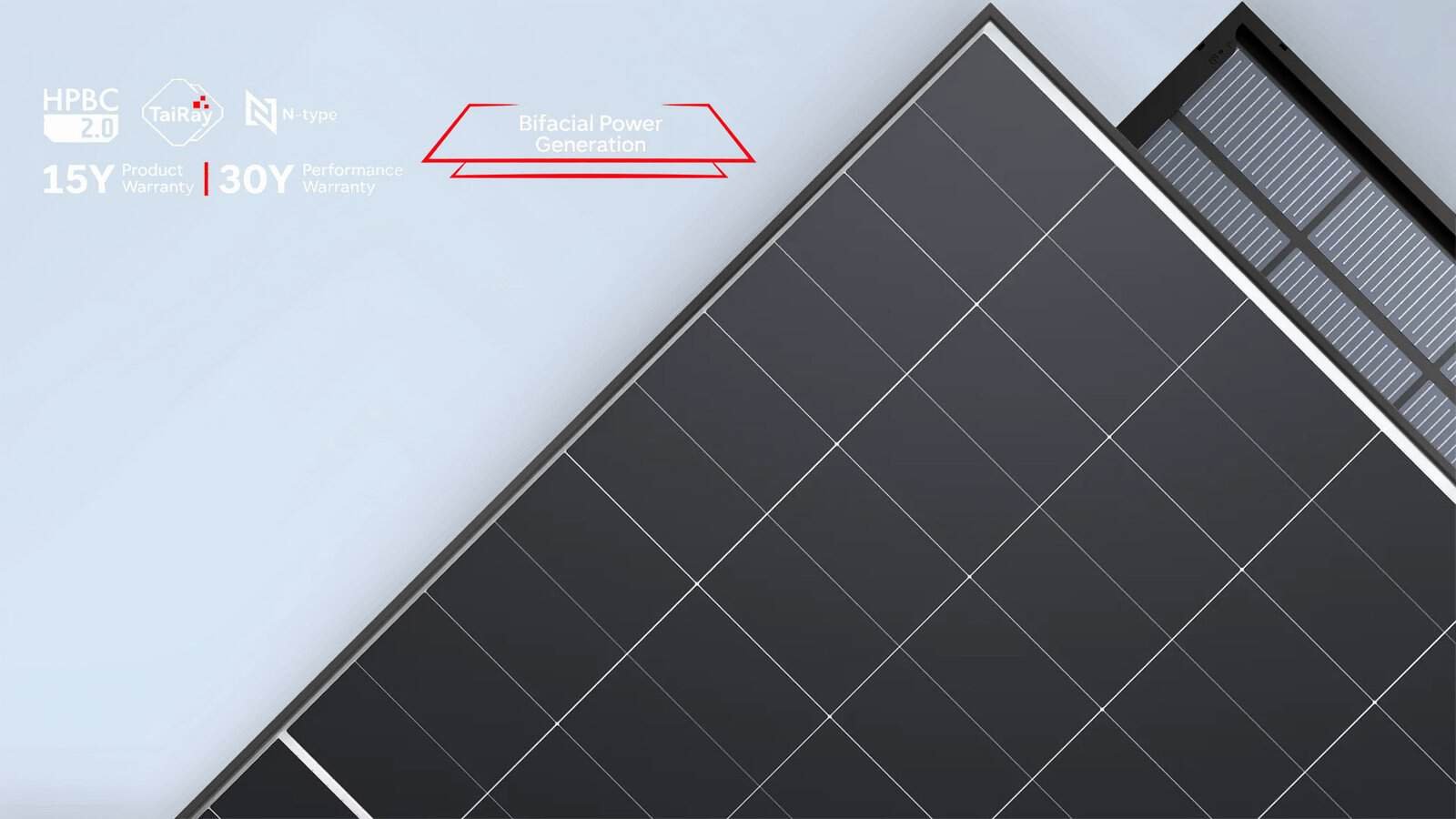
Back-contact modules are no longer a niche product. Distributors, installers, and OEM buyers across North America and Europe are actively searching for HPBC 2.0 panels, and many of them want a manufacturing partner who will work at container-and-pallet volumes, not just gigawatt contracts. This guide walks through the CLM-540M-60 Series, a 530–555 W dual-glass HPBC 2.0 module, and explains what to check before you buy high efficiency HPBC solar modules from China.
Short answer: Yes, HPBC 2.0 (back-contact) modules are worth the premium for rooftops and surfaces exposed to small, localized shading — vents, railings, chimneys, debris — and Couleenergy supplies the CLM-540M-60 Series (530–555 W) at pallet-and-container MOQ with OEM/ODM and private-label options, not only full-vessel volumes.
Key Takeaways
- The CLM-540M-60 Series covers six power bins from 530 W to 555 W, with module efficiency up to 24.6%.
- HPBC 2.0 removes front-side gridlines and busbars, which is why the improved shading behavior is real, not just marketing language.
- Couleenergy works as a low MOQ solar panel manufacturer in China, building this series to OEM and ODM specification with private-label options.
- Power tolerance is 0 to +3%, so the label never overstates what leaves the factory.
- Plan container logistics around 36 pieces per pallet, 360 per 20-foot container, and 792 per 40-foot high-cube.
What HPBC 2.0 Actually Means
HPBC stands for hybrid passivated back contact. The cell design moves both the positive and negative connections to the rear of the cell. Nothing sits on the front of the wafer to block sunlight.
Conventional panels use silver gridlines and busbars on the front glass. Those lines carry current, but they also shade a small percentage of every cell, all day, every day. HPBC 2.0 removes that shading and gives the module a clean, gridline-free black surface. That is also why the format has become popular for architectural and rooftop projects where appearance matters.
The “2.0” in HPBC 2.0 refers to a second generation of back-contact processing. It typically brings a tighter cell layout, improved passivation at the rear junction, and better control of hot-spot risk compared with first-generation back-contact designs. Buyers researching an HPBC 2.0 solar panel OEM partner should ask specifically which generation of the process a factory runs, since the term alone is not a guarantee of performance.
One thing worth knowing: HPBC is one manufacturer’s name for this cell architecture. Other companies sell comparable back-contact designs under different names, such as ABC (All Back Contact) or IBC (Interdigitated Back Contact). The shared idea across all of them — no metal contacts on the front of the cell — is what actually drives the efficiency and shading benefits, not the trademark itself. If you want the full side-by-side, we cover it in our HPBC vs IBC technology comparison.
The CLM-540M-60 datasheet lists 120 half-cut BC cells arranged 6 by 20, bifacial construction, and a rated efficiency band of 23.5% to 24.6% across the six power bins. That band sits well above conventional PERC modules, which top out near 21.7% module efficiency, and above most mainstream TOPCon products on the market today. It is not the absolute ceiling of the category — back-contact modules from other manufacturers passed 25% module efficiency in commercial production during 2026 as tracked by independent industry analysis — so treat 24.6% as a strong, current mainstream figure rather than a world record.
Inside the CLM-540M-60 Series: Full Technical Profile
The CLM-540M-60 is a residential-and-commercial dual-glass module. It uses 2.0 mm plus 2.0 mm semi-tempered glass on both faces, a black anodized aluminum frame, and an IP68 junction box with three bypass diodes. The module measures 1990 by 1134 by 30 mm and weighs 28 kg.
| Model | Pmax (STC) | Voc | Isc | Vmp | Imp | Module Eff. |
|---|---|---|---|---|---|---|
| CLM-530M-60 | 530 W | 44.95 V | 14.90 A | 37.17 V | 14.26 A | 23.5% |
| CLM-535M-60 | 535 W | 45.05 V | 15.00 A | 37.27 V | 14.36 A | 23.7% |
| CLM-540M-60 | 540 W | 45.15 V | 15.10 A | 37.37 V | 14.45 A | 23.9% |
| CLM-545M-60 | 545 W | 45.25 V | 15.20 A | 37.47 V | 14.55 A | 24.2% |
| CLM-550M-60 | 550 W | 45.35 V | 15.30 A | 37.57 V | 14.64 A | 24.4% |
| CLM-555M-60 | 555 W | 45.45 V | 15.40 A | 37.67 V | 14.73 A | 24.6% |
Values at STC (AM1.5, 1000 W/m², 25°C). Power tolerance 0 to +3%; test uncertainty for Pmax is ±3%.
Reading the Power Bins the Right Way
Six power bins live in one product family. That is normal for back-contact production, because cell binning naturally spreads output across a narrow window. Do not assume the 555 W bin is a “better” module than the 530 W bin. Both come off the same line, with the same materials and the same warranty.
Notice the gap between STC and NOCT figures. STC is a lab benchmark at 1000 W/m² and 25°C cell temperature. NOCT reflects a more realistic 800 W/m² and 20°C ambient with light wind. The CLM-540M-60 bin drops from 540 W at STC to 411 W at NOCT. That drop is normal physics, not a flaw, and every serious manufacturer publishes both numbers.
A buyer who only compares STC wattage across brands is not comparing like for like. Ask for NOCT figures and temperature coefficients before you size a system. The CLM-540M-60 Series publishes a Pmax temperature coefficient of −0.260%/°C, which tells you how much power the module loses for every degree above 25°C.
Bifacial Gain: What the Rear Side Adds
Because HPBC 2.0 cells carry no gridlines, the rear side can also collect reflected light. The datasheet publishes a rear-side power gain table, reference-binned against the CLM-535M-60.
| Pmax | Isc | Imp | Rear Power Gain |
|---|---|---|---|
| 535 W | 15.00 A | 14.36 A | 0% (baseline) |
| 562 W | 15.75 A | 15.07 A | 5% |
| 589 W | 16.50 A | 15.79 A | 10% |
| 669 W | 18.75 A | 17.90 A | 25% (max) |
Real bifacial gain depends on the surface under the array. A white membrane roof or light gravel returns much more light than dark asphalt or bare soil. Independent bifacial field studies generally report gains under 10% over natural ground at typical albedo, rising toward the published ceiling only over snow or highly reflective surfaces. Treat 25% as the datasheet ceiling under ideal reflectivity, not a default field result, and ask any supplier what ground albedo they used to calculate their bifacial claim.
Anti-Shading Performance: Why HPBC 2.0 Handles Shadows Differently
This is the question most buyers actually want answered: is an anti-shading solar module a genuine advantage, or a sales line? The honest answer is that it depends on the size and shape of the shadow.
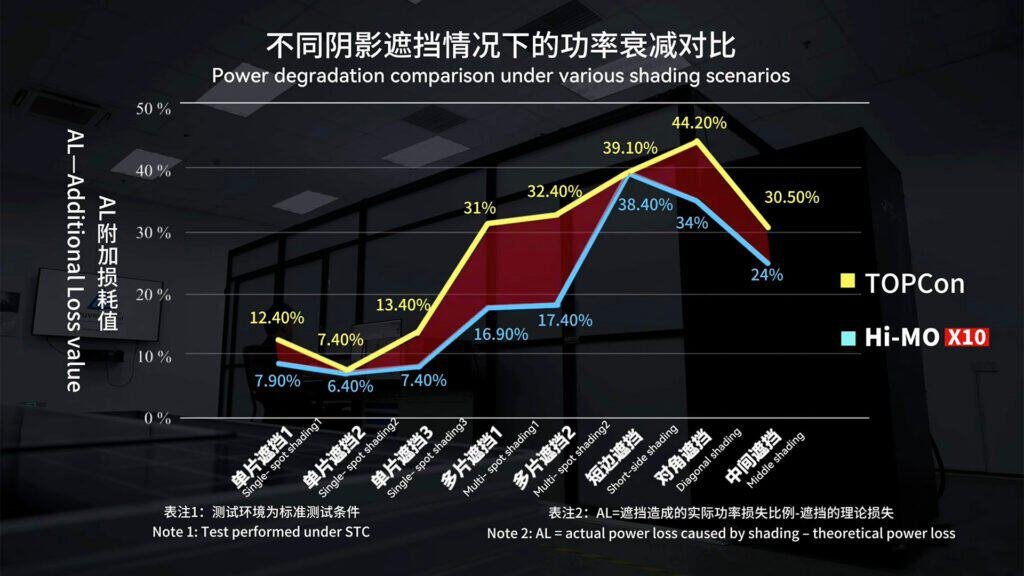
Independent flash testing and field data on back-contact cells consistently show the same pattern. When a small, localized object shades one cell, such as a vent pipe, a bird dropping, a leaf, or a railing bracket, back-contact modules lose noticeably less power than conventional gridded panels. TÜV Rheinland has issued shadow-resistance certification for HPBC 2.0 modules, including an A+ rating specifically scoped to point-like shading conditions (reporting summarized here). Separately, China’s CPVT quality center measured a single fully-shaded cell causing a 10.15% power loss on a back-contact module, against 36.48% on a TOPCon module tested under the same condition.
Back-contact manufacturers have published technical explainers on the underlying mechanism describing how the cell handles a soft breakdown state, and how field installers have applied it against real obstructions such as chimneys and roof vents. The short version: current can shunt internally within the cell before the bypass diode needs to engage, so a small shadow does not force an entire substring offline the way it can on a conventionally gridded cell.
That advantage narrows as the shadow grows. Published thresholds vary by manufacturer and test method — one back-contact brand states its bypass diode engages once roughly four adjacent cells are shaded, while independent research on a different back-contact design found the advantage held for one or two isolated cells before converging with TOPCon once a full row was covered. Treat “three to four cells” as the general neighborhood, not a spec you can hold any single supplier to without their own test data. Row-to-row shading from a neighboring building, or a full parapet wall shadow, is not the scenario where back-contact technology earns its premium.
One honesty note: the shading figures above are published third-party and manufacturer test results for back-contact cell technology as a category, not a flash-test result for the CLM-540M-60 specifically. The physics applies to any true back-contact cell, including the ones in this series, but ask your supplier for their own module’s shading test data if a project’s financial model depends on a specific percentage. For a deeper walkthrough of how this stacks up against ABC and TOPCon under real shadow conditions, see our shade-performance comparison article.
The rule of thumb we give buyers
If the obstruction is smaller than the module — a vent, an antenna mount, a chimney shadow edge, dust or debris — HPBC 2.0 partial shading performance is a genuine, measurable advantage. If the obstruction is larger than the module, such as a full row of panels shading the next row, fix the layout first. No cell technology solves a design problem.
Built to Last: Mechanical and Environmental Ratings
A high-efficiency cell only matters if the module survives its environment. The CLM-540M-60 Series carries the following ratings:
| Operational Temperature | −40°C to +85°C |
| Maximum System Voltage | DC 1500 V (IEC) |
| Front Side Static Loading | 5400 Pa |
| Rear Side Static Loading | 2400 Pa |
| Hailstone Test | 25 mm hailstone at 23 m/s |
| Junction Box | IP68, three bypass diodes |
| Fire Rating | IEC Class C |
| Power Warranty | 30-year linear power output |
| Materials & Workmanship | 15-year warranty |
Modules are designed to meet IEC 61215 and IEC 61730 quality and safety requirements. Ask any manufacturer for the specific certificate numbers and the issuing test house before you finalize a purchase order — a certification claim without a document is not verification.
Buying High-Efficiency HPBC Modules from China: What “Low MOQ” Actually Means
Most tier-one factories are built for utility-scale contracts. A distributor who wants five containers a year, or a project developer testing a new product line, often cannot get past the minimum order quantity, let alone get a custom frame color or a private label.
That gap is exactly where working with a low MOQ solar panel manufacturer in China pays off. Couleenergy (Ningbo Coulee Tech Co., Ltd.) builds the CLM-540M-60 Series to pallet and small-container volumes, not only full-container or vessel-scale orders. That means:
- Smaller initial orders while you validate a market or a project.
- Faster sampling before you commit to a full production run.
- Room to request frame color, cell layout, or cable length changes without renegotiating a mega-contract.
If you are researching an HPBC 2.0 solar panel OEM partner, ask three questions early: What is the real minimum order in pieces or pallets? What is the sample lead time? And can they hold a fixed spec across repeat orders so your second shipment matches your first?
Private-Label and OEM/ODM: Putting Your Brand on the Module
Private label BC solar modules let a distributor or installer sell under their own brand instead of reselling someone else’s nameplate. That matters for margin control, customer retention, and long-term brand equity in a crowded market.
On the CLM-540M-60 platform, Couleenergy supports OEM and ODM work at the cell layout, size, voltage, frame color, and packaging level. OEM means the electrical design stays as published; you supply the branding, box art, and documentation. ODM goes further, adjusting the physical configuration — string count, connector type, cable length, or dimensions — to match a specific project or product line.
| Route | What Stays Fixed | What You Control |
|---|---|---|
| OEM (private label) | Cell type, electrical layout, core dimensions | Brand name, nameplate, packaging, documentation |
| ODM (custom design) | Cell technology and manufacturing process | Voltage, dimensions, frame color, connectors, string design |
Whichever route you choose, ask for a sample run before a production order. A sample confirms fit, finish, and documentation quality before you commit pallet quantities to your own brand.
Not sure whether OEM or ODM fits your volume? Send Couleenergy your target spec and we’ll tell you which route — and what it actually requires — in one reply.
Talk to a Solar Pro »Importing HPBC 2.0 Modules from China: Logistics Buyers Should Plan For
Planning to import HPBC solar modules from China starts with packaging math, not just the factory quote. The CLM-540M-60 Series ships 36 pieces per pallet, 360 pieces per 20-foot general-purpose container, and 792 pieces per 40-foot high-cube container.
| Container | Modules | Approx. DC Capacity at 540 W |
|---|---|---|
| 1 pallet | 36 pcs | ~19.4 kW |
| 20′ GP container | 360 pcs | ~194.4 kW |
| 40′ HC container | 792 pcs | ~427.7 kW |
Beyond container math, plan for four things before you place a first order:
- Documentation: confirm which certificates ship with the product — IEC test reports, CE declarations, and any country-specific listing your market requires.
- Incoterms: know whether your quote is FOB China, CIF your port, or DDP your warehouse, since freight and duty change the landed math significantly.
- Lead time: confirm production lead time separately from ocean freight time — they are two different clocks.
- Inspection: ask about pre-shipment quality checks, EL imaging, and whether a third-party inspection can be arranged before the container closes.
A supplier who answers these questions clearly, before you ask twice, is telling you something about how the rest of the relationship will go.
How HPBC 2.0 Compares to Conventional Gridded Panels
| Factor | HPBC 2.0 Back-Contact | Conventional Front-Gridded Panel |
|---|---|---|
| Front-side appearance | No visible gridlines or busbars | Visible silver gridlines |
| Module efficiency (typical) | Up to ~24.6% | Typically lower, front metal blocks some light |
| Small, point-like shading | Better tolerance, measured under certification testing | More sensitive to localized shade |
| Large row-to-row shading | Advantage narrows, converges toward parity | Same layout problem applies equally |
| Bifacial rear collection | Supported, rear electrode design | Depends on cell type, often lower gain |
Buyer’s Checklist Before You Place an Order
- Confirmed power tolerance stated as 0 to +3%, not a plus-or-minus range that can undershoot the label.
- NOCT figures published alongside STC, not STC alone.
- Temperature coefficients for Isc, Voc, and Pmax listed on the datasheet.
- Bifacial gain figures paired with the ground albedo or surface assumption used.
- Real minimum order quantity, in pieces or pallets, confirmed in writing.
- OEM/ODM scope defined — what changes, what does not.
- Container loading count and Incoterms confirmed before booking freight.
- Certificate numbers and issuing test house named, not just referenced.
- Warranty terms stated as a document, not a footnote line.
- Sample availability and sample lead time confirmed before a production order.
Frequently Asked Questions
Is HPBC 2.0 the same as TOPCon or PERC?
No. TOPCon and PERC are front-and-back contact cell designs with visible gridlines on the front. HPBC 2.0 moves all contacts to the rear, which removes front-side shading loss from the metal itself.
Do Couleenergy HPBC solar panels come with a written warranty?
Yes. The CLM-540M-60 Series carries a 30-year linear power warranty and a 15-year materials and workmanship warranty, as stated on the product datasheet.
Can I get a custom frame color or cable length?
Yes. Cell layout, size, voltage, frame color, and cable length are available as OEM/ODM options. Confirm any custom change against a sample before a full production order.
Does the anti-shading benefit apply to every installation?
No. It is strongest against small, localized shadows. Large shadows, such as full row-to-row shading, reduce the advantage toward parity with conventional panels. Layout still matters more than cell technology in that scenario.
What is the real minimum order quantity?
Couleenergy works at pallet-and-container scale rather than requiring full-vessel commitments. Contact the team directly with your target volume for a confirmed minimum.
How long does sampling take before a full order?
Sample lead times vary by customization level. Standard-spec samples move faster than a custom ODM configuration. Ask for a confirmed date in writing before you plan around it.
How This Article Was Checked
Electrical, mechanical, and warranty figures for the CLM-540M-60 Series come directly from the current Couleenergy product datasheet. Anti-shading claims are stated with their tested geometry — point-like versus full-row shading — rather than as an unqualified percentage, and are flagged as category-level third-party data rather than a CLM-540M-60-specific flash test. The efficiency-ranking claim was checked against a live industry tracker rather than asserted from memory. Published by Ningbo Coulee Tech Co., Ltd. (Couleenergy), a Zhejiang-based back-contact module manufacturer serving OEM and distributor accounts in North America and Europe. Fact-checked and revised September 2026.
Sourcing HPBC 2.0 Modules for Your Market?
Send Couleenergy your target power, format, volume, and destination market. The team will confirm real MOQ, sample lead time, and OEM/ODM options for the CLM-540M-60 Series or a custom configuration built around your project.
Request a Quote »info@couleenergy.com · +1 737 702 0119 · couleenergy.com


 English
  Español
  Français
  Deutsch
  Русский
  العربية