
By the time you finish reading this, another homeowner somewhere in the UK has probably Googled “solar panels for my roof.” The question is whether they’ll find you — and whether you can offer them what they actually need.
The UK’s solar market is shifting fast. On 24 March 2026, the Department for Energy Security and Net Zero (DESNZ) confirmed that plug-in solar panels will be available for self-installation “within months.”[1] That announcement landed alongside the government’s Future Homes Standard, which mandates solar panels and heat pumps in all new English homes — coming into legal force from March 2027, with full compliance required from March 2028.[4] Together, these two policy moves are reshaping residential solar demand from the ground up.
For solar roof tile installers, this creates both an urgent challenge and a significant opportunity. Understanding how the pieces fit together is the first step to turning market noise into a pipeline of serious jobs.
💡 What Exactly Is Plug-In Solar?
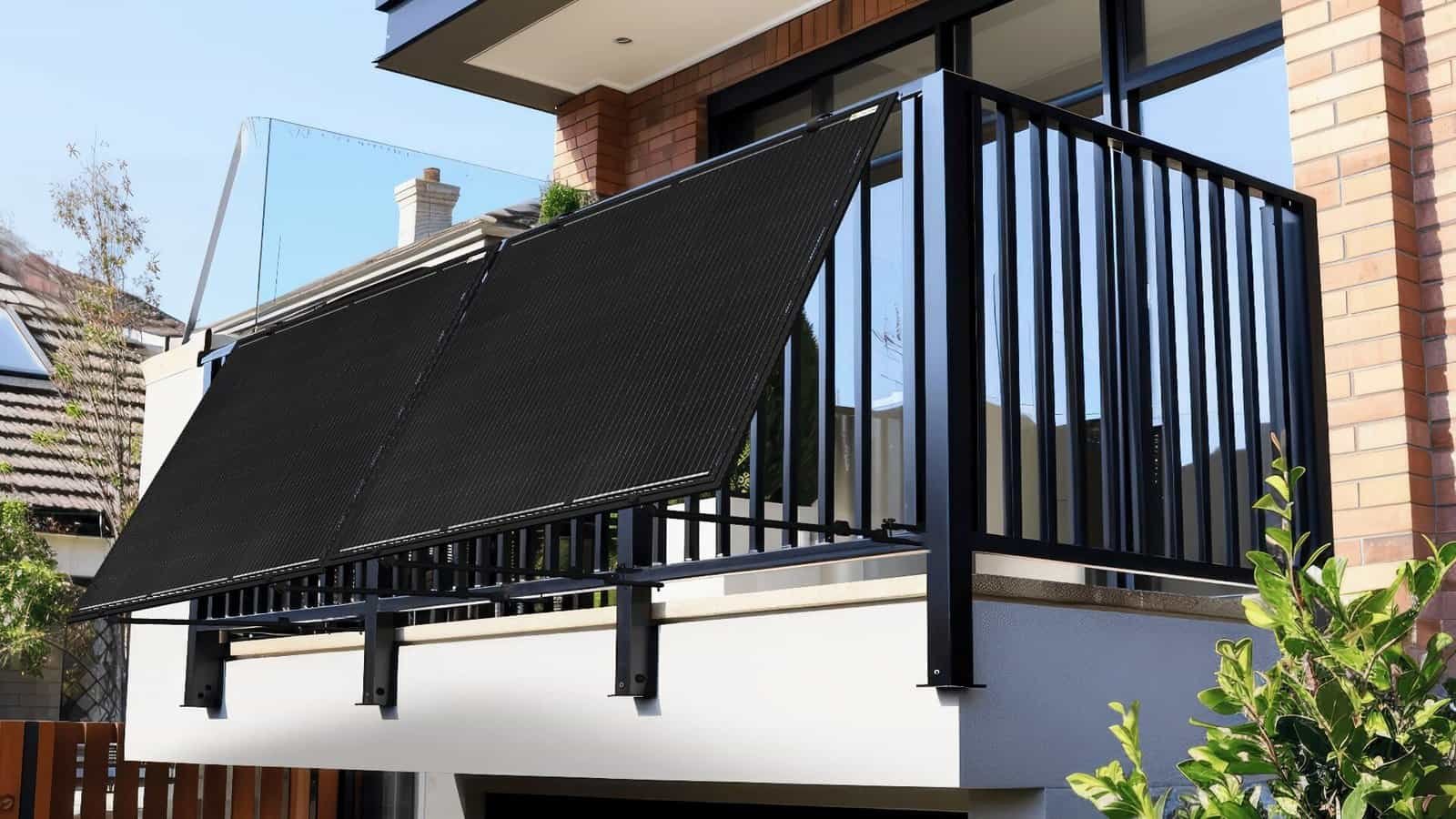
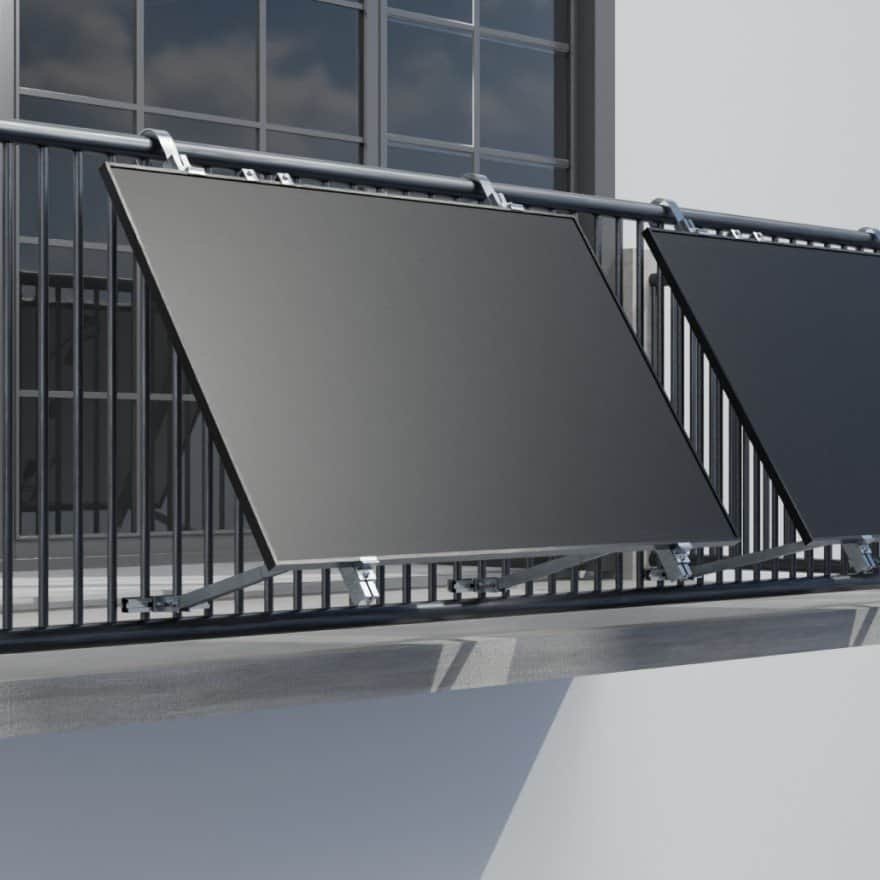
Plug-in solar — also called balcony solar or micro-PV — is a small photovoltaic system, typically two 400–450 W monocrystalline panels plus a microinverter, designed to connect into a household’s electrical circuit and offset daytime consumption directly. The appeal is obvious: no scaffolding, no planning permission, no major installation cost. In Germany, over 1.15 million households had installed these systems by June 2025, with around 500,000 new units going in each year.[2]
The UK has been slower to adopt this model. The primary regulatory barrier was BS 7671 Section 712[3] — which required all photovoltaic systems to be hard-wired on dedicated circuits and did not permit reverse power flow through standard domestic sockets. BS 7671:2018+A4:2026, published 15 April 2026, updates the framework for low-voltage generating sets and battery storage, laying the legal groundwork. However, Amendment 4 alone does not complete the picture: the BSI product standard for UK-certified plug-in devices — which defines exactly what an approved kit must do — is expected around July 2026. Until that standard is published, no products are formally certified for the UK market. European CE marks and German VDE certification do not transfer automatically post-Brexit.
G98 — often cited alongside BS 7671 — is not itself a barrier. It is the fit-and-notify grid-connection framework: once a certified system is installed, the DNO (Distribution Network Operator) is notified within 28 days. No pre-approval is needed for systems under 3.68 kW per phase, well above the expected 800 W AC limit for plug-in solar.[3]
📋 UK regulatory pathway to legal self-install plug-in solar
- ✓ DESNZ policy announcement (24 March 2026) — Government confirms intent; retailers preparing stock
- ✓ BS 7671:2018+A4:2026 published (15 April 2026) — Wiring regulations framework updated for generating sets and batteries
- ● BSI plug-in solar product standard (expected July 2026) — Defines approved device specifications; required before retail sale
- ● Simplified G98 registration pathway — Online DNO notification process to replace current paper-based form
- ● UK-certified kits available in shops (summer–autumn 2026) — Products from EcoFlow, Lidl, Iceland and others
Once the full framework is in place, millions of renters, flat-dwellers, and homeowners without suitable roofs will be able to buy a certified solar kit from a supermarket shelf and generate their own electricity. A standard 800 W system in Germany costs around £210–£300 at current exchange rates. UK pricing will be somewhat higher — China removed its 9% VAT export rebate on solar panels from 1 April 2026, affecting kit costs for the whole market.
“An 800 W south-facing plug-in system in central England generates approximately 650–700 kWh per year. At typical 2026 self-consumption rates, annual bill savings range from £70 to £115 — modest on their own, but a powerful entry point into the solar journey.”Based on PVGIS irradiance data for central England, DESNZ guidance, and EcoFlow product data, 2026 [1]
🔍 Why This Should Interest Solar Roof Tile Installers
Your first instinct might be to see plug-in solar as a rival. In terms of direct revenue, it is not. Plug-in kits are low-cost, portable, and explicitly aimed at people who cannot or do not want to commit to a full installation. Your customers — homeowners planning a re-roof, new-build developers, conservation area owners, households wanting an integrated solution — are a completely different audience.
What plug-in solar does is broaden the entire market. It normalises solar as a household technology. It brings energy self-sufficiency into everyday conversation — in supermarkets and on social media. And it creates a clear upgrade pathway: many of today’s plug-in users are tomorrow’s roof tile customers.
Think of it as a funnel. A household starts with a £500 balcony kit, watches their meter, gets interested in what a full rooftop system could deliver, then moves to a house with a south-facing roof and gets in touch with an installer. That journey — from curiosity to committed buyer — happens faster when the concept is already familiar. Plug-in solar accelerates the top of your funnel without touching the bottom.
🏢 The Policy Context: Why Now Is a Strong Moment to Grow
Plug-in solar is just one piece of a larger policy picture. Three other developments are directly relevant to roof tile installers.
1️⃣ The Future Homes Standard (In Force from March 2027)
The Future Homes Standard was enacted in Building Regulations amendments on 24 March 2026 and comes into legal force on 24 March 2027, with a 12-month transition period ending on 24 March 2028, after which all new homes must comply.[4] New homes in England must include solar panels covering an area equivalent to 40% of the ground floor, combined with low-carbon heating — heat pumps or heat network connections. Exemptions exist for buildings over 18 metres, sites where the minimum 720 kWh/year output cannot be achieved, and certain complex roof geometries, but these are the minority. Developers are already submitting planning applications under the new rules, and the race to beat the 2027 registration deadline is creating real demand now.
For installers who can offer complete design-to-commissioning packages — roof tile integration, inverter specification, grid paperwork — this is a growing and predictable channel. Volume is high. Margins per project are tighter than on bespoke retrofits, but the lead flow is structured.
2️⃣ The Warm Homes Plan
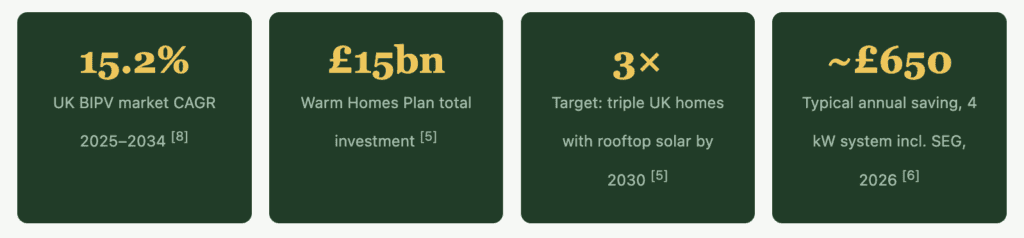
The government’s Warm Homes Plan commits approximately £15 billion to energy efficiency upgrades across up to 5 million homes.[5] The plan explicitly pledges to triple the number of homes with rooftop solar by 2030. Around £5 billion is earmarked specifically for low-income households, including fully funded solar-plus-battery systems worth £9,000–£12,000 per home at current costs. For installers, this means scheme-backed leads and grant-funded projects — not just organic retail enquiries.
3️⃣ Energy Bill Pressure and Geopolitical Risk
Gas and energy prices have spiked sharply over recent years. Energy security has moved from a policy abstraction to a dinner-table concern. At 2026 electricity rates,[6] a typical 3–4 kW rooftop system saves a UK household £500–£850 per year in combined bill reductions and Smart Export Guarantee income. When homeowners are actively feeling energy costs, the payback conversation becomes much easier to have.
📈 The BIPV Market: Numbers Behind the Opportunity
The UK BIPV market was valued at $0.1 billion in 2024. It is projected to reach $0.5 billion by 2034, growing at a compound annual rate of 15.2%.[8] Residential applications are the fastest-growing segment, driven by government incentives, the FHS mandate, and declining manufacturing costs.
For installers currently working primarily with standard solar panels, this is a clear signal: adding BIPV capability now, while the market is still in its early growth phase, is far less costly than catching up later when competition is denser.
⚖️ Where Solar Roof Tiles Fit In: An Honest Assessment
Standard solar panels still dominate the residential market on cost grounds. A typical 4kW system — the most popular residential size — costs between £5,500 and £7,500 fully installed (0% VAT applies to all eligible domestic solar).[11] Panel prices have fallen roughly 17% since 2023. A comparable solar roof tile system costs between £12,000 and £35,000, depending on system size and roof complexity.
The efficiency comparison requires some precision. Premium monocrystalline panels achieve 20–23% module efficiency; mid-range residential panels sit at 18–20%. Solar roof tiles using current crystalline silicon technology — including TOPCon, PERC, and IBC (Interdigitated Back-Contact) cells — achieve 15–22% module efficiency depending on product and manufacturer.[9] Older ceramic-encapsulated formats sit at the lower end; premium glass-glass back-contact tiles reach the upper end. A more practical metric for system design is yield per m² of total roof area: because tiles are distributed across the whole roof including sub-optimal sections, a full-tile system typically requires 3–4× more roof area than a concentrated south-facing panel array for the same annual kWh output.
So who actually needs solar roof tiles? The answer is more specific than it used to be — but also more commercially attractive per job.
| Feature | Plug-In Solar | Solar Roof Tiles (BIPV) |
|---|---|---|
| Typical system cost | £500 – £800 | £12,000 – £35,000 |
| Annual saving (bills + SEG) | £70 – £115 (self-consumption only until MCS-certified) [1] | £600 – £1,400 [6] |
| Standard panel cost (comparison) | N/A | £5,500 – £7,500 for 4 kW [11] |
| Module efficiency | ~20 – 22% [9] | 15 – 22% (technology-dependent) [9] |
| Planning permission | Usually not required | Varies; stronger case in conservation areas |
| Best suited for | Renters, flats, entry-level buyers | Re-roofing, listed buildings, new builds |
| MCS certification req’d | Yes (for SEG eligibility) | Yes (installer & product) [7] |
| Smart Export Guarantee | Once UK-certified kits available [7] | Eligible now [7] |
| Portability | Yes — take it when you move | No — permanent installation |
| Installer involvement | Minimal (once BSI standard published) | Full — roofing + electrical expertise required |
ⓘ Module efficiency figures are measured at Standard Test Conditions (STC: 1,000 W/m², 25°C, AM 1.5 spectrum). Real-world output is lower due to temperature, shading, and sub-optimal orientation. Plug-in savings are for self-consumption only until BSI product standard and MCS pathway are established (expected 2026).
🏠 The Four Strongest Use Cases for Solar Roof Tiles
- Re-roofing homeowners. When a household needs a new roof anyway, the comparison shifts. BIPV replaces a conventional building material the owner must buy regardless. Subtract the avoided roofing cost, and the net solar premium narrows considerably. This is your most persuasive sales conversation.
- Conservation areas and listed buildings. Standard panels are difficult to approve in many heritage settings. Solar tiles that closely match existing roof materials have a significantly better chance of planning consent. This is a specialist niche with limited competition and committed buyers.
- Design-conscious homeowners. Some buyers simply will not accept visible panels on a house they care about aesthetically. Solar tiles deliver generation without compromising street appeal — a premium that the right customer is happy to pay.
- New-build developers seeking Future Homes Standard compliance. Integrated roof tiles can satisfy the FHS mandate[4] while delivering a visually coherent product. A developer building 20 homes with a modern aesthetic has a clear reason to prefer tiles over bolted-on panels — especially for projects already being designed to the new standard.
✍️ Six Practical Steps: What to Do Right Now
- Develop a clear re-roofing offer. Build a service package that combines roofing and solar as a single proposition, including a net-cost comparison that subtracts the conventional roofing cost. Many homeowners do not realise the comparison is this favourable until you show them the numbers side by side.
- Get familiar with planning pathways in conservation areas. Research your local conservation officers’ current guidance on solar tiles. Some areas have become more permissive; others still have tight restrictions. Knowing the boundaries lets you give prospects an honest assessment quickly — which builds trust faster than any brochure.
- Position plug-in solar as a referral source, not a threat. Publish a simple comparison guide — balcony solar versus roof tile installation — covering output, lifespan, and long-term value. One useful point of differentiation: early plug-in kits, before BSI certification and an MCS pathway are established, will not qualify for Smart Export Guarantee[7] payments — meaning homeowners who want full SEG income will need an MCS-certified rooftop system. Offer plug-in kit buyers a free “future upgrade consultation” when they plan to move or renovate.
- Sharpen your bill-savings messaging. Lead with numbers people can feel.[6] A compelling, honest claim for 2026: “A typical 4kW rooftop system saves £500–£850 per year in bills and export income — shielding your home from gas price shocks for the long term.” For new-build conversations: “The Future Homes Standard makes solar mandatory for new homes from March 2027 — design it in from day one and maximise your yield.”[4]
- Build heat pump partnerships. Policy explicitly links solar PV with heat pumps in new homes. Homeowners increasingly ask whether a roof solar system can support a heat pump. Either train up to offer integrated packages, or form a formal partnership with a reputable heat pump contractor.
- Explore Warm Homes Plan grant routes and confirm MCS status. Familiarise yourself with the grant and loan pathways[5] for low-income households — fully funded installations for eligible customers can significantly widen your addressable market. Ensure your business holds a current MCS certification:[7] MCS registration is required for both SEG eligibility and Warm Homes Plan grant work. Under the Renters’ Rights Act 2025,[10] tenants can also request energy improvements, opening another channel for installers with the right offer.
💬 The Conversation That Wins Jobs
The homeowner who needs a new roof, lives in a conservation area, or cares deeply about how their home looks is not shopping for the cheapest solar product. They are looking for someone who understands their specific situation and can give them a credible, honest answer.
That is your competitive advantage. A plug-in kit from Lidl cannot survey a heritage roof, navigate a planning application, specify an IBC back-contact tile system for a challenging shaded urban plot,[8] or commission an installation that looks like it was always meant to be there. And it cannot earn SEG income for the household — not until the certification pathway matures.
The plug-in solar boom will bring more people into the solar conversation than ever before. Some of them will stay at the balcony-kit tier. Many of them will eventually want something more. When they do, make sure they already know who to call.
📋 Key Takeaways
- The UK government confirmed on 24 March 2026 that self-install plug-in solar will be available “within months.” BS 7671:2018+A4:2026 (published 15 April 2026) updates the wiring framework; the BSI product standard expected July 2026 is the remaining step before certified kits ship.[1][3]
- Plug-in solar targets renters and flat-dwellers. It is not in direct competition with solar roof tiles — it widens the funnel and creates an upgrade pathway. Early kits will not qualify for SEG without MCS certification.
- The Future Homes Standard comes into legal force from March 2027, with all new English homes required to comply from March 2028.[4] Developers are already designing for the new standard now.
- A typical 4 kW rooftop system saves £500–£850/year in combined bill reductions and SEG export income at 2026 electricity rates (Ofgem Q1 cap: 24.5p/kWh).[6]
- The UK BIPV market is forecast to grow at 15.2% CAGR through 2034.[8] Solar tiles using IBC and TOPCon technology now achieve 15–22% module efficiency — closing the gap with standard panels on premium products.
- The strongest use cases for solar tiles remain re-roofing, conservation areas, design-conscious homeowners, and new-build FHS compliance.
- Key priorities: develop a net-cost re-roofing offer, maintain MCS certification, build heat pump partnerships, explore Warm Homes Plan grants,[5] and treat plug-in kits as a lead-generation entry tier.
Couleenergy (Ningbo Coulee Tech Co., Ltd.) supplies back-contact solar tiles and BIPV modules for residential and commercial applications across Europe and North America. Custom shapes, sizes, and finishes are available from 100 units.
📧 info@couleenergy.com
📞 +1 737 702 0119
📋 Footnotes & Sources
- DESNZ Plug-In Solar Announcement (24 March 2026). The UK government confirmed plug-in solar panels will be made available “within months,” citing the German 800 W AC model. Retail partnerships announced with Lidl, Iceland, and EcoFlow. DESNZ will introduce “tailored safety standards” via the BSI product standard process. Government guidance cites annual savings of £70–£110 for a standard 800 W system.
🔗 gov.uk — Government to make plug-in solar available within months - BSW Solar / Bundesnetzagentur — German Balcony Solar Registrations (2025). Germany surpassed 1.15 million plug-in solar (Balkonkraftwerk) installations by June 2025, with approximately 500,000 new registrations per year. Registrations are widely considered to undercount total sales. Germany’s rapid uptake followed streamlined registration in April 2024.
🔗 Sunsave — Plug-In Solar UK Guide (citing BSW Solar and Bundesnetzagentur data) - BS 7671:2018+A4:2026 — IET Wiring Regulations, 18th Edition (Amendment 4). Published 15 April 2026 by the IET and BSI. The previous version (BS 7671:2018+A2:2022+A3:2024) is withdrawn six months later on 15 October 2026. Amendment 4 updates the standard for low-voltage generating sets (Chapter 708) and introduces new requirements for stationary battery storage (Chapter 57) — the regulatory framework underpinning domestic plug-in solar deployment. Note: Amendment 4 alone does not legalise plug-in self-install; the separate BSI product standard for certified plug-in devices (expected July 2026) is also required before retail kits can ship.
G98 (Energy Networks Association) is the grid-connection notification standard for micro-generators up to 3.68 kW (16 A/phase). It is a fit-and-notify administrative process — not a prohibition. An 800 W plug-in system falls well within G98 scope; no prior DNO approval is needed.
🔗 IET & BSI — Amendment 4 press release, 15 January 2026 | ENA — G98 standard - Future Homes Standard — Building Regulations etc. (Amendment) (England) Regulations 2026 (SI 2026/335). Signed 23 March 2026 and published 24 March 2026. The Regulations come into force on 24 March 2027 for standard residential work, and on 24 September 2027 for Higher-Risk Buildings (HRBs ≥18 m or ≥7 storeys with ≥2 units). A 12-month transition period runs until 24 March 2028; after that date all new homes regardless of registration date must comply. Requirement L3 (Approved Document L 2026, para 5.73) mandates rooftop solar PV covering approximately 40% of the dwelling’s ground-floor area, with exemptions where shading, orientation, or roof geometry means minimum output of 720 kWh/year cannot be achieved. Gas boilers are effectively banned in new homes; heat pumps or heat network connections are required. The FHS Impact Assessment estimates savings of up to £830/year for FHS-compliant homes versus a standard EPC-C property.
🔗 legislation.gov.uk — Building Regulations etc. (Amendment) (England) Regulations 2026 (SI 2026/335) | gov.uk — Building Circular 01/2026 (MHCLG, 24 March 2026) | HEM Guide — full technical breakdown - UK Warm Homes Plan — January 2026. The plan commits £15 billion in public investment (including devolved nation allocations; the 2025 Spending Review confirmed £13.2 billion in ring-fenced funding) to upgrade up to 5 million homes by 2030. The government explicitly pledges to triple the current number of homes with rooftop solar — not a specific “3 million” target. Around £5 billion supports low-income households with fully funded solar-plus-battery installations (£9,000–£12,000 per home at current costs). A further £2 billion provides low/zero-interest loans for all households.
🔗 gov.uk — Warm Homes Plan announcement, January 2026 | Solar Power Portal — £13.2bn Spending Review confirmation - Solar Panel Savings — UK Industry Data, 2026. At the Ofgem Q1 2026 unit rate of 24.5p/kWh, a typical 4 kW south-facing rooftop system saves £500–£850 per year in combined electricity bill reductions and SEG export income, depending on self-consumption rate, export tariff, battery use, and location. The FMB (Federation of Master Builders) April 2026 data shows £818–£953/year for a 4.5 kW system with battery storage. A PVGIS estimate for an 800 W south-facing plug-in system at 30–35° tilt in central England yields approximately 650–700 kWh/year; at 35–45% self-consumption and Ofgem rates, annual bill savings are £60–£90. The government’s FHS Impact Assessment cites potential savings of up to £830/year for fully FHS-compliant homes (solar + heat pump + upgraded fabric) vs a standard EPC-C property.
🔗 FMB — Solar Panel Costs UK, April 2026 | HEM Guide — FHS Impact Assessment savings data - Smart Export Guarantee (SEG) & MCS Certification — April 2026. The SEG requires MCS-certified systems; installers must hold a current MCS registration to sign off eligible installations. As of April 2026: bundled tariffs (switching supplier) offer 12–15p/kWh; unbundled open tariffs range from 6–12p/kWh. Octopus Outgoing dropped from 15p to 12p/kWh on 1 March 2026. Ofgem’s 2024–25 annual report found the average SEG rate paid was approximately 13p (bundled) and 4.47p (unbundled). Plug-in solar kits are designed primarily for self-consumption; until UK-certified kits exist and an MCS pathway is established for plug-in systems, early self-installed units will not qualify for SEG payments.
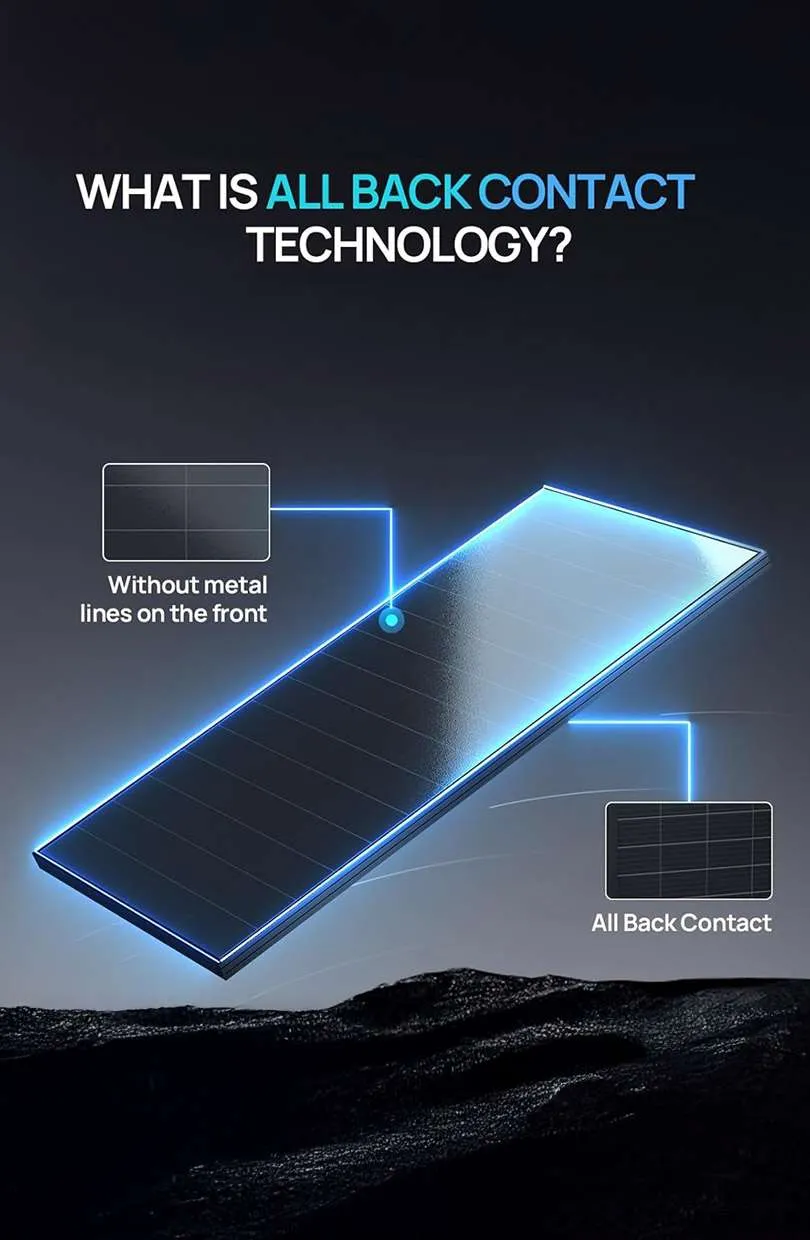
🔗 Ofgem — Smart Export Guarantee | Sunsave — Best SEG Rates, April 2026 | MCS — Microgeneration Certification Scheme - Allied Market Research — UK BIPV Market Report (2025). The UK building-integrated photovoltaics (BIPV) market was valued at approximately $0.1 billion in 2024 and is projected to reach $0.5 billion by 2034, growing at a CAGR of 15.2%. Residential rooftop BIPV is the fastest-growing application segment. IBC (Interdigitated Back-Contact) technology is increasingly specified for premium BIPV applications — all electrical contacts are placed on the rear of the cell, eliminating front-surface shading losses and enabling a uniform all-black aesthetic. Note: HJT (Heterojunction Technology), which uses amorphous silicon passivation layers, is a distinct cell architecture and should not be conflated with IBC; some manufacturers produce hybrid IBC-HJT cells, but the technologies are separately commercialised.
🔗 Allied Market Research — UK BIPV Market Forecast, 2025–2034 - Solar Roof Tile & Plug-In Solar Module Efficiency (2026). Solar roof tiles: module efficiency varies significantly by cell technology and manufacturer. Products using current crystalline silicon (TOPCon, PERC, IBC/back-contact cells) achieve 15–22% module efficiency under STC. Older ceramic-encapsulated or thin-film formats may be as low as 12–14%. All efficiency figures are stated at Standard Test Conditions (STC: 1,000 W/m², 25°C, AM 1.5 spectrum); real-world output is lower due to temperature, shading, and orientation. At the system level, tile installations covering the full roof including sub-optimal sections typically require 3–4× more total roof area than a concentrated south-facing panel array for the same annual kWh yield. Plug-in solar: modern 2026 kits use 420–450 W monocrystalline panels typically at 20–22% module efficiency; the 800 W microinverter caps AC output regardless of panel wattage.
🔗 SurgePV — BIPV Guide 2026 (cell vs system efficiency) | Clean Energy Reviews — Most Efficient Solar Panels 2026 - Renters’ Rights Act 2025 — UK Parliament (2025 c. 26). Legislation receiving Royal Assent on 27 October 2025, strengthening tenants’ rights in England and Wales. Key provisions relevant to solar: tenants may request energy efficiency improvements; landlords may not “unreasonably refuse” qualifying requests. Core provisions commenced 27 December 2025; full tenancy reform provisions commenced 1 May 2026. Relevant to plug-in solar and small-scale BIPV installations in rented properties.
🔗 legislation.gov.uk — Renters’ Rights Act 2025 (c. 26) | gov.uk — Guide to the Renters’ Rights Act - Solar Panel Installation Costs UK, 2026. Following a roughly 17% fall in prices since 2023, typical fully installed prices (0% VAT; includes panels, inverter, mounting, scaffolding, and MCS certification) are: 3 kW = £4,500–£6,000; 4 kW = £5,500–£7,500; 6 kW = £7,000–£9,000. The 4 kW system is the most common residential size. Battery storage adds approximately £2,500–£5,000 depending on capacity and brand. Note: China’s removal of its 9% VAT export rebate on solar panels from 1 April 2026 may place modest upward pressure on module prices later in 2026.
🔗 FMB — Solar Panel Costs UK, April 2026 | UK




 English
  Español
  Français
  Deutsch
  Русский
  العربية