
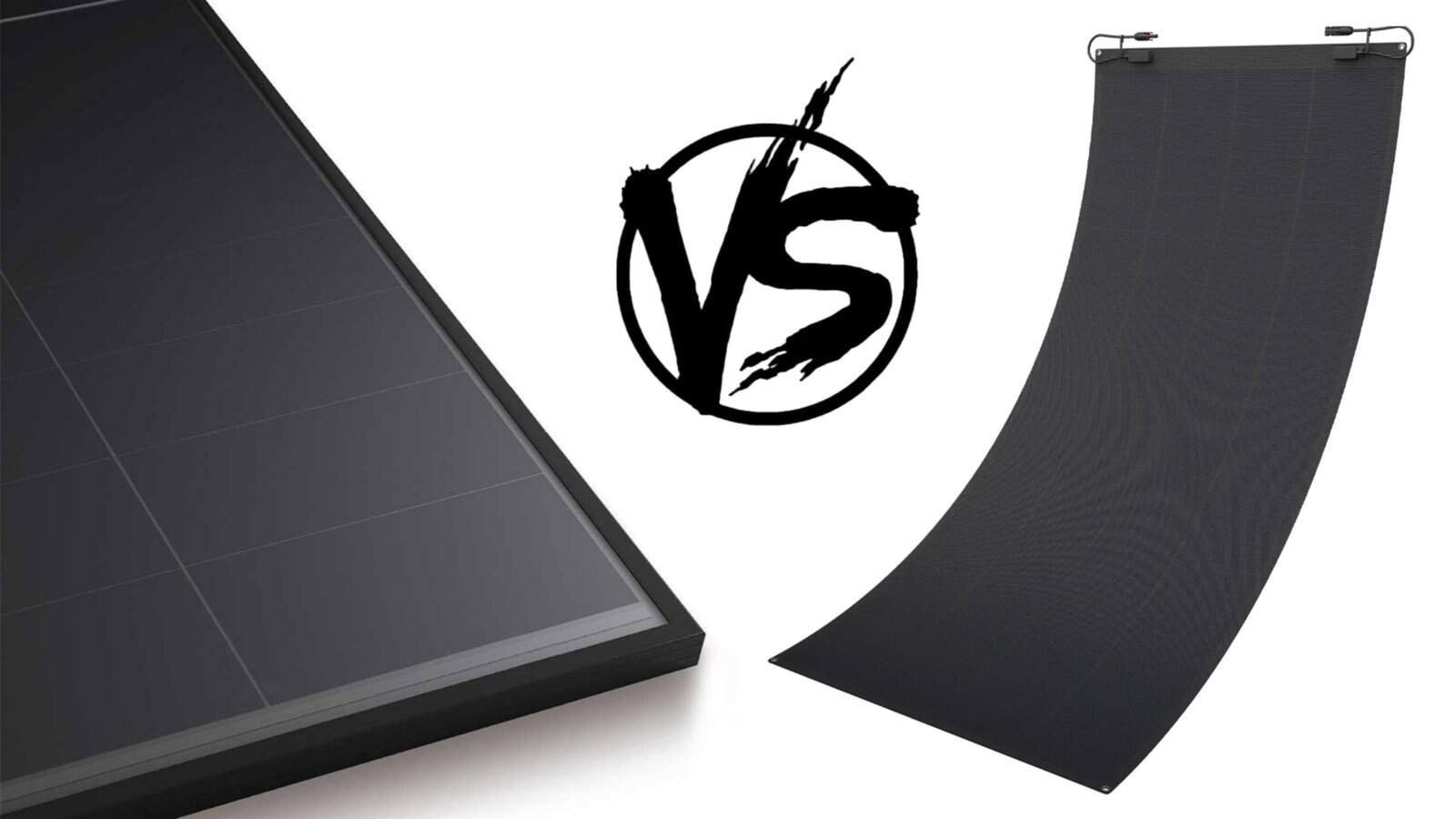
For off-grid solar projects — boats, motorhomes, campervans, remote cabins, portable power builds, and architectural integrations — weight is not just a specification. It is often the deciding factor between a project that works and one that does not.
Flexible solar panels are the obvious answer for any surface that is curved, weight-sensitive, or inaccessible to standard mounting hardware. But not all flexible panels are equal. The front-sheet material, the lamination stack, the cell technology, and the panel thickness all determine whether your panel survives one season or ten.
This guide gives you real weight-per-watt data from verified specifications, a plain-language material comparison, a two-tier product overview, and a practical sourcing framework — with everything calibrated to off-grid and custom OEM applications.

📊 The Right Metric: Weight Per Watt (g/W)
Total panel weight is a starting point. The number engineers actually use is grams per watt (g/W) — how much panel mass you are adding for every watt of installed capacity. It is the only metric that makes a fair comparison across wattage classes.
Flexible solar panels are typically 60–70% lighter per watt than rigid panels of equivalent output. Using Couleenergy’s own CLM product line — same manufacturer, same product family, like-for-like — the verified weight saving is 63–67% per watt across the range.1
| Power | CLM Rigid (glass/frame) | CLM Standard Flexible (ETFE) | Weight Saving | Rigid g/W | Flexible g/W |
|---|---|---|---|---|---|
| 80W | 4.5 kg (CLM080-12M10) | 1.5 kg (CLM-80W) | 67% | 56.3 | 18.8 |
| 120W | 6.6 kg (CLM120-12M10) | 2.2 kg (CLM-120W) | 67% | 55.0 | 18.3 |
| 150W | 8.2 kg (CLM150-12M10) | 2.8 kg (CLM-150W) | 66% | 54.7 | 18.7 |
| 230W | 11.7 kg (CLM230-24M10) | 4.3 kg (CLM-230W) | 63% | 50.9 | 18.7 |
| 320W | 16.7 kg (CLM320-24M10) | 5.9 kg (CLM-320W) | 65% | 52.2 | 18.4 |
Source: Couleenergy CLM series product specifications, 2025–2026.1 Weight saving = (rigid − flexible) ÷ rigid × 100%.
💡 Key insight: The standard CLM flexible series delivers a consistent ~18–19 g/W across 80W–320W — roughly three times lighter per watt than the rigid equivalent. That ratio, not the total panel weight, is what shapes structural, installation, and logistics decisions.
⚡ Why Weight Matters: Four Engineering Reasons
1 — Structural Load and Mounting Cost
Every kilogram on a boat deck, RV roof, or building facade adds structural load. Rigid panels typically require reinforced racking and sometimes upgrades to the surface beneath. A properly built flexible panel eliminates most of that.
For marine use: a 1,200W array using CLM rigid panels adds roughly 100–140 kg to the vessel. The same array in CLM standard flexible format adds around 25–35 kg — the difference between a structural engineering problem and a straightforward adhesive bond.
2 — Fuel and Range (Marine & Mobile Applications)
Weight affects fuel consumption, particularly on smaller vessels where panel mass represents a meaningful share of total displacement. For a typical recreational powerboat or sailing vessel in the 5–15 tonne range, reducing topside weight by 100 kg has a measurable effect on fuel consumption and range at planing speeds. For campervans and RVs, lighter panels directly improve payload capacity and tow-vehicle ratings.
3 — Installation Speed and Access
Flexible modules mount with adhesive, grommets, Velcro, or lacing — no drilling, no racking rails, no specialist hardware. On curved surfaces or cramped spaces where rigid panels cannot fit, flexible panels are the only viable option. A two-person crew can install a full boat array in hours, not days.
4 — Curvature and Surface Compatibility
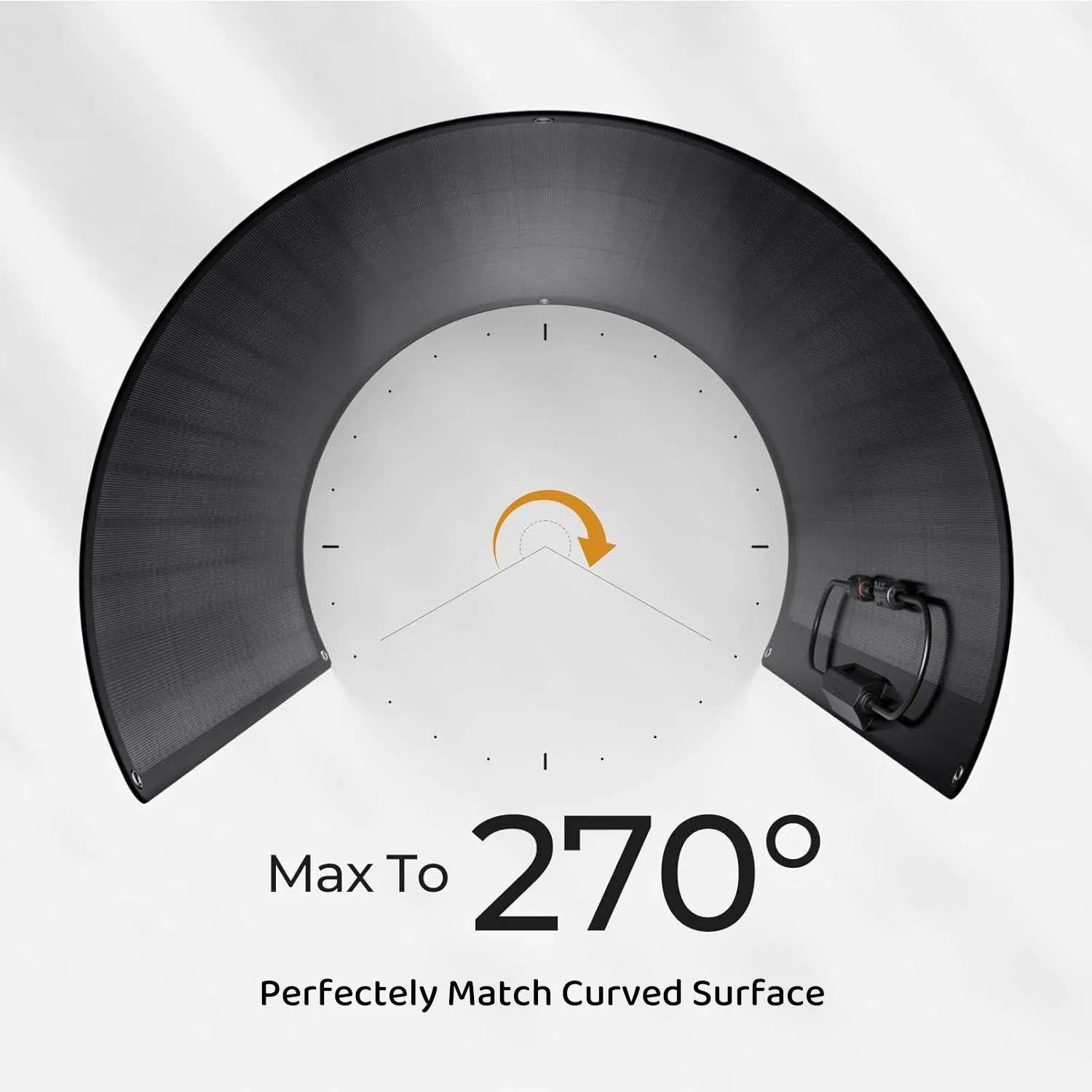
At ~2.7 mm (standard) and ~3.3 mm (premium), CLM flexible panels conform to curved surfaces with up to a 240° bend radius. Biminis, motorhome roofs, boat decks, and shaped BIPV surfaces all require this. Rigid panels cannot do it.
🔬 ETFE vs PET: The Front Sheet That Determines Lifespan
The single biggest material decision in a flexible panel is the front sheet. Here’s what each option delivers in practice:
| Front Sheet | UV Resistance | Outdoor Lifespan | Light Transmission | Salt Resistance | Self-Cleaning |
|---|---|---|---|---|---|
| PET (Polyester) | Low | 1–3 years | ~88% | Poor | No |
| ETFE (Fluoropolymer) | Excellent | 10–20+ years* | 94–96%4 | Excellent | Yes† |
*ETFE film itself has demonstrated 30+ year durability in architectural installations.5 In a flexible solar module, overall panel lifespan is determined by encapsulant integrity and cell interconnects — not the ETFE front sheet. †Self-cleaning via lotus effect is most pronounced in textured-grade ETFE, where micro-embossed surface structure encourages water to bead and roll off. Smooth ETFE also sheds water through its inherently low surface energy, though the effect is less pronounced.
⚠️ PET warning: PET yellows and becomes brittle within 1–3 years of UV exposure. Salt spray accelerates breakdown at edges and the junction box perimeter. For any serious outdoor or marine deployment, a PET-fronted panel is a short-term solution at best.
ETFE was originally developed for stadium roofs, greenhouse membranes, and aerospace wiring. In solar applications, it transmits more light than glass (94–96% vs. ~91%)4, maintains UV resistance for the life of the module5, and its textured surface sheds saltwater and grime without manual intervention.
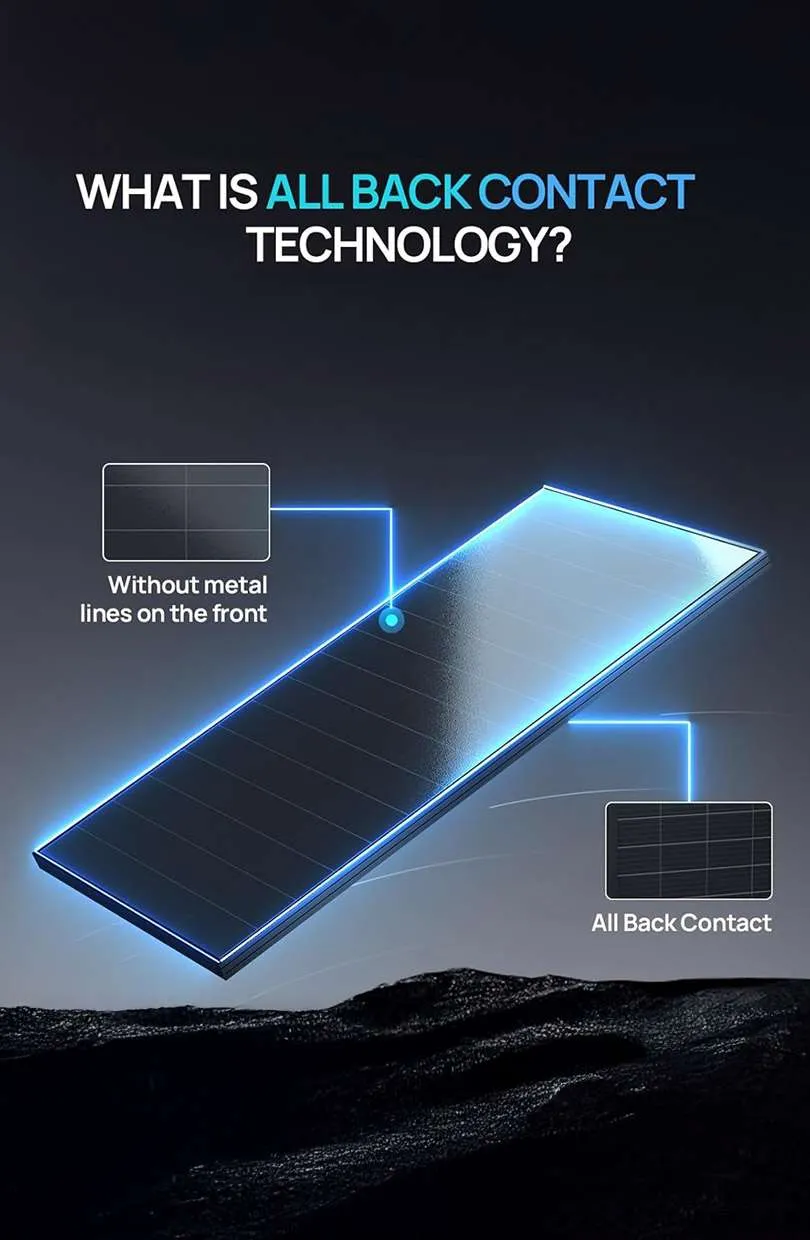
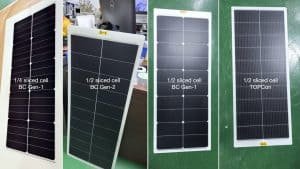
Premium flexible panels now pair ETFE with N-type back contact (HPBC/IBC) cell technology. In flexible format, these can deliver module efficiencies of 20–22%12 — significantly better than conventional flexible panels (15–18%) and comparable to standard rigid monocrystalline panels — alongside a temperature coefficient of −0.26%/°C (vs. −0.35–0.40%/°C for standard PERC)10 and superior shade tolerance. Both matter on boats where masts and rigging cast irregular shadows and deck temperatures regularly exceed 50°C.
💡 Note on efficiency: LONGi’s HPBC 2.0 achieves up to 24.8% in rigid glass modules.10 In flexible format, assembly-related losses reduce this to 20–22%.12 This is still a substantial step above conventional flexible panels at 15–18% and comparable to standard rigid PERC modules.
🔧 The Micro-Crack Problem: Why Low-Cost Flexible Panels Fail Fast
Silicon solar cells are brittle. Every flex, every vibration, every thermal cycle puts mechanical stress on them. A micro-crack is invisible to the naked eye, but it disrupts current flow, raises internal resistance, and can create hot spots in cells with significant crack area.3
In mechanical load testing of 27 crystalline silicon PV modules, research found that 50% of observed cracks ran parallel to front-side busbars — the orientation most likely to create electrically isolated cell areas and the highest-risk crack type for long-term power loss.2
Budget flexible panels can degrade well beyond warranty expectations within 1–3 years of harsh deployment. Unlike the 0.5–0.8%/year degradation typical of quality crystalline modules, poorly constructed flexible panels using PET front sheets and EVA encapsulants fail early from inadequate protection of brittle silicon cells against continuous mechanical and thermal stress. The solution is layered protection:
- Polymer encapsulants (not EVA) — flexible, stress-absorbing materials. EVA is designed for rigid glass panels and is too stiff for flexible formats.
- Fiberglass-reinforced substrate — limits bending to the safe design range and distributes mechanical loads evenly.
- Symmetrical dual-layer encapsulation — matching polymer above and below the cells reduces asymmetric stress during bending and thermal cycling.
- Back contact cell architecture — removes all electrical contacts from the front surface, eliminating the primary initiation site for busbar-parallel cracks. TÜV Rheinland testing of HPBC 2.0 modules documented hot-spot peak temperatures ~38% lower than TOPCon under identical shading conditions, confirming the thermal and reliability advantages of BC architecture.11
- ECA (electrically conductive adhesive) — flexible joints that absorb cyclic mechanical shock instead of fracturing under repeated stress.
A 5-layer panel (ETFE / EVA / cells/ EVA / backsheet) leaves most failure modes unaddressed. A 9-layer engineered structure addresses each one at the material level.
📋 Two Product Tiers: Standard and Premium
Couleenergy’s CLM flexible series covers two clearly distinct tiers. Most off-grid and custom OEM projects specify one based on deployment environment, expected service life, and surface requirements.
Standard Tier
CLM Standard — 2.7 mm
Off-the-shelf flexible panel with ETFE front sheet. Available from stock, 30W to 320W, suited to most off-grid and recreational applications.
- ETFE front sheet
- Polymer encapsulant
- Monocrystalline cells
- 2.7 mm uniform thickness
- 30° bend angle
- ~18–19 g/W (80W–320W range)
- IP68 junction box
- 12V / 24V system configurations
Best for: recreational marine, RV, camping, caravan, standard OEM
Premium Tier
CLM Premium — 9-Layer, 3.3 mm
Engineered for long-service demanding environments. Built to or exceeding standard benchmarks even without mandatory certification for off-grid use. Custom dimensions are the norm — most builds are OEM or bespoke.
Best for: offshore marine, harsh off-grid, demanding OEM applications
Standard CLM — Full Specification Table (2.7 mm)
| Model | Power | Dimensions (mm) | Weight | g/W | Vmp | Voc |
|---|---|---|---|---|---|---|
| CLM-30W | 30W | 440 × 400 × 2.7 | 0.8 kg | 26.7 | 18V | 21.6V |
| CLM-45W | 45W | 625 × 400 × 2.7 | 1.0 kg | 22.2 | 18V | 21.6V |
| CLM-60W | 60W | 815 × 400 × 2.7 | 1.3 kg | 21.7 | 18V | 21.6V |
| CLM-80W | 80W | 1010 × 400 × 2.7 | 1.5 kg | 18.8 | 20V | 24.0V |
| CLM-120W | 120W | 990 × 585 × 2.7 | 2.2 kg | 18.3 | 18V | 21.6V |
| CLM-140W | 140W | 1170 × 590 × 2.7 | 2.5 kg | 17.9 | 18V | 21.6V |
| CLM-150W | 150W | 1270 × 595 × 2.7 | 2.8 kg | 18.7 | 24V | 28.8V |
| CLM-170W | 170W | 1080 × 780 × 2.7 | 3.1 kg | 18.2 | 24V | 28.8V |
| CLM-230W | 230W | 1460 × 780 × 2.7 | 4.3 kg | 18.7 | 18V | 21.6V |
| CLM-250W | 250W | 1550 × 780 × 2.7 | 4.5 kg | 18.0 | 18V | 21.6V |
| CLM-280W | 280W | 1735 × 780 × 2.7 | 5.1 kg | 18.2 | 18V | 21.6V |
| CLM-320W | 320W | 1365 × 1145 × 2.7 | 5.9 kg | 18.4 | 24V | 28.8V |
Standard CLM catalog specifications, 2025–2026. Full datasheet (Isc, power tolerance, STC efficiency) available on request.
🔄 Premium 9-layer (3.3 mm) specifications are configuration-dependent. The additional protective layers typically add an estimated 10–15% to base weight vs. the standard tier. Custom dimensions, wattage, and voltage are standard for premium OEM builds. Send requirements to info@couleenergy.com for a confirmed specification sheet.
⚓ What Off-Grid and Marine Buyers Actually Need
For off-grid applications, the relevant buying criteria differ from grid-tied or utility solar. Weight, installation method, surface compatibility, and long-term reliability in unattended environments matter most. Formal certification is often not a purchase requirement for off-grid use — but the responsible standard is for the manufacturer to build to or exceed those benchmarks regardless.
| Specification | Minimum Acceptable | Best Practice (Premium Tier) |
|---|---|---|
| Front sheet | ETFE | Textured ETFE (self-cleaning) |
| Encapsulant | Polymer-based | Dual-layer polymer (symmetrical) |
| Substrate | Fiberglass-reinforced | Multi-layer + dedicated moisture barrier |
| Junction box | IP67 | IP68 |
| Connectors | MC4 compatible | Marine-rated MC4, UV-stable cable |
| Bend angle | 30° | 240° |
| Thickness | Much thinner or thicker | 2.7 mm (standard) / 3.3 mm (premium) |
| Salt exposure | Basic resistance | Halogen-free, sealed edge construction |
| Customisation | Standard sizes | Any dimension, any voltage, OEM branding |
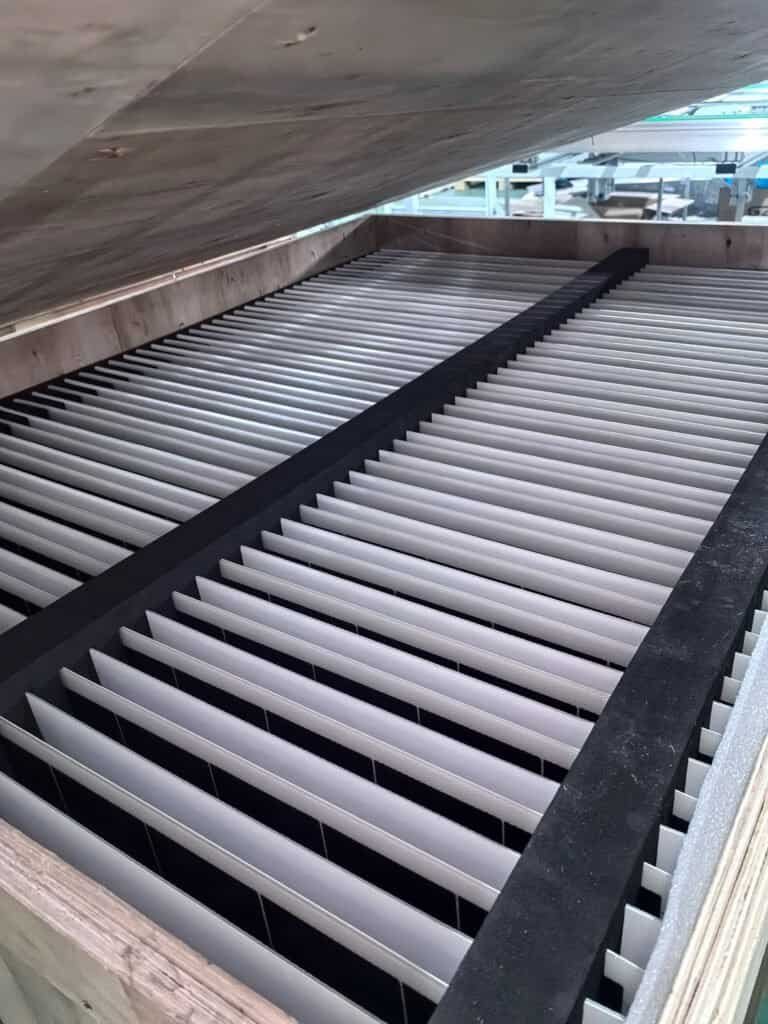
🔍 Four Questions to Ask Any Flexible Panel Supplier
1. What is the full layer structure?
A manufacturer who knows their product will describe the lamination stack layer by layer. An answer of “ETFE front, EVA encapsulant, PET backsheet” describes a 4–5 layer basic construction. The premium standard for demanding off-grid use is 7–9 layers with polymer (not EVA) encapsulant.
Ask: “Can you walk me through your layer structure and explain the function of each layer?”
2. How do you prevent micro-cracks?
This is the most important durability question. A serious manufacturer can describe their approach: symmetric encapsulant placement, fiberglass reinforcement, ECA vs. traditional soldering, and cell architecture. Vague answers here almost always mean a basic construction that will underperform in vibration-heavy or thermally demanding environments.
Ask: “Is your encapsulant EVA or polymer-based? Is it symmetrical above and below the cells? Do you use ECA or solder? What is your tested bend radius?”
3. Do you provide EL test reports as standard?
Electroluminescence (EL) imaging reveals micro-cracks and cell-level defects that are invisible under standard visual inspection.9 Responsible manufacturers run EL testing as standard quality control per production batch.
4. What are your customisation capabilities, MOQ, and lead times?
- Sample MOQ: How many units for a qualification sample run?
- Production MOQ: Minimum for a full production order?
- Dimensions: Can you size panels to my surface drawing?
- Lead time: Current timeframe from order confirmation to shipment?
- OEM branding: Custom labels, connectors, or cable lengths available?
📊 Three-Tier Comparison: Budget vs Standard vs Premium
| Feature | Budget (3–4 Layer) | Standard CLM (2.7 mm) | Premium CLM (9-Layer, 3.3 mm) |
|---|---|---|---|
| Front sheet | PET | ETFE | Textured ETFE |
| Cell technology | Mono PERC | Standard monocrystalline | HPBC Back Contact (20–22% module eff.)12 |
| Temperature coefficient | −0.35–0.40%/°C | −0.35–0.40%/°C | −0.26%/°C10 |
| Encapsulant | EVA | Polymer | Dual-layer polymer (symmetrical) |
| Thickness | Much thinner or thicker | 2.7 mm (catalog verified) | 3.3 mm (premium standard) |
| g/W at 150W | 27–40 g/W (est.) | 18.7 g/W (CLM-150W, verified) | ~22–24 g/W (est., specs on request) |
| Bend angle | 15–20° | 30° | 240° |
| Micro-crack resistance | Minimal | Moderate | Engineered (9-layer, BC cells, ECA) |
| Custom dimensions | Standard sizes only | Limited | Any dimension — standard for OEM |
| Expected lifespan (outdoor) | 1–3 years | 3–5 years‡ | 5–15+ years |
| Best for | Short-term, budget | Recreational off-grid, standard OEM | Demanding off-grid, harsh marine, long-term |
‡Standard ETFE panel lifespan varies by deployment environment. Quality ETFE panels in moderate conditions often achieve 10–15 years; 5–15 years reflects the realistic range across varied off-grid deployments including harsh and marine conditions.
❓ Frequently Asked Questions
How much does a flexible solar panel weigh compared to a rigid panel?
Using Couleenergy’s CLM product line as a like-for-like comparison, the standard flexible panel weighs 63–67% less per watt than the rigid equivalent — ~18–19 g/W versus 51–56 g/W for rigid. In absolute terms, a CLM-150W standard flexible panel weighs 2.8 kg vs. 8.2 kg for the rigid equivalent. The premium 9-layer (3.3 mm) adds an estimated 10–20% to base weight but remains dramatically lighter than any rigid panel.
What is the difference between the 2.7 mm standard and 3.3 mm premium panels?
The standard CLM (2.7 mm) is an off-the-shelf ETFE flexible panel suited to most recreational and off-grid applications. The premium 9-layer (3.3 mm) adds dedicated layers for moisture barrier, electrical insulation, symmetrical stress management, and fiberglass reinforcement. It uses HPBC back contact cells (20–22% module efficiency in flexible format) and is designed for long-service harsh environments. Most premium builds are custom or OEM — dimensions, wattage, and voltage are project-specific.
Are flexible panels as efficient as rigid panels?
The premium CLM uses HPBC back contact cells achieving 20–22% module efficiency in flexible format12 — significantly better than conventional flexible panels (15–18%) and comparable to standard rigid monocrystalline panels. LONGi’s HPBC 2.0 achieves up to 24.8% in rigid glass modules; design and assembly losses from the flexible substrate account for the difference.10,12 The main trade-off versus rigid glass panels remains lifespan (25–30 years) — though the ETFE front sheet itself can last 30+ years.
Why do flexible solar panels fail faster than rigid ones?
Budget flexible panels using PET front sheets and EVA encapsulants fail primarily through micro-cracking and UV degradation. Silicon cells are brittle — bending, vibration, and thermal cycling cause fractures that are invisible early but grow over time. In mechanical testing, 50% of observed cracks run parallel to front-side busbars — the most damaging orientation.2 A 9-layer structure with dual polymer encapsulants, fiberglass reinforcement, and back contact cells removes the primary crack-initiation pathway and significantly reduces this risk.
Can I order custom panel sizes and configurations?
Yes — especially for the premium 9-layer tier, where custom dimensions, wattage, voltage, connector type, and OEM branding are standard parts of the order process. The standard 2.7 mm CLM catalog is available in fixed sizes (30W–320W). For non-standard requirements, send your surface drawings and power requirements to info@couleenergy.com and we will confirm feasibility and provide a quotation within 24 hours.
The Bottom Line
For off-grid and custom power applications, the right flexible solar panel comes down to three decisions:
- Which tier fits your environment?
Standard 2.7 mm for recreational and general off-grid use. Premium 9-layer 3.3 mm for harsh conditions, long service life, and custom OEM builds. - Does the supplier build to a quality standard?
Ask about the layer structure, encapsulant type, and EL testing. A manufacturer who understands their own product can answer all of these without hesitation. - Is the weight-per-watt figure verified?
The CLM standard flexible series runs ~18–19 g/W across the full range — confirmed by published catalog data. Demand the same specificity from any supplier you evaluate.
Footnotes & Sources
- Couleenergy CLM series product specifications (flexible & rigid lines), 2025–2026. g/W = published weight (g) ÷ rated power (W). Weight saving = (rigid − flexible) ÷ rigid × 100%.
- Köntges et al. (Fraunhofer ISE): in mechanical load testing of 27 c-Si PV modules per IEC 61215, 50% of observed cracks ran parallel to front-side busbars — the orientation with 16–24% probability of creating electrically isolated cell areas. researchgate.net | MDPI Sustainability (2020)
- Al-Soeidat et al., Scientific Reports, Nature (2022): cracks exceeding ~20% cell area generate hot spots; output losses can approach −60% in severely affected cells. nature.com
- ETFE light transmittance 94–96%. Sinovoltaics, citing S. Ebnesajjad, Fluoroplastics Vol. 2, 2015. sinovoltaics.com
- ETFE 30-year accelerated weathering test showed “almost no signs of deterioration”; architectural use since early 1980s. Wikipedia: ETFE
- EL imaging: applying forward-bias current to a PV module causes functioning cells to emit near-infrared light (900–1300 nm); cracked or electrically isolated areas emit significantly less light and appear dark in the captured image. Open-access peer-reviewed review: Zaghloul et al., “From Indoor to Daylight Electroluminescence Imaging for PV Module Diagnostics,” PMC/NCBI (2025). pmc.ncbi.nlm.nih.gov
- LONGi HPBC 2.0 rigid module efficiency up to 24.8% and temperature coefficient −0.26%/°C confirmed for Hi-MO X10 series (October 2024). pv-magazine.com
- LONGi HPBC 2.0 TÜV Rheinland anti-shading certification (2025): under identical shading conditions, HPBC 2.0 maintained a peak hot-spot temperature of ~100°C vs. >160°C for TOPCon modules — approximately 38% lower. The BC architecture eliminates front-surface ribbon soldering and busbars, removing the primary mechanical stress concentration site for busbar-parallel crack initiation. energyindustryreview.com
- HPBC + ETFE flexible module efficiency (20–22% in flexible format): assembly-related losses from flexible substrate construction account for the difference vs. rigid HPBC modules (24–25%). Source: Couleenergy HPBC + ETFE OEM technical guide (2025): “HPBC cells achieve 25.3% efficiency. But flexible modules achieve 20–22% due to assembly losses.” couleenergy.com
 English
  Español
  Français
  Deutsch
  Русский
  العربية