
Buyers searching for a solar panel for a camper roof, a boat deck, or a remote power system often hit the same wall. Standard panels are wide, silver-lined, and hard to fit into tight spaces.
Back contact (BC) solar panels solve part of this problem. They pack more cells into a smaller footprint and skip the visible metal grid lines up front. But BC technology is not magic, and it does not solve every shading or mounting challenge on its own.
This guide breaks down what BC panels actually do well, where the real-world data supports the marketing claims, and what to check before you place an OEM order. Along the way, we’ll use Couleenergy’s CLR175BC 175W rigid module as a working example, and flag the sourcing issues that trip up importers, distributors, and OEM brands most often.
What Is Back Contact Solar Technology, Really?
Most solar cells put their metal contacts on the front. Those thin silver lines block a small amount of sunlight.
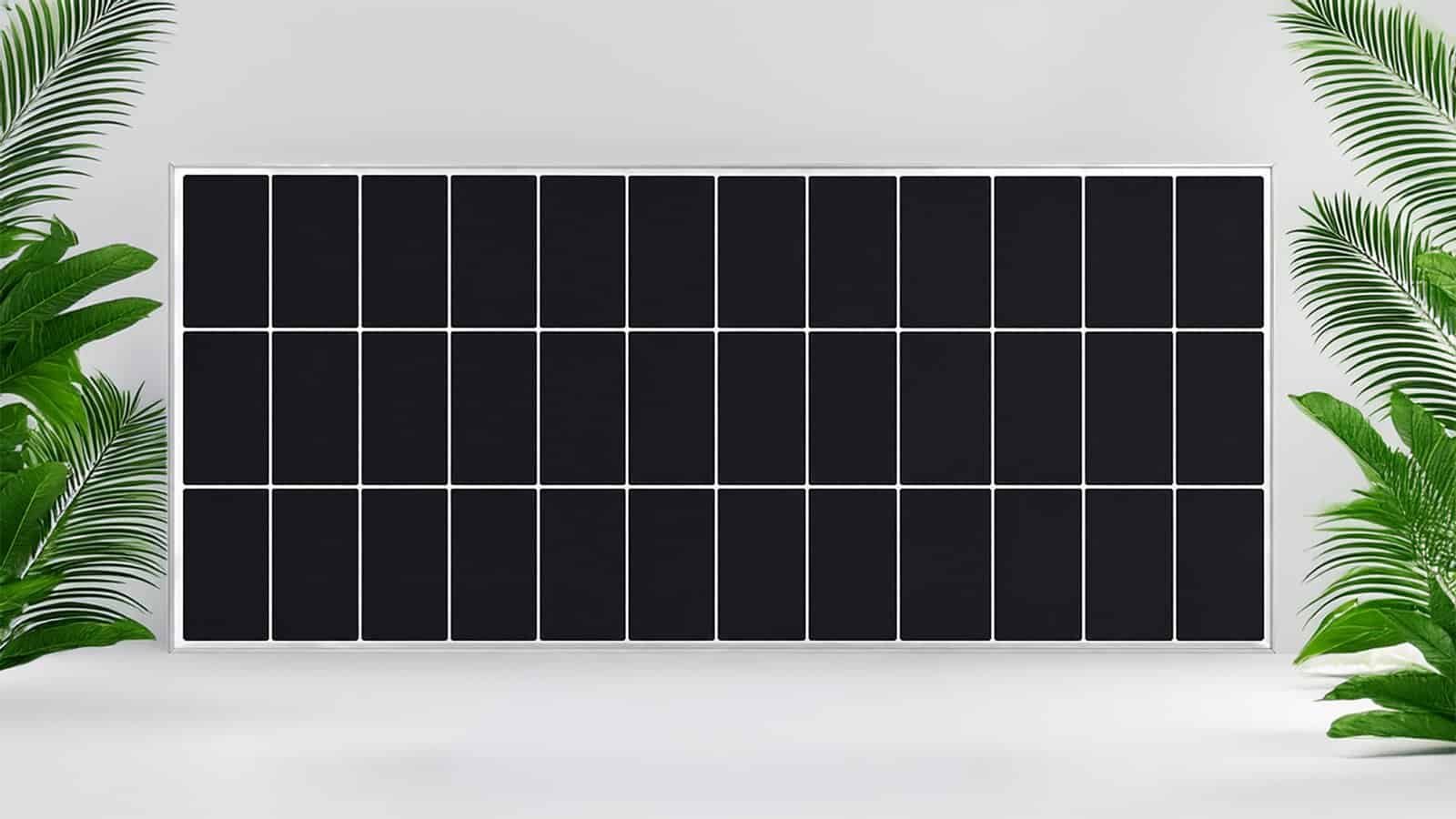
Back contact (BC) cells move every contact to the rear of the cell. Light hits a clean, uniform surface with no visible grid. The front looks fully black, which is why BC panels are popular for RVs, yachts, and premium outdoor gear.
BC is not one single technology, though. The original design, the interdigitated back contact (IBC) architecture, inspired newer branded versions like HPBC and ABC, and each manufacturer tunes the cell layout differently. The shared idea stays the same: move the wiring out of the light path and improve both output and appearance.
Shading Performance: What the Research Actually Shows
Shading tolerance is the most repeated claim in BC marketing. The real data backs it up, but only part of the way.
A 2026 TÜV NORD shading study compared BC and TOPCon modules under controlled shading conditions. A single fully shaded BC cell lost about 13 percent of its power. The same shading on a TOPCon cell caused a loss closer to 34 percent. That is a real advantage for light, scattered shadows, like a vent pipe or antenna shadow crossing part of a panel.
The advantage narrows fast, though. Once shading covers four or more cells within a string, BC and TOPCon modules start losing power at similar rates, both dropping close to half their output. Full-row or long-side shading erases the BC advantage almost entirely.
The practical takeaway: BC panels handle small, patchy shadows better than standard modules, but they do not fix a poorly planned layout. If your roof or deck has large fixed obstructions, plan panel placement first, rather than relying on the cell technology to compensate.
Shading tolerance research is still an active field. A 2026 study in Nature Communications explored built-in bypass diodes at the cell level, aiming to cut thermal damage from shading even further. That kind of ongoing work is a sign the industry still treats shading as an unsolved engineering problem, not a finished one.
Rigid vs Flexible BC Panels: Which One Fits Your Application?
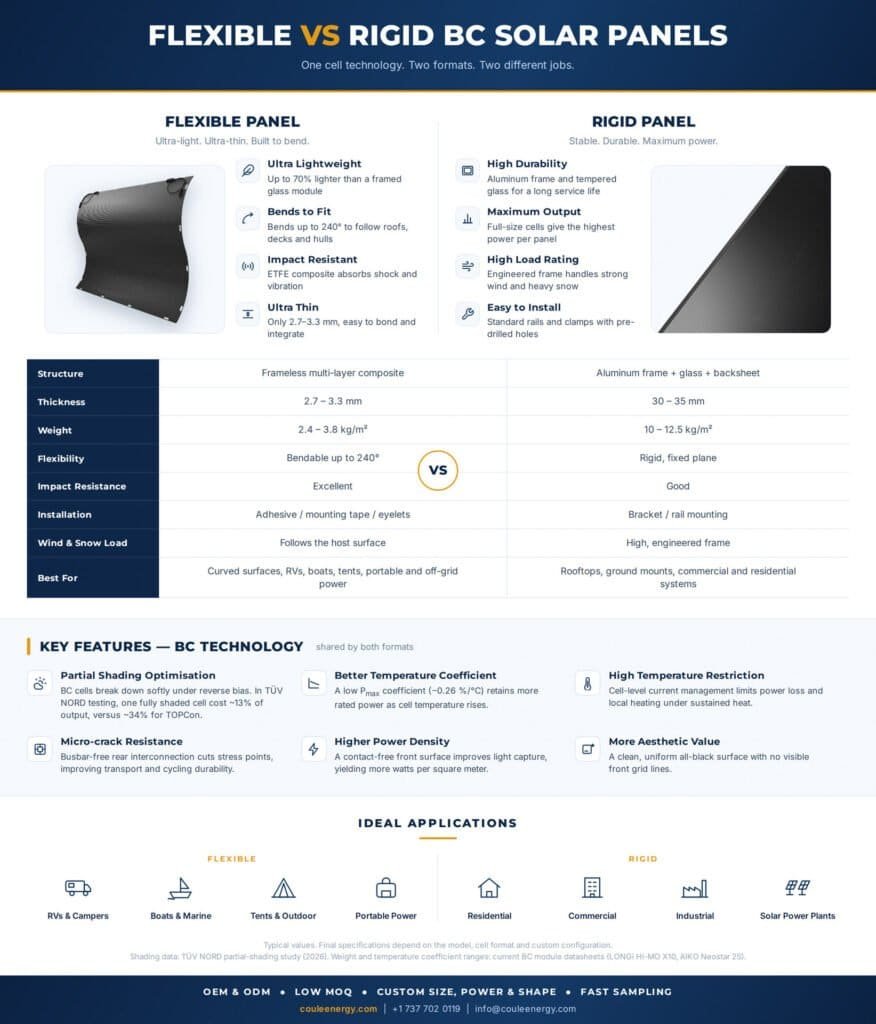
Rigid and flexible BC panels solve different problems. Rigid panels use a glass or polymer front sheet and an aluminum frame. They handle years of outdoor exposure well and mount with standard brackets and rails.
Flexible ETFE panels skip the frame and glass. They bend to match a curved roof or hull and weigh much less. That flexibility comes with trade-offs. Flexible panels usually need a smooth, stable surface for full adhesion, and they are more sensitive to foot traffic and improper mounting.
Neither option is universally better. The right choice depends on the surface, the application, and how the panel will be handled over its working life.
| Factor | Rigid BC Panel | Flexible ETFE BC Panel |
|---|---|---|
| Weight | Heavier: frame plus glass | Lightweight, no frame |
| Best surface | Flat roofs, standard mounts | Curved roofs, hulls, low-profile decks |
| Mounting method | Standard rails and clamps | Adhesive or grommet mounting |
| Durability under foot traffic | Higher | Lower; avoid regular walking |
| Typical fit | RV roofs, marine decks, ground mounts | Vans, boats, tight curved surfaces |
Where BC Panels Make the Most Sense
Three applications get the most value from BC technology today.
RV and camper systems. Roof space is the real limit on most RVs, not the budget. Vents, air conditioners, and antennas already take up prime space. Nearly half of RVers upgrading their rigs now cite solar or electrical upgrades as a priority, per an RV Industry Association survey. Output per square meter matters more here than raw panel size.
Marine systems. Boats deal with constant partial shading from masts, rigging, and antennas. The clean black finish also matches the design standards that many marine brands already follow.
Off-grid and remote power. Communication towers, agricultural sensors, and security systems often run on small, unattended solar setups. These systems benefit from stable output and a compact footprint, since panel space is frequently limited by the mounting structure itself.
A Working Example: The CLR175BC Rigid BC Module
Couleenergy’s CLR175BC is a useful reference point for how these principles play out in a real product. It is a 175W rigid, mono-facial BC module, built for exactly the roof and deck constraints described above.
It measures 1320mm x 580mm x 30mm, a compact footprint for RV roofs, marine decks, and off-grid mounts where space is tight. Its electrical profile (23.01V Vmp, 26.24V Voc, 7.61A Imp) pairs directly with MPPT controllers on 12V battery banks. A 24V bank needs a boost-capable controller, since Voc alone isn’t high enough to direct-charge a 24V nominal system.
The goal isn’t to push one SKU — it’s to show how the checklist below turns into real numbers you can compare against your own project.
Before You Order: A Buyer’s Spec Checklist
Wattage isn’t the only number that matters. Engineers and installers lean on the items below; distributors and OEM brands should weigh the next section’s sourcing questions just as heavily.
- Voltage class. Match Vmp and Voc to your battery bank and charge controller, especially for 12V and 24V systems.
- Temperature coefficient. Ask for this figure if the panel will run in consistently hot climates.
- Connector type and cable length. Confirm compatibility with your existing wiring and charge controller.
- Frame or frameless. Frameless panels save weight but need careful edge sealing.
- Junction box rating. Look for an IP rating suited to marine or fully exposed installs.
- Standards compliance. A fully custom module isn’t always run through formal IEC or UL certification the way a fixed catalog SKU is. Ask instead for the underlying test data showing it meets or exceeds those benchmarks.
- Degradation warranty. Compare the guaranteed output at year 10 and year 25 against typical crystalline silicon degradation rates, not just the headline number.
Sourcing BC Panels: Where Buyers Actually Get Stuck
Importers, distributors, OEM brands, system integrators, and RV or marine equipment manufacturers rarely fail on wattage or appearance. They get stuck on the business side of sourcing. These are the recurring friction points:
- MOQ mismatches. A minimum order built for a large distributor doesn’t work for a pilot run or a new product line.
- Slow customization quotes. Dimension, connector, or label changes that take weeks to price instead of days stall a launch schedule.
- Unclear private label terms. Branding and packaging rules that only surface after a deposit is paid create rework and delay.
- Compliance documentation gaps. A module engineered to one region’s requirements may need extra test documentation before it clears another, easy to miss when selling into both North America and Europe.
- No samples before commitment. A supplier that pushes straight to a full production order, with no sample unit, is asking you to buy blind.
- Inconsistent lead time updates. Vague answers once production starts usually mean the schedule is already slipping.
None of these are technical problems. They’re process issues, and they affect landed cost and launch timing more than the spec sheet does. Ask a supplier directly about MOQ tiers, customization turnaround, and which markets their documentation already covers — this is the exact gap Couleenergy’s OEM model is built around, with modules engineered to your dimensions, connectors, and labeling, sample units before a full production commitment, and documentation covering both North American and European deployment.
Key Takeaways
- BC panels give a real shading advantage, but only under mild, patchy shading conditions.
- Rigid and flexible BC panels serve different surfaces; pick based on the mounting structure, not looks alone.
- RV, marine, and off-grid buyers benefit most from BC’s output density and shading behavior. The CLR175BC’s compact, 12V-class profile shows what that looks like in a real spec sheet.
- Voltage class, temperature coefficient, and documented standards compliance matter as much as wattage.
- Most sourcing failures are process problems, not technical ones. Vet MOQ tiers, customization turnaround, and dual-market documentation before you commit.
- A reliable OEM partner shares real test data and sample panels before a large order.
Frequently Asked Questions
Are back contact solar panels always better than standard panels in shade?
Not always. BC panels perform better under light, patchy shading. Once shading covers several cells or a full row, BC and standard panels lose power at similar rates.
Can I walk on a flexible BC solar panel?
Occasional light contact is usually fine, but flexible panels are not built for regular foot traffic. Rigid panels handle this better.
What voltage class do I need for a 12V battery bank?
Look for Voc and Vmp figures that fall in the standard 12V-class range, and confirm your charge controller can handle them. A true 24V-nominal system needs a panel with roughly double the Voc, or a boost-capable MPPT controller paired with a 12V-class panel.
Is a rigid or flexible panel better for a boat?
It depends on the deck or hull shape. Flat, stable areas favor rigid panels. Curved surfaces favor flexible ETFE panels.
Does the CLR175BC support OEM or private label customization?
Yes. Couleenergy supports customized dimensions, connectors, labels, and packaging on the CLR175BC and similar modules. Confirm your specific requirements and volume with our team before production begins.
Every application has different roof space, mounting constraints, and performance priorities. Whether you’re evaluating the CLR175BC or planning a fully custom OEM module for an RV, marine, or off-grid project, our technical team can review your specs, MOQ, and target-market documentation needs, and recommend the right configuration.
Contact Couleenergy at info@couleenergy.com or +1 737 702 0119 for project-specific advice.




 English
  Español
  Français
  Deutsch
  Русский
  العربية