
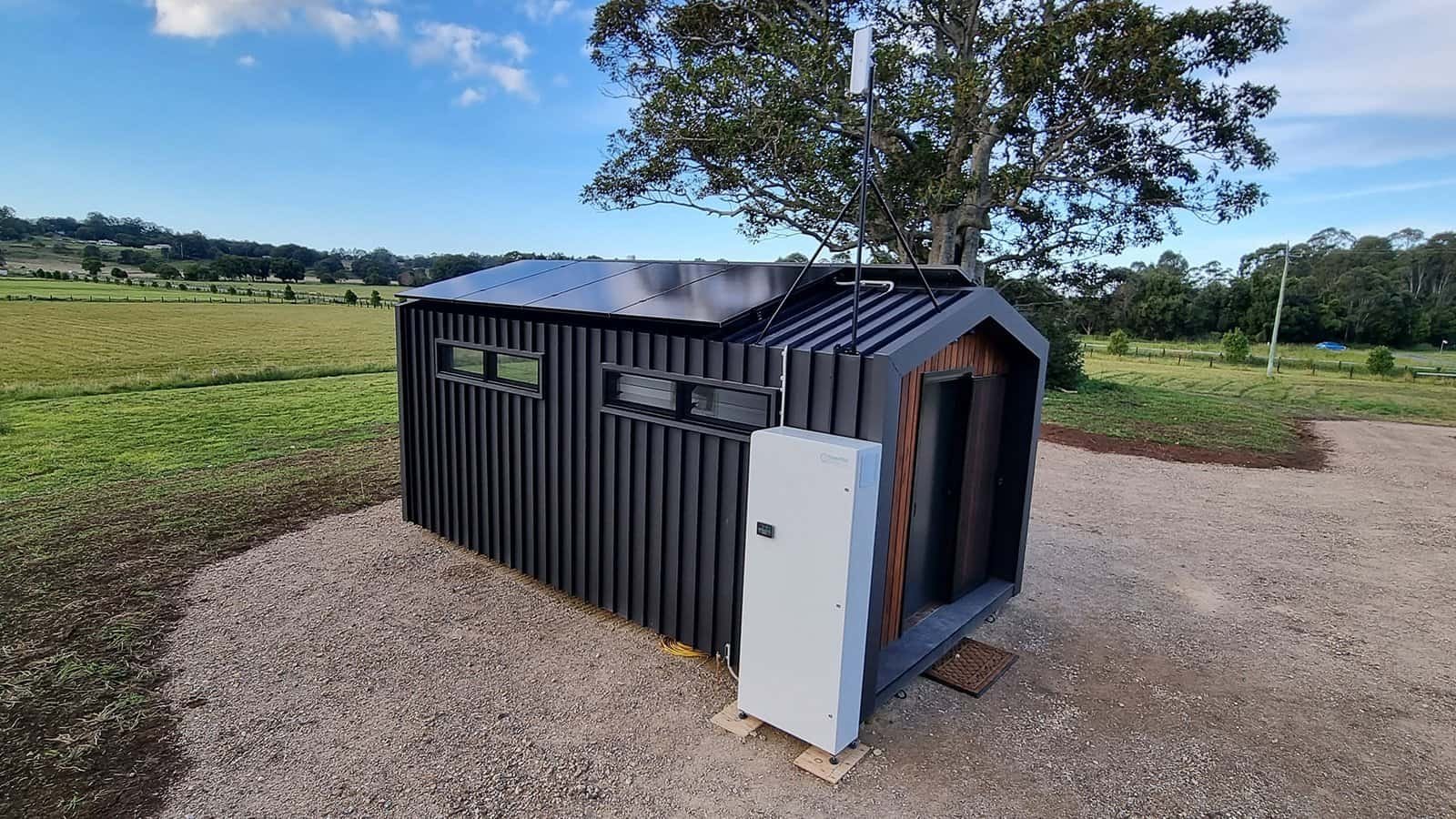
The cabin already has a woodstove, a water filter, and a week’s worth of food. What it doesn’t have — yet — is a reliable power supply. That’s the conversation most off-grid buyers start with. And it’s the wrong starting point.
Choosing solar panels for an off-grid cabin isn’t really about the panels. It’s about understanding your energy demand, matching your system voltage, and then picking the right module technology for your specific site conditions. Get that sequence right, and the panels almost choose themselves.
This guide walks through the full decision-making process — from load calculation to module selection — with a focused look at why Back-Contact (BC) solar panels are increasingly the technology of choice for space-constrained, partially shaded, or performance-sensitive cabin installations.
⚡ Quick Answer
How large an array does a cabin need? Calculate total daily watt-hours (Wh), divide by your local worst-month peak sun hours, and multiply by 1.25 for system losses. Most seasonal cabins need 600W–2,000W; full-time off-grid homes typically require 4 kW or more.
Which system voltage? 12V for DC-only micro-cabins. 24V for most seasonal builds with a fridge and inverter. 48V for full-time use or any array above 2,000W.
Are BC solar panels worth it for a cabin? Yes — when roof space is limited, partial shading is unavoidable, or the system must run reliably for decades with minimal service. Where space is unlimited and shading is absent, high-quality N-type TOPCon is a competitive alternative at a lower upfront cost.
Why Off-Grid Cabin Solar Is Different from Grid-Tied
On the grid, undersizing your solar array costs you a slightly higher electricity bill. Off-grid, it means no power.
That asymmetry changes everything. Off-grid cabin systems must account for worst-case weather, winter sun angles, battery discharge curves, and days without meaningful generation. Every component — panels, charge controller, batteries, inverter — needs to work as a coordinated system, not a collection of individually purchased parts.
BC solar panels have gained real traction in off-grid applications for one practical reason: they generate more power per square meter of roof than conventional technologies. For a small cabin roof with partial shade from surrounding trees, that efficiency advantage isn’t theoretical — it shows up directly in battery state-of-charge at the end of a cloudy November afternoon.
Step 1 — Calculate Your Daily Energy Demand First
Most system design errors start here. Buyers pick panel wattage before understanding their actual consumption. A 600W array sounds impressive until you realize the cabin needs 2,000 Wh per day to run a refrigerator, a water pump, and a few lights through a four-hour peak sun window.
The correct sequence:
- List every electrical device in the cabin
- Record each device’s wattage (check the nameplate label)
- Estimate realistic daily hours of use
- Multiply wattage × hours = daily watt-hours (Wh) per device
- Add up all devices
- Multiply the total by 1.20 to 1.30 to account for wiring losses, inverter conversion, and battery round-trip inefficiency
That final number — your adjusted daily Wh — is the foundation of every other decision.
Quick reference by cabin type:
| Cabin Type | Typical Daily Demand | Starting Array Size |
|---|---|---|
| Basic weekend cabin (lights, phones) | 300–600 Wh | 200–400W |
| Seasonal cabin (fridge, lighting, laptop) | 600–1,500 Wh | 500–1,000W |
| Comfortable part-time cabin (full appliances) | 1,500–4,000 Wh | 1.5–3 kW |
| Full-time off-grid home | 4,000 Wh+ | 4 kW+ |
Once you have your daily Wh figure, apply your local peak sun hours (PSH) — the number of hours per day when solar irradiance reaches 1,000 W/m² — to size the array:
Array wattage = (Daily Wh × 1.25) ÷ Peak Sun Hours
For North American sites, use the PVWatts calculator from NLR (the National Laboratory of the Rockies, formerly NREL — migrated to pvwatts.nlr.gov in May 2026). For European and international cabin projects, the EU Commission’s free PVGIS tool covers global locations with comparable accuracy. Always design for your worst month, not the annual average. In most of North America and northern Europe, December or January defines the performance ceiling your system must clear.
A cabin in Montana consuming 1,500 Wh/day with 3.2 PSH in December needs roughly 585W of panels before losses — meaning a 750W to 1,000W array is the practical starting point. Not 400W.
Step 2 — Choose System Voltage: 12V, 24V, or 48V
System voltage shapes the entire electrical design. Higher voltage means lower current for the same power level. Lower current means thinner wire, less heat loss, and better overall system efficiency.
The practical decision guide:
| System Voltage | Best Fit | Practical Array Range |
|---|---|---|
| 12V | Tiny cabin, lights-and-phone use, DC-only loads | Up to ~800W |
| 24V | Weekend cabin with inverter, fridge, basic appliances | ~800W–2,000W |
| 48V | Full-time cabin, high-power appliances, larger battery banks | 2,000W+ |
12V is simple and familiar. Most small RV and marine hardware runs on 12V. For a hunting cabin with only lights, a radio, and phone charging, it works well. Above about 800W, the cable sizing requirements become burdensome.
24V is the sweet spot for most seasonal cabin builds. It halves the current compared to 12V at the same power level, enabling sensible wire runs and a practical inverter setup for a refrigerator, laptop, lights, and a water pump.
48V is the right choice for full-time living. High-capacity inverter-chargers from brands like Victron, Outback, and Schneider Electric are designed around 48V battery banks. Modern LiFePO₄ battery systems scale most efficiently at 48V. High-output BC modules — rated at 400W+ — string cleanly into 48V MPPT charge controllers.
Step 3 — Choose the Right Solar Module Format: Rigid, Flexible, or Dual-Glass
Not all solar panels perform the same way in off-grid conditions. The right module depends on roof structure, available area, shading environment, climate, and whether the installation is permanent or seasonal.
Rigid Glass Modules
Rigid framed glass panels are the default for most permanent cabin systems. They offer robust mechanical durability, excellent thermal stability, and well-established mounting options. On a fixed timber or metal roof with adequate structural load capacity, they’re the reliable, long-term choice.
Best for: permanent installations, ground-mounted arrays, snow-load regions, full-time off-grid homes.
Flexible ETFE Modules
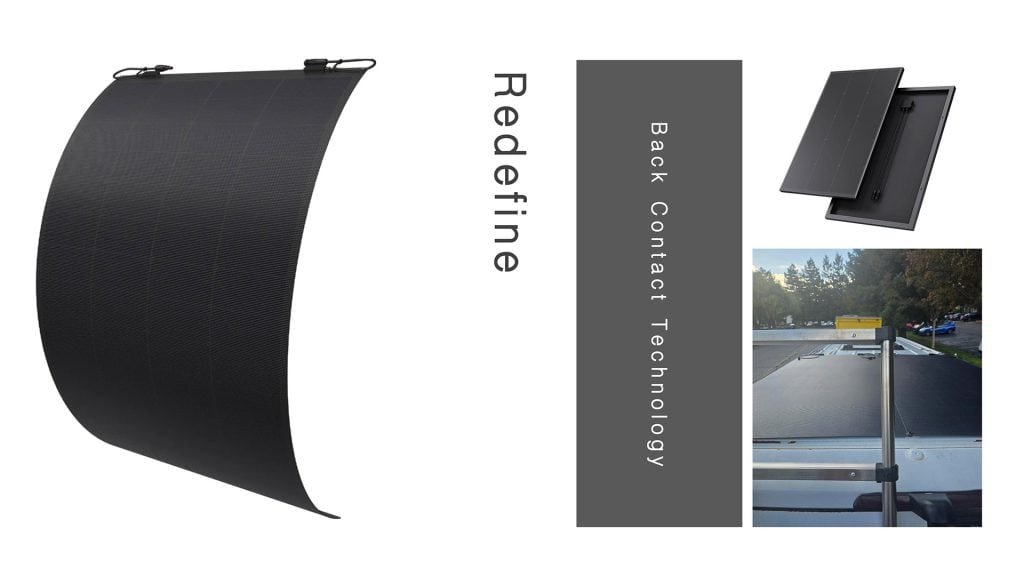
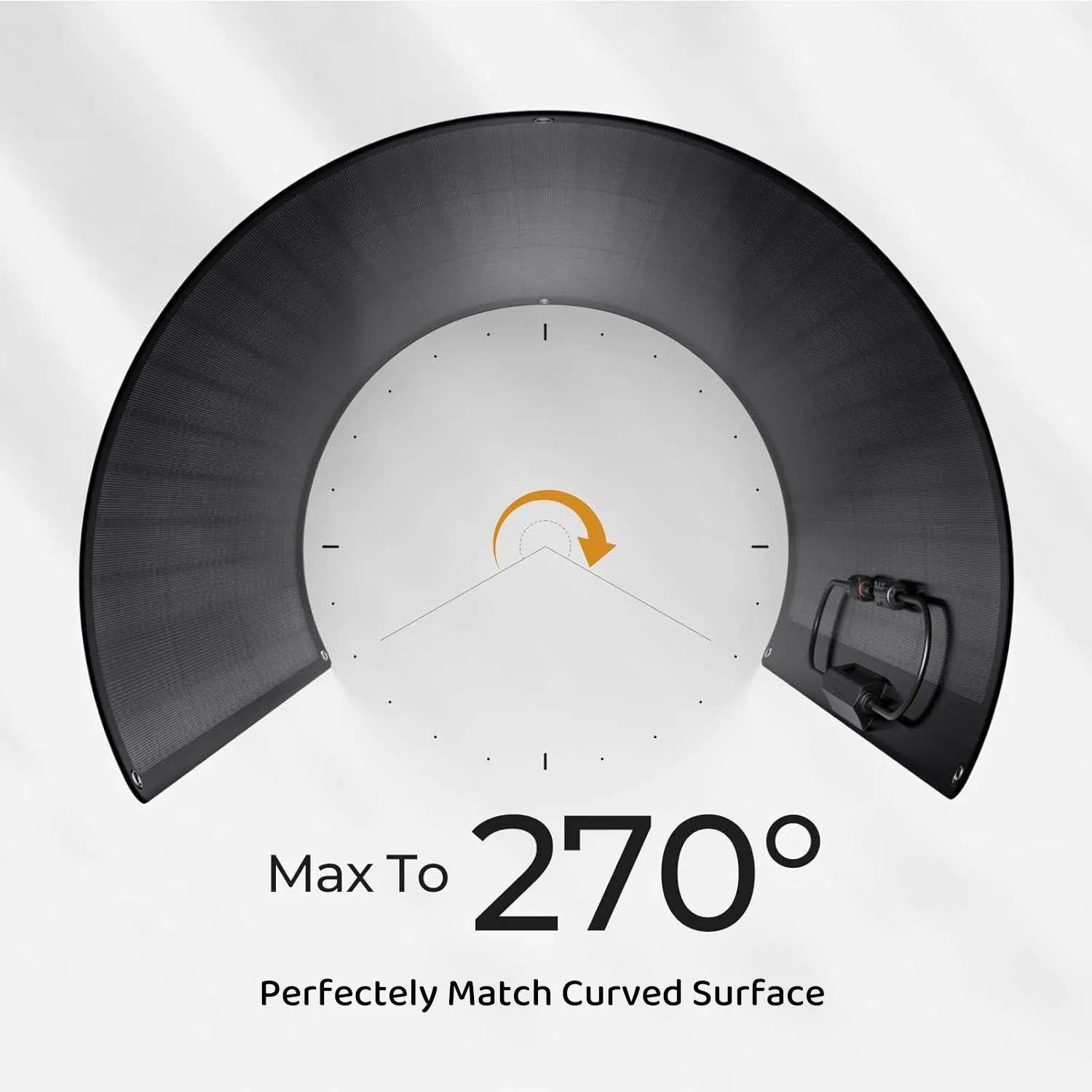
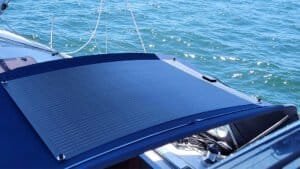
Flexible panels — particularly those with an ETFE (ethylene tetrafluoroethylene) front surface — solve problems rigid glass can’t. Curved metal roofs, lightweight timber frames, A-frame structures, and portable setups all benefit from a flexible, lightweight module with no aluminum frame adding structural load.
ETFE is the important qualifier. Lower-cost PET-backed flexible panels are prone to delamination, moisture ingress, and cell cracking after a few outdoor seasons. Premium ETFE-encapsulated flexible modules — especially those using BC cells — are engineered for long-term durability and substantially better performance retention.
Best for: curved roofs, lightweight structures, mobile or portable cabin kits, installations where panel weight is a constraint.
Dual-Glass Modules
Dual-glass panels replace the rear polymer backsheet with a second glass layer, dramatically improving moisture resistance, fire resistance, and durability. Coastal cabins, high-humidity environments, and BIPV applications benefit from dual-glass construction.
Best for: BIPV cabin roofs, harsh coastal or alpine environments, high-end architectural builds with a long design life.
Step 4 — Why BC Solar Panels Stand Out for Off-Grid Cabins
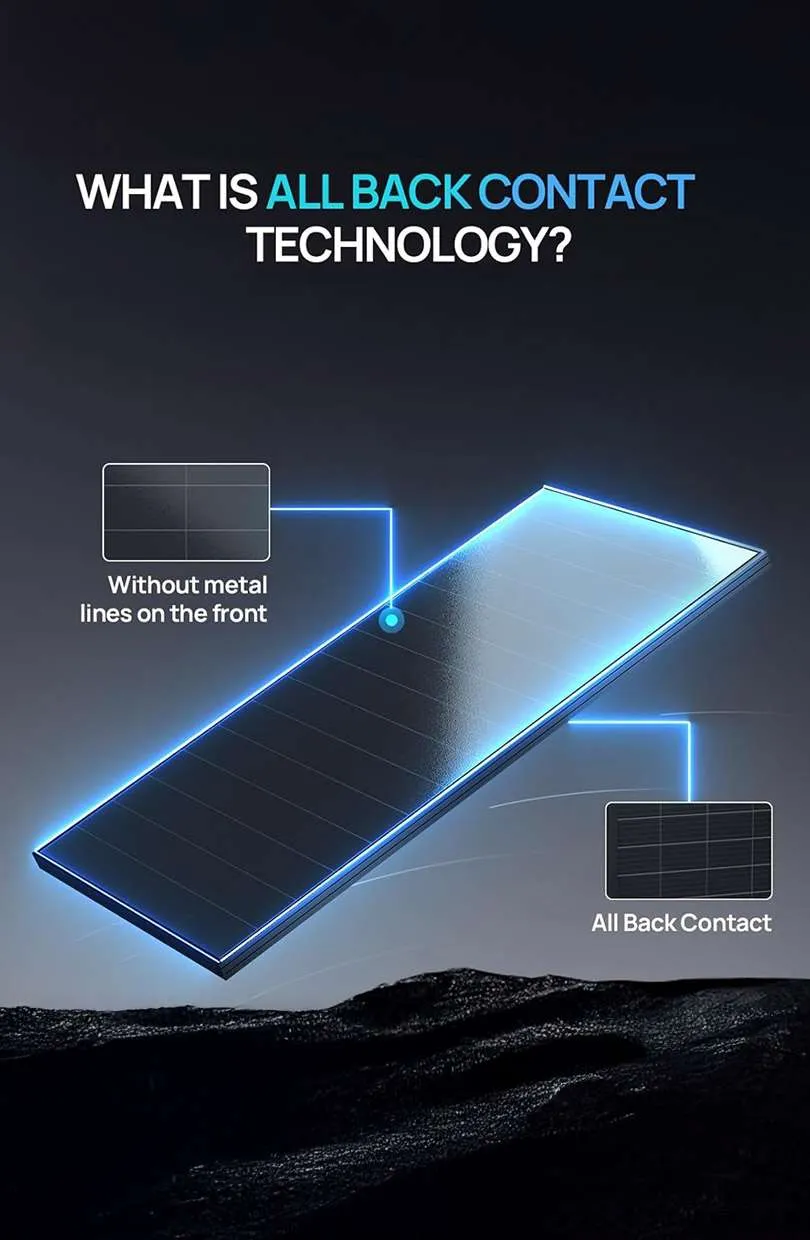
Back-Contact (BC) solar panels represent a meaningful technological step. Conventional panels run metal grid lines across the front surface to collect current. Those lines block 3–5% of incoming light before it can reach the silicon absorber.
BC panels move all electrical contacts — positive and negative terminals alike — to the rear of the cell. The front surface is unobstructed. Every photon that clears the front glass has a chance to generate current.
The result is higher efficiency, a cleaner visual profile, and measurably better performance in real-world conditions.
The Four Main Variants of BC Technology
IBC (Interdigitated Back Contact): The original BC architecture, commercialized by Maxeon (formerly SunPower). IBC panels have a multi-decade track record in high-performance applications and carry industry-leading warranty terms.
HPBC (Hybrid Passivated Back Contact): LONGi’s BC platform, now in its second generation (HPBC 2.0). It combines heterojunction-style passivation with back-contact cell architecture to achieve commercial module efficiencies above 24%, with the HPBC 2.0 module record standing at 25.4% (Fraunhofer ISE, October 2024). HPBC is also the cell technology behind advanced flexible ETFE modules — including Couleenergy’s CLM series.
ABC (All Back Contact): Aiko Solar’s architecture, one of the commercial module efficiency leaders in 2025–2026. The latest generation (rebranded as INFINITE in March 2026) crossed 25% module efficiency in volume production, with 535–550W output in standard formats.
HIBC (Heterojunction IBC): LONGi’s newest-generation BC architecture, launched commercially as the Hi-MO S10 EcoLife series at Intersolar Munich in May 2025 — the first mass-produced HJT + BC module in the world. HIBC stacks heterojunction-style amorphous silicon passivation onto an IBC rear-contact structure. The result: cell efficiency of 27.3% and module efficiency up to 25% in the 54-cell residential format (510W), with larger commercial versions achieving 25.9% at 700W+. HIBC is currently positioned as the premium option for space-limited residential and BIPV markets. Availability across North America and Europe is expanding throughout 2026.
BC Performance Advantages That Matter Off-Grid
Efficiency: Commercial BC modules deliver 22–25% module efficiency. Mainstream N-type TOPCon reaches 22–24%; standard mono PERC sits at 17.5–21%. More watts per square meter of cabin roof means fewer panels needed for the same output.
Temperature Coefficient: This is where BC modules show one of their clearest practical advantages. Every solar panel loses output as cell temperature rises above 25°C. The temperature coefficient — expressed as percentage per degree Celsius — tells you the rate of that loss. Lower is better.
| Technology | Temperature Coefficient (Pmax) |
|---|---|
| Polycrystalline P-type | −0.39 to −0.43%/°C |
| Mono PERC | −0.35 to −0.40%/°C |
| N-type TOPCon (mainstream) | −0.29 to −0.32%/°C |
| N-type TOPCon (premium flagship) | −0.26 to −0.28%/°C |
| IBC / HPBC 2.0 / ABC Gen 3 | −0.26 to −0.30%/°C |
| HJT | −0.24 to −0.27%/°C |
Sources: Clean Energy Reviews (March 2026); SurgePV (May 2026); LONGi Hi-MO X10, Aiko Gen 3 INFINITE, and Maxeon 7 manufacturer datasheets.
Important nuance: Some premium flagship N-type TOPCon modules from leading manufacturers now achieve temperature coefficients of −0.26 to −0.28%/°C, narrowing the historical gap with HPBC 2.0 and ABC Gen 3 on this specific metric. For hot-climate installations, always verify the individual module datasheet rather than relying on a technology-level generalization.
What this means in practice: On a summer afternoon with cell temperatures reaching 70°C — common on dark cabin roofs in July — a BC module rated at −0.26%/°C loses roughly 11.7% of its rated output. A standard PERC module at −0.38%/°C loses roughly 17.1% under identical conditions. That is nearly 50% more thermal loss from the PERC panel at the same nameplate wattage. The gap compounds across every hot day over a 25-year operating life.
Shade Tolerance: BC cells have a lower breakdown voltage than front-contact cells. When a BC cell is partially shaded and placed under reverse bias, it self-bypasses more readily — containing power loss to the shaded area rather than engaging bypass diodes and dropping entire substring output.
A simulation study published in PV Magazine (August 2025) by researchers at Trinasolar’s State Key Laboratory and Nanchang University confirmed this advantage — with an important boundary condition: BC modules outperform TOPCon when fewer than three cells per substring are shaded. When full rows are shaded, the performance gap narrows substantially.
In practice, this boundary condition matters less than it might seem for typical cabin sites. Moving tree shadows, partial chimney shade, roof vent shadows, and antenna mounts typically produce the cell-level partial shading where BC’s advantage is most pronounced. Full-row shading from adjacent structures is less common in standalone cabin settings. Independent testing has validated this advantage for both main commercial BC platforms: LONGi’s Hi-MO X10 (HPBC 2.0) received TÜV Rheinland Class A certification for shadow resistance in June 2025, demonstrating over 70% less power loss under shading than TOPCon modules in comparative testing. Aiko’s ABC technology holds an equivalent TÜV Rheinland Class A partial shading certification. Both certifications are conducted against the same TÜV Rheinland standard (2 PfG 2926), and the underlying HPBC 2.0 cell technology is the same platform used in Couleenergy’s CLM flexible ETFE series.
Combined with parallel string layouts or power optimizers, BC modules provide a meaningful reliability advantage on partially shaded cabin roofs.
Low-Light Performance: Without front busbar shading, BC cells absorb diffuse irradiance — the scattered light from overcast skies — more effectively than conventional modules. Pacific Northwest cabins, Canadian properties, and UK or Scandinavian installations see measurable benefit from this characteristic during cloudy periods, when diffuse light comprises a large share of winter-season energy yield.
Long-Term Degradation: N-type BC cells are largely immune to light-induced degradation (LID), which affects older P-type architectures. LONGi HPBC 2.0 and Aiko Gen 3 ABC both specify annual degradation rates of ≤0.35% per year from Year 2 through Year 30, with power output retention of 90%+ at Year 25. Premium IBC modules from Maxeon achieve even lower degradation rates — as low as 0.25–0.30% per year — backed by the industry’s longest warranty terms.
For context: mainstream TOPCon modules typically specify ≤0.40–0.45%/year degradation; standard PERC ≤0.45–0.55%/year. Over 25 years, even a 0.1 percentage point annual difference produces a cumulative energy gap that becomes significant in a remote cabin system that won’t be serviced or upgraded easily.
Specifying BC modules for your cabin project?
Couleenergy’s CLM flexible ETFE series uses HPBC 2.0 cell technology in a lightweight, bendable format engineered for curved cabin roofs, A-frames, and structural weight-constrained applications. The CLM-BCF range covers 30W to 300W with 20–22% module efficiency, a 3.4mm ultra-thin profile, IP67/68 junction boxes, and bending radius down to 30 cm — all certified to ISO 9001:2015, IEC 61215, IEC 61730, TÜV, and CE. For rigid BC or dual-glass BIPV needs, the team can help match module format to your site.
Contact: info@couleenergy.com • +1 737 702 0119
Step 5 — Honest Comparison: BC vs. TOPCon vs. PERC
| Criteria | BC (IBC / HPBC / ABC / HIBC) | N-type TOPCon | Mono PERC |
|---|---|---|---|
| Module efficiency (2026) | 22–25% | 22–24% | 17.5–21% |
| Temperature coefficient | −0.26 to −0.30%/°C | −0.26 to −0.32%/°C* | −0.35 to −0.40%/°C |
| Low-light performance | Excellent | Good | Moderate |
| Partial shade tolerance | Excellent (cell-level)† | Good | Fair |
| Aesthetics | All-black, no visible busbars | Black with thin busbars | Blue/black with busbars |
| Annual degradation | ≤0.35%/yr (HPBC/ABC); ≤0.30%/yr (premium IBC) | ≤0.40–0.45%/yr | ≤0.45–0.55%/yr |
| Best cabin fit | Space-limited, shaded, hot climate, BIPV, flexible | General off-grid, balanced budget-performance | Large ground arrays, entry-level systems |
* Premium flagship TOPCon from leading manufacturers achieves −0.26 to −0.28%/°C, narrowing the gap with HPBC 2.0 and ABC Gen 3 on this metric.
† BC shade advantage is most pronounced when fewer than three cells per substring are shaded; narrows under full-row shading per 2025 peer-reviewed research (Trinasolar/Nanchang University, PV Magazine, August 2025).
BC is the right choice when the cabin roof is small, the site has meaningful partial shading, the climate is hot in summer, or the installation demands longevity with minimal servicing. TOPCon remains a strong choice where space is less constrained and upfront cost is the primary driver. PERC is best suited to large open ground arrays where per-watt economics dominate.
Step 6 — Electrical Design: Matching BC Panels to Your System
MPPT Charge Controller Sizing
Correct controller sizing involves three separate checks — not one.
1. Current rating: Per NEC 690.8, PV circuit conductors — and the controller’s rated input current — must be sized for at least 125% of the array’s short-circuit current (Isc). Solar irradiance can briefly exceed the 1,000 W/m² STC reference during cloud-edge enhancement events; the 125% margin is not conservative, it is code-required.
2. Voltage ceiling — critical for BC modules in cold climates: Always calculate the cold-temperature string open-circuit voltage (Voc) using this formula:
Voc (cold) = Panel Voc × Series panel count × [1 + (Voc temperature coefficient × (Coldest site temperature − 25°C))]
Note on sign convention: The Voc temperature coefficient is always listed as a negative value on module datasheets — for example, −0.27%/°C is entered as −0.0027. At temperatures below 25°C, the temperature delta is negative, making the product positive, which correctly increases Voc. At −20°C with a coefficient of −0.0027: 1 + (−0.0027 × −45) = 1 + 0.121 = 1.121 — a 12.1% voltage increase above STC.
Use the module datasheet’s published Voc temperature coefficient — not a generic approximation. This value ranges from approximately −0.22%/°C to −0.32%/°C depending on cell technology. For the coldest site temperature, use the ASHRAE 99.6% design minimum for your location. The resulting cold-temperature string Voc must remain below the controller’s absolute rated maximum input voltage.
NEC 690.7 mandates this calculation. Skipping it — particularly with high-efficiency BC modules that have elevated Voc values — is one of the most common sources of charge controller damage in cold-climate off-grid systems.
3. MPPT tracking range: The string Vmp at the hottest expected operating temperature must stay above the controller’s minimum MPPT threshold. This is a separate limit from the Voc ceiling and must be checked independently.
System Design by Cabin Size
☀ Small Weekend Cabin — 12V / 24V
- 1–3 BC panels (300–500W each)
- MPPT charge controller (30–60A)
- 100–200Ah LiFePO₄ battery bank (80% DoD; target 2–3 days autonomy)
- 1,000–2,000W pure-sine inverter
🏠 Seasonal Part-Time Cabin — 24V / 48V
- 4–8 BC panels (400–500W each)
- MPPT charge controller (60–100A), e.g., Victron SmartSolar or Midnite Classic
- 200–400Ah LiFePO₄ battery bank (2–3 days autonomy)
- 2,000–3,000W inverter/charger
🏢 Full-Time Off-Grid Home — 48V
- 10–20+ BC panels (400–500W each)
- MPPT charge controller (100A+) or multiple parallel controllers
- 400Ah+ LiFePO₄ battery bank (target 3–5 days autonomy)
- 3,000–6,000W pure-sine inverter/charger
- Generator backup for extended low-production periods
Battery Autonomy and Depth of Discharge
Battery capacity must be sized independently from the solar array. Extended cloudy periods are not solved by more panels.
For LiFePO₄ batteries, a maximum depth of discharge (DoD) of 80% is widely recommended as the optimal balance between usable capacity and cycle life. For AGM/GEL lead-acid batteries, limit DoD to 50% — which effectively halves the usable capacity relative to the nameplate rating compared to LiFePO₄.
Battery Capacity (Ah) = (Daily Wh × Days of Autonomy) ÷ (System Voltage × Depth of Discharge)
Target 2–3 days of autonomy for weekend cabins; 3–5 days for full-time off-grid residences.
Mounting, Orientation, and Tilt
- Face true south in the northern hemisphere (not magnetic south, which varies by location)
- Set tilt equal to your latitude for year-round balance (e.g., 40° tilt at 40°N)
- For winter-optimized performance: increase tilt to latitude + 10–15°
- Use parallel string layouts for shaded sites — a shaded panel in one string won’t affect an unshaded parallel string
- BC panels’ cell-level shade behavior makes them particularly suitable for cabin sites with tree canopy or uneven terrain
Five Design Mistakes Off-Grid Cabin Buyers Make
Sizing for average sun hours, not worst-month production. A system sized for July’s 6.5 PSH will leave the cabin dark in December’s 2.8 PSH. Always use winter or worst-month figures as the design baseline.
Ignoring battery autonomy. More panels don’t solve extended cloudy periods. Battery capacity needs to cover 2–3 days for weekend cabins, and 3–5 days for full-time residences. Size both independently, then verify they’re matched.
Skipping the cold-weather Voc calculation. High-efficiency BC modules have relatively high Voc values — typically 45–55V per panel. A string of three panels at −20°C can push Voc 10–15% above the STC rating. If that exceeds the controller’s maximum rated input voltage, equipment damage follows. Calculate using the module’s datasheet Voc coefficient and your site’s ASHRAE 99.6% design minimum temperature.
Underspecifying the MPPT controller. Conductors and overcurrent protection must be rated for 125% of array Isc (NEC 690.8). Verify the maximum PV input voltage covers cold-weather Voc. Also confirm the MPPT tracking range covers string Vmp at peak summer operating temperature. Skimping on the controller is one of the most common sources of off-grid system failure.
Buying flexible panels without verifying the encapsulation. ETFE-front flexible panels are not all equivalent. PET-backed modules fail in permanent outdoor installations — often within two to four years. For cabin applications, premium ETFE encapsulation with proper multi-layer cell structure is the baseline specification.
Off-Grid Cabin Solar: Selection Checklist
Before specifying any module, confirm:
Frequently Asked Questions
What are the best solar panels for an off-grid cabin?
The best solar panels for an off-grid cabin depend on three site-specific factors: available roof area, shading profile, and climate. For space-limited or partially shaded cabin roofs, Back-Contact modules (BC — including IBC, HPBC, ABC, or HIBC) deliver the highest watts per square meter and perform better under partial shading and heat. For open ground-mounted arrays with no shading, N-type TOPCon offers strong performance at lower cost. For curved or lightweight cabin roofs, flexible ETFE panels with HPBC or ABC cells are the most practical choice.
How many solar panels does an off-grid cabin need?
It depends entirely on daily energy demand, local sun hours, and system efficiency. A weekend cabin with basic lighting and phone charging might be well-served by 300–500W. A full-time off-grid home can require 4–8 kW or more. Calculate daily Wh first — that number determines everything else.
Are BC solar panels worth it for a small cabin?
For space-limited cabin roofs, sites with partial shading, or hot-climate installations, BC panels deliver more energy per square meter and lose less power to heat. The efficiency and temperature coefficient advantages are most valuable precisely where small systems operate under real-world constraints. For a large open ground array with no shading, the performance gap between BC and high-quality TOPCon narrows.
Can I use flexible solar panels permanently on a cabin roof?
Yes, with the right specification. Premium ETFE flexible modules with multi-layer encapsulation — particularly those using HPBC 2.0 or ABC Gen 3 cells — are engineered for long-term outdoor durability. Avoid PET-backed panels for permanent cabin installations.
What’s the best system voltage for an off-grid cabin?
For small weekend cabins with basic DC loads, 12V is straightforward. Most seasonal cabins with an inverter, a refrigerator, and moderate AC loads are best served by a 24V system. For full-time off-grid use or any system above 2,000W, 48V delivers better efficiency and broader hardware compatibility.
Why does cold weather matter for BC panel string design?
Solar panel open-circuit voltage (Voc) increases as temperature drops — a fundamental property of silicon cells. A BC module with a 50V Voc at 25°C can produce 55–58V at −20°C. Wire three such panels in series and the cold-weather string Voc reaches 165–174V — which can exceed the maximum input voltage of many off-grid MPPT controllers. NEC 690.7 requires this calculation be performed using the module’s datasheet Voc temperature coefficient and the ASHRAE 99.6% design minimum temperature for the site.
What happens during extended cloudy weather?
Battery autonomy covers short cloudy periods. For full-time off-grid cabins in cloudy climates, most experienced designers integrate a generator backup that the inverter-charger engages automatically when battery state of charge drops below a set threshold. This hybrid approach is more reliable than over-sizing the solar array for every possible weather scenario.
Does BC shade tolerance make optimizers unnecessary?
Not entirely. BC cells’ lower breakdown voltage gives them a natural partial-shade advantage most pronounced when fewer than three cells per substring are shaded — a finding confirmed in peer-reviewed research covered by PV Magazine (August 2025) from Trinasolar and Nanchang University. For heavily shaded sites or complex roof geometries, string-level optimizers remain valuable. BC’s shade behavior reduces the frequency of power loss events; careful string layout planning still matters.
Key Takeaways
Off-grid cabin solar follows one non-negotiable sequence: size for energy demand first, choose voltage second, select module technology third. Here’s what that means in practice:
- Calculate before you shop. Daily watt-hours ÷ worst-month peak sun hours × 1.25 = array wattage. Everything else follows from this number.
- Voltage determines system architecture. 12V for DC micro-cabins. 24V for most seasonal builds. 48V for full-time living or arrays above 2 kW.
- BC modules earn their premium in specific conditions. Space-limited roofs, partially shaded sites, hot-summer climates, and systems designed for 25+ years of minimal-maintenance operation are exactly where IBC, HPBC 2.0, ABC Gen 3, and HIBC outperform conventional alternatives.
- Shade tolerance has a boundary. The BC advantage over TOPCon is strongest when fewer than three cells per substring are shaded — the pattern most common on cabin sites with trees or chimneys. Under full-row shading, the gap narrows. Design around this.
- Battery autonomy is a separate calculation. Target 2–3 days for weekend cabins; 3–5 days for full-time use. Size it independently from the array.
- Cold-weather Voc is a safety calculation, not a guideline. Use the module datasheet’s Voc coefficient and your site’s ASHRAE 99.6% design minimum temperature. Skipping this step damages controllers.
- Flexible ETFE matters for curved and lightweight roofs. Premium ETFE-encapsulated BC flexible modules are engineered for long-term outdoor use. PET-backed alternatives are not.
The best off-grid cabin system isn’t the largest one. It’s the one correctly sized for actual demand, properly matched to local conditions, and built from components that will still perform reliably fifteen winters from now.
Get Module Recommendations for Your Project
Every off-grid cabin has a different combination of roof size, shading profile, climate, usage pattern, and system voltage. Standard sizing tables get you to the right ballpark — but the right module specification requires a conversation about your specific site.
Couleenergy is a Zhejiang-based B2B solar module manufacturer specializing in HPBC 2.0 back-contact flexible ETFE panels, rigid BC modules, and dual-glass BIPV products. The CLM flexible series is certified to ISO 9001:2015, IEC 61215, IEC 61730, TÜV, and CE, and covers 30W to 300W with 20–22% module efficiency in a 3.4mm bendable ETFE format. The team works directly with installers, EPC contractors, and off-grid project owners across North America and Europe on module selection, string configuration, and custom OEM formats.
When you reach out, it helps to have: your cabin’s available roof or mounting area, the system voltage you’re targeting, any known shading constraints, and your location (for PSH estimation). From there, Couleenergy’s team can recommend the right module format and configuration for your build.
 English
  Español
  Français
  Deutsch
  Русский
  العربية