

Your building has curved walls. Your boat deck follows natural contours. Your RV roof isn’t flat. Traditional solar panels? They simply don’t fit.
This is the challenge engineers and designers face daily. Standard rigid solar panels work great on flat roofs. But modern projects demand flexibility—literally. That’s where narrow flexible solar panels change everything.
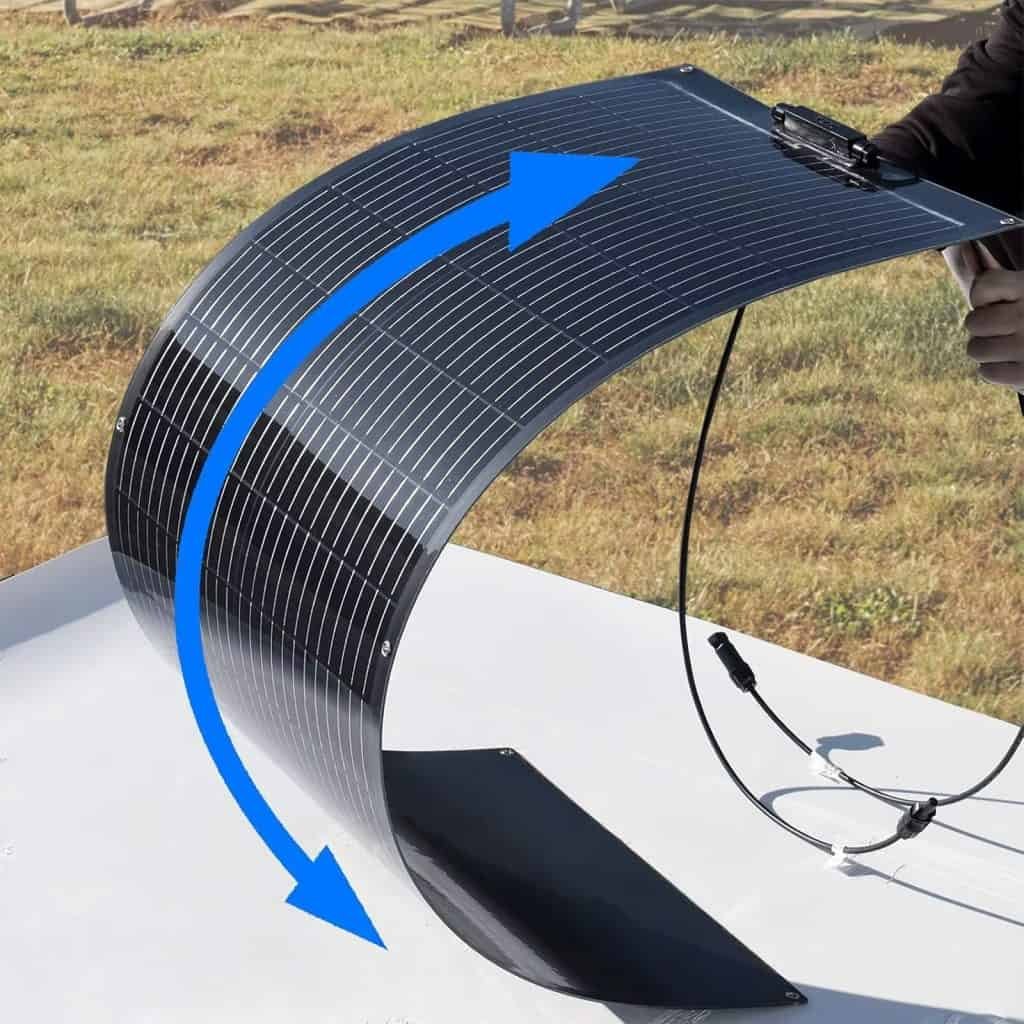
These innovative solar panels bend, conform, and adapt to surfaces that seemed impossible before. They’re transforming how we think about solar power in tight spaces, curved applications, and weight-sensitive projects.
What Makes Narrow Flexible Solar Panels Different?
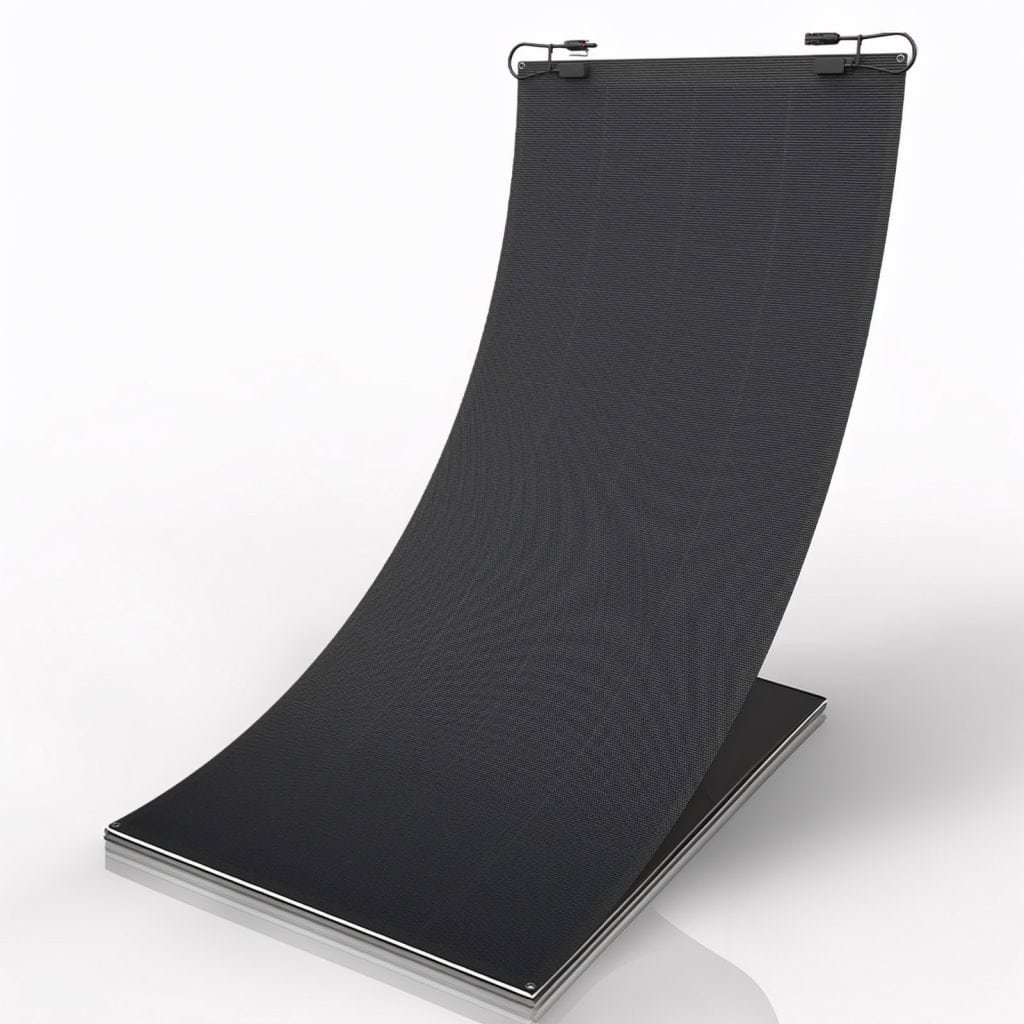
Think of these solar panels as the opposite of traditional solar. They’re incredibly thin—just 2 to 3 millimeters compared to 30 to 40 millimeters for standard solar panels. Weight? A fraction of conventional options at 2 to 3 kilograms instead of 18 to 20 kilograms.
| Feature | Typical Flexible Panels | Traditional Rigid Panels |
|---|---|---|
| Thickness | 2-3 mm | 30-40 mm |
| Weight | 2-3 kg | 18-20 kg |
| Efficiency (Standard) | 15-20% | 20-22% |
| Efficiency (Advanced) | 20-22% (Premium) | Up to 25.4% (HPBC) |
| Flexibility | Bends to 30 cm radius | Rigid only |
| Installation | Adhesive backing | Complex mounting |
| Lifespan | 10-15 years | 25-30 years |
⚠️ Important Efficiency Context: Most flexible panels trade 3-5% efficiency for flexibility and lightweight design. Typical flexible solar panels achieve 15-20% efficiency compared to 20-22% for rigid solar panels. However, advanced HPBC solar cell technology[^1] can reach world-record efficiencies up to 25.4%—though this represents cutting-edge technology rather than standard products. The lower efficiency is often offset by the ability to install solar panels in positions where rigid panels simply cannot go.
🔧 The Secret Lies in Their Construction:
- Ultra-thin photovoltaic cells that flex without breaking
- Advanced ETFE coating material[^2] instead of heavy glass (10+ year outdoor durability)
- Lightweight backing materials that maintain durability
- Flexible junction boxes that move with the panel
These solar panels can bend to fit curves with radii as small as 30 centimeters. Try that with a traditional solar panel and watch it crack.
The technology uses monocrystalline or advanced HPBC cells. HPBC (Hybrid Passivated Back Contact) represents the cutting edge. It moves all electrical contacts to the back of the cell. This eliminates shading and boosts efficiency up to 25.4%.

Where These Solar Panels Solve Real Problems
🚤 Marine Applications That Demand Flexibility
Boats need power, but they also need solar panels that handle saltwater, movement, and curved surfaces. Flexible solar panels check all these boxes.
Canal boat operators love them. The solar panels fit narrow boat roofs perfectly. They follow deck contours without gaps. One installation with ten solar panels generated 580 kilowatt-hours over three months of continuous cruising. That’s real power from a real-world application.
Installation is straightforward. Most solar panels use adhesive backing. No drilling through your boat’s structure. No complex mounting systems that add weight and stress points.
🚐 RVs and Motorhomes Finally Get Proper Solar
RV roofs curve. They have air conditioning units, vents, and skylights. Traditional solar panels? They create a puzzle with missing pieces.
Flexible solar panels solve this perfectly:
- They conform to roof curves
- They fit around obstacles
- They install with simple adhesive or minimal hardware
The weight savings matter too. Every kilogram counts when you’re traveling. Flexible solar panels add power without significantly impacting your vehicle’s performance or fuel efficiency.
🏢 Building Integration That Looks Intentional
Architects dream of solar that doesn’t scream “solar panel.” Building-integrated photovoltaics (BIPV)[^3] makes this possible. Narrow flexible solar panels integrate into facades, curved architectural features, and even windows.
Custom colors transform them into design elements:
- Black blends with modern buildings
- Terracotta matches heritage structures
- Semi-transparent options create shaded windows that generate power
The solar panels follow complex geometries that rigid options can’t match. Your artistic vision stays intact while adding sustainable energy generation.
💡 Street Lighting and IoT Infrastructure
Smart cities need smart power solutions. Solar street lights with IoT sensors, cameras, and communication equipment require precisely sized PV panels. Standard sizes rarely fit designated mounting areas.
Custom narrow flexible panels solve this challenge. They fit curved poles perfectly. They provide exact voltage outputs for integrated electronics. They handle the weight restrictions of pole-mounted systems.
⛺ Portable Power for Adventures
Camping and outdoor activities demand lightweight, packable power. Flexible solar panels deliver exactly this.
- Strap a panel to your backpack while hiking
- Drape it over your tent at camp
- Lay it flat on the ground during the day
A 100-watt solar panel produces approximately 350-400 watt-hours per day in good conditions—enough energy for laptop use (4-6 hours), LED lighting (8-10 hours), and device charging (10+ phone charges). They pack small, weigh little, and deploy quickly. Perfect for situations where traditional PV panels would be impractical or impossible.
Custom Manufacturing Opens New Possibilities
Off-the-shelf solutions force compromise. Custom manufacturing eliminates this problem.
📏 Size Flexibility Ranges Dramatically:
- Tiny 52 by 52 millimeter units for small electronics
- Large formats up to 2200 by 3300 millimeters for significant power
- Any dimension in between for specific applications
⚡ Voltage Options Adapt to Your System:
- 2 volts for small devices
- 12 or 24 volts for standard battery systems
- 48 volts or custom outputs for specialized equipment
🔷 Shape Possibilities Extend Beyond Rectangles:
- Circular solar panels for unique designs
- Triangular configurations for specific spaces
- Octagonal formats for architectural features
- Completely custom geometries for one-of-a-kind projects
💪 Power Output Scales to Requirements:
- 0.33 watts for sensor applications
- Mid-range options for mobile systems
- 400 watts and beyond for substantial installations
Understanding Key Technical Specifications
Making informed decisions requires understanding what matters.
Cell Technology Affects Performance
| Cell Type | Typical Module Efficiency | Best For |
|---|---|---|
| HPBC Technology | Up to 25.4% (cutting-edge) | Maximum power generation |
| PERC Cells | 20-22% | Balanced performance and cost |
Environmental Protection Ratings Matter
- IP67 waterproof rating[^4]: Dust-tight with temporary submersion resistance (1 meter for 30 minutes). Essential for marine environments and extreme weather exposure.
- IP65 rating: Dust-tight and water-resistant against low-pressure jets. Good for most outdoor applications.
- IP68 rating: Handles continuous submersion beyond 1 meter. Critical for the most demanding marine applications.
Flexibility Range Defines What’s Possible
Quality solar panels handle 30 to 50 centimeter radius curves safely. Push beyond these limits and you risk cracking cells or breaking waterproof seals.
Always verify the minimum bending radius for your specific application. Different manufacturers use different materials with varying flexibility characteristics.
Certifications Provide Quality Assurance
- IEC 61215 certification standard[^5] tests performance through 1,000 hours of damp heat and 200 temperature cycles for design qualification
- IEC 61730 covers safety certification preventing electrical hazards and fire risks
- CE marking required for European markets (verify third-party certification)
- TÜV Rheinland photovoltaic module certification[^6] provides rigorous testing with over 40 individual tests and monthly production sampling
Premium manufacturers exceed minimum standards. They conduct extended environmental stress tests and real-world performance validation.

How to Choose the Right Solution
Start With Your Application Requirements
Ask yourself these critical questions:
- What surface are you working with? Measure its curves, dimensions, and available space.
- What are your weight restrictions and mounting options?
- How much energy do you require daily?
- What voltage does your battery system use?
- What are your environmental conditions?
Work With Experienced Manufacturers
Direct manufacturer relationships offer significant advantages. You gain access to engineering expertise that distributors can’t provide.
🎯 Benefits of Working Directly with Manufacturers:
- Custom specifications mean exact dimensions, voltage, and power output
- Engineering support helps optimize system integration
- Quality control becomes transparent throughout the process
- Better pricing by eliminating distributor markups
Prioritize Long-Term Performance
Don’t just look at initial specifications. Consider lifespan and degradation rates. Quality flexible solar panels maintain performance for 10 to 15 years—shorter than the 25-30 year lifespan of traditional panels, but sufficient for mobile applications, temporary installations, and projects where flexibility outweighs longevity requirements.
ETFE coating provides excellent UV resistance and weathering performance. It maintains flexibility while protecting cells from environmental damage.
Check warranty coverage. Reputable manufacturers stand behind their products with comprehensive warranties. This protects your investment over time.
Real-World Applications Prove the Value
🚁 Drone Charging Stations
Advanced drone operations need compact charging solutions. Custom solar panels integrate into landing pads with exact voltage specifications. They match battery systems perfectly without compromising flight dynamics.
🏙️ Smart Pole Infrastructure
Cities installing smart poles face tight space constraints. Solar panels must fit designated areas while powering multiple devices 24/7. Custom narrow flexible panels deliver precise sizing and reliable performance.
🏛️ Architectural Solar Integration
Building facades with complex geometries need PV panels that follow artistic curves. Standard rectangles create unsightly gaps. Custom flexible panels maintain structural integrity while respecting design vision.
📡 Remote Monitoring Systems
IoT sensors in remote locations need reliable power. Small custom panels provide exact voltage outputs for sensor electronics. They mount easily in exposed environments with minimal infrastructure.
Why Couleenergy for Your Custom Project?
Couleenergy specializes in transforming challenging requirements into reliable solutions. With our rich manufacturing experience, we understand custom PV applications deeply.
Our Advanced Capabilities Include:
- HPBC/ABC technology delivering industry-leading efficiency
- Complete certifications including TÜV, CE, and IEC standards
- Flexible manufacturing from prototypes to large-scale production
- Global shipping with established logistics partnerships
- Engineering support throughout the entire process
Our Proven Development Process
- Requirements Analysis – We discuss your project specifications in detail. Understanding your exact needs ensures optimal solutions.
- Custom Design – Our engineers create detailed drawings with precise dimensions and electrical specifications.
- Prototype Development – We produce sample panels for testing and validation before full production.
- Production Planning – We optimize manufacturing schedules for your timeline with efficient planning.
- Quality Control – Rigorous testing happens throughout production. Every panel meets our high standards.
- Global Delivery – We ship securely worldwide with complete documentation ready for installation.
Frequently Asked Questions
❓ How long do flexible solar panels last?
Quality flexible solar panels typically last 10 to 15 years with proper maintenance, though some high-end models can reach 20-25 years. While this is shorter than traditional rigid panels (25-30 years), it’s sufficient for mobile applications, temporary installations, and projects where flexibility is essential. Lifespan depends on material quality, environmental conditions, and maintenance practices.
❓ Can flexible solar panels be walked on?
No, flexible solar panels should not be walked on. While they’re more impact-resistant than rigid panels, walking on them can cause microcracks in the cells, damage the protective coating, and significantly reduce efficiency. If foot traffic is unavoidable in your application, consider installing protective walkways or choosing ruggedized panel designs specifically rated for occasional foot traffic.
❓ How do you install flexible solar panels?
Most flexible panels install using industrial-grade adhesive backing or marine-grade double-sided tape, eliminating the need for drilling. For permanent installations: (1) Clean and prepare the mounting surface, (2) Apply primer if recommended, (3) Peel and stick the panel, ensuring no air bubbles, (4) Connect wiring through the junction box. Some panels also offer grommets or eyelets for screw mounting on removable applications.
❓ What are the main applications for narrow flexible solar panels?
Narrow flexible panels excel in space-limited and curved surface applications: RVs and motorhomes (curved roofs), marine vessels (boat decks), building integration (architectural facades), portable power (camping and hiking), smart infrastructure (street lighting poles), and IoT devices (remote sensors). They’re ideal wherever weight restrictions, installation complexity, or surface geometry make rigid panels impractical.
❓ Can flexible solar panels be cut to size?
No, you cannot cut flexible solar panels. Cutting would damage the electrical connections between cells and void all warranties. For custom sizes, work with manufacturers who offer made-to-order panels in your exact dimensions. Custom manufacturing allows precise sizing from 52mm to 2200mm in any dimension, with shapes including rectangles, circles, triangles, and completely custom geometries.
Ready to Transform Your Energy Project?
Narrow flexible solar panels make the impossible possible. They power projects where traditional solutions simply fail.
Whether you’re developing next-generation IoT sensors, designing architectural solar integration, or creating mobile power solutions, we provide the expertise and manufacturing flexibility you need.
📞 Contact Us Today:
📧 Email: info@couleenergy.com
☎️ Phone: +1 737 702 0119
Don’t let space constraints or curved surfaces limit your solar ambitions. Reach out now for a consultation and custom quote tailored to your exact specifications. Your next innovation deserves power that fits perfectly.
Footnotes
- [^1] HPBC solar cell technology – NREL’s efficiency chart tracks world-record solar cell achievements and technology advances.
- [^2] ETFE coating material – DuPont explains ETFE durability and UV resistance for solar applications.
- [^3] Building-integrated photovoltaics (BIPV) – U.S. Department of Energy’s overview of solar building integration technologies.
- [^4] IP67 waterproof rating – IEC official standards explain ingress protection ratings for electrical equipment.
- [^5] IEC 61215 certification standard – International Electrotechnical Commission defines global PV module testing requirements.
- [^6] TÜV Rheinland photovoltaic module certification – Comprehensive testing protocols and ongoing quality monitoring for solar panels.



 English
  Español
  Français
  Deutsch
  Русский
  العربية