
A buyer asked us a simple question last month: “Will back contact panels actually keep producing power when my roof gets partial shade?” It is a fair question. Shading is one of the most expensive, least understood problems in solar design. And back contact (BC) technology has earned a reputation as the fix.
The short answer is yes, BC panels generally handle partial shade better than standard TOPCon or PERC modules. But the full answer is more useful than the short one. It explains why this happens, how much better the improvement really is, and where BC technology still cannot save a poorly designed system.
This guide walks through the physics, the independent lab data, and the practical buying checklist that engineers and project managers actually need.
Why a Small Shadow Causes a Big Power Loss
Picture a string of cells like a chain of buckets passing water down a line. Every bucket must move the same amount, or the whole chain slows down. Solar cells work the same way when wired in series.
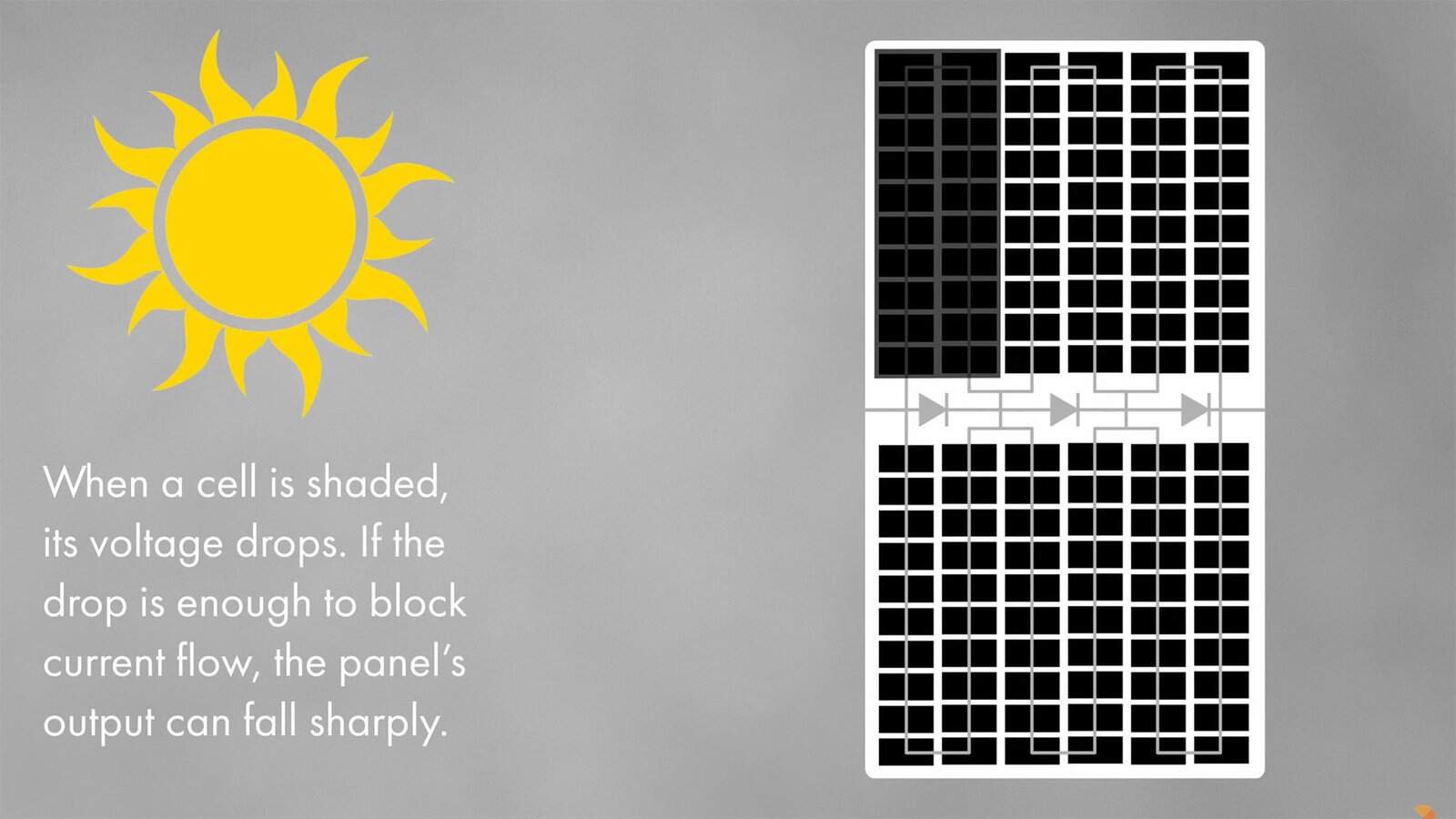
If one cell falls into shadow, it cannot pass the same current as its neighbors. The whole string drops to the output of the weakest cell, no matter how small the shadow is. This is basic series-circuit behavior, and it is why even a shadow the size of a bird dropping can matter.
Worse, the shaded cell does not just stop producing power. It starts absorbing it. Surrounding cells push current backward through the dark cell, and that cell heats up fast. Engineers call this a hot spot. Left unmanaged, hot spots degrade encapsulant, crack solder joints, and in rare cases start fires.
Bypass diodes exist to limit this damage. When voltage across a shaded section drops too low, the diode reroutes current around that entire section. The catch: a standard module usually splits into three diode-protected sections. One shaded cell can switch off a full third of the panel, even though the shadow itself covers a tiny area.
What Makes Back Contact Cells Different
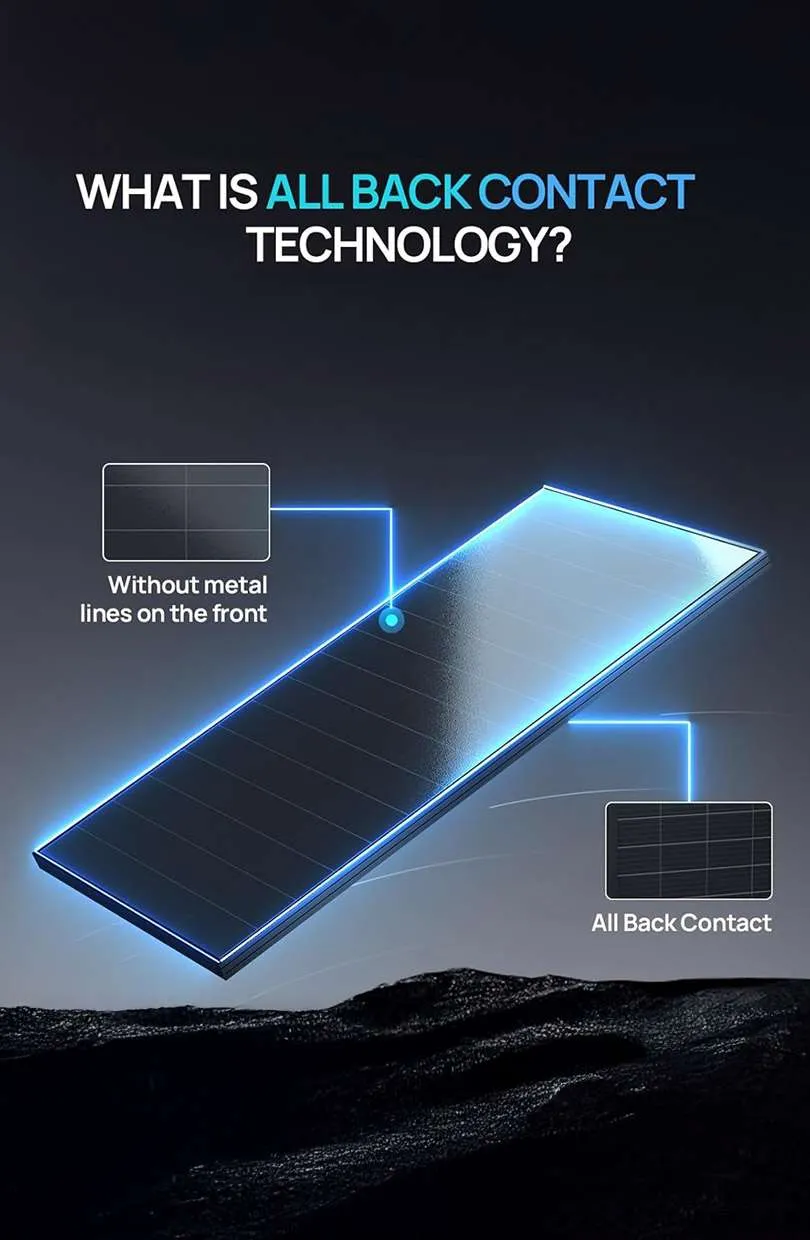
Back contact cells move both electrical contacts to the rear of the cell. Front-contact designs like PERC and TOPCon need metal busbars running across the front surface to collect current. BC cells remove that grid entirely.
This single design change creates two separate advantages for shading:
More usable surface area. Without front busbars blocking sunlight, BC cells start with a higher baseline efficiency. Even a partially shaded BC module often produces more power than a fully unshaded panel of an older design, simply because the unshaded portion works harder.
A built-in soft breakdown mechanism. The gap between positive and negative contacts on the back of a BC cell is very short. Under reverse bias, that short gap causes the cell to enter what engineers call “soft breakdown” at a low voltage, typically two to five volts, compared with roughly ten to twenty volts in conventional front-contact cells [8]. In plain terms, the cell itself starts rerouting current around the shaded area before the module-level bypass diode ever needs to activate.
Manufacturers describe this cell-level rerouting with different marketing names. LONGi calls its version “weak conduction” design in its HPBC 2.0 platform. AIKO calls its approach partial shading optimization in its ABC modules. The underlying physics is closely related: current finds a path around the dark cell instead of forcing the whole string to shut a section down.
What Independent Labs Actually Measured
Marketing claims are easy to make. Independent lab data is harder to argue with. Three independent organizations — TÜV Rheinland, CPVT, and TÜV Nord — have published four sets of comparative results between BC modules and conventional TOPCon modules under controlled shading conditions.
| Lab / Certification | Module Tested | Test Condition | Result |
|---|---|---|---|
| TÜV Rheinland (Oct 2025) | LONGi HPBC 2.0 (Hi-MO X10) vs. TOPCon | Identical partial shading, hot spot temperature | TOPCon peaked above 160°C; HPBC 2.0 stayed near 100°C, a 77°C reduction [1] |
| TÜV Rheinland (June 2025) | LONGi Hi-MO X10 | Point-like shading classification | A+ rating for anti-shading performance |
| CPVT, China (Sept 2025) | LONGi Hi-MO X10 vs. TOPCon | Single cell, 50 percent shaded | 10.15 percent power loss vs. 36.48 percent for TOPCon [2] |
| TÜV Rheinland 2 PfG 2926/01.23 | AIKO Neostar 475 W | Three standard shadow masks (long edge, short edge, single cell) | Class A certificate, five percent or less additional power loss [3] |
| TÜV Nord | AIKO ABC vs. TOPCon | Single cell fully shaded | Up to 30 percent more output from the ABC module [4] |
These results share a pattern worth noting. The advantage shows up most clearly under light, localized shading: a bird dropping, a single leaf, a small vent shadow. That is also the most common real-world shading scenario on commercial and residential rooftops, far more common than a chimney or tree casting a shadow over a third of the array.
The Honest Caveat Every Buyer Should Know
Here is the nuance that separates a careful technical assessment from a sales pitch. There is no single IEC standard that certifies “all back contact panels are superior under partial shading” as a blanket category claim.
The relevant standards, including IEC 61215-2 MQT09 for hot spot endurance [6] and IEC 61730-2 for reverse bias safety [7], test reliability and safety. They do not rank energy yield between cell technologies. A separate standard, IEC TS 63140, addresses partial shade endurance, but it was written primarily for monolithically integrated thin-film modules, not the crystalline silicon panels most commercial buyers specify [5].
The certifications cited above, TÜV Rheinland’s A+ rating and Class A classification, CPVT’s Three-Proof certificate, are real, independently verified, and meaningful. But they apply to specific module families tested against specific competitors under specific shadow patterns. They are not a universal industry ruling that every BC panel outperforms every TOPCon panel in every shading scenario.
For procurement teams, this distinction matters. When a supplier claims shading superiority, ask which lab ran the test, which competing module was used as the benchmark, and which shadow pattern was applied. A vague reference to “BC technology” without a named test report deserves a follow-up question.
A 2025 peer-reviewed simulation study from Trinasolar’s State Key Laboratory of Photovoltaic Science and Technology and Nanchang University adds useful precision here [9]. The researchers modelled BC and TOPCon modules under three standardised shading patterns — single-cell, short-edge, and long-edge occlusion — and found that BC modules outperform TOPCon only when fewer than three cells in a substring are shaded. Beyond that threshold, the two technologies produce statistically identical output, because both eventually rely on the same bypass diode logic once shading grows large enough. This finding lines up with the certification data above: the documented BC advantage is real, but it lives in the small-shadow zone, not across every shading scenario.
| Not sure which certification applies to your project’s shading profile? Ask Couleenergy’s engineering team for the test report behind any module you’re evaluating. |
BC Sub-Technologies Are Not All Identical
| Technology | Shading Mechanism | Best Documented Result |
|---|---|---|
| IBC (Interdigitated Back Contact) | Soft reverse breakdown at the cell level, engineered for shading tolerance | Improved power output and lower reverse stress in peer-reviewed cell-level testing, with bypass diodes still required for larger shaded areas [8] |
| HPBC 2.0 (LONGi) | Weak conduction current shunting design | 77°C lower hot spot temperature; 10.15 percent vs. 36.48 percent power loss under single-cell 50 percent shading, per CPVT |
| ABC (AIKO) | Low reverse-breakdown voltage inherent to the interdigitated rear contact geometry; controlled soft breakdown passively reroutes current at the cell level — no separate electronics required | Up to 30 percent higher output under single fully shaded cell, per TÜV Nord; TÜV Rheinland Class A certificate |
Each design solves the same underlying physics problem with a different engineering approach. None of them eliminate shading losses. They reduce the penalty and lower the fire risk that comes with hot spot formation.
What Matters More Than Cell Technology Alone
This is the part suppliers rarely emphasize, because it shifts the conversation away from the cell and toward the system. In real installations, several other factors usually outweigh the choice between BC and TOPCon when it comes to shading performance.
- Bypass diode configuration. A module split into more, smaller diode-protected sections loses less power per shaded cell than one with fewer, larger sections.
- Half-cut or third-cut cell layout. Smaller cell segments narrow the area any single bypass event affects.
- String design and parallel wiring. Spreading strings across different roof planes reduces the chance that one shadow source affects an entire string.
- Module-level power electronics. Optimizers and microinverters let each panel operate at its own maximum power point, independent of its shaded neighbors. This single change often produces a larger shading improvement than switching cell technology.
- Array orientation and tilt. Site-specific shadow analysis during design catches problems no cell technology can fix after installation.
Our recommendation for engineers specifying systems on partially shaded sites: treat BC technology as a strong baseline improvement, then layer in smart string design and, where shading is severe or unpredictable, module-level electronics. The combination consistently outperforms either approach alone.
A Buyer’s Checklist for Evaluating Shading Claims
| ✅ | Ask for the specific lab name and test report, not a general marketing claim. |
| ✅ | Confirm which competing module was used as the benchmark. |
| ✅ | Check whether the shadow pattern matches your actual site conditions (single cell, edge strip, or large area). |
| ✅ | Review the bypass diode count and section layout on the datasheet. |
| ✅ | Ask whether degradation data accounts for repeated thermal cycling from shading events, not just initial output. |
| ✅ | For sites with heavy or unpredictable shade, request a quote that includes optimizer or microinverter pairing alongside the module. |
Where BIPV and VIPV Projects Benefit Most
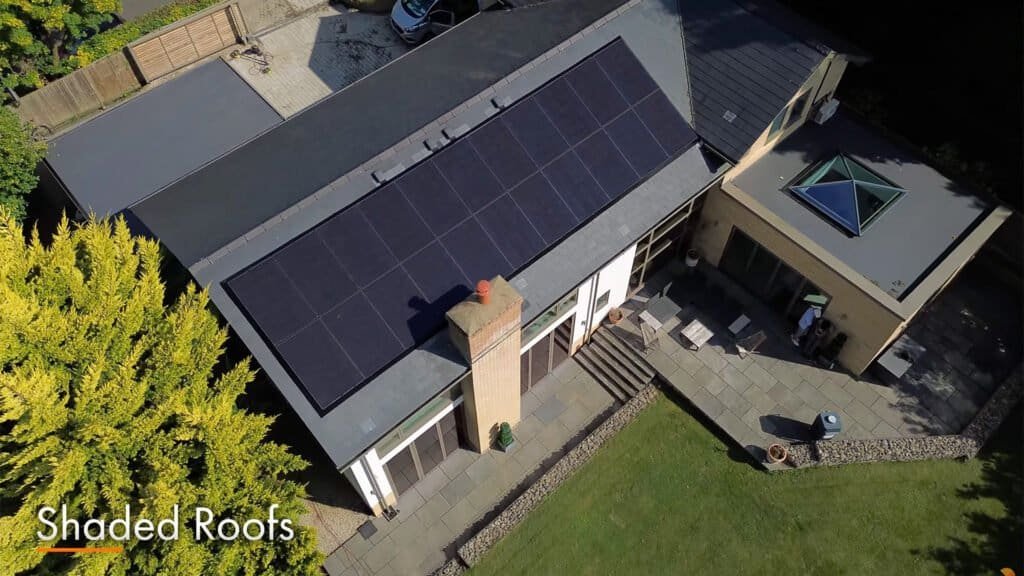
Building-integrated and vehicle-integrated solar projects rarely get a clean, shadow-free surface. Parapets, vents, antennas, and structural elements create predictable partial shade. This is exactly the scenario where BC technology’s cell-level shading tolerance produces the clearest practical benefit, because the shadows tend to be small, localized, and recurring rather than large and total.
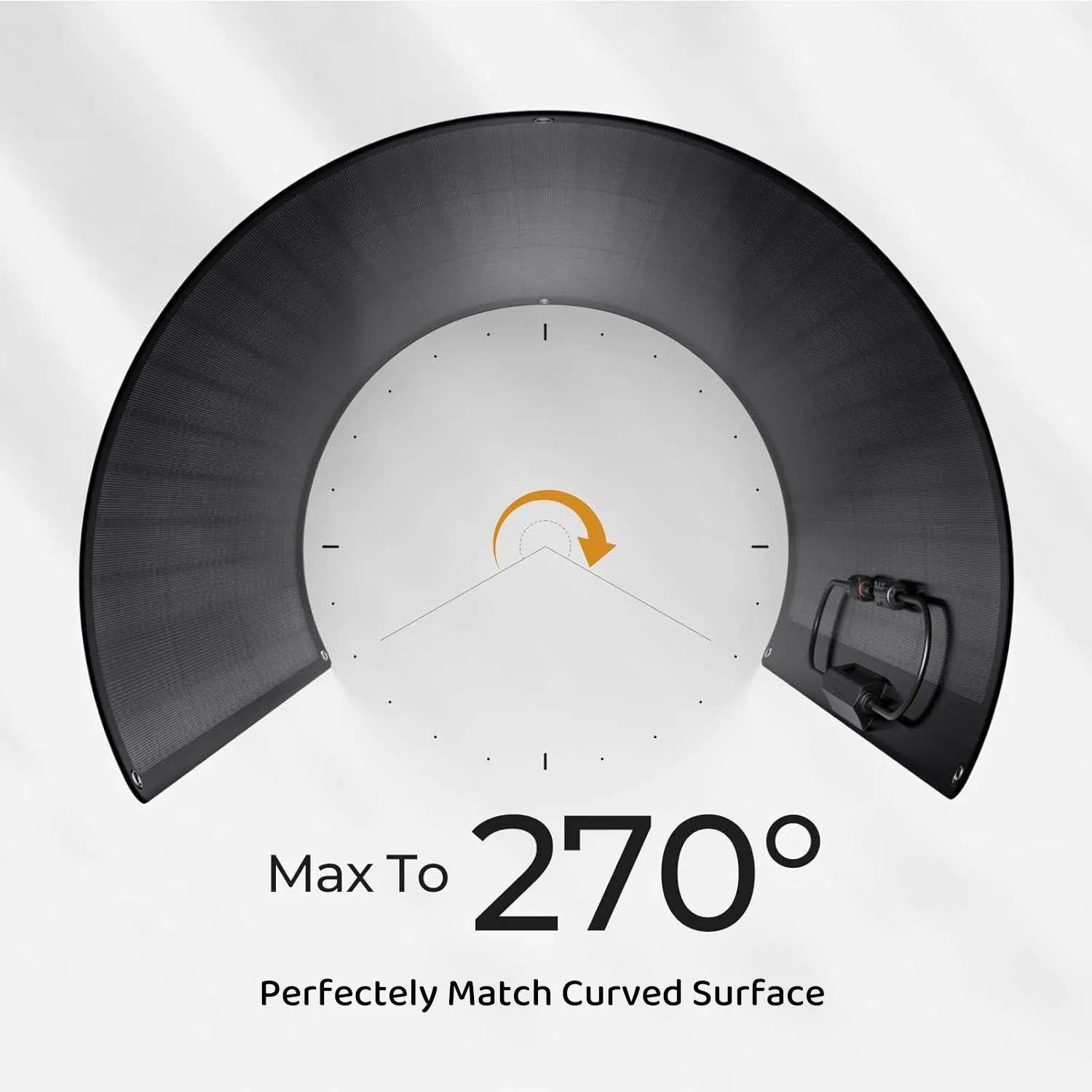
For facade installations and curved or embedded solar surfaces, pairing BC cells with careful string segmentation gives the most reliable real-world yield. Couleenergy’s OEM and BIPV product lines are built around this combination for exactly this reason.
Frequently Asked Questions
Do BC panels still need bypass diodes?
Yes. Cell-level soft breakdown reduces how often diodes activate and how much power they sacrifice when they do, but diodes remain a necessary safety feature for larger shaded areas.
Will a BC panel work normally in full shade?
No technology can generate meaningful power from a fully shaded module. Shading tolerance improves performance under partial coverage, not total coverage.
Is HPBC 2.0 the same as ABC?
No. They are separate cell architectures from different manufacturers, LONGi and AIKO respectively, each with its own patented shading mitigation design and independent certification record.
Should I still use optimizers with BC panels on a shaded roof?
For sites with significant tree cover or unpredictable shadows, yes. BC technology and module-level power electronics solve different parts of the same problem and work well together.
Are these shading tests relevant for OEM and custom-format modules?
The underlying cell physics carries over to custom and embedded formats, but module-level results depend on the specific lamination, wiring, and diode layout used in that product. Always request format-specific test data from your supplier.
Key Takeaways
| • | Back contact cells reduce shading losses through a built-in soft breakdown mechanism, not just by moving contacts to the rear. |
| • | Independent labs, including TÜV Rheinland, TÜV Nord, and CPVT, have published comparative data showing meaningful improvements over TOPCon under partial shading. |
| • | No single IEC standard certifies BC technology as universally superior; claims should always reference a specific test and benchmark module. Independent academic testing puts the practical BC advantage at fewer than three shaded cells per substring. |
| • | Bypass diode design, string layout, and module-level electronics often matter as much as cell technology for real-world shading performance. |
| • | BIPV, VIPV, and rooftop projects with unavoidable partial shade benefit most from combining BC cells with smart system design. |
Footnotes
| [1] | TÜV Rheinland comparative shading test recorded a 77°C peak hot-spot temperature reduction for LONGi HPBC 2.0 (Hi-MO X10) versus TOPCon under identical conditions. eu.longi.com |
| [2] | China’s CPVT (National Center of Supervision and Inspection on Solar Photovoltaic Product Quality) measured power loss under single-cell 50 percent shading. longi.com |
| [3] | TÜV Rheinland Class A Partial Shading Certificate (standard 2 PfG 2926/01.23), confirming the AIKO Neostar 475 W loses 5 percent or less extra power across three standard shadow masks. aikosolar.com |
| [4] | TÜV Nord test result cited by AIKO and SolarLab AIKO Europe for single fully shaded cell conditions. electronicspecifier.com |
| [5] | IEC TS 63140:2021 official scope statement, confirming the standard applies to monolithically integrated modules and excludes modules formed by interconnected separate cells. webstore.iec.ch |
| [6] | IEC 61215-2:2021, the official design qualification and test procedure standard for terrestrial PV modules, including the hot-spot endurance test (MQT 09). webstore.iec.ch |
| [7] | IEC 61730-2:2023 (Ed. 3.0), the current official PV module safety testing standard covering electrical shock, fire hazard, and reverse-bias related hot-spot test requirements. Supersedes the 2016 edition. webstore.iec.ch |
| [8] | Chu, H. et al., “Soft Breakdown Behavior of Interdigitated-back-contact Silicon Solar Cells,” peer-reviewed at SiliconPV 2015, Energy Procedia 77 (2015): 29–35. Confirms BC cell breakdown voltages of roughly 2–5 V versus 10–20 V for conventional front-contact cells. sciencedirect.com |
| [9] | Trinasolar State Key Laboratory of Photovoltaic Science and Technology and Nanchang University, “Power output performance analysis of back-contact photovoltaic module under actual field shading conditions: A comparison with TOPCon photovoltaic module,” Solar Energy (2025). Simulation-based study; found BC modules outperform TOPCon only when fewer than three cells in a substring are shaded, as reported by pv magazine. pv-magazine.com |
Specifying modules for a site with partial shade, a BIPV facade, or a custom OEM format? Couleenergy’s engineering team can walk through your shading profile, certification requirements, and module configuration options.
| Email info@couleenergy.com Call +1 737 702 0119 |
 English
  Español
  Français
  Deutsch
  Русский
  العربية