
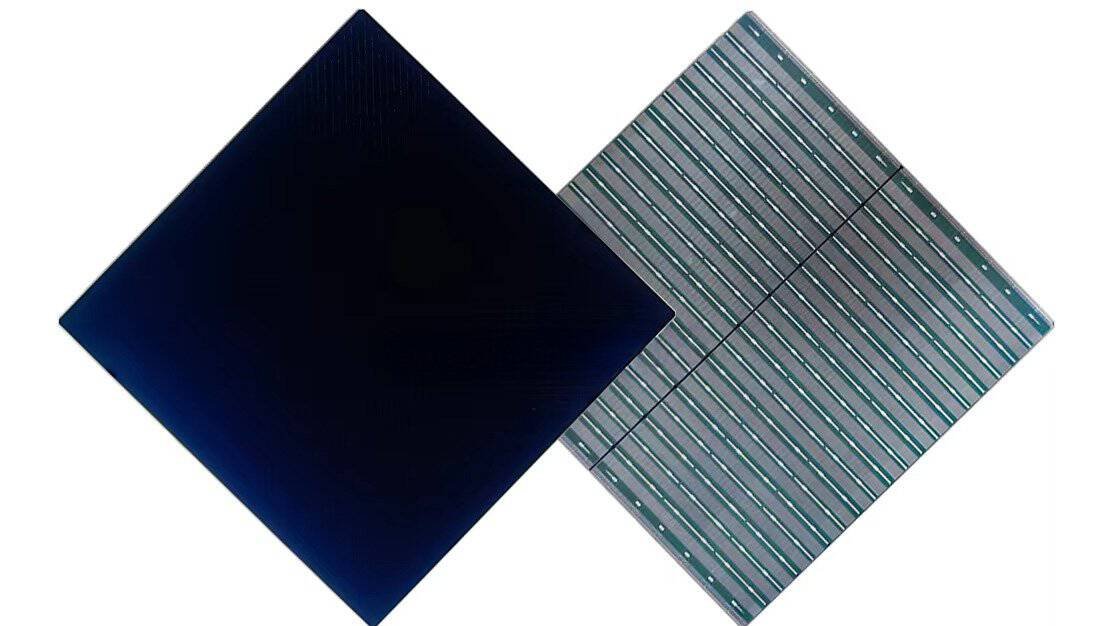
BC cell formats · Buyer’s guide
By the Couleenergy technical sales team · Last reviewed September 2026
Four back-contact cells sit on a test bench. They use the same silicon, the same rear-contact design, and the same 26% efficiency bin. Yet one makes 8.66 W and another makes 9.94 W. The only real difference is size.
That gap surprises many buyers. It also causes costly mistakes. A bigger cell does not always mean a better panel. On a small product or a tight roof, the “biggest” option can give you fewer watts, not more.
This guide explains why BC wafer and cell sizes vary. It shows what size really changes and what it doesn’t. Then it helps you match the right format to your project.
Quick answer
Cell size changes watts per cell, current, and how cells fill a given outline. It does not change efficiency, voltage per cell, heat behavior, or low-light behavior. Those come from the cell technology.
For small, custom, and 12 V products, compact formats (182.2 × 183.75 mm or 182.2 × 188 mm) usually fit best. For 2382 × 1134 mm commercial modules, 182.2 × 192 mm or 210R often wins. Always choose the size that fills your outline and suits your electronics.
The market shift
Why This Question Matters More Than It Used To
For years, buying cells was simple. Most panels used a few square formats. Then the industry moved fast.
Today you will see many “182” cells that are not 182 × 182 mm at all. You will see 182.2 × 183.75, 182.2 × 188, 182.2 × 191.6, 182.2 × 199, and 182.2 × 210 mm. Industry analysts at InfoLink list at least eight rectangular sizes in use.
Rectangular formats took over fast. The latest ITRPV roadmap (17th edition), summarized by TaiyangNews in September 2026, puts it plainly. G12 and rectangular G12R are now the mainstream formats. M10 is expected to keep losing share.
So “which size?” is now a real design choice. For back-contact (BC) cells, it matters even more. BC cells cost more to make, so every square centimeter should work hard for you.
Know the labels
Solar Cell Size Names, Decoded: M10, 182R, 210R and G12
Suppliers use short codes for wafer formats. They are easy to mix up, so here is what each one means.
| Name you’ll see | Wafer size | Shape | Typical module use |
|---|---|---|---|
| M10 (“182”) | about 182 × 182 mm | Square with rounded corners | The earlier 182-series standard |
| 182R family (incl. M10+) | 182.2 × 183.75 mm up to 182.2 × 191.6 mm | Near-rectangle to rectangle | Rooftop and C&I modules, 1134 mm wide |
| 210R / G12R | 182.2 × 210 mm | Rectangle | Rooftop, C&I and utility modules, 1134 mm wide |
| G12 / M12 | about 210 × 210 mm | Square with rounded corners | Large utility modules, about 1303 mm wide |
Sources: TaiyangNews on the M10 standard (2020) and InfoLink on rectangular formats (2024).
Half-cut cells are these same cells cut in two across the long side. A half-cut 210R cell, for example, measures 182.2 × 105 mm.
Back-contact basics
First, a Quick Refresher on BC Cells
A back-contact cell moves all its metal contacts to the rear side. The front has no busbars and no grid lines. Nothing blocks the sunlight.
That sounds small, but it adds up. A 2024 review in Photovoltaics International, written by a BC cell maker’s R&D team, notes that removing 1–2% front shading can add about 0.2–0.5% absolute efficiency. BC cells also look cleaner, which matters for rooftops, vehicles, and building facades.
Two more points matter for this guide:
- BC cells need high-quality wafers. The design works best when the silicon has long carrier lifetimes. Most BC cells today use n-type wafers, though some earlier BC products used p-type.
- All current flows through the rear metal. So current levels, pad layout, and busbar count matter more in BC design.
Keep those two points in mind. They explain part of why size choices differ.
Five forces
Why BC Wafer and Cell Sizes Vary
No single “best size” exists, because each size solves a different problem. Here are the five main forces.
1. Getting more from each silicon ingot
Silicon wafers start as round ingots. The ingot must be wide enough to cover the wafer’s diagonal. A 182.2 × 210 mm (210R) wafer has a diagonal of about 272 mm with trimmed corners. A square 210 × 210 mm (G12) wafer needs about 295 mm. So a rectangle gives you the same long side from a smaller, easier-to-grow ingot.
Many formats also keep small rounded corners, called a pseudo-square shape. This uses more of the round ingot. Our 182.2 × 183.75 mm cell, for example, has a corner arc of R125 mm.
2. Fitting standard glass and shipping containers
Modules built on 182-series and 210R cells share one width: 1134 mm. Six cells at 182.2 mm fit across it. That’s why these rectangular formats keep one side at 182.2 mm. Only the long side changes.
In July 2023, a group of leading manufacturers proposed a common 2382 × 1134 mm module size. In August 2023, six of them also agreed on a standard 182.2 × 191.6 mm wafer, as PVTIME reported. The goal was simpler racking, packing, and transport, with about 98.5% container use. That module holds 72 cells of 191.6 mm, or 66 cells of 210 mm.
3. Pushing module power without a new cell technology
Cell efficiency gains are now slow and hard-won. A longer cell adds watts right away. It’s the easiest lever a factory has.
4. Staying inside current limits
A bigger cell makes more current. More current means more heat in ribbons, junction boxes, and cables. Resistive loss grows with the square of current, so small increases matter.
Electronics set hard ceilings, too. Many older string inverters accept only about 12.5 A per input, as inverter maker Solis explains. Newer models often take 16 A or more. Square 210 mm half-cut modules already run above 18 A, a 2021 TaiyangNews analysis noted. That analysis came from a backer of smaller formats, but the physics holds.
Mid-size rectangles help here. They add power without jumping to the highest current class.
5. Matching the product, not just the factory
This one matters most for custom work. A cell size that suits a 2.4-meter utility module may be wrong for a 600 mm boat hatch. Small modules have fixed outlines. The cell has to fit the outline, not the other way around.
The spec sheet view
Four BC Cell Formats, Side by Side
Here are the four HPBC (hybrid passivated back contact) formats we build with. They share one cell platform, so the table shows the pure effect of size. All values are per full cell at the 26.0% efficiency bin, under standard test conditions (1000 W/m², 25 °C).
| Format | Full cell size | Half-cut size | Active area | Power | Isc | Thickness |
|---|---|---|---|---|---|---|
| CLM-183.75mm-BC | 182.2 × 183.75 mm | 182.2 × 91.875 mm | 333.1 cm² | 8.66 W | 14.08 A | 165 µm |
| CLM-188mm-BC | 182.2 × 188 mm | 182.2 × 94 mm | 341.9 cm² | 8.89 W | 14.45 A | 165 µm |
| CLM-192mm-BC | 182.2 × 192 mm | 182.2 × 96 mm | 349.8 cm² | 9.09 W | 14.78 A | 165 µm |
| CLM-210mm-BC (210R) | 182.2 × 210 mm | 182.2 × 105 mm | 382.3 cm² | 9.94 W | 16.16 A | 135 µm |
Look at the pattern. The 210R cell has 14.8% more area than the 183.75 mm cell. It also makes 14.8% more power. Watts track area, one to one.
Now look at what stays the same across all four:
- Voltage: at the 26.0% bin, about 0.645 V at max power and 0.735 V open circuit per cell.
- Temperature coefficient: −0.238%/°C for power at cell level. Module datasheets can differ slightly. For context, typical TOPCon modules sit near −0.29%/°C and PERC modules near −0.35%/°C. Always compare module to module.
- Low-light behavior: at 200 W/m², open-circuit voltage still holds about 94.6% of its full-sun value.
Key point
Size sets watts and amps. Technology sets efficiency, voltage, and heat behavior. Does a seller say a bigger cell “performs better in heat” or “works better in low light”? Ask for the data.
Voltage, current, fit
What Cell Size Really Changes in Your Panel
Voltage comes from cell count
Every cell adds roughly the same voltage, whatever its size. So your target voltage decides how many cells you need in series. Size has nothing to do with it.
This is key for 12 V products. The panel needs enough cells in series to charge the battery. Once that count is fixed, cell size decides the rest.
Current comes from cell size
A larger cell pushes more current. With half-cut cells in a single series string, current roughly halves. With two half-cell strings in parallel, as in most rigid modules, current returns close to the full-cell value.
So ask early: what is the max input current of your charge controller or inverter? Then pick a size and layout that stays safely below it. Build in margin. Current climbs with strong sun, cloud-edge bursts, and rear-side gain on bifacial designs. That’s why the US National Electrical Code (NFPA 70, Article 690) starts its PV circuit math at 125% of short-circuit current.
Fit decides your final wattage
This is where many projects win or lose. Cells come in fixed steps. If your outline is a few millimeters short, you lose a whole cell.
Here is a simple example. Say you have one row of cells along a fixed usable length. We allow a 15 mm border at each end and 2 mm gaps. We pick the best layout, full or half-cut, for each format. Values are raw cell watts at the 26.0% bin, before module losses.
| Usable length | 183.75 mm | 188 mm | 192 mm | 210R |
|---|---|---|---|---|
| 800 mm | 34.6 W | 35.6 W | 31.8 W (half-cut) | 34.8 W (half-cut) |
| 1000 mm | 43.3 W | 44.5 W | 45.5 W | 44.7 W (half-cut) |
| 1200 mm | 52.0 W | 53.3 W | 54.5 W | 49.7 W |
| 1500 mm | 65.0 W (half-cut) | 66.7 W (half-cut) | 68.2 W (half-cut) | 64.6 W (half-cut) |
Bold = best result for that length. One row, 15 mm end borders, 2 mm gaps, 26.0% bin, before module losses.
Notice something? The biggest cell never wins in this example. At 1200 mm, 210R gives about 9% less than the 192 mm cell. At 800 mm, the 192 mm cell drops about 11% below the 188 mm cell.
One caution: a half-cut row carries about half the current of a full-cell row. So the layout choice also changes your wiring and controller math.
The lesson is simple. The best cell size is the one that fills your outline with the least wasted space. Real layouts have more options, such as rotated cells or mixed cuts. That is why we run the numbers for every custom design.
Want this table for your exact outline?
Send us your usable length and width. We’ll run this comparison for all four formats, full and half-cut, and show you which one gives the most watts. Email info@couleenergy.com or call +1 737 702 0119.
Thickness affects handling and bending
Three of our formats use 165 µm cells. The 210R cell is thinner, at 135 µm. The industry keeps moving thinner to save silicon. The ITRPV expects TOPCon wafers to drop from about 130 µm in 2026 to about 120 µm by 2036.
Thinner cells need gentler handling and careful lamination. For flexible panels, cell thickness is only one factor. Bend radius, encapsulant, front sheet, and layer balance matter just as much. Ask for the minimum bend radius in millimeters, not a bend angle.
Cell count affects shade response
Bigger cells mean fewer cells for the same watts. Fewer cells can mean fewer substrings and less room to place bypass diode breaks. On a shaded boat deck or a cluttered van roof, a finer cell grid helps you plan shade zones. BC cells have their own shade behavior, too. That’s a design topic worth discussing early.
Match format to application
Which BC Cell Size Is Best for Your Project?
There is no universal winner. But there are clear patterns. Use this table as a starting point.
| Project type | Usually the best fit | Why |
|---|---|---|
| Portable power, consumer products, small OEM modules | 183.75 mm or 188 mm, often cut | Lower current, fine size steps, easy to fit small outlines |
| RV, van, and marine flexible panels | 188 mm or 192 mm | Good watts per cell; pick by roof or deck length |
| 12 V off-grid and battery charging | 183.75 mm or 188 mm | Moderate current and fine size steps for smaller panels |
| Residential rooftop (rigid, all-black) | 183.75 mm or 188 mm in 48–54 cell layouts | One-person handling, tidy fit on small roofs |
| Commercial and industrial rooftops | 192 mm or 210R in 2382 × 1134 mm modules | Standard racking, high power per module |
| BIPV, facades, and custom glass | Any size, chosen to match the architectural grid | The building sets the outline |
| Utility ground mount | 210R | Most watts per module and per mounting point; confirm inverter current first |
A closer look at each format
182.2 × 183.75 mm: the flexible all-rounder. It’s close to square. That makes it easy to rotate, cut, and mix. It suits small and odd-shaped products best. It also has the lowest current of the four.
182.2 × 188 mm: the balanced middle. It adds about 2.7% more watts per cell than 183.75 mm. Current stays moderate. It is a strong pick for rooftop modules and many flexible panels.
182.2 × 192 mm: the standard-module choice. It sits close to the 191.6 mm size behind the 2382 × 1134 mm standard. It works well where standard racking and logistics matter.
182.2 × 210 mm (210R): the power leader. It makes the most watts per cell. It also runs the highest current and uses the thinnest wafer. Check your inverter or controller limits before you choose it.
Before you order
Five Checks Before You Commit to a Cell Size
- Measure the usable outline, not the total area. Subtract borders, vents, hatches, and mounting clearances first.
- Write down your system voltage. This fixes your cell count in series.
- Find the max input current of your controller or inverter. Leave a safety margin for hot, bright days.
- Compare watts per outline, not watts per cell. Run the fit math for each format.
- Ask for real bin data. Efficiency bins, flash-test reports, and tolerances matter more than a size label.
One more tip. Datasheets sometimes mix up full-cell and half-cell values. Half-cut cells show about half the power and current, but the same voltage. Always confirm which one you’re reading.
Honest limits
What We Won’t Claim
We want you to choose well, so here are the honest limits.
A larger cell does not raise efficiency. A 210R cell and a 183.75 mm cell at the same bin convert light equally well. Also, cell watts are not module watts. Gaps, borders, glass or ETFE, and wiring all take a share. A 26% cell usually ends up in a module somewhere around 20–25%, depending on the build.
Finally, our higher efficiency bins (26.5–27.2%) are calculated from published BC cell data. We confirm them against flash-test data per batch. We’ll show you that data before you order.
Custom BC modules
Let’s Find the Right Size for Your Project
Choosing a BC cell size is not about picking the biggest number. It’s about fit, current, voltage, and your end use. Get those right, and you get more watts from the same space.
That’s where we help. At Couleenergy, we design custom BC modules around your product, not around a stock catalog. We work with all four formats above. We run the fit math, check your electronics, and suggest the layout that gives you the most usable power.
Send us these five details:
- Your usable outline (length × width, in mm)
- Your target power and system voltage (12 V, 24 V, 48 V, or grid-tied)
- Your controller or inverter max input current
- Your application (portable, RV, marine, rooftop, BIPV, or other)
- Your expected order quantity
We’ll reply with a recommended cell size, layout, and next steps.
Email: info@couleenergy.com · Call: +1 737 702 0119
FAQ
Frequently Asked Questions
Is a bigger BC cell more efficient?
No. Efficiency comes from the cell technology and its bin. A bigger cell makes more watts because it has more area, not because it converts light better.
Why do so many “182” cells have different lengths?
Factories keep the 182.2 mm side fixed to fit 1134 mm module widths. They change only the long side, from about 183.75 mm up to 210 mm. That lets them hit different module sizes and power targets.
What does 210R mean?
It means a rectangular cell of 182.2 × 210 mm, also called G12R. It takes the 210 mm length of the square G12 format but keeps the 182.2 mm width.
182 mm or 210 mm cells: which is better?
Neither wins everywhere. 210 mm-long cells give the most watts per cell and suit large standard modules, if your inverter handles the current. 182-series cells give lower current and finer size steps, which suits small, custom, and 12 V panels.
Does cell size change panel voltage?
Not directly. Each cell gives about the same voltage whatever its size. Panel voltage depends on how many cells sit in series.
Which size is best for a 12 V flexible panel?
Usually 183.75 mm or 188 mm. They keep current moderate and fit smaller outlines in finer steps. But the final answer depends on your exact dimensions.
Are half-cut cells better?
They lower current per string and can reduce resistive losses. They also give you finer size steps. But they add cutting and more connections. Use them when the layout or current limits call for it.
Can I mix cell sizes in one panel?
Not within one series string. Mixed sizes produce mixed currents, and the smallest cell limits the string. Separate strings with their own electronics are a different matter.
How this article was checked
Cell data comes from Couleenergy’s own specifications for the four HPBC formats. Bins from 26.5% to 27.2% are calculated values, confirmed per batch by flash test. The fit table is our own arithmetic, shown with its assumptions. Market and standards claims link to the original report or a named industry outlet. Two sources reflect a manufacturer’s view (the 2021 TaiyangNews analysis and the 2024 Photovoltaics International review), and we say so where we use them.
Last reviewed: September 2026
Sources
- TaiyangNews — ITRPV expects TOPCon to lead as BC and tandem technologies expand (Sept 2026)
- InfoLink Consulting — Rectangular module: trends and prospects (March 2024)
- PVTIME — Standardized wafer size: six PV manufacturers reach an agreement (Aug 2023)
- PV Tech / Photovoltaics International Vol. 50 — Evolution of silicon photovoltaics toward a back contact future (July 2024)
- Solis — Choosing the correct inverter for high-power M10 and G12 modules
- TaiyangNews — Bigger is not always better (April 2021, manufacturer perspective)
- TaiyangNews — Group proposes M10 as new silicon wafer standard size (June 2020)
- NFPA 70, National Electrical Code — code development page (Article 690 covers PV systems)
- Couleenergy CLM-183.75mm-BC, CLM-188mm-BC, CLM-192mm-BC, and CLM-210mm-BC cell specifications





 English
  Español
  Français
  Deutsch
  Русский
  العربية