
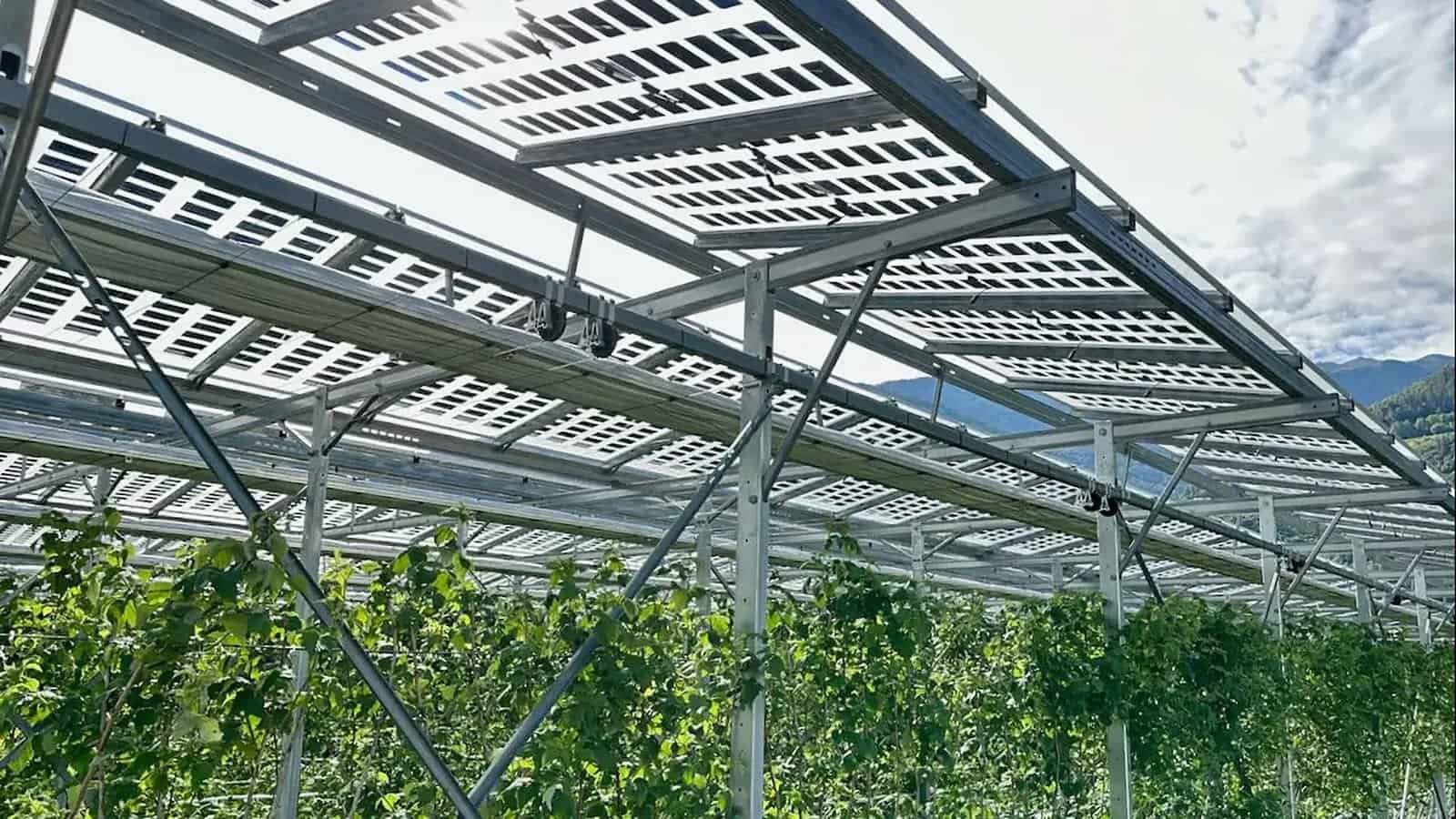
Solar panels and crops used to compete for the same land. Today, they work together on it. Agrivoltaic solar systems place photovoltaic panels above growing crops — generating electricity while the farm below keeps producing food. The idea sounds simple. Getting it right takes science.
This guide explains how agrivoltaic systems work, what recent research says about shading and crop yields, why panel cell technology matters more than most buyers realize, and how to choose the right transparent solar panel for your specific project.
What Is Agrivoltaic Solar?
Agrivoltaics — sometimes called agri-PV or dual-use solar farming — is the practice of growing crops and generating solar electricity on the same piece of land at the same time. Elevated solar panels sit above the crop canopy, typically mounted 2 to 4 meters high to allow machinery access. The panels intercept some sunlight. The crops below receive what passes through.
This is not a compromise. It is a design choice. Most crops do not need every photon of sunlight that reaches them. Beyond a certain light level — called the light saturation point — extra sunlight does not help a plant grow. It just creates heat stress and increases water demand.
Agrivoltaic systems capture the surplus light, convert it to electricity, and cool the growing environment below. Done correctly, both the crop and the solar yield win.
Key concept: Agrivoltaic solar is not about taking light away from crops. It is about using the light that crops cannot use — and doing something productive with it.
Why Agrivoltaics Is Growing Fast
Land is the bottleneck for both food production and renewable energy. Conventional utility-scale solar farms compete directly with agricultural land, and that conflict is driving policy friction worldwide. Agrivoltaics resolves it.
Research consistently shows that agrivoltaic systems outperform single-use land. Most studies find 20–80% greater combined land-use efficiency, measured by Land Equivalent Ratio values between 1.2 and 1.8, with some studies in optimal arid conditions reporting gains up to 200%.[1] Water savings are also significant. Agrivoltaic systems typically improve crop water-use efficiency by 20–47% across diverse climates, with some cross-study reviews documenting irrigation demand reductions of around 14%.[1][13]
The microclimate benefits extend beyond water. Panels reduce the direct heat load on crops. University of Arizona research from 2025 found that agrivoltaic shading lowered wet bulb globe temperatures — the measure of extreme heat risk — by up to 9.9°F compared to open-air farms.[2] That is significant not just for crops, but for the farmworkers tending them.
Cornell University researchers published new findings in April 2026 showing that solar panel rows in agrivoltaic arrays also act as windbreaks. Wind erosion costs U.S. agriculture an estimated $9 billion annually.[3] Properly designed agrivoltaic structures can reduce that damage — an entirely unexpected co-benefit that is only now being studied in depth.
Ecological gains show up too. Iowa State University found that intentionally adding native perennial flowering vegetation to an agrivoltaic site increased honey production from managed bee colonies by 412% — without interfering with energy generation or farming operations.[4] The gain required deliberate habitat design, not solar panels alone. Biodiversity, soil health, and pollinator activity all improve when site management is planned around ecological co-benefits.
The Make-or-Break Variable: Shading Level
Every agrivoltaic project lives or dies on one number: how much light the panels transmit to the crop below. Too much shade and yields fall. Too little and you lose solar output.
Panel transmittance and shading percentage are two sides of the same number. A panel at 70% transmittance creates 30% shading. Lock down this number before you order a single panel.
A February 2026 Nature study synthesizing field crop research across multiple geographies established a working rule: shading up to 20–30% generally has little or no negative impact on most crops.[5] Above 30%, yield losses become likely and accelerate quickly.
Japan’s national agrivoltaic policy reflects the same threshold. It requires that crop yields not fall by more than roughly 20% compared to the regional average.[6] France applies a stricter standard: its 2023 agrivoltaic decree limits approved configurations to those achieving less than a 10% yield reduction — or demonstrating a quality improvement in the harvested product.[14] For European project developers, France’s threshold is the more demanding design target.
A 2026 University of Illinois study published in PNAS added important regional nuance. Climate drives outcomes as much as shading level does. In humid eastern Midwest conditions, solar shading reduced maize yields by 24% and soybean yields by 16%. In semi-arid parts of the same region, shading alleviated water stress and actually increased soybean yields.[7] The same panel design produced opposite economic outcomes depending on local aridity.
Rule of thumb: In arid and semi-arid climates, agrivoltaics typically boosts performance. In humid climates, careful shading management is critical. Know your climate before you set your transmittance target.
Crop-by-Crop Shading Guide: What the Research Shows
Shading tolerance varies significantly by crop. Below are research-backed safe shading ceilings and minimum Daily Light Integral (DLI) requirements for four key crops, drawn from peer-reviewed studies published in 2024–2026.[5][8][9]
| Crop | Safe Shading Ceiling | Panel Transmittance | Min DLI (mol/m²/day) | Key Risk |
|---|---|---|---|---|
| Rice | ≤ 27% | 73–80% | ≥ 12 | Reduced panicle count in vegetative stage |
| Soybean | ≤ 30% | 70–80% | ≥ 14 | Strong shade-avoidance response; choose tolerant cultivars |
| Sweet Potato | ≤ 20% | 80%+ | ≥ 16 | Most shade-sensitive; organic cultivation worse |
| Tomato (greenhouse) | ~50% (mono-Si only) | 50% (PV-Si) | ≥ 18 (winter) | CdTe thin-film fails minimum DLI in winter |
| Potato | ≤ 13–15% | 85–90% | ≥ 14 | Tuber size shifts smaller above 30% shading; moderate shade improves WUE |
| Leafy greens (lettuce, spinach) | ≤ 40–50% | 50–60% | ≥ 10–12 | Among highest shade-tolerance; heat stress during summer often reduced under panels |
Potato data: Catholic University of the Sacred Heart / Smart Agricultural Technology, 2026 — four-year Italian field trial. Leafy greens data: Barron-Gafford et al., Nature Sustainability 2019, and multiple greenhouse agrivoltaic trials. Contact Couleenergy for crop-specific transmittance guidance on additional crops including grape, strawberry, maize, and cannabis.
Rice is the most shade-tolerant staple crop studied. It shows no significant yield reduction under 27% shading. It compensates for any vegetative-stage shading by producing more spikelets per panicle later in the season.
Soybean has a hard safety ceiling near 30% shading, established by the Nature 2026 synthesis. A separate 2024 ScienceDirect study found that soybean yield dropped by 31% under 33% shading — confirming how quickly performance falls once that ceiling is breached. The same 2024 study also found that semi-transparent panels at 40% transmittance — meaning 60% shading — can still maintain yield and quality, provided you select shade-tolerant cultivars.[9] The shade-avoidance response in soybean causes stem elongation and reduced branching, so cultivar choice matters enormously.
Sweet potato is the most light-sensitive crop in recent agrivoltaic research. Yield decreased linearly with shading. Even 20% shading caused decline in some cultivars. Organic cultivation under agrivoltaic structures showed even steeper losses of 42–49%. If you are growing sweet potato under solar, select cultivars bred for lower shade-avoidance response — the Japanese varieties Amahazuki and Silksweet both performed better in trials.
Tomato results depend almost entirely on cell technology. See the next section.
Potato is a globally important crop that has received growing research attention in agrivoltaics. A four-year Italian field trial published in Smart Agricultural Technology (2026) found that low seasonal shading of around 13% produced limited yield penalties averaging just 12%. Shading above 30%, however, caused reductions exceeding 30% and a consistent shift toward smaller tubers. Importantly, even moderate shading delayed soil-moisture depletion, extended biomass accumulation, and improved water-use efficiency — making potato a viable candidate in high-irradiance regions where heat and drought are the primary yield constraints.
Leafy greens — lettuce, spinach, and similar crops — are among the most shade-tolerant categories in agrivoltaic systems. They can perform well under 40–50% shading, particularly in high-summer conditions where unshaded heat stress is the bigger yield threat. Research at Jack’s Solar Garden in Colorado found lettuce fresh weight increased significantly under panels during hot periods compared to the open-field control. High-transmittance panels are not required; 50–60% transmittance panels are appropriate and maximise dual-use energy output.
Why Cell Technology Changes Everything: The DLI Lesson
Transmittance percentage is not the whole story. A landmark April 2026 study from IMIDA Spain — published in Smart Agricultural Technology — tested two greenhouse panels with identical 50% transmittance ratings.[10] One used monocrystalline silicon (PV-Si). The other used cadmium telluride thin-film (CdTe/PV-TF). The results were striking.
| Technology | Winter DLI (mol/m²/day) | Summer DLI (mol/m²/day) | Energy Output (2 seasons) |
|---|---|---|---|
| PV-Si Monocrystalline | 18.1 | 25.4 | 726.8 kWh |
| PV-TF (CdTe thin-film) | 10.8 | 17.0 | 488.4 kWh |
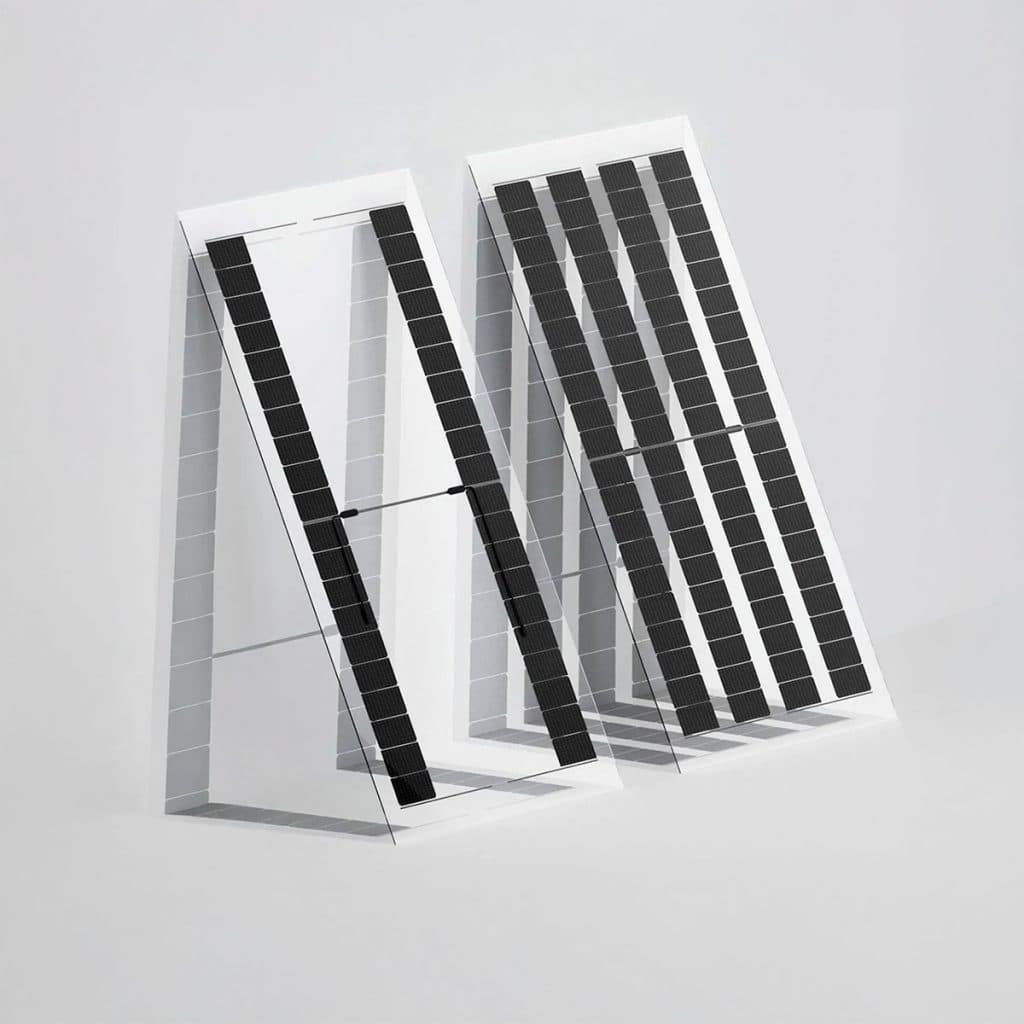
Both panels had the same transmittance number on the spec sheet. But PV-Si delivered 67% more DLI in winter. The difference lies in panel construction, not a simple spectral rule. Standard monocrystalline silicon panels are spatially segmented: opaque cell rows alternate with strips of transparent solar-grade glass that transmit full-spectrum light directly to the crop canopy. The CdTe thin-film panels in the IMIDA study achieved transparency by thinning the absorber layer — a different optical mechanism that resulted in lower effective PAR delivery at canopy level, particularly in the low-irradiance winter months when ambient light is already limited.
The crop outcome was decisive. PV-Si tomatoes weighed 25% more than the unshaded control in winter-spring. CdTe panels dropped DLI below the minimum threshold for optimal development during that same season. PV-Si also generated 49% more electricity than PV-TF over the two-season trial.
Critical takeaway: Two panels with the same transmittance % can deliver radically different results for your crop. Specify cell technology — not just transmittance — when ordering agrivoltaic panels.
Daily Light Integral (DLI) is the number that ties it together. DLI measures total photosynthetically active radiation over a full day, in mol/m²/day.[11] It accounts for seasonal variation in ambient light in a way that a fixed transmittance percentage cannot. A panel that delivers enough DLI in July may fall short in December. Design around seasonal DLI requirements, not annual averages.
The IMIDA data shows cell technology matters as much as transmittance.
Couleenergy supplies monocrystalline, TOPCon, and HJT transparent panels at your specified transmittance level. Request a technical datasheet or sample order for your crop and climate.
Dual-Glass vs Transparent Backsheet: Choosing Your Construction
Transparent solar panels for agrivoltaics come in two main construction types. The right choice depends on your structure, climate, and installation priorities.
Dual-Glass (Glass-Glass) Panels
Dual-glass agrivoltaic panels use glass on both the front and rear surfaces. They deliver fire resistance, excellent humidity tolerance, and lifespans exceeding 30 years. Both surfaces carry high optical transmittance, and bifacial variants capture reflected light from below. These suit permanent greenhouse roofs and open-field agrivoltaic structures where long-term durability matters most. The tradeoff is weight — glass-glass panels are heavier, adding load to support structures and shipping costs.
Transparent Backsheet Panels
Transparent backsheet panels replace rear glass with a high-performance transparent polymer. They are significantly lighter than dual-glass, reducing structural loads and transport costs. The polymer dissipates heat more effectively, which helps maintain lower operating temperatures in hot climates. Two specific advantages stand out: UV transmittance below 1% (versus 40–50% for standard glass), which matters for crops where UV exposure drives stress responses; and superior resistance to saline-alkali conditions, making them the better choice for coastal or salt-affected soil sites.
How to Specify the Right Agrivoltaic Panel
Choosing a transparent solar panel for agriculture is not like choosing a standard rooftop panel. You are matching a panel specification to agronomic requirements. Here is a practical decision framework.
Step 1 — Set your DLI target. Most vegetables and fruiting crops need 12–20 mol/m²/day minimum. Leafy greens can work with 10–12. High-light crops like tomatoes prefer 20+. Find your crop’s threshold.
Step 2 — Check local ambient DLI by season. A 50% transmittance panel in southern Spain in July still delivers ample DLI. The same panel in northern Germany in December likely falls short. Use seasonal DLI data for your location, not annual averages.
Step 3 — Apply the 20–30% shading ceiling. For most field crops, stay at or below 30% shading. That means panels at 70%+ transmittance for light-sensitive crops. For shade-tolerant crops in high-light climates, 50–60% transmittance can work.
Step 4 — Specify monocrystalline cell technology. For greenhouse tomatoes or any winter-season crop, monocrystalline silicon — including TOPCon and HJT variants — has demonstrated measurably higher effective PAR delivery at canopy level in field trials. Panel construction, not just transmittance percentage, drives this outcome. Do not substitute thin-film and expect the same crop result.
Step 5 — Choose your construction type. Dual-glass for permanent, heavy-duty installations. Transparent backsheet for lighter structures, retrofits, or saline environments.
Step 6 — Match dimensions to row spacing. Shading is not just a panel number. It depends on how much of the canopy sits under the panels at any given time. Panel width, row pitch, and mounting height all affect the shading pattern on the ground.
Available specifications from Couleenergy:
Transmittance levels: 30% / 40% / 45% / 50% / custom
Cell types: BC / TOPCon / HJT
Construction: Dual-glass or transparent backsheet
Custom dimensions · Framed or frameless · OEM available
Is Agrivoltaics Always Worth It?
Honestly, no — not in every case. The 2026 University of Illinois PNAS study is important here. In humid eastern Midwest conditions, agrivoltaic shading reduced soybean and maize yields significantly. High installation costs for elevated solar arrays can further reduce economic competitiveness relative to stand-alone solar, particularly without policy support.[12]
Agrivoltaics works best when at least one of these conditions applies: the climate is arid or semi-arid; the crop benefits from heat stress reduction; irrigation savings are meaningful; or the land value makes dual-use economically compelling. In cool, humid climates with moderate solar irradiance, a careful feasibility study matters before commitment.
That said, for high-value crops in high-light climates, the evidence is increasingly strong. The IMIDA Spain research showed monocrystalline silicon panels actually producing tomatoes heavier than the unshaded control — not just maintaining yield, but improving it. The agrivoltaic system managed heat and moisture better than open air. That outcome is possible. Getting there requires the right panel specification.
FAQ
What is the best panel transmittance for agrivoltaics?
It depends on crop and climate. For most field crops, panels at 70–80% transmittance (20–30% shading) are the safe starting range. For shade-tolerant crops in high-light climates, 50% transmittance monocrystalline panels can work well. Always verify against your crop’s minimum DLI requirement by season.
Does cell technology matter as much as transmittance?
Yes — the 2026 IMIDA Spain study proved it conclusively. Monocrystalline silicon at 50% transmittance delivered 67% more DLI in winter than CdTe thin-film at the same rating. Specify cell type, not just transmittance percentage.
Can agrivoltaic panels reduce water use?
Yes. Research typically finds crop water-use efficiency improvements of 20–47% across diverse climates, with irrigation demand reductions of around 14% documented in cross-study reviews. In some individual studies under extreme arid conditions, higher figures have been reported. Partial shading reduces evapotranspiration and keeps soil moisture higher throughout the day.
What is DLI and why does it matter?
DLI (Daily Light Integral) is the total photosynthetically active radiation a crop receives over a full day, measured in mol/m²/day. It is more useful than shading percentage because it accounts for seasonal changes in ambient light. A panel that passes enough DLI in summer may fall short in winter. Design around seasonal DLI, not annual averages.
Are dual-glass panels better than transparent backsheet panels?
Neither is universally better. Dual-glass offers longer lifespan and fire resistance for permanent installations. Transparent backsheet panels are lighter, manage heat better, and resist saline environments — better for retrofit projects or coastal sites.
How do I order a sample or get a custom quote from Couleenergy?
Contact Couleenergy directly at info@couleenergy.com or call +1 737 702 0119. Sample orders for pre-installation testing are supported, as are full project quotes based on your transmittance level, cell technology, panel dimensions, and construction type. OEM and white-label manufacturing is also available for trade buyers and integrators. Share your crop type, project location, and target transmittance — and the technical team can advise on the right specification before you commit to an order.
Footnotes
- Pandey G. et al., “A systematic review of agrivoltaics: productivity, profitability, and environmental co-benefits,” Sustainable Production and Consumption, Vol. 56, 2025, pp. 13–36 (Elsevier). Reports land-use efficiency up to 200% and irrigation demand reduction of 14% in AVS vs conventional systems. Note: the 200% figure represents a reported maximum under optimal arid conditions; typical LER-based gains across the literature are 20–80% (see also [13]). sciencedirect.com
- Neesham-McTiernan T., University of Arizona, presented at American Geophysical Union Annual Meeting 2025; reported via ASCE Civil Engineering Source, March 2026. Wet bulb globe temperature (WBGT) reductions of up to 9.9°F measured at Jack’s Solar Garden agrivoltaic farm, Longmont, Colorado. asce.org
- Sibley School of Mechanical and Aerospace Engineering, Cornell University, “Agrivoltaics wind shelter benefits with single-axis tracking solar panels,” Agricultural and Forest Meteorology, April 2026. Wind erosion figure ($9B/yr) sourced from the study’s U.S. agricultural damage estimate. cleantechnica.com
- O’Neal M. et al., Iowa State University / Alliant Energy Solar Farm agrivoltaics research; reported via ASCE Civil Engineering Source, March 2026. A 412% rise in honey production was achieved by adding native perennial flowering vegetation to the agrivoltaic site — the gain required deliberate pollinator habitat management alongside the solar installation, not co-location with panels alone. asce.org
- Sekiyama T. et al., “On-farm agrivoltaic impacts on main crop yield,” npj Sustainable Agriculture (Nature Portfolio), February 2026. Multi-geography synthesis establishing 20–30% as the working shading threshold for most crops, with rice, soybean, and sweet potato data. nature.com
- Japan Ministry of Agriculture, Forestry and Fisheries (MAFF) agrivoltaic guidelines; benchmark cited in: Cranberry agrivoltaics shading study, Frontiers in Horticulture, November 2025. Japan policy requires crop yield not fall more than ~20% vs regional average. frontiersin.org
- Jia M. et al., “Climate-driven divergence in biophysical and economic impacts of agrivoltaics,” Proceedings of the National Academy of Sciences, 2026. DOI: 10.1073/pnas.2514380123. 15-year simulation across Midwest climate zones; maize −24%, soybean −16% in humid east vs soybean yield gains in semi-arid west. phys.org
- Sekiyama T. et al., npj Sustainable Agriculture, February 2026 (see [5]). Rice: no significant yield loss at ≤27% shading; sweet potato: 40% tuber yield decrease at 31% shading, 42–49% decrease under organic cultivation. nature.com
- Aroca-Delgado R. et al., “Agrivoltaics with semitransparent panels — soybean yield and quality,” Solar Energy (ScienceDirect), 2024. Semi-transparent panels at 40% solar transmittance maintained soybean yield and quality; 31% yield drop confirmed at 33% shading vs control. sciencedirect.com
- IMIDA (Instituto Murciano de Investigación y Desarrollo Agrario y Medioambiental), Spain, published in Smart Agricultural Technology, April 2026; reported via PV Magazine. PV-Si monocrystalline vs CdTe thin-film at identical 50% transmittance: DLI, tomato weight, and energy output comparison across two growing seasons in Murcia, Spain. The DLI difference between technologies is attributed to panel construction: spatially segmented c-Si panels transmit full-spectrum light through transparent glass strips, while the thin-film CdTe design achieves transparency via absorber layer thinning with lower effective PAR delivery at canopy level. pv-magazine.com
- Daily Light Integral (DLI) is the cumulative amount of photosynthetically active radiation (PAR, 400–700 nm) delivered to a surface over a 24-hour period, expressed in mol/m²/day. Reference: Runkle E., “Daily Light Integral — Defined,” Michigan State University Extension / Floriculture & Greenhouse Crop Production. canr.msu.edu
- Trommsdorff M. et al., “Scientific frontiers of agrivoltaic cropping systems,” Nature Reviews Clean Technology, November 2025. AV systems are typically 20–90% costlier to install than conventional ground-mounted PV, and global electricity potential is estimated at 66–385 PWh annually if deployed in suitable areas. nature.com
- Jan W. et al., “Impacts of agrivoltaic systems on microclimate, water use efficiency, and crop yield: A systematic review,” Renewable and Sustainable Energy Reviews, Vol. 221, 2025. Analysis of 33 studies finds WUE improvement of 20–47% and air/soil temperature reductions of 1–4°C across diverse climates. Cross-referenced with: MDPI PRISMA-based systematic review (249 studies, 2010–2025), which finds WUE improvements of 15–30% in water-stressed regions and LER values of 1.2–1.8 (20–80% territorial efficiency gain). sciencedirect.com · mdpi.com
- French Decree No. 2023-1408 of 29 December 2023 on the development of agrivoltaics (Décret n° 2023-1408 relatif au développement de l’agrivoltaïsme). Limits approved agrivoltaic configurations to those where crop yield does not decrease by more than 10%, or where the quality of the agricultural product is demonstrably improved. Referenced in: Efficiency, Sustainability and Governance of Agrivoltaic Systems, Energies, MDPI, 2026 (249-study PRISMA review). mdpi.com
Get a Sample, Datasheet, or Custom Project Quote
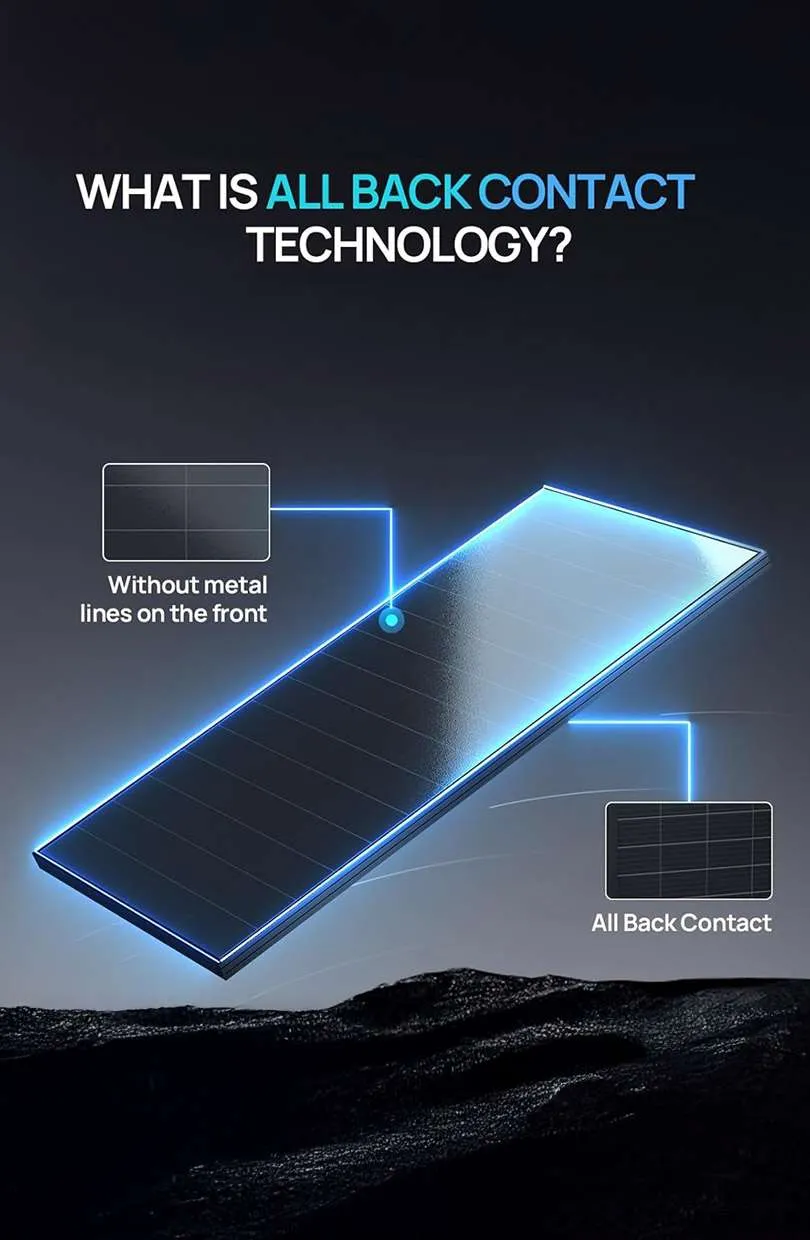
Couleenergy (Ningbo Coulee Tech Co., Ltd.) is a Zhejiang-based solar manufacturer specialising in back-contact and semi-transparent photovoltaic technology. We supply custom-spec transparent panels to greenhouse operators, agrivoltaic integrators, EPC contractors, and OEM partners across Asia, Europe, and beyond.
Tell us your crop, project location, and target transmittance level. We will recommend the right cell technology, construction type, and panel dimensions — then supply to your exact specification.
Three ways to engage:
→ Sample order — test panels at your transmittance target before committing to volume
→ Technical datasheet — full spec sheet for your chosen cell type and construction
→ Custom project quote — dimensions, power output, transmittance, and construction matched to your agronomic requirements
 English
  Español
  Français
  Deutsch
  Русский
  العربية