

“Three market forces converge in 2026 to create the steepest price pressure the solar industry has seen in five years. Here’s your strategic playbook.”
📋 Executive Summary: What Decision Makers Need to Know
Situation: Three simultaneous market forces are driving projected Chinese solar panel price increases of 20-30% through 2026:
- Policy Change: China eliminates 9% VAT export rebate on April 1, 2026 (confirmed government policy)
- Manufacturing Disruption: Chinese New Year shutdown (February) compresses procurement window
- Material Costs: Silver prices surged 200% year-over-year; polysilicon prices recovering 50%
Financial Impact (Conservative Estimates):
- 10 kW residential: +$260 module cost increase
- 100 kW commercial: +$2,580 module cost increase
- 1 MW utility-scale: +$25,800 module cost increase
- Total project costs: 12-16% higher due to module price impact
Three Strategic Options:
Option A: Accelerated Procurement (By January 31)
Best for: Confirmed Q2-Q3 projects with secured financing
Pricing: $0.086-0.092/W
Savings: 18-22% vs. post-April pricing
Risk: Inventory carrying costs, demand uncertainty
Option B: Post-Stabilization Procurement (May+)
Best for: Flexible timelines, uncertain project schedules
Pricing: $0.108-0.112/W (accept new market baseline)
Advantage: Normal lead times, better quality control, avoid rush production
Trade-off: Pay 20-24% more than February, but avoid chaos
Option C: Phased Procurement (60% Now / 40% Later)
Best for: Large buyers, distributors with multi-phase deployment
Pricing: $0.098/W blended cost
Benefit: Risk mitigation through diversified timing
Critical Timeline:
- January 31, 2026: Last realistic date for pre-Chinese New Year delivery
- February 15 – March 8: Industry-wide manufacturing shutdown
- April 1, 2026: VAT rebate elimination takes effect (prices reset upward)
Bottom Line Recommendation:
If you have confirmed Q2-Q3 projects with approved financing, accelerated procurement offers 18-22% cost savings that significantly outweigh typical inventory carrying costs (0.5-1% monthly).
If your project timeline is uncertain or extends beyond Q3 2026, waiting until May provides normal market conditions without rush production risks.
This strategic guidance reflects market intelligence from 32+ authoritative sources. It is not financial advice—consult your financial and legal advisors for decisions specific to your situation.
📊 Key Market Facts (January 2026)
- Current TOPCon pricing: $0.089-0.094/W (up 10-15% since December 2025)
- Projected May 2026 pricing: $0.108-0.112/W (20-30% increase from late 2025)
- Silver price surge: +200% year-over-year (hit record $83.62/oz December 28)
- Policy deadline: April 1, 2026 VAT elimination (confirmed by Ministry of Finance)
- Manufacturing gap: February 15 – March 8 (Chinese New Year shutdown for most manufacturers)
The perfect storm: A manufacturing shutdown (Chinese New Year) coinciding with major policy change (VAT elimination) plus material cost pressures creates the tightest procurement window in five years.

Understanding the 2026 Market Shift
One policy change is reshaping global solar procurement: China’s elimination of the 9% VAT export rebate on April 1, 2026.
This policy adjustment alone would create significant market movement. Combined with record silver prices (+200% year-over-year), polysilicon supply discipline, government-mandated capacity shutdowns, and a 3-week industry shutdown for Chinese New Year, it creates notable procurement challenges.
Strategic buyers who understand this timeline are securing supply now. Here’s your comprehensive playbook.
Important Disclaimer: This article provides strategic market intelligence based on verified industry data and policy announcements. It is not financial, legal, or investment advice. Projections reflect current market conditions and may change based on unforeseen developments. Consult qualified financial and legal advisors for decisions specific to your situation.
💰 Financial Impact Analysis: What These Changes Mean for Your Budget
Understanding the financial implications helps justify procurement decisions to stakeholders. Here’s what the projected pricing shift means in real dollars.
Module Cost Projection: February 2026 vs. May 2026
| Project Size | Feb 2026 Projected | May 2026 Projected | Estimated Increase |
|---|---|---|---|
| 10 kW residential | $860 | $1,120 | +$260 |
| 50 kW commercial | $4,300 | $5,590 | +$1,290 |
| 100 kW commercial | $8,600 | $11,180 | +$2,580 |
| 500 kW industrial | $43,000 | $55,900 | +$12,900 |
| 1 MW utility-scale | $86,000 | $111,800 | +$25,800 |
Projections based on TOPCon module pricing: $0.086/W (February) → $0.112/W (May), reflecting estimated 30% increase from combined VAT elimination, material cost pressure, and market adjustment. Module costs represent approximately 40-50% of total installed system cost for commercial/utility projects. Note: These are modeled projections based on current market conditions; actual prices will vary based on market dynamics, supplier negotiations, and unforeseen developments.
Decision Framework: Timing Your Procurement
Consider accelerated procurement (before March 15) if:
- You have confirmed projects in pipeline for Q2-Q3 2026 deployment
- Cash flow permits pre-buying inventory (distributors/installers)
- Warehouse capacity available for 3-6 months of projected demand
- Financing approved or customer deposits secured
Consider waiting until May if:
- Projects uncertain or timeline extends beyond Q3 2026
- Limited warehouse capacity or cash flow constraints
- Customer contracts not yet finalized
- You prefer to avoid inventory risk
The cost-benefit calculation: Storage costs (warehouse, insurance, opportunity cost of capital) typically run 0.5-1% per month. Even at 6 months storage, you potentially save 20-25% on modules vs. May pricing—a favorable equation for confirmed demand.

⚠️ Critical Timeline Factor: Chinese New Year Manufacturing Shutdown
“The February 17 holiday creates a 3-week production gap that fundamentally changes your procurement window.”
While many buyers focus on the April 1 VAT deadline, there’s an immediate disruption that creates a narrow ordering window measured in days, not months.
The Chinese New Year Impact
Chinese New Year 2026: February 17 (Year of the Horse)
The manufacturing disruption doesn’t start February 17—it can begin in late January and extend through early March.
Actual Production Impact Timeline:
| Period | Dates | Factory Status | Impact |
|---|---|---|---|
| Pre-Holiday Rush | Jan 27-Feb 14 | Scaling down production | Rush premiums, shipping congestion |
| Complete Shutdown | Feb 15-Mar 7 | Factories closed (except skeleton crews) | Zero production for most manufacturers |
| Slow Restart | Mar 8-20 | Gradual ramp-up, 40-60% capacity | Extended lead times, quality monitoring important |
| Full Recovery | Mar 21-Apr 1 | Near-normal capacity | Final pre-April rush begins |
Manufacturing reality: Based on industry assessments, approximately 10-15% of manufacturers (primarily Tier-1 companies like LONGi, Trina, JinkoSolar) maintain skeleton crews during Chinese New Year at 40-50% capacity. The remaining 85-90% implement complete shutdowns for 2-3 weeks.
📅 Why April 1, 2026 Represents a Market Reset
On April 1, 2026, China’s Ministry of Finance eliminates the 9% Value-Added Tax (VAT) export rebate for photovoltaic products. This is confirmed government policy.
Official announcement: A joint notice released January 9, 2026 by the Ministry of Finance and the State Taxation Administration confirmed the complete elimination of VAT export rebates for solar products effective April 1, 2026.
Understanding the VAT Rebate Mechanism
How it works through March 31, 2026:
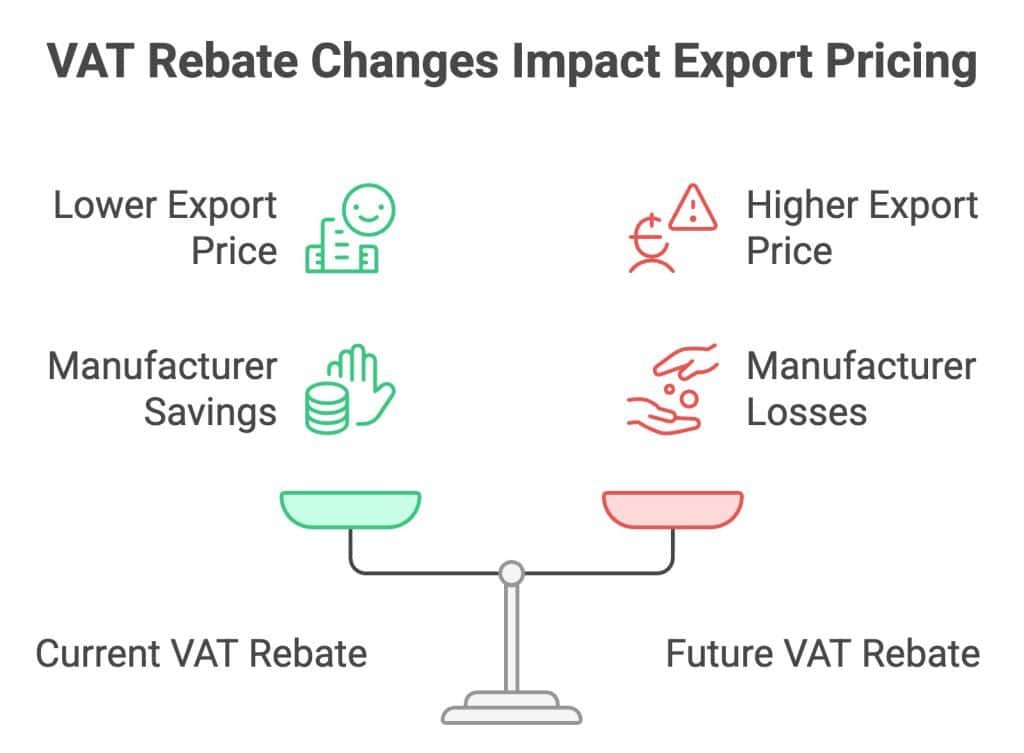
When Chinese manufacturers export solar panels, they pay 13% VAT on domestic inputs (materials, labor, overhead). The government refunds 9% of this VAT to support export competitiveness. Manufacturers typically pass this savings to international buyers through lower pricing.
Current pricing structure (through March 31):
- Module production cost: $0.093/W
- Minus 9% VAT rebate: -$0.008/W
- Export price to buyers: $0.085/W
What changes April 1, 2026:
The 9% refund is eliminated completely—no phase-out, no exceptions, no grandfathering for existing orders. Manufacturers lose this rebate instantly.
New pricing structure (from April 1):
- Module production cost: $0.093/W (unchanged)
- Minus VAT rebate: $0 (eliminated)
- Export price to buyers: $0.093/W (+9.4%)
Understanding Customs Clearance Timing (Critical for Planning)
Here’s what many buyers don’t understand about the April 1 deadline:
The VAT rebate eligibility is determined by customs clearance dates, not production or shipping dates.
Policy language: According to the Ministry of Finance joint notice, VAT rebate eligibility is “determined based on the export date declared on the customs declaration form.”
Practical implications:
- ✅ Panels produced in March, shipped April 3, customs cleared March 31: Eligible for 9% VAT rebate
- ❌ Panels produced in February, shipped March 25, customs cleared April 2: Not eligible for VAT rebate
🔥 Three Structural Forces Driving Price Adjustments
The April 1 VAT elimination doesn’t occur in isolation. Three additional cost pressures create compounding effects:
🥈 Force #1: Silver Cost Pressure (200% Price Surge)
Silver is essential for solar cell electrical contacts. Each TOPCon cell contains 80-86 milligrams of silver paste.
The price movement:
Over 12 months (January 2025 → January 2026), silver prices surged approximately 200%, reaching a record $83.62 per ounce on December 28, 2025.
Current market conditions (January 2026):
- TOPCon front-side silver paste: $2,955/kg
- TOPCon busbar silver paste: $2,764/kg
- PERC rear-side silver paste: $1,967/kg
Silver consumption by technology (verified data):
- HJT (Heterojunction): 75 mg per cell
- TOPCon: 86 mg per cell
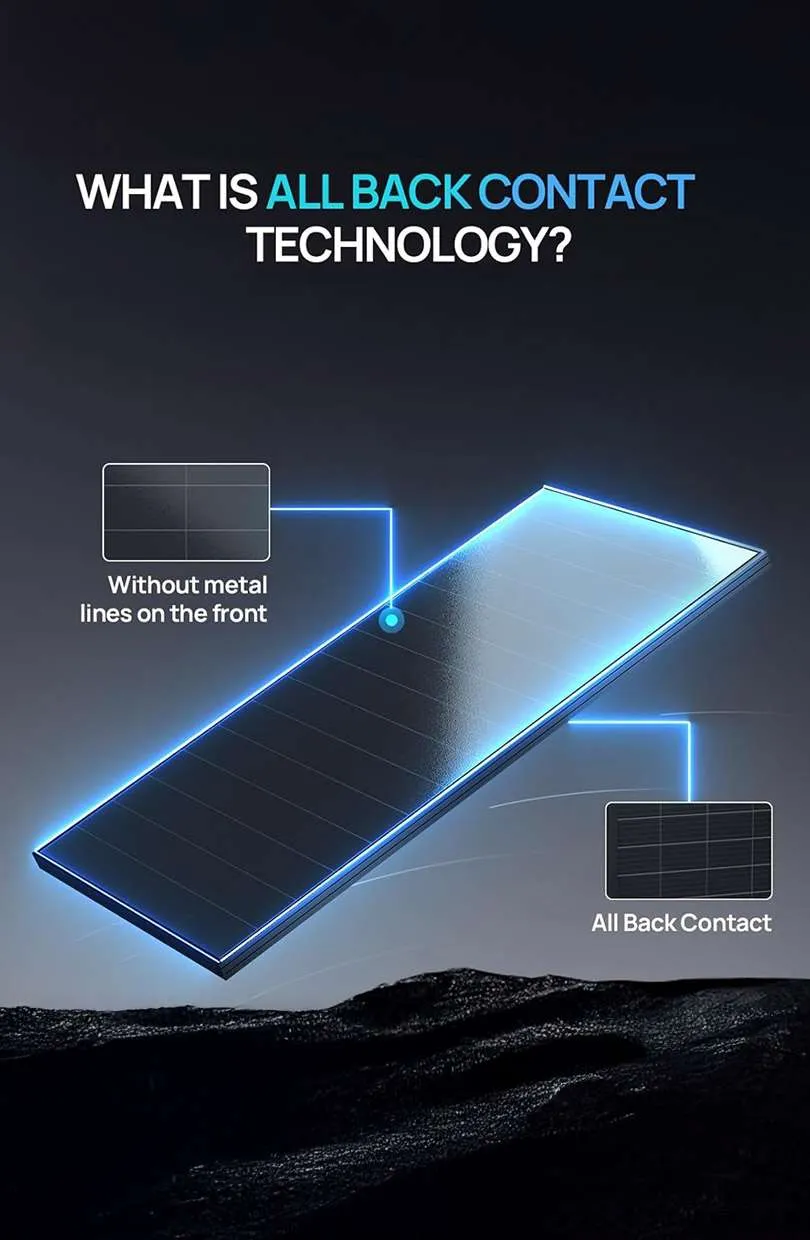
- Back-contact (conventional): 135 mg per cell
Source: China Photovoltaic Industry Association (CPIA) 2025 official statistics
Industry response to silver costs:
Major manufacturers are developing silver-reduction and silver-free technologies:
- LONGi Green Energy: Announced Q2 2026 mass production of copper-metallized cells
- Aiko Solar: Currently producing 6.5 GW annually using ABC (All Back Contact) technology with copper electroplating—completely silver-free
- JinkoSolar, Trina Solar: Developing copper paste alternatives targeting Q3 2026
⚛️ Force #2: Polysilicon Market Discipline (Price Recovery)
Polysilicon is the foundational material for solar wafers and cells. After years of oversupply, producers are implementing supply discipline.
Current pricing (January 2026):
- Spot market: RMB 50-60/kg
- New contracts: RMB 60-65/kg
- Futures market: RMB 49-51/kg
Industry consolidation developments:
In mid-2025, China’s leading polysilicon producers proposed establishing a consolidation fund to permanently reduce global capacity. This initiative aimed to shut down approximately one-third of capacity (roughly 500,000-600,000 metric tons).*
*Update: This consolidation plan was subsequently suspended by China’s antitrust regulator on January 9, 2026 due to monopoly concerns. While the specific consolidation mechanism was halted, broader industry dynamics continue to support price recovery as financially weaker producers exit the market.
🏭 Force #3: Government-Mandated Capacity Discipline
China’s Ministry of Industry and Information Technology (MIIT) is encouraging industry consolidation through regulatory guidance:
- Technology upgrades: Transition from older PERC to advanced TOPCon/HJT technologies
- Efficiency standards: Phasing out lower-efficiency production lines
- Market discipline: “Anti-involution” directives discouraging below-cost selling
⚖️ Risk Assessment: What Could Go Differently Than Projected
“No market projection is certain. Understanding potential variances helps you make informed decisions.”
Scenario Analysis: Price Movement Possibilities
| Scenario | Probability | Price Impact | Key Drivers |
|---|---|---|---|
| Base Case | 60-65% | +20-25% by May | VAT elimination + moderate material costs + normal demand |
| Higher Increase | 20-25% | +25-30% by May | Silver stays elevated + strong Q2 demand + supply constraints |
| Lower Increase | 10-15% | +12-18% by May | Silver-free tech accelerates + demand softens + competition |
Key Uncertainty Factors
Factors that could moderate price increases:
- Silver-free technology: Faster-than-expected copper metallization adoption
- Demand softening: Economic headwinds reducing solar installations globally
- Competition: Non-Chinese manufacturers (India, Southeast Asia, U.S.) ramping capacity
- Inventory liquidation: Manufacturers clearing stock to generate cash flow
Factors that could accelerate price increases:
- Silver prices: Continued precious metals rally beyond current levels
- Strong demand: Robust global solar installations exceeding projections
- Supply constraints: Extended Chinese New Year impacts or other disruptions
- Further policy changes: Additional trade restrictions or tariff adjustments
Risk Mitigation Strategies
If prices rise less than projected (12-18% instead of 20-30%):
- Early buyers still benefit from avoiding Chinese New Year disruption
- Inventory carrying costs (0.5-1% monthly) remain manageable
- Project certainty and timeline control provide non-price value
If prices rise more than projected (30%+ instead of 20-30%):
- Early procurement savings amplify significantly
- Competitive advantage increases vs. delayed competitors
- Customer value proposition strengthens
If demand softens unexpectedly:
- Phased procurement (60% now, 40% later) limits exposure
- Focus pre-buying only on confirmed projects with deposits
- Maintain flexibility in uncommitted pipeline
📆 2026 Procurement Timeline: Month-by-Month Market Dynamics
Understanding how market conditions evolve helps optimize procurement timing.
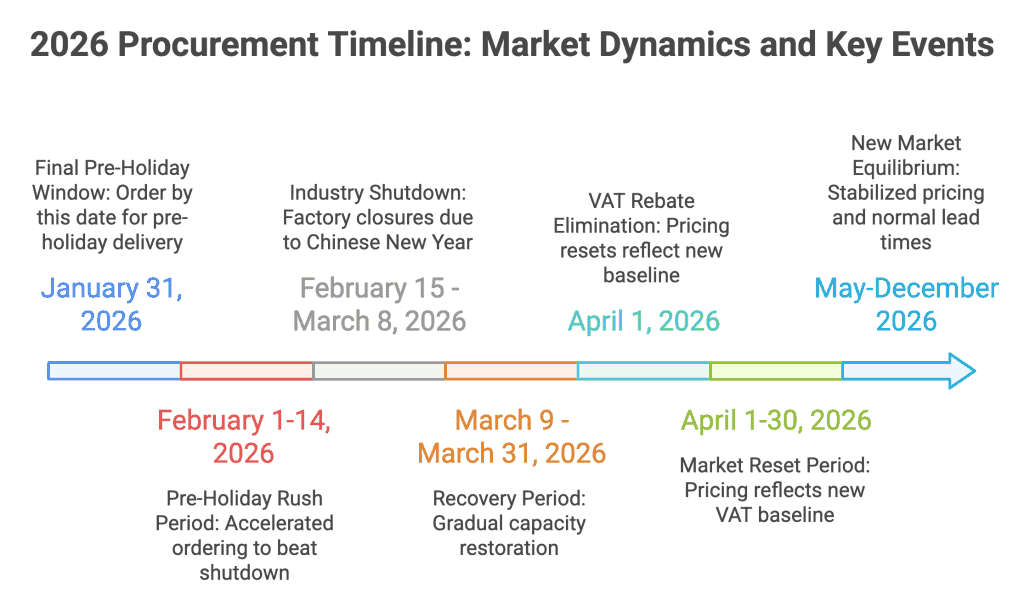
NOW – January 31, 2026: Final Pre-Holiday Window
Current pricing: $0.089-0.094/W TOPCon modules (export FOB China)
Verified against OPIS Chinese Module Marker benchmark and InfoLink Consulting data
Market conditions: Strategic buyers securing inventory; pre-Chinese New Year ordering beginning
Critical Timeline Compression:
Chinese New Year (February 17) begins factory shutdowns February 15. For pre-holiday delivery, orders should be placed by January 31, 2026.
February 1-14, 2026: Pre-Holiday Rush Period
Projected pricing: $0.092-0.096/W
Market conditions: Accelerated ordering to beat shutdown; shipping congestion likely
Considerations for this period:
- Rush premiums possible (additional 3-5%)
- Shipping surcharges likely (+15-25% on freight)
- Payment terms may tighten (manufacturers want cash before holiday)
- Delivery certainty decreases as window closes
February 15 – March 8, 2026: Industry Shutdown
Factory status: Approximately 85-90% of manufacturers completely closed
Delivery situation: Minimal production capacity available
March 9 – March 31, 2026: Recovery Period
Projected pricing: $0.095-0.100/W
Market conditions: Gradual capacity restoration; final pre-April rush
Reality check: Orders placed in this window face high risk of missing April 1 VAT deadline due to production and customs clearance timelines.
April 1-30, 2026: Market Reset Period
Projected pricing: $0.102-0.107/W
Key event: VAT rebate officially eliminated; pricing resets reflect new baseline
May-December 2026: New Market Equilibrium
Projected pricing: $0.108-0.112/W (stabilized at new baseline)
Market conditions: Normal lead times resume (4-5 weeks); pricing volatility decreases
Note: These projections reflect current market intelligence and confirmed policy changes. Actual pricing will vary based on market dynamics, supplier negotiations, and unforeseen developments. Regular monitoring of market conditions recommended.
🎯 Strategic Procurement Playbooks: Choose Your Approach
Different situations require different strategies. Select the approach that matches your circumstances.
Playbook #1: Accelerated Procurement
Best for: Confirmed Q2-Q3 projects, secured financing, warehouse capacity
Timeline: Order by January 31
Projected cost: $0.086-0.092/W
Potential advantage: 18-22% savings vs. May procurement
Execution steps:
- Week 1: Send RFQs, evaluate production availability
- Week 2: Negotiate terms, finalize supplier selection
- Week 3: Execute contracts, process deposits
- Week 4: Production monitoring, shipping coordination
Playbook #2: Post-Stabilization Procurement
Best for: Flexible timeline, uncertain projects, limited warehouse capacity
Timeline: Wait until May
Projected cost: $0.108-0.112/W
Trade-off: Accept higher baseline but avoid rush production and inventory risk
Advantages of waiting:
- Normal manufacturing lead times (4-5 weeks)
- Better quality control (no rushed production)
- Avoid Chinese New Year logistics complexity
- No inventory carrying costs or warehouse requirements
- Greater certainty in project timing before committing capital
Playbook #3: Phased Procurement
Best for: Large buyers, distributors, multi-phase deployment
Allocation: 60% February-March / 40% May-June
Blended cost: $0.098/W
Benefit: Risk mitigation through timing diversification
Risk-balanced approach:
- Secure core volume at pre-April pricing (60%)
- Maintain flexibility for market developments (40%)
- Sacrifice 9% of optimal savings for 50% risk reduction
Playbook #4: Inventory Pre-Loading (Distributors)
Best for: Distributors with warehouse capacity, consistent demand patterns
Strategy: Pre-buy 3-6 months inventory at current pricing
Financial model (100 kW example):
- Purchase cost: $8,600
- Carrying costs (4 months): $358 (warehouse, insurance, capital cost)
- Total investment: $8,958
- June sale price (projected): $11,000
- Projected profit: $2,042 (22.8% ROI in 4 months)
Risk considerations:
- Market risk (prices may rise less than projected)
- Demand risk (inventory may sit longer than anticipated)
- Technology risk (focus on TOPCon; avoid older PERC)
- Operational risk (warehouse damage, theft—mitigate with insurance)

🔬 Technology Selection: Which Solar Panels for 2026
Not all technologies face equal market pressures. Understanding the differences helps optimize selection.
| Technology | Current Price | Q4 2026 Projection | Efficiency | Recommendation |
|---|---|---|---|---|
| PERC | $0.084/W | $0.095/W | 20.5-21.5% | Legacy Technology |
| TOPCon | $0.086/W | $0.098/W | 22.0-24.0% | Recommended Default |
| Back-Contact | RMB 0.42-0.48/W | Premium narrowing | 22.5-24.5% | Specialty Applications |
✅ TOPCon: Recommended Default Choice
Why TOPCon is the strategic choice for 2026:
- Market position: 49% global market share; becoming industry standard
- Efficiency advantage: 22.0-24.0% (typically 3-5% better than PERC)
- Manufacturing scale: 280+ GW Tier-1 capacity globally
- Better degradation: 0.40% annual vs. PERC’s 0.55%
- Bifacial capability: Standard feature on most TOPCon modules
- Warranty security: Long-term manufacturer commitment
Bottom line: TOPCon is the default choice for approximately 95% of commercial and utility procurement in 2026. Proven technology, massive production scale, optimal efficiency-to-price ratio.
🌳 Decision Matrix by Project Type
| Your Situation | Recommended Strategy | Action Deadline | Projected Pricing |
|---|---|---|---|
| Confirmed Q2 project, <500 kW | Accelerated procurement | January 31 | $0.086-0.090/W |
| Confirmed Q2 project, >500 kW | Phased: 60% now, 40% May | Jan 31 / May 1 | $0.098/W blended |
| Q3-Q4 project, flexible timeline | Post-stabilization | May 1+ | $0.108-0.112/W |
| Distributor, steady demand | Inventory pre-loading | January 31 | $0.086/W + carrying |
| Uncertain timeline/funding | Wait for stabilization | May 1+ | $0.108-0.112/W |
⏰ Critical Decision Deadlines
| Action | Deadline | Impact of Missing |
|---|---|---|
| Send RFQs for pre-CNY delivery | January 27 | Insufficient time for supplier response and production |
| Finalize supplier selection | January 30 | Cannot guarantee February delivery |
| Execute contracts & deposit | January 31 | Miss pre-Chinese New Year window entirely |
| Last-opportunity February orders | February 10 | High probability of March delivery (miss both CNY and April 1) |
| Chinese New Year shutdown | Feb 15 – Mar 8 | Industry-wide production suspension |
| Post-CNY restart orders | March 9-15 | Will likely miss April 1 deadline (8-10 week delivery minimum) |
| VAT Rebate Elimination | March 31 | All orders after this pay new baseline pricing (9% higher minimum) |
Compressed Timeline Reality:
Due to Chinese New Year, the functional procurement windows are:
- ✅ NOW – January 31: Normal ordering (pre-CNY delivery possible)
- ⚠️ Feb 1-10: High-risk ordering (may miss CNY window)
- 🚫 Feb 15 – March 8: Factory shutdown (minimal production)
- ❌ March 9+: Too late for April 1 benefit (delivery in May at new pricing)
📞 Couleenergy: Specialized Solutions for Unique Requirements
If standard procurement strategies don’t address your specific needs:
Our specialized capabilities:
- Flexible MOQs: 100-piece minimums for specialized projects
- Custom specifications: Non-standard wattages, dimensions, mounting configurations
- Bifacial TOPCon: 75-85% rear-side gain optimization for ground-mount applications
- Flexible panels: Lightweight, bendable modules for curved surfaces and portable applications
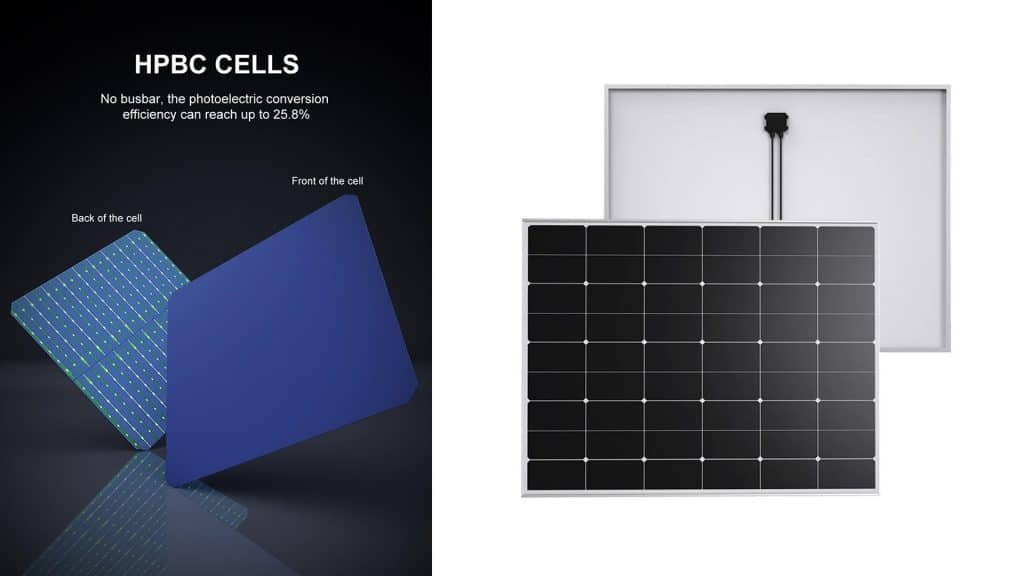
- HPBC back-contact: Premium aesthetics for luxury residential and BIPV
February 2026 pricing available through March 15 for confirmed orders with deposits.
How we can assist:
- Structure phased procurement strategies across multiple delivery windows
- Specify optimal technology for your specific application requirements
- Negotiate volume pricing for multi-year supply commitments
- Coordinate international logistics and customs clearance
📧 Email: info@couleenergy.com
📞 Phone: +1 737 702 0119
🎯 Strategic Summary: Your Path Forward
The Market Reality
Chinese solar panel prices are projected to increase 20-30% through 2026 based on confirmed policy changes and observable market forces:
- 9% VAT rebate elimination (April 1, 2026—confirmed government policy)
- 200% silver price surge (structural market pressure)
- Polysilicon market discipline (industry consolidation dynamics)
- Chinese New Year shutdown (February 15 – March 8 production gap)
Your Strategic Options
Three clear pathways, each appropriate for different circumstances:
Option A: Accelerated Procurement (By January 31)
Appropriate for: Confirmed Q2-Q3 projects with secured financing and warehouse capacity
- Projected pricing: $0.086-0.092/W
- Potential savings: 18-22% vs. May procurement
- Trade-off: Inventory carrying costs vs. price appreciation
- Timeline: Order this week for pre-CNY delivery
Option B: Post-Stabilization Procurement (May+)
Appropriate for: Flexible timelines, uncertain projects, limited inventory capacity
- Projected pricing: $0.108-0.112/W (accept new market baseline)
- Benefits: Normal lead times, better quality control, no inventory risk
- Trade-off: Higher pricing vs. operational simplicity
- Timeline: Evaluate market in late April, procure in May
Option C: Phased Procurement (60% Now / 40% Later)
Appropriate for: Large buyers seeking risk mitigation through timing diversification
- Blended pricing: $0.098/W
- Benefits: Capture some savings while maintaining flexibility
- Trade-off: Slightly higher cost than optimal timing but significantly lower risk
- Timeline: 60% by January 31, 40% in May
What Successful Procurement Looks Like in 2026
Strategic procurement isn’t about perfect timing—it’s about matching your approach to your specific circumstances:
- If you have confirmed demand: Accelerated procurement captures significant savings
- If timeline is uncertain: Waiting until May provides operational certainty
- If you’re managing portfolio risk: Phased approach balances both considerations
“The optimal strategy varies by buyer. The key is making an informed decision aligned with your specific situation—not following a one-size-fits-all approach.”
📞 Ready to Develop Your Procurement Strategy?
Whether you’re navigating the January 31 window or planning post-stabilization procurement, we’re here to help.
Disclaimer: This article provides strategic market intelligence based on verified industry data, confirmed government policies, and authoritative industry sources. It is intended for informational purposes only and does not constitute financial, legal, or investment advice. Market projections reflect current conditions and may change based on unforeseen developments. All procurement decisions should be made in consultation with qualified financial and legal advisors who understand your specific circumstances. Couleenergy makes no warranties regarding the accuracy of future price projections or market developments.



 English
  Español
  Français
  Deutsch
  Русский
  العربية