

The solar industry enters 2026 facing a significant market shift. After years of declining prices, custom solar module costs began climbing in late 2025 and continue rising into Q1 2026. For buyers planning projects, understanding these changes and acting quickly matters more than ever.
This article explains why prices are rising, how ABC (All Back Contact) technology offers unique protection against cost volatility, and what custom solar buyers should do right now to secure favorable terms.
🔑 Key Takeaways for B2B Buyers
- Silver prices surged 30%+ in 2025, driving solar cell prices up 25%+ and creating pressure across the supply chain
- ABC technology is silver-free, providing unique price stability while TOPCon and HJT technologies face cost volatility
- Q1 2026 procurement window is closing—order books are 60-70% committed for H1 2026
- Couleenergy offers 100-unit MOQ with 2-4 week delivery versus industry standard 500+ units and 8-12 weeks
- Lock orders by January 31, 2026 to secure current pricing before Q2 increases take effect
The Q1 2026 Price Reality: What’s Driving Costs Up?
Solar module prices stopped falling in late 2025. As we move into Q1 2026, three major factors continue pushing costs higher. Understanding these drivers helps buyers make informed decisions in a rapidly changing market.
Silver Prices Hit Solar Manufacturers Hard
Silver is essential for most solar cell production. Silver prices surged over 30% during 2025, driving solar cell prices up over 25% in response. This hits TOPCon and HJT technologies especially hard because they use silver on both sides of each cell.
Most manufacturers use 12-15 mg of silver per watt. When silver costs jump, solar module prices must follow. Cell manufacturers raised prices approximately 10% in late December 2025 alone. These increases flow directly to module buyers throughout Q1 2026.
Wafer Manufacturers End Price Wars
Major Chinese wafer producers made a strategic decision. They collectively raised prices to stop “vicious competition” that pushed costs below production levels.
Leading manufacturers like Longi and TCL Zhonghuan increased wafer prices by roughly 12% in late December. They also cut production capacity to 50-80% utilization. This tightens supply and supports higher pricing.
Raw Material Costs Keep Climbing
Beyond silver and wafers, other materials face inflation:
- Solar glass prices nearly doubled in some markets
- EVA and POE films increased approximately 40%
- Aluminum frame costs continue rising
- Polysilicon rebounded from lows
These combined pressures create a new cost floor. The era of constant price drops appears to be pausing.
Why ABC Technology Stands Apart During Price Volatility
Not all solar technologies face equal pressure from these cost increases. ABC (All Back Contact) technology has a structural advantage that matters right now.
ABC Is Silver-Free: A Game-Changing Difference
Aiko Solar’s ABC technology uses copper electroplating instead of silver paste. This isn’t just “low silver”—it’s completely silver-free.
While TOPCon manufacturers scramble to absorb silver cost increases, ABC manufacturers face no silver surcharge. This creates pricing stability when other technologies see volatility.
Key distinction: Most back contact technologies still use some silver. Aiko’s ABC is the verified exception. This makes it uniquely protected from the current silver crisis.
Solar Technology Comparison: ABC vs. TOPCon vs. HJT
| Feature | ABC (Aiko) | TOPCon | HJT |
|---|---|---|---|
| Silver Content | ✓ Zero (copper-based) | ✗ 12-15 mg/W (both sides) | ✗ High (22+ mg/W) |
| Efficiency | 24-25% | 23-24% | 22-24% |
| Price Stability (2026) | High (insulated from silver) | Moderate (vulnerable) | Low (highly vulnerable) |
| Aesthetics | All-black (no front grid) | Standard (visible grid) | Standard (visible grid) |
| Custom Voltage Options | High flexibility | Moderate | Moderate |
Data as of January 2026. Efficiency ranges reflect commercial production capabilities.
The Competitive Gap Is Shrinking
Here’s what matters for buyers in early 2026: the price premium for ABC technology is decreasing relative to standard options.
TOPCon prices rose sharply in late 2025 due to silver costs. ABC prices remained more stable thanks to copper-based metallization. Industry analysts observe that the gap between standard and premium back-contact technology is narrowing significantly in early 2026.
When you factor in ABC’s superior efficiency of 24-25% versus 23-24% for standard TOPCon, the cost per watt delivered becomes increasingly competitive. This is especially true for space-constrained applications.

Other Cost Pressures Still Apply
ABC isn’t immune to all cost increases. Wafer and auxiliary material costs affect all solar module types. However, ABC manufacturers face milder increases because they avoid the sharpest cost driver—silver.
This positions ABC as a strategically smarter choice during market turbulence.
Strategic Timing: Why Q1 2026 Is the Window for Custom ABC Orders
For custom solar solutions, timing matters even more than standard products.
Production Capacity Fills Fast
Back contact module capacity is expanding rapidly. However, it’s still a fraction of TOPCon’s total capacity. Custom production lines fill up first during market tightening.
Industry distributors report that major ABC manufacturers’ order books for H1 2026 are already 60-70% committed. Delayed buyers risk being pushed to Q3 delivery windows at potentially higher pricing.
MOQ Requirements May Tighten
As demand surges, manufacturers often raise minimum order quantities. Industry observers note that what required 500 pieces in Q4 2025 might demand 1000-1500 pieces by Q2 2026 at some suppliers.
Locking orders now preserves access to current MOQ flexibility—particularly important for Couleenergy buyers who benefit from the 100-unit minimum.
Lead Times Create Project Delays
Custom ABC orders from responsive manufacturers like Couleenergy require just 2-4 weeks from deposit to shipment. Order in January, receive solar panels in February. This beats Q2 price hikes and ensures timely project completion.
Wait until March, and you might face longer lead times from other suppliers (often 8-12 weeks) and higher prices—potentially delaying installations until May or June.
ABC Technology Benefits for Custom Applications
Beyond price stability, ABC technology solves specific problems for custom solar buyers. These advantages make ABC particularly valuable for specialized applications and challenging environments.
Note: Efficiency specifications and performance data reflect commercial production capabilities as of early 2026. Laboratory records may exceed these figures, but we focus on real-world, mass-produced module specifications relevant to B2B buyers.
Premium Aesthetics Without Compromise
ABC moves all grid lines to the back of the cell. This creates a sleek, all-black frontal appearance with no visible busbars.
For architects and premium device makers, this aesthetic quality is essential. Building-integrated photovoltaics (BIPV) and high-end consumer devices benefit most.
You don’t need custom painting or film overlays that add cost and reduce efficiency. The clean look comes standard.
Maximum Power in Limited Space
ABC achieves 24-25% efficiency—among the highest available for commercial solar panels as of early 2026. This means you need fewer panels to reach target wattage. For weight-sensitive boats, RVs, or space-constrained IoT devices, this efficiency advantage is critical.
Higher efficiency also means better performance in low-light and shaded conditions. This extends operational hours for sensors and smart devices.
Enhanced Durability for Harsh Environments
ABC modules perform well in demanding conditions. Marine and industrial applications particularly benefit from advanced back-contact design.
Temperature coefficient performance stays strong. Whole life-cycle hot-spot control technology addresses a major failure mode in mobile installations exposed to vibration and thermal cycling.

Customization Flexibility
Silver-free design gives manufacturers more flexibility in cell stringing configurations. Custom voltage matching becomes easier without material cost penalties.
This matters for specialized applications requiring non-standard electrical specifications.
Couleenergy’s Custom ABC Solutions: Solving Real Buyer Pain Points
Couleenergy addresses the specific friction points that frustrate custom solar buyers.
Low MOQ Opens Opportunities
Most manufacturers require 500-1,000+ units for custom orders. Couleenergy cut this barrier dramatically.
100-unit minimum orders make pilot projects viable. Small-to-mid-sized specialized applications become accessible. IoT device makers, niche marine builders, and RV manufacturers can test custom designs without massive upfront inventory commitments.
Sample orders (1-2 units) support prototype development before full production.
Fast Custom Design Process
Custom engineering typically involves weeks of back-and-forth at traditional manufacturers. Couleenergy streamlined this to just 2-4 weeks from deposit to shipment for most custom orders—a significant competitive advantage.
The process moves from initial concept to prototype in 3-4 weeks when needed, though many standard custom orders ship even faster. This rapid turnaround is possible through:
Direct engineering access: Engineers handle requests directly, not through sales intermediaries. This speeds feasibility checks for unique voltages, odd shapes like triangles or curves, and specialized specifications.
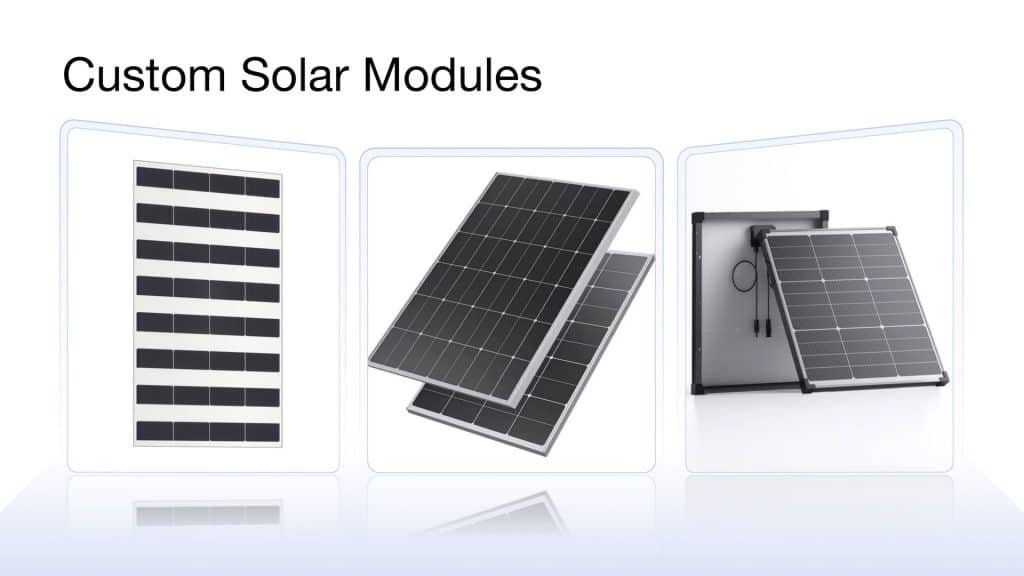
Advanced manufacturing: Laser cutting technology allows precise custom shapes without expensive re-tooling for minor changes. This flexibility reduces both time and cost for buyers.
ETFE Coatings Extend Lifespan
Standard flexible PV panels often degrade in 2-3 years from salt spray and UV exposure. Couleenergy exclusively uses ETFE coatings (not cheap PET alternatives).
This extends lifespan to 10-15 years. The self-cleaning material reduces maintenance costs by approximately 60%. Marine and RV buyers get reliable long-term performance.
Factory-Direct Advantages
Eliminating distributor margins saves buyers significant costs. More importantly, factory-direct access provides transparency.
Buyers get visibility into the 3-stage quality control process. Electroluminescence testing spots micro-cracks before shipment. Real-time production updates replace middleman uncertainty.
Comparison: Couleenergy vs. Industry Standard
| Feature | Couleenergy | Industry Standard |
|---|---|---|
| Minimum Order Quantity | 100 units | 500-1,000+ units |
| Lead Time | 2-4 weeks | 8-12 weeks |
| Engineering Access | Direct to engineers | Through sales reps |
| Flexible Panel Coating | Premium ETFE (10-15 year lifespan) | Often PET (2-3 year lifespan) |
| Pricing Model | Factory-direct | Through distributors |
What Custom Solar Buyers Should Do Now
Market conditions won’t stay favorable indefinitely. Follow this prioritized action plan to secure optimal terms before the Q1 2026 window closes.
⚡ Quick Action Checklist
Complete these steps by January 31, 2026 to secure Q1 pricing and avoid Q2 increases:
- ☐ Request quotes from 2-3 ABC suppliers by January 10
- ☐ Finalize technical specifications and certification requirements by January 12
- ☐ Negotiate fixed-price contracts with delivery penalty clauses by January 20
- ☐ Place orders and confirm production slots by January 31
- ☐ Arrange financing/payment terms before order placement
Immediate Actions
Day 1-2: Request Competitive Quotes
Contact 2-3 qualified ABC module suppliers immediately, for low-MOQ custom solutions. Specify:
- Target delivery date (aim for late January/early February)
- Exact quantity (even if approximate)
- Key technical requirements
- Budget constraints (if any)
Request price validity for 15-30 days minimum while you evaluate options. In volatile markets, even 7-day validity windows pose risk.
Day 3-5: Finalize Technical Specifications
Draft a detailed specification sheet covering:
Physical Requirements:
- Exact dimensions (length, width, thickness)
- Weight constraints (critical for marine/RV applications)
- Shape (standard rectangular, or custom triangular/curved/irregular)
- Mounting method compatibility
Electrical Specifications:
- Power output per module (watts)
- Voltage requirements (Vmp, Voc)
- Current specifications (Imp, Isc)
- String configuration needs
Environmental & Application Details:
- Installation environment (marine, BIPV, mobile, stationary, industrial)
- Expected temperature ranges
- Exposure conditions (salt spray, UV intensity, vibration)
- Aesthetic requirements (all-black, frameless, transparency needs)
Compliance & Quality:
- Required certifications (IEC, UL, CE standards)
- Warranty expectations
- Quality control documentation needs
Clear specifications speed quote turnaround from days to hours and reduce revision cycles that waste precious time in volatile markets.
Week 2: Evaluate Suppliers & Negotiate Terms
Verify MOQ Flexibility and Production Timeline
Confirm your order size qualifies for expedited production slots:
- 100-200 pieces: Typically qualify for priority at specialized manufacturers like Couleenergy
- 200-500 pieces: Standard commercial orders, widely accepted
- 500+ pieces: May unlock volume pricing but verify if truly necessary
Ask specific questions:
- What’s your current production queue status?
- Can you guarantee delivery by [target date]?
- What happens if my order grows/shrinks by 10-20%?
- Do you offer staged delivery options?
Understanding staging options matters. Some buyers prefer 60% initial shipment + 40% follow-up to manage cash flow and test quality before full commitment.
Negotiate Smart Contract Terms
Market volatility makes contract details critical. Don’t accept standard terms without negotiation:
Fixed-Price Contracts:
Insist on price locks through delivery, not just order placement. In volatile markets, “price at time of shipment” clauses create unacceptable risk. Many suppliers tried pushing this in Q4 2025—sophisticated buyers refused.
Example language: “Unit price of $X.XX/W remains fixed through delivery, regardless of raw material cost fluctuations, with delivery guaranteed by [date].”
Staged Payment Protection:
Tie deposits to measurable milestones for custom orders:
- 30% deposit at order confirmation
- 30% upon prototype approval (for custom designs)
- 40% upon shipment or delivery
This protects you if specifications don’t match expectations or quality issues emerge.
Delivery Penalty Clauses:
With lead times stretching and capacity tightening, negotiate compensation for missed timelines:
- 1-3% price reduction per week of delay beyond agreed date
- Right to cancel without penalty after X weeks
- Expedited shipping at supplier’s cost if delay exceeds threshold
Force Majeure Limits:
Standard force majeure clauses are too broad. Specify that raw material price increases, capacity constraints, or production scheduling issues don’t qualify. Only genuine external events (natural disasters, government restrictions) should trigger protection.
Prioritize Technical Quality Over Marginal Cost Savings
For custom ABC orders, certain specifications directly impact long-term value. Don’t compromise here:
Cell Grade Matters:
ABC’s efficiency advantage (24-25%) is its core value proposition. Manufacturers sometimes offer lower-grade cells to hit aggressive price targets. Verify:
- Actual module efficiency (not just cell efficiency)
- Testing methodology (STC vs. real-world conditions)
- Power tolerance (±3W is standard, ±5W suggests quality issues)
Coating Quality for Harsh Environments:
If ordering flexible panels for marine, RV, or industrial use, confirm premium ETFE coating—not cheaper PET alternatives:
- ETFE lifespan: 10-15 years in salt spray/UV
- PET lifespan: 2-3 years before degradation
- Cost difference: ~15-20% upfront
- Replacement cost avoidance: 200-300% over panel lifetime
Ask: “Is this your standard ETFE formulation or a cost-reduced version?” Differences exist even within ETFE grades.
Warranty Transferability:
Essential for projects you may sell, refinance, or transfer ownership:
- Confirm 25-year performance warranty transfers to new owners
- Verify workmanship warranty terms (typically 10-12 years)
- Request sample warranty documentation during quote phase
- Check manufacturer’s claims process—some are notoriously difficult
Temperature Coefficient Verification:
ABC panels should demonstrate temperature coefficient of -0.24% to -0.30%/°C. Higher numbers (-0.35% or worse) suggest older technology or quality compromises. This matters significantly in hot climates where panels regularly exceed 65°C (149°F).
Quality Documentation:
Request evidence of:
- Electroluminescence testing for micro-crack detection
- Flash test results (actual output vs. rated output)
- Factory audit certifications (if available)
- Sample batch quality reports
⚖️ Risk vs. Opportunity: Q1 2026 Procurement Decision
| ❌ Risks of Waiting Until February-March | ✅ Benefits of Ordering Now (January 2026) |
|---|---|
| Prices stabilize 5-15% higher MOQs tighten to 300-500 units Production slots fill (Q3 delivery) Lost 8-12 weeks of operation time Weaker negotiating position | Lock current pricing (before increases) Secure 100-200 unit MOQ flexibility Receive panels by late January/early February Beat Q2 price hikes and rush Strong contract negotiation leverage |
The procurement window closes January 31, 2026. Act now to secure advantages.
The Bottom Line: Act Before the Window Closes
Q1 2026 represents a rare convergence of favorable conditions for custom solar buyers—but this window is closing rapidly. Here’s what makes early January 2026 the optimal procurement moment:
- ✓ Price stability for ABC technology while competitors face silver-driven inflation
- ✓ Shrinking premium versus standard technologies (best value ratio in years)
- ✓ Pre-rush availability before Q2-Q3 procurement panic and tightening MOQs
- ✓ Technology maturity (ABC is mass-production-proven with established supply chains)
- ✓ Fast delivery (2-4 weeks from suppliers like Couleenergy vs. 8-12 weeks industry average)
The Two Scenarios for Buyers Who Wait:
Scenario A (Most Likely): By March 2026, prices stabilize 5-15% higher as the new cost floor settles. MOQs tighten from 100-200 units to 300-500 units at many manufacturers. Production slots fill, pushing delivery into Q3. Your early January competitors already have panels installed and generating value while you’re still negotiating quotes.
Scenario B (Optimistic): Prices unexpectedly plateau or edge slightly lower—but even in this best case, you’ve lost 8-12 weeks of potential system operation, revenue generation, or project development time. For most B2B applications, the opportunity cost of delay exceeds any marginal price savings.
For custom B2B buyers—distributors, project developers, OEMs, specialized installers—the strategic choice is clear: Request quotes immediately, lock pricing and MOQs immediately, and execute before spring demand begins.
Ready to Explore Custom ABC Solutions?
Couleenergy specializes in custom solar panel manufacturing with ABC and HPBC technologies. Our low MOQ approach (starting at 100 units) makes premium technology accessible for specialized applications.
Whether you need flexible solar panels for marine use, custom-shaped modules for BIPV integration, or specialized power/voltage configurations for IoT devices, we deliver factory-direct solutions with engineering support.

Contact Our Team to Discuss Your Custom Requirements:
📧 Email: info@couleenergy.com
📞 Phone: +1 737 702 0119
Share your technical specifications, project timeline, and quantity requirements. Our engineers will provide detailed feasibility assessments and competitive quotes within 24 hours.
Frequently Asked Questions
1. Why are custom solar module prices increasing in Q1 2026?
Custom solar module prices began rising in late 2025 and continue increasing into Q1 2026 due to three converging factors. First, silver prices surged over 30% during 2025, driving solar cell prices up over 25% in response—this particularly impacts TOPCon and HJT technologies that use silver on both cell sides. Second, major wafer manufacturers collectively raised prices by approximately 12% in late December 2025 while cutting production capacity to 50-80% utilization, ending the “vicious competition” that drove prices below production costs. Third, raw material inflation continues across the supply chain: solar glass prices nearly doubled in some markets, EVA/POE films increased approximately 40%, and aluminum frame costs keep rising. These combined pressures create a new cost floor across the industry. However, ABC technology using copper electroplating instead of silver remains more insulated from the sharpest price increases compared to silver-dependent technologies like TOPCon and HJT.
2. How does ABC solar technology compare to TOPCon panels for custom applications?
ABC (All Back Contact) technology offers several advantages over TOPCon for custom solar applications. ABC is completely silver-free, providing price stability during material cost volatility, while TOPCon uses silver on both cell sides making it vulnerable to raw material price spikes. ABC achieves 24-25% efficiency—among the highest for commercial modules—versus TOPCon’s 23-24%, meaning fewer panels needed for target wattage. This is critical for space-constrained applications like marine, RV, or BIPV installations. ABC also provides superior aesthetics with all grid lines on the back, creating an all-black appearance without custom coatings or films that reduce efficiency. For customization flexibility, ABC’s silver-free design offers more options in cell stringing and voltage configurations without material cost penalties. Additionally, ABC panels demonstrate excellent temperature coefficient performance and enhanced durability in harsh environments.
3. What is the minimum order quantity for custom ABC solar panels at Couleenergy?
Couleenergy offers custom ABC and HPBC solar panels with a minimum order quantity of just 100 units, significantly lower than the industry standard of 500-1,000+ units. This low MOQ makes premium back-contact technology accessible for pilot projects, specialized marine/RV builders, IoT device manufacturers, and niche applications. Sample orders of 1-2 units are also available for prototype development, allowing buyers to test custom designs without massive upfront inventory commitments.
4. How long does custom solar panel manufacturing take from order to delivery?
Lead times vary by manufacturer and order complexity. Couleenergy delivers custom ABC solar panels in just 2-4 weeks from deposit to shipment—significantly faster than industry averages. Our streamlined design process moves from initial concept to prototype in 3-4 weeks, with production often occurring concurrently for simple orders. Orders placed in early January 2026 receive panels by late January or early February, beating Q2 price increases and ensuring timely project completion. Many other manufacturers require 8-12 weeks for custom orders, making Couleenergy’s rapid turnaround a competitive advantage. Custom specifications, certification requirements, and order volume can influence final timelines, but most standard custom orders from Couleenergy ship within this 2-4 week window.
5. What makes Couleenergy’s custom solar panel manufacturing different from other suppliers?
Couleenergy differentiates through four key advantages: (1) Low 100-unit MOQ versus industry standard 500-1,000+ units, making custom solutions accessible for smaller projects; (2) Direct engineering access rather than sales intermediaries, speeding feasibility checks for unique voltages, shapes, or specifications; (3) ETFE coating exclusively for flexible panels (not cheap PET), extending lifespan to 10-15 years versus 2-3 years for standard alternatives; (4) Factory-direct pricing eliminating distributor markups while providing visibility into 3-stage quality control including electroluminescence testing. Advanced laser cutting technology enables precise custom shapes without expensive re-tooling.
6. When should I order custom solar panels to avoid Q1 2026 price increases?
Order custom solar panels immediately in early January 2026 to lock current pricing before market adjustments take full effect. ABC module manufacturers’ order books for H1 2026 are already 60-70% committed, and delayed buyers risk Q3 delivery windows at higher prices. Request quotes this week and secure 15-30-day price validity windows. With Couleenergy’s 2-4 week lead time, January orders arrive by late January or early February—well before Q2 price hikes. Note that other manufacturers often require 8-12 weeks, so early ordering is even more critical if you’re comparing multiple suppliers. MOQ requirements may also tighten from 200 pieces to 300-500 pieces by Q2 2026 as demand surges. Contract negotiations should include fixed-price terms through delivery, not just order placement.
7. Can ABC solar technology withstand harsh marine and outdoor environments?
Yes, ABC solar technology performs exceptionally well in harsh environments. ABC modules feature enhanced durability through advanced back-contact design, strong temperature coefficient performance, and whole-life-cycle hot-spot control technology addressing vibration and thermal cycling common in marine/mobile installations. When combined with premium ETFE coatings (as Couleenergy provides), flexible ABC panels achieve 10-15 year lifespans even in salt spray and intense UV exposure conditions. ETFE’s self-cleaning properties reduce maintenance costs by approximately 60% compared to standard materials. The 24-25% efficiency also ensures reliable power generation in low-light and partially shaded conditions typical of challenging outdoor applications.
Market Data Sources
- Late December 2025 wafer and cell pricing data from Chinese market reports
- Q4 2025 silver commodity pricing from Metals Focus and industry analysts
- Back contact manufacturing capacity projections from BC technology experts
- Industry distributor reports on H1 2026 order book commitments
About Couleenergy
We manufacture custom solar solutions including flexible solar panels, back-contact technologies (HPBC, ABC), and advanced cell types for global B2B markets. Our low MOQ approach (100-piece minimums), direct engineering access, and factory-direct pricing serve distributors, installers, EPCs, and OEM partners worldwide.
Disclosure: This article is published by Couleenergy for educational and informational purposes. All market data, technical specifications, and industry trends have been independently verified against authoritative sources. Readers are encouraged to conduct their own due diligence and verify current specifications with multiple suppliers before making procurement decisions.




 English
  Español
  Français
  Deutsch
  Русский
  العربية