

⚡ Quick Summary: TÜV certification subjects solar panels to 19+ rigorous tests based on IEC 61215:2021 standards, plus provides ongoing factory monitoring. Research indicates certified solar panels can demonstrate significantly lower failure rates and typically maintain better performance over 25 years. The certification provides quality assurance through continuous monitoring beyond initial testing.
Why TÜV Certification Matters for Solar Panels
Solar panels represent a major investment expected to perform reliably for 25 years or more. TÜV certification offers one of the most comprehensive quality assurance programs available in the industry.
TÜV certification combines over 19 different tests with ongoing factory surveillance. This dual approach—rigorous testing plus continuous monitoring—sets it apart from basic certifications that only verify initial samples.
One documented case from Southeast Asia illustrates the potential risks of inadequate quality control. A solar farm using non-certified PV panels experienced widespread failures within three years, requiring complete system replacement. While this extreme case involved PV panels that failed to meet basic quality standards in harsh tropical conditions, it highlights the importance of proper certification.
⚠️ Important Context: Certification tests simulate accelerated aging but cannot predict all real-world conditions. Performance varies based on installation angle, shading, soiling, maintenance, and local climate factors.
What Is TÜV Certification?
Understanding the Certification System
TÜV stands for Technischer Überwachungsverein (German technical inspection association). Multiple organizations provide TÜV certification, with TÜV Rheinland, TÜV Nord, and TÜV SÜD being the most common for solar panels. Each may have slightly different testing procedures and specializations.
Key features that distinguish TÜV certification:
- ✅ Regular factory visits (frequency varies by agreement and manufacturer)
- ✅ Production line sampling rather than manufacturer-selected samples
- ✅ Material verification to ensure consistency with certified specifications
- ✅ Supply chain auditing throughout the certification period
Note: TÜV certification applies to specific manufacturing batches and facilities. Changes in production location or processes may require recertification.
The 19+ Tests Explained: IEC 61215:2021 Standards
Five Test Sequences
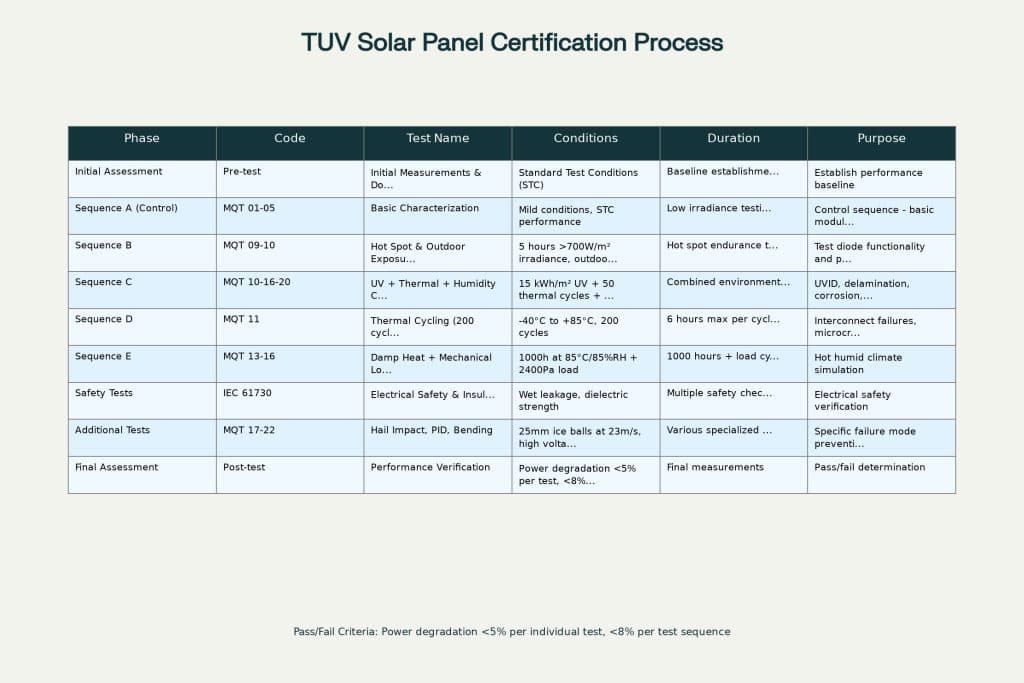
TÜV certification follows IEC 61215:2021 standards, organizing tests into five sequences (A through E). Each targets specific potential failure modes:
| Test Sequence | Focus Area | Key Tests |
|---|---|---|
| Sequence A | Basic Performance | Baseline measurements under standard test conditions |
| Sequence B | Hot Spot Safety | 5 hours at >700W/m², bypass diode functionality |
| Sequence C | Combined Stress | UV (15 kWh/m²) + 50 thermal cycles + 10 humidity freeze cycles |
| Sequence D | Extended Temperature | 200 thermal cycles from -40°C to +85°C |
| Sequence E | Tropical Conditions | 1,000 hours at 85°C/85% RH + 2,400 Pa mechanical load |
Environmental Testing Details
🌡️ Temperature Cycling Tests
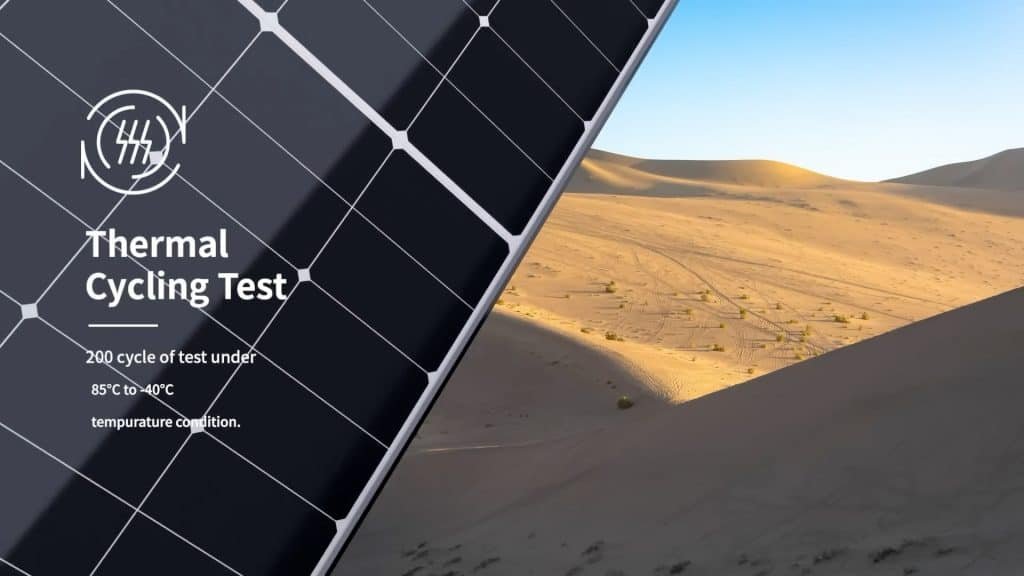
Solar panels undergo 50 to 200 thermal cycles between -40°C (-40°F) and +85°C (185°F), depending on the sequence. Each cycle follows specific ramp rates and dwell times to simulate decades of temperature variations.
These tests evaluate how different materials (aluminum frames, glass, silicon cells, polymer encapsulants) handle thermal expansion and contraction at different rates.
💧 Damp Heat Testing
The damp heat test maintains 85°C with 85% relative humidity for 1,000 hours. This accelerated aging protocol simulates approximately 20-25 years in tropical climates, though actual correlation to field performance varies by specific conditions.
☀️ UV Preconditioning
Solar panels receive 15 kWh/m² of UV radiation in wavelengths from 280-400nm, with at least 5 kWh/m² in the more damaging 280-320nm range. This represents several months of concentrated UV exposure to identify materials susceptible to UV degradation.
Mechanical Testing Protocols
Static Load Testing
- Standard test: 2,400 Pa pressure for one hour (front and back)
- Enhanced test: Up to 5,400 Pa for extreme conditions
- Simulates: Heavy snow loads or wind speeds exceeding 130 mph
Dynamic Mechanical Load Testing
Introduced in the 2021 standard update, this test applies 1,000 cycles of oscillating pressure between +1,000 Pa and -1,000 Pa, simulating wind-induced flexing over the panel’s lifetime.
Hail Impact Testing
Standard testing fires 25mm diameter ice balls at 23 m/s (83 km/h) at 11 specific locations. Ice balls are frozen to -5°C to -20°C, as colder ice produces up to 70% higher impact forces. Some facilities test with larger projectiles (up to 70mm) for regions prone to severe hail.

Pass/Fail Criteria and Performance Standards
Power Retention Requirements
To achieve certification, PV panels must maintain:
- Individual test minimum: 95% of initial rated power
- Complete sequence minimum: 92% of initial rated power
- Electrical integrity: No open circuits or ground faults
These thresholds are based on field data correlating test performance with long-term reliability, though individual PV panel performance in real installations will vary.
Visual and Structural Standards
⚠️ Automatic Failure Conditions:
- Delamination of encapsulant materials
- Visible cracks in solar cells
- Frame corrosion or structural damage
- Backsheet discoloration or degradation
- Junction box or connector damage
Ongoing Quality Assurance: Beyond Initial Testing
Factory Surveillance Programs
TÜV organizations conduct regular factory inspections, though frequency varies based on manufacturer agreements and risk assessments. These inspections typically include:
- Random sampling from active production lines
- Verification of materials against certified specifications
- Quality control process audits
- Supplier qualification reviews
- Testing equipment calibration checks
Important Limitations
What certification doesn’t guarantee:
- Specific power output in your installation (depends on local conditions)
- Warranty enforcement (depends on manufacturer stability)
- Performance in conditions outside tested parameters
- Protection against all possible failure modes
Performance Comparison: Certified vs Non-Certified
| Factor | Non-Certified Panels | TÜV-Certified Panels |
|---|---|---|
| Quality Control | Varies widely by manufacturer | Standardized testing + monitoring |
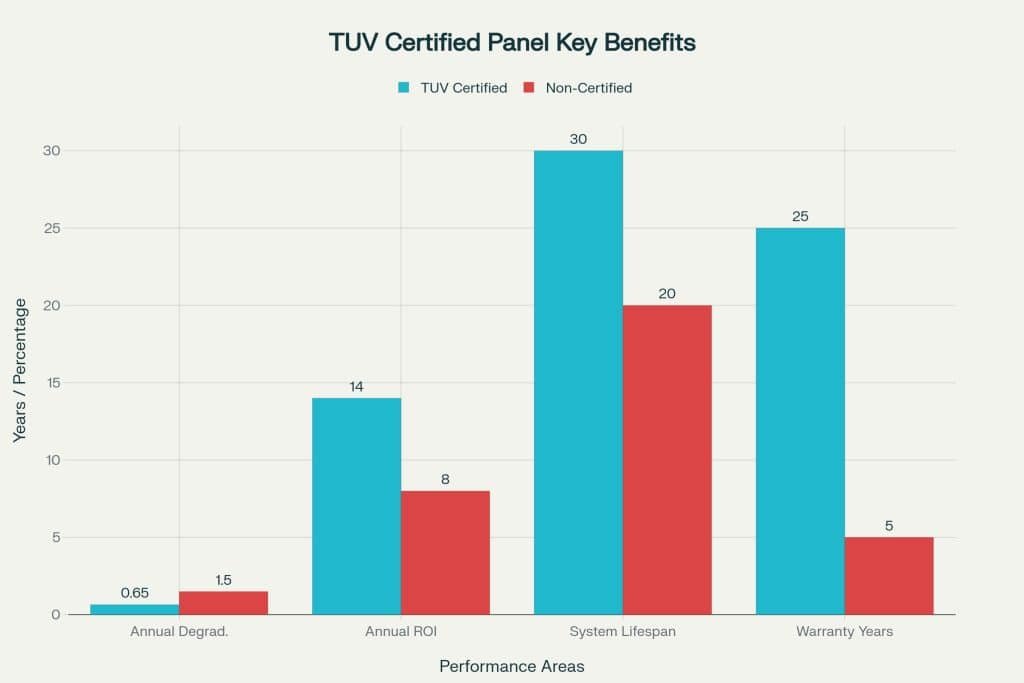
| Typical Annual Degradation* | Often 1-2% or higher | Usually 0.5-0.8% |
| Failure Rates | Variable, limited data | Some studies show up to 60% fewer repairs |
| 25-Year Output* | Can be 75-80% of original | Often 85-90% of original |
| Documentation | Basic specifications | Comprehensive test reports |
*Actual degradation depends on environmental conditions, installation quality, maintenance, and specific panel technology. These figures represent typical ranges, not guarantees.
How to Verify Authentic Certification
Verification Steps
- Check official databases: Use the TÜV certificate database
- Verify specific models: Ensure the exact model number matches the certificate
- Check validity dates: Certificates typically valid for 2-3 years with renewal requirements
- Request documentation: Legitimate suppliers can provide complete certificate copies
Red Flags to Avoid
- ❌ Certificates claiming to cover “all models” from a manufacturer
- ❌ Missing or incomplete certification labels on solar panels
- ❌ Expired certificates without renewal documentation
- ❌ Certificate numbers that cannot be verified online
- ❌ Reluctance to provide certification documentation
Global Market Recognition
Regional Requirements and Acceptance
| Region | TÜV Status | Important Notes |
|---|---|---|
| Europe | Widely recognized | Often required for incentives; specific requirements vary by country |
| United States | Growing acceptance | UL certification equally recognized; project-specific requirements |
| Asia-Pacific | Premium indicator | Australia requires IEC 61215:2021 compliance (not specifically TÜV) |
| Middle East | Often specified | Common for utility-scale projects; local standards may also apply |
Important: While TÜV is widely recognized, specific project requirements vary. Some regions require additional local certifications alongside international standards.
❓Frequently Asked Questions
1. What does TÜV stand for in solar panels?
TÜV stands for Technischer Überwachungsverein (Technical Inspection Association in German). It’s an independent organization that tests and certifies solar panels for quality, safety, and performance through rigorous protocols based on international standards.
2. Is TÜV certification mandatory for solar panels?
TÜV certification is not universally mandatory but is required or strongly preferred in many regions, particularly Europe and for large commercial projects. Requirements vary significantly by location, project type, and financing arrangements. Always verify local requirements.
3. What’s the difference between TÜV and UL certification?
Both are reputable testing organizations following similar IEC standards. TÜV originated in Germany and is widely recognized globally, especially in Europe and Asia. UL (Underwriters Laboratories) is US-based and predominant in North America. TÜV typically emphasizes ongoing factory monitoring, while UL focuses more on safety standards. Both certifications are equally valid quality indicators.
4. Can I verify if my solar panels are really TÜV certified?
Yes, verification is straightforward through official databases. TÜV Rheinland offers Certipedia, and TÜV SÜD maintains its own certificate database. Check the certificate number on your panels against these databases, ensuring model numbers match exactly.
5. Do TÜV certified PV panels actually last longer?
Research suggests TÜV certified PV panels often demonstrate better longevity, typically maintaining 85-90% of original capacity after 25 years compared to potentially lower retention for non-certified panels. However, actual lifespan depends on installation quality, environmental conditions, and maintenance practices.
6. What happens if PV panels fail TÜV testing?
Manufacturers receive two additional attempts after identifying and documenting root causes and corrective actions. After two failures, the entire certification process must restart. This ensures genuine quality improvements rather than random success.
7. Are solar panels certified under older standards still valid?
Many solar panels certified under IEC 61215:2016 standards remain valid and acceptable in most markets. However, new installations increasingly require 2021 standard compliance. The 2021 update added tests for newly identified failure modes but doesn’t invalidate earlier certifications.
Making an Informed Decision
Critical Questions for Suppliers
Which specific TÜV organization conducted certification?
What’s the exact certificate number and validity date?
Can you provide complete certificate documentation?
Does certification cover this exact model number?
When was the most recent factory audit?
Are there any pending certification updates?
Key Evaluation Criteria
- ✅ IEC 61215:2021 compliance for newest installations
- ✅ Current certification with valid dates
- ✅ Exact model matching on certificates
- ✅ Verifiable documentation through official databases
- ✅ Clear manufacturer transparency about testing results
When Alternative Certifications May Suffice
TÜV certification provides excellent quality assurance, but it’s not the only option:
- Small residential systems in mild climates may perform adequately with other certifications
- UL certification is equally reputable, particularly for North American installations
- Regional certifications may be more relevant for local conditions
- Reputable manufacturers with strong track records and other certifications can offer reliable products
Remember: TÜV certification is one quality indicator among several factors, including manufacturer reputation, warranty terms, local support, and installation quality.
The Bottom Line
TÜV certification provides comprehensive quality assurance through rigorous testing and ongoing factory monitoring. While certified PV panels typically carry a modest premium, they often demonstrate advantages in reliability and performance retention.
Key benefits of TÜV certification:
- ✅ Standardized testing to IEC 61215:2021 protocols
- ✅ Ongoing factory quality monitoring
- ✅ Typically better degradation rates (though varies by conditions)
- ✅ Wide international recognition
- ✅ Comprehensive documentation for warranty claims
- ✅ Quality assurance for long-term investments
However, certification alone doesn’t guarantee performance. Actual results depend on:
- Installation quality and system design
- Local environmental conditions
- Regular maintenance and monitoring
- Manufacturer financial stability for warranty support
For most solar investments, particularly in challenging climates or for commercial projects, TÜV certification provides valuable quality assurance. Yet it’s important to evaluate certification as part of a comprehensive assessment, including manufacturer reputation, local support, and specific project requirements.
📌 Final Considerations: Solar panels represent a 25+ year commitment. While TÜV certification helps ensure quality, success depends equally on proper system design, professional installation, and appropriate maintenance. Consider certification alongside other critical factors when making your solar investment decision.
Get Professional Solar Consultation
Disclaimer: This guide provides general information about TÜV certification standards as of 2025. Requirements change regularly and vary by region. Performance depends on numerous factors, including installation conditions, local climate, and system maintenance. Always consult qualified solar professionals and verify current local requirements for your specific project. Neither certification nor any testing protocol can guarantee specific performance outcomes in all real-world conditions.


 English
  Español
  Français
  Deutsch
  Русский
  العربية