

Discover how Back Contact (BC) technology and ETFE materials are improving flexible solar panels — with honest insights about performance gains, realistic lifespans, and whether they’re worth the investment for your specific needs.
🚨 The Flexible Solar Panel Challenge
If you’ve been using flexible solar panels on your boat, RV, or remote installation, you know the frustration all too well:
“The solar panels looked perfect for my curved RV roof—lightweight, easy to install, no drilling required. But after just two seasons, the power output dropped noticeably, and by year three, I was shopping for replacements.”
⚠️ Common Issues with Standard Flexible Solar Panels:
- Shorter lifespan — Typically 3-10 years vs. 25-30 years for rigid panels
- Power degradation — Faster efficiency loss than rigid counterparts
- Heat sensitivity — Poor performance in high temperatures
- Moisture damage — Delamination and corrosion over time
- Limited warranties — Usually 1-2 years vs. 25 years for rigid solar panels
💡 Reality Check:
According to industry data, flexible solar panels inherently last 3-10 years on average, while quality rigid panels can exceed 30 years. This isn’t necessarily a failure—it’s a trade-off for the flexibility and lightweight design that makes them perfect for certain applications.
💡 Enter Back Contact Technology: A Genuine Improvement
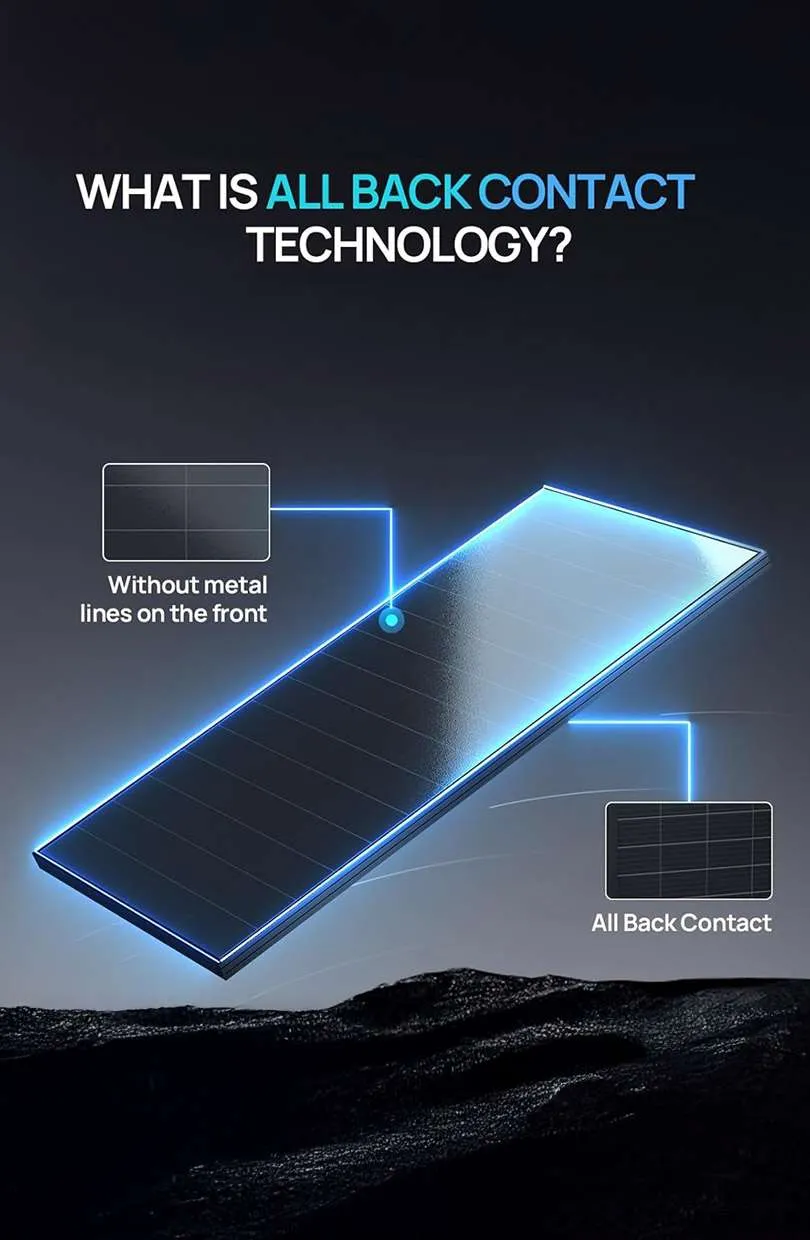
Back Contact (also called Interdigitated Back Contact or IBC) solar cells represent a real advancement in solar technology. By moving all electrical contacts to the rear of the cell, they eliminate front-side shading and reduce certain failure points.
🎯 What Makes BC Technology Different
Back Contact cells have achieved laboratory efficiencies up to 27.81%, with commercial applications showing 24-25% efficiency. While flexible solar panels can’t match these numbers due to encapsulation requirements, they still benefit from the improved design with efficiency gains of 10-15% over standard flexible panels.
Real Benefits of Back Contact Technology in Flexible Panels
1 Reduced Shading Losses
Eliminating front busbars increases the active cell area by 3-5%, allowing more light absorption. This translates to approximately 5-10% more power output in real-world conditions compared to traditional flexible panels.
2 Better Heat Management
Quality BC cells can achieve temperature coefficients around -0.26% to -0.29%/°C, compared to -0.39% to -0.45%/°C for standard cells. This means better performance in hot conditions—crucial for RV roofs and boat decks.
3 Improved Mechanical Stress Distribution
The rear contact design distributes mechanical stress more evenly during flexing, potentially reducing microcracking by 20-30% according to manufacturer testing. This can extend panel life by 1-3 years under normal use.

4 ETFE: A Superior Protective Layer
ETFE (Ethylene Tetrafluoroethylene) offers 95% light transmission compared to 85-90% for standard materials. It’s UV-stable, self-cleaning, and can extend panel life to 10-15 years compared to 3-8 years for PET-covered panels.
5 Cleaner Aesthetics
All-black appearance with no visible grid lines creates a premium look that blends better with vehicle and marine applications. This is especially valued in high-end RV and yacht installations.
📊 Honest Performance Comparison
| Feature | Standard Flexible Panels | BC + ETFE Flexible | Rigid Panels (Reference) |
|---|---|---|---|
| Typical Lifespan | 3-8 years | 10-15 years | 25-30+ years |
| Real-World Efficiency | 15-18% | 18-21% | 20-23% |
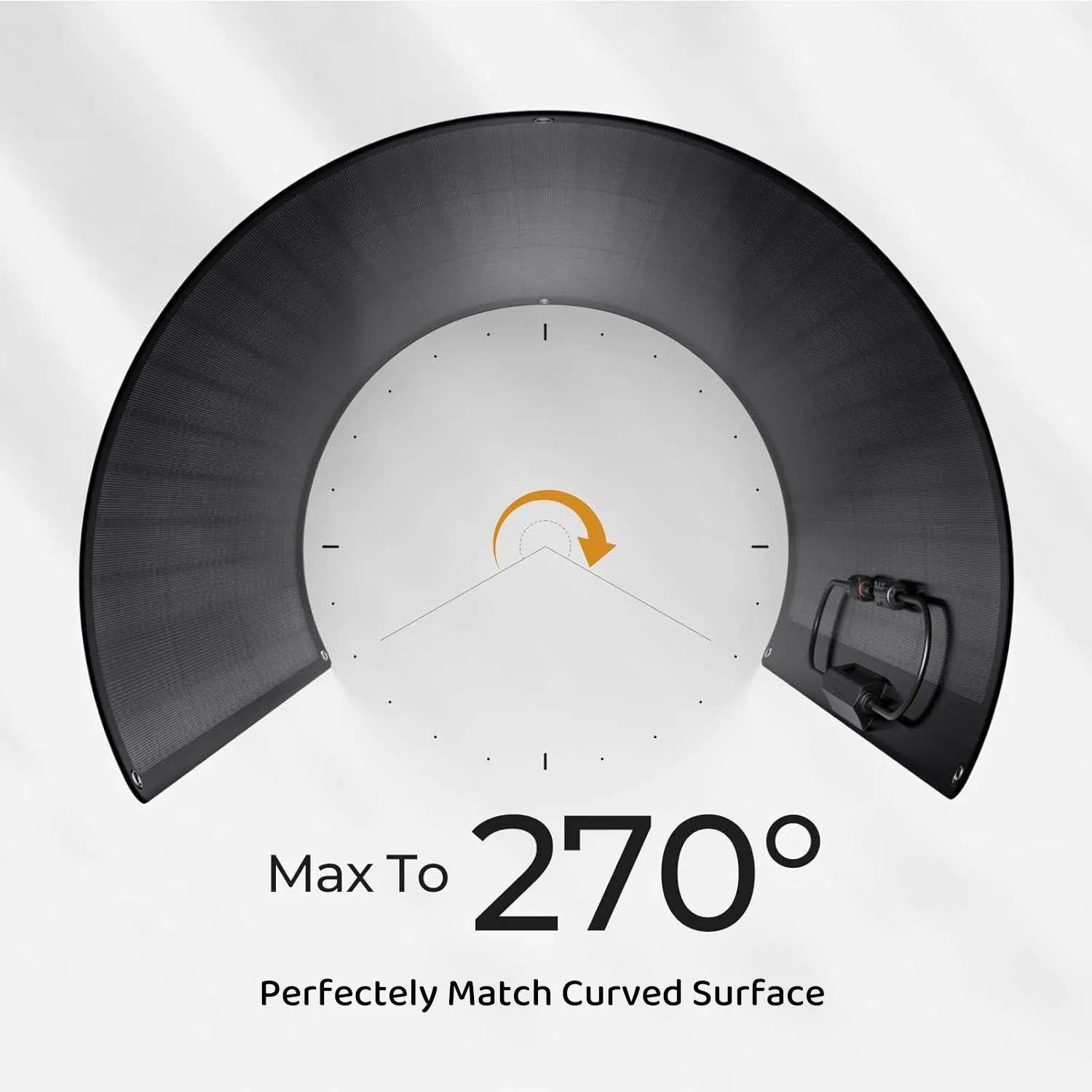
| Minimum Bend Radius | 30cm | 30cm* | Not applicable |
| Temperature Coefficient | -0.40 to -0.45%/°C | -0.29 to -0.35%/°C | -0.30 to -0.40%/°C |
*Bend radius depends on specific construction; always follow manufacturer specifications
⚖️ The Balanced Truth: Pros and Cons
✅ Genuine Advantages
- 10-15% efficiency improvement over standard flexible
- Better heat tolerance for hot climates
- 2-5 years longer lifespan than basic flexible panels
- Superior aesthetics for visible installations
- ETFE durability in marine environments
- Reduced degradation rate (0.5-0.7% vs 0.8-1.0% annually)
❌ Important Limitations
- 50-100% more expensive than standard flexible
- Still can’t match rigid panel longevity
- Limited availability from manufacturers
- Complex manufacturing = fewer suppliers
- 15-20% less efficient than equivalent rigid panels
- Not suitable for permanent home installations
🚀 Where BC + ETFE Panels Make Sense
⛵ Marine Applications
Perfect fit: Salt resistance, flexibility for curved decks, and 10+ year durability justify the premium cost. The ETFE layer’s self-cleaning properties are invaluable in marine environments.
🚐 Premium RVs and Expedition Vehicles
Good investment: For full-timers and serious travelers, the extended lifespan and better heat performance make the higher cost worthwhile. Expect 30-40% more usable power over the panel lifetime.
📡 Remote Monitoring Stations
Consider carefully: While more reliable than standard flexible solar panels, rigid solar panels remain the better choice for permanent installations where flexibility isn’t required.
🏕️ Portable and Temporary Applications
Worth considering: For equipment that needs frequent setup/takedown, the durability improvements can justify the cost through reduced replacement frequency.
📈 What to Actually Expect
- 10-15% More Power Than Standard Flexible
- 10-15yr Realistic Lifespan
- -0.30%/°C Temperature Coefficient
🎯 Making the Right Choice for Your Needs
BC + ETFE flexible solar panels are a genuine improvement—but they’re not magic
Consider BC + ETFE Solar Panels If:
- ✓ You need solar panels for curved or irregular surfaces
- ✓ Weight is a critical factor (boats, RVs)
- ✓ You’re in a marine or high-UV environment
- ✓ You can afford the premium for better performance
- ✓ 10-15 year lifespan meets your needs
Stick with Rigid Solar Panels If:
- ✓ You’re doing a permanent home installation
- ✓ Maximum efficiency is your priority
- ✓ You want 25+ year warranties
- ✓ Cost per watt is your main concern

❓ Frequently Asked Questions
Q: Are BC flexible soalr panels really worth higher the price?
It depends on your application. For marine use or premium RVs where you’ll keep the panels 10+ years, the longer lifespan and better performance can justify the cost. For occasional camping use, standard flexible solar panels offer better value.
Q: How much more power will I actually get from BC panels?
In real-world conditions, expect 10-15% more power output compared to standard flexible panels of the same size. This means a 100W BC panel performs like a 110-115W standard solar panel, but with better longevity.
Q: Can BC flexible panels really last 15 years?
Quality BC panels with ETFE coating can reach 10-15 years with proper installation and maintenance. However, they’ll still experience gradual power degradation (0.5-0.7% annually) and won’t match the 25-30 year lifespan of rigid solar panels.
Q: What’s the actual temperature coefficient improvement?
The best BC flexible panels achieve temperature coefficients around -0.26% to -0.35%/°C, compared to -0.39% to -0.45%/°C for standard flexible panels. This means about 20-30% less power loss in hot conditions.
Q: Will BC solar panels work on my curved RV roof?
Yes, BC flexible solar panels maintain the same 30cm minimum bend radius as standard flexible panels. They can handle typical RV roof curves, but always check manufacturer specifications for your specific curvature.
Q: Are there any downsides to ETFE coating?
ETFE is superior to PET in most ways, but it’s more expensive and can be slightly more slippery when wet. Some users also report it shows dirt more readily than matte finishes, though it’s self-cleaning in rain.
Q: Which manufacturers actually make BC flexible panels?
Currently, only a few manufacturers produce true BC flexible solar panels, including several select Chinese manufacturers. Many solar panels marketed as “back contact” use simplified designs that don’t offer full IBC benefits. Always verify specifications before purchasing.
Q: How do I maintain BC + ETFE panels?
ETFE’s self-cleaning properties reduce maintenance, but periodic gentle cleaning with water and soft cloths helps maintain efficiency. Avoid harsh chemicals, pressure washing, or abrasive materials. Check for lifting edges or delamination annually, especially in marine environments.
Q: Can I walk on BC flexible panels?
While some manufacturers claim their solar panels are “walkable,” it’s best to avoid stepping on any flexible panel. If absolutely necessary, use soft-soled shoes and distribute weight evenly. Repeated foot traffic will shorten lifespan regardless of the technology.
✅ The Bottom Line: Innovation with Realistic Expectations
“BC technology and ETFE materials represent genuine improvements in flexible solar panels—they’re just not miracle solutions.”
If you need flexible panels for your boat, RV, or curved installation, BC + ETFE panels offer measurably better performance and longevity than standard options. They’ll cost roughly double to triple but can deliver 40-50% more total energy over their lifetime through improved efficiency and extended lifespan.
However, let’s be clear: flexible panels remain a compromise solution. When flexibility isn’t required, rigid solar panels still offer better efficiency, longevity, warranties, and value. Choose BC + ETFE flexible panels for the right reasons—superior flexibility and improved performance where rigid panels won’t work—not as a replacement for traditional solar installations.
The technology is real, the improvements are measurable, and for the right applications, they’re worth the investment. Just make sure you’re choosing them for what they are: the best flexible solar panels available, not alternatives to rigid panels.
Get Honest Advice for Your Solar Project: info@couleenergy.com, +1 737 702 0119 (WhatsApp).


 English
  Español
  Français
  Deutsch
  Русский
  العربية