

📖 What You’ll Learn:
- Why encapsulant choice can make or break your solar project
- Detailed comparison of all 4 major encapsulant types plus emerging alternatives
- Real performance data from IEC 61215:2021 and IEC 61730-2:2016 testing
- Climate-specific selection guidance for optimal performance
- Expert tips to avoid costly mistakes and warranty issues
- ROI calculation frameworks for different material choices
The Make-or-Break Decision Hiding Inside Every Solar Panel
Picture this: You just finished installing a massive 50MW solar farm. Everything looks perfect. Three years later, you’re dealing with warranty claims because panels are yellowing, losing power, and letting moisture seep in.
What went wrong? The problem isn’t the solar cells or the glass. It’s a thin film most people never think about – the encapsulant material.
“This isn’t some horror story. It’s happening to solar developers right now across the country. The global solar encapsulation market is growing fast, and more manufacturers are realizing that this ‘invisible’ material can make or break their entire project.”
Here’s what’s crazy: Encapsulant materials are a big chunk of what goes into making a solar panel. But they control over 70% of how well that panel will work for the next 25 years. Pick the wrong one, and you’re looking at angry customers, warranty headaches, and damaged reputation.
What Exactly Are Solar Encapsulants?
Think of encapsulants as the bodyguards for your solar cells. These thin, clear films sit between the glass and the solar cells, working around the clock to protect them from:
- Water damage that can ruin electrical connections
- UV rays that slowly destroy performance over time
- Hot and cold cycles from blazing summer heat to freezing winter nights
- Physical stress from wind, hail, and everyday wear and tear
- Power loss problems that can cut energy production by 30% or more
These films are incredibly thin – less than a millimeter – but they have to stay crystal clear while keeping everything safe. If they fail, your solar panels start losing power immediately.
⚠️ Current Industry Reality
Solar panel production is at an all-time high, and new high-efficiency technologies are becoming mainstream. This makes picking the right encapsulant more important than ever. The wrong choice turns a profitable investment into a costly mistake.
Key Industry Developments (2024-2025):
- N-type cell market share projected to reach 85% by 2026
- Bifacial module adoption exceeding 95% in utility applications
- New IEC 63209-1:2022 standards for encapsulant performance
- Supply chain regionalization due to trade policies
📊 Meet the Four Main Players
EVA: The Tried-and-True Workhorse
Market share: 68-85% | Best for: Budget-conscious projects
EVA has been the king of solar encapsulants for over 35 years. It’s like the reliable pickup truck of the materials world – not fancy, but it gets the job done.
Why EVA still dominates:
- Sticks to everything – bonds perfectly with glass, solar cells, and backsheets
- Easy to work with – melts at low temperatures so it won’t damage delicate solar cells
- Rock-solid supply chain – you can get it anywhere, anytime
- Budget-friendly – the most affordable option by far
- Proven track record – decades of real-world performance data
Where EVA struggles:
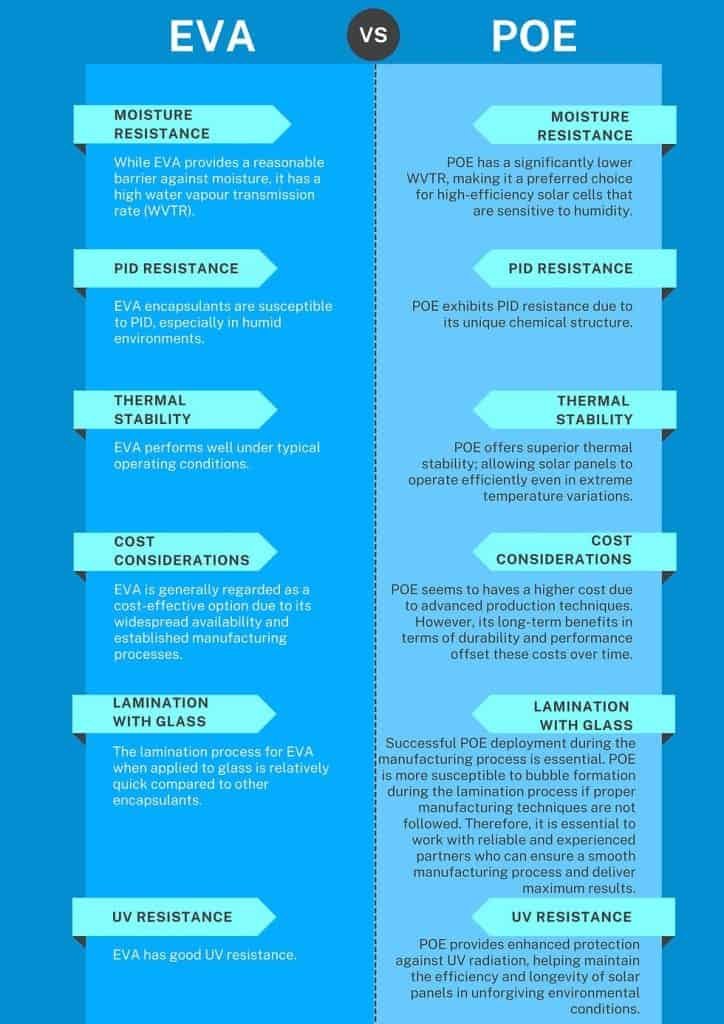
- Lets moisture through more than newer materials
- Can create acid over time that eats away at metal parts
- Doesn’t handle high-voltage well – problems with newer, high-efficiency solar panels
- Can turn yellow after years in the sun, reducing power output
Real-world reality: EVA panels in humid places like Florida can lose noticeable power each year due to moisture problems. But for many projects, it’s still the smart financial choice.
POE: The High-Performance Champion
Market share: 25-28% | Best for: Premium solar panels and tough environments
POE is the sports car of encapsulants. It costs more, but it delivers serious performance where it matters most. It’s growing fast as more manufacturers switch to high-efficiency solar technologies.
Why POE is taking off:
- Moisture blocker supreme – keeps water out 8 times better than EVA
- Handles high voltage like a champ – perfect for today’s efficient panels
- No acid problems – won’t corrode your metal parts over time
- Temperature tough – works great in extreme hot or cold
- Bifacial ready – ideal for panels that generate power from both sides
POE’s downsides:
- Costs significantly more than EVA
- Trickier to manufacture – longer processing times, bubble problems
- Chemistry issues – additives can migrate and cause surface problems
- Limited suppliers – fewer options means potential supply risks
Performance proof: Independent testing shows POE solar panels keep producing more power than EVA panels over time, especially in challenging climates.
EPE: The Smart Compromise
Market share: Growing fast in premium segments | Best for: Balancing performance and cost
EPE is the innovation that’s got everyone talking. It’s like a sandwich – EVA on the outside, POE in the middle. This three-layer design gives you the best of both worlds and is exploding in popularity.
Why EPE is hot right now:
- Best of both worlds – EVA’s easy processing plus POE’s protection
- Reasonable pricing – costs more than EVA but less than pure POE
- Manufacturer-friendly – easier to work with than pure POE
- Versatile – works great with all types of solar cell technologies
- Bifacial optimized – especially good for glass-on-glass panels
EPE considerations:
- Still relatively new – less long-term field data available
- Potential separation issues – different materials expanding at different rates
- Special equipment needed – requires investment in new manufacturing tools
- Quality control complexity – three layers means more things to monitor
Market buzz: EPE use in high-efficiency PV panels has grown dramatically in recent years, showing the industry really believes in this technology.
PVB: The Safety Specialist
Market share: Niche applications | Best for: Building-integrated solar
PVB is the specialist. It comes from the car windshield and building glass world, so it knows how to handle safety and durability. It’s expensive, but for certain applications, it’s required by law.
PVB’s superpowers:
- Incredibly strong – can handle impacts that would destroy other materials
- Safety approved – meets building codes for overhead installations
- UV champion – stays clear and strong for decades
- Proven in buildings – decades of use in architectural glass
- Recyclable – supports green building and sustainability goals
PVB’s limitations:
- Most expensive option by far
- Poor moisture protection – actually worse than EVA
- Slow processing – takes much longer to manufacture
- Specialized uses only – mainly for building-integrated solar
Legal reality: Many building codes require PVB for solar installations on roofs or facades where people walk underneath.
📊 Performance Testing: What Really Matters
How We Test These Materials
The industry uses tough standardized tests to see how these materials hold up. Think of it as putting them through 25 years of abuse in just a few months:
The Stress Tests:
- Heat and humidity bath – 85°C and 85% humidity for 1,000+ hours
- UV blasting – concentrated sunlight equivalent to decades of exposure
- Temperature shock – cycling from freezing cold to blazing hot 200+ times
- Freeze-thaw cycles – testing what happens when water gets in and freezes
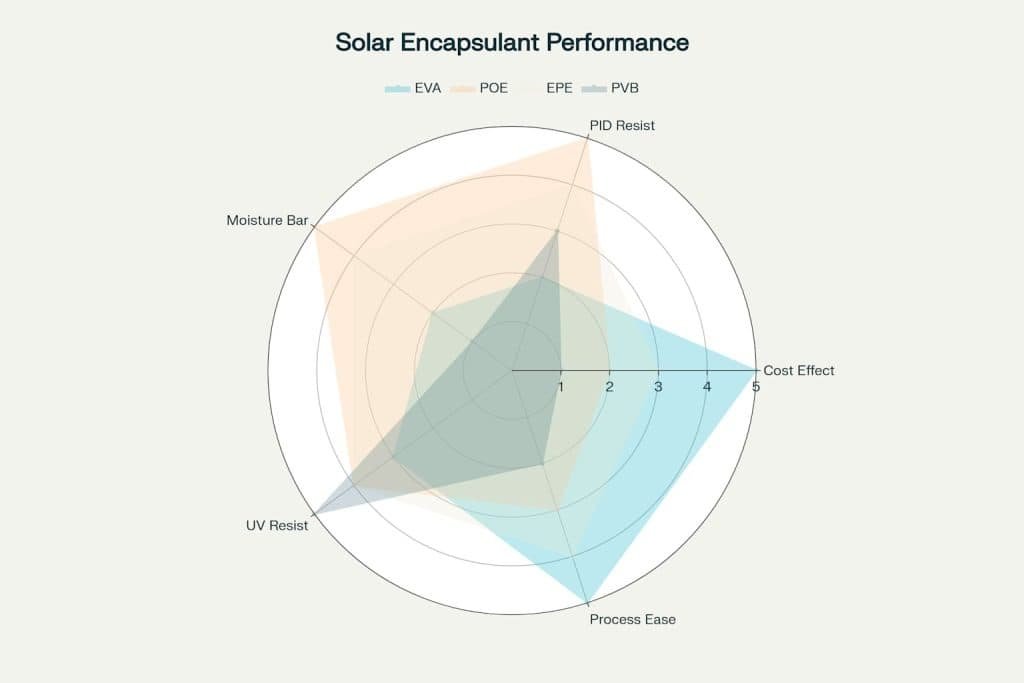
Strength Comparison
| Material | How Strong | How Stretchy | Sticks How Well | Impact Resistance |
|---|---|---|---|---|
| EVA | Good | Very stretchy | Strong | Good |
| POE | Better | Very stretchy | Stronger | Excellent |
| EPE | Good | Very stretchy | Strong | Very Good |
| PVB | Strongest | Less stretchy | Strongest | Outstanding |
What Happens After 1,000 Hours of Torture Testing
How well they stick together (higher is better):
- ✅ POE: 87% – Excellent long-term bonding
- ✅ PVB: 82% – Meets industry standards
- ⚠️ EPE: 75% – Good enough for most uses
- ❌ EVA: 65% – Needs better formulations
How much they yellow (lower is better):
- ✅ POE: 0.8 – Barely any change
- ✅ EPE: 1.2 – Slight yellowing, still good
- ⚠️ PVB: 1.5 – Some change, fine for most uses
- ❌ EVA: 2.8 – Visible yellowing affects performance
Moisture Protection Test
| Material | Water Getting Through (grams/day) | Rating |
|---|---|---|
| POE | 3-8 grams | Outstanding |
| EPE | 15 grams | Good |
| EVA | 25-35 grams | Okay |
| PVB | 35-50 grams | Poor |
Picking the Right Material for Your Project
Big Solar Farms
Go with: Premium EVA
For massive projects where keeping costs down is crucial:
- ✅ Use EVA’s proven track record and cost advantage
- ✅ Choose high-quality EVA grades with better UV protection
- ✅ Set up strict quality control with your suppliers
- ✅ Plan for regular maintenance to keep performance up
What to expect: Great power retention over the warranty period with proper material choice and maintenance
Keys to success:
- Audit your suppliers to ensure consistent quality
- Pick the right EVA grade for your climate
- Get professional installation and setup
- Monitor performance regularly
High-End Residential and Commercial
Go with: EPE for the sweet spot
For premium installations where you need performance but can’t go crazy on cost:
- ✅ Get POE’s moisture protection at a reasonable price
- ✅ Works great with high-efficiency solar cell types
- ✅ More suppliers available, reducing risk
- ✅ Perfect choice for warranty-sensitive residential jobs
What to expect: Superior power retention across different climates with minimal degradation
Cutting-Edge Solar Technology
Go with: POE for maximum protection
For the latest tech like advanced cell types and high-voltage systems:
- ✅ Essential protection for sensitive high-efficiency cells
- ✅ Superior moisture barrier for delicate components
- ✅ Proven performance in two-sided and glass-glass panels
- ✅ Required to maintain warranties on premium products
What to expect: Outstanding power retention with minimal degradation throughout the warranty period
Building-Integrated Solar
Go with: PVB for safety compliance
For architectural installations and overhead mounting:
- ✅ Required by building codes and insurance
- ✅ Superior impact resistance for safety
- ✅ Proven durability in building applications
- ✅ Maintains appearance for architectural requirements
What to expect: Meets tough architectural standards for long-term building integration
❓ Common Questions and Real Answers
Q: How do I convince cost-conscious customers to pay more for POE?
A: Focus on the total picture, not just upfront cost. In tough environments like coastal areas or humid climates, POE’s superior moisture protection prevents significant power loss that builds up over the years. The better performance and reduced maintenance often justify the initial extra cost.
Value points to highlight:
- Better moisture protection means less power loss
- Superior high-voltage protection maintains output
- Reduced maintenance costs through better reliability
- Longer effective life in challenging environments
- Fewer warranty claims and problems
Q: Is EPE reliable enough for 25-year warranties?
A: Yes, with proper precautions. EPE shows 75% strength retention after brutal testing – good enough for most warranty requirements. But use enhanced quality controls and consider it for situations where EVA isn’t good enough, but POE costs too much.
How to reduce risk:
- Test incoming materials more thoroughly
- Optimize your manufacturing process for three-layer structure
- Monitor field performance on early installations
- Make sure suppliers have good long-term testing data
Q: When does PVB make sense outside of building applications?
A: PVB is rarely worth it for standard projects, but consider it for:
- Premium architectural jobs where looks justify the extra cost
- Extreme weather areas needing maximum toughness
- Research projects showcasing maximum durability
- Special applications where safety rules require superior impact resistance
Q: How can I avoid encapsulant-related failures?
A: Build a complete quality system that covers everything:
Supply chain controls:
- Audit suppliers thoroughly to ensure consistent quality
- Test incoming materials to verify they meet specs
- Store materials properly to maintain quality before use
- Track everything so you can quickly identify and fix problems
Manufacturing excellence:
- Optimize your process for each material type and thickness
- Monitor quality in real-time including cure level and bonding
- Control your environment – proper temperature and humidity
- Train your people to ensure consistent techniques
Field performance tracking:
- Test before you sell with accelerated aging
- Monitor real-world performance with tracking systems
- Analyze data to spot trends and potential issues early
- Keep improving based on what you learn in the field
Why Choose Couleenergy as Your Manufacturing Partner
At Couleenergy, we get it. Picking the right encapsulant isn’t just about material specs – it’s about optimizing your entire operation for maximum profit, reliability, and market success. We take a complete approach that covers every aspect of encapsulant selection and use.
Our Expertise That Makes the Difference
1. Smart Material Selection & Engineering
- Direct partnerships with top encapsulant suppliers worldwide
- Our own materials testing lab with industry-standard equipment
- Climate-specific recommendations based on where panels will be installed
- Complete cost-benefit modeling tools for project optimization
2. Manufacturing Excellence & Quality You Can Trust
- ISO 9001:2015 and industry certified manufacturing processes
- Advanced equipment optimized for each encapsulant type
- Real-time quality monitoring with statistical process control
- Flexible production that can quickly adapt to material changes
3. Performance Validation & Technical Support
- Testing that goes beyond industry standards
- Field performance monitoring with smart data collection
- Technical consultation throughout your entire project
- Warranty support backed by comprehensive testing and validation
4. Strategic Supply Chain Management
- Multiple qualified suppliers reducing single-source risk
- Smart inventory management ensuring materials are always available
- Global sourcing with regional supply chain optimization
- Market intelligence on pricing trends and technology developments
Custom Solutions for Every Type of Project
| Project Type | Our Solution | Key Benefits |
|---|---|---|
| Utility-Scale | Premium EVA solutions | Enhanced specs, strict quality controls, optimized costs |
| Commercial & Industrial | EPE configurations | Balanced performance and economics for mid-scale installations |
| Residential Premium | POE-based modules | Maximum efficiency, durability, premium warranties |
| Building-Integrated | PVB expertise | Architectural requirements, building codes, aesthetic demands |
The Couleenergy Advantage: More Than Just Manufacturing
Technical Innovation Leadership
- Partnerships with leading material suppliers for early access to new tech
- Integration of smart monitoring and diagnostic capabilities
- Continuous R&D investment in emerging material technologies
Quality Assurance Excellence
- Third-party validation of all performance claims and warranties
- Complete traceability from raw materials to final assembly
- Statistical process control ensuring consistent quality
- Custom quality requirements and testing protocols
Market Intelligence & Strategic Support
- Real-time analysis of material costs and market changes
- Performance benchmarking against industry leaders
- Regulatory compliance expertise for global markets
- Technical training and support for your engineering teams
What’s Coming Next in Solar Materials
Advanced Multi-Layer Technologies
The success of EPE shows where the industry is heading – engineered composite materials. Expect continued innovation in:
- Specialized barrier layers for extreme environments
- Functional layers providing enhanced electrical and thermal management
- Cost-optimized structures balancing performance with economics
- Smart materials with built-in sensing and diagnostic capabilities
Smart Material Integration
Revolutionary encapsulant technologies being developed include:
- Built-in sensors for real-time module health monitoring
- Self-healing materials that automatically repair micro-cracks
- Adaptive properties that adjust based on environmental conditions
- Better thermal management improving module efficiency through heat control
Sustainability and Environmental Focus
Growing environmental awareness is driving development of:
- Bio-based materials reducing carbon footprint and fossil fuel use
- Enhanced recyclability supporting end-of-life material recovery
- Reduced processing energy minimizing manufacturing environmental impact
- Life cycle optimization balancing performance, durability, and environmental impact
Ready to Make the Right Choice?
The encapsulant material you choose today will define how your solar panels perform for the next 25 years. Don’t let this critical decision become your biggest business risk or miss out on a competitive advantage.
Ready to optimize your encapsulant selection and manufacturing?
Get Your Free Technical Assessment
| Service | What You Get | Value |
|---|---|---|
| Material Selection Optimization | Free encapsulant analysis including climate modeling and performance projections | Make data-driven decisions |
| Manufacturing Process Enhancement | Custom production solutions optimizing quality, throughput, and cost efficiency | Reduce waste, increase profit |
| Performance Validation & Testing | Comprehensive testing protocols ensuring material compatibility and reliability | Reduce warranty risk |
| Strategic Supply Chain Development | Supply chain optimization reducing risk and controlling costs | Ensure material availability |
📞 Ready to Revolutionize Your Solar Manufacturing?
- Phone: +1 737 702 0119
- Email: info@couleenergy.com
Contact our engineering team for a free consultation and discover how the right material choices can enhance your product performance, reduce warranty risks, and strengthen your competitive position.
About Couleenergy: Leading solar panel manufacturer specializing in custom solutions, advanced materials integration, and manufacturing excellence. From encapsulant selection to final module assembly, we deliver the technical expertise and manufacturing capability needed to optimize every aspect of your solar panel production.
Related Topics:
solar panel manufacturing, solar encapsulation technology, custom solar modules, EVA encapsulant materials, POE solar panels, EPE encapsulation film, PVB applications, high-efficiency module manufacturing, bifacial solar technology, building-integrated solar, solar panel reliability, encapsulant selection guide, solar materials engineering, manufacturing quality assurance, renewable energy components

 English
  Español
  Français
  Deutsch
  Русский
  العربية