

Learn why the right encapsulant can make your solar panels last 40% longer and produce more energy
🛡️ What Is Solar Panel Encapsulation?
Think of encapsulants as the protective coating that keeps your solar panels working for decades. They’re like invisible shields that protect the delicate parts inside your solar panels from rain, heat, cold, and harmful UV rays.
This protection matters more than ever. Today’s best solar panels can convert over 24% of sunlight into electricity in commercial applications. Research laboratories have even achieved efficiency records approaching 27.30%, as confirmed by Germany’s Institute for Solar Energy Research.
⚠️ Why This Protection Is So Important
Modern solar panels have very sensitive parts inside. If moisture gets in or the coating breaks down, bad things happen:
- ⚡Power drops permanently – Your solar panels make less electricity
- 🔧Metal parts corrode – This can cause complete failure
- 🔥Hot spots form – These can be dangerous
- 💡Less light gets through – Your panels become less efficient
The right encapsulant keeps your solar panels working at their best for 25 years or more.

❌ Why EVA Isn’t Enough Anymore
EVA (Ethylene Vinyl Acetate) has been the go-to choice for years. It’s cheap and works okay for basic solar panels. But as panels get more advanced, EVA’s problems become serious issues.
🚫 EVA’s Main Problems
💧 Too Much Moisture
EVA allows 25-35 grams of water vapor per square meter every day. That’s too much for today’s sensitive solar cells.
🧪 Creates Harmful Acid
Research shows that EVA makes acetic acid as it ages. This acid eats away at the metal parts in your panels.
⚡ Poor Electrical Protection
Modern PV panels operate at higher voltages. EVA struggles with this and can cause power loss over time.
🌡️ Heat Limitations
EVA typically operates effectively up to approximately 80°C (176°F). Rooftops can get much hotter.
✅ When POE Came Along
POE (Polyolefin Elastomer) solved many of EVA’s problems:
- Much better moisture protection – Only 5-10 grams per square meter daily
- No harmful acids – POE doesn’t break down into corrosive chemicals
- Great electrical protection – Handles high voltages much better
- Higher heat tolerance – Works reliably at higher temperatures than EVA
But POE has its own challenges. It takes longer to process and needs special handling during manufacturing.
🎯 EPE: The Smart New Solution
EPE (EVA-POE-EVA) is like getting the best of both worlds. It’s a three-layer sandwich with POE in the middle and EVA on both sides.
🔧 Why This Design Is Brilliant
🔗 Outer EVA Layers
Stick really well to glass and solar cells. Manufacturers already know how to work with EVA, so no major changes needed.
🛡️ Middle POE Layer
Acts like a super-strong barrier against moisture and electrical problems. It also prevents acid formation.
The result? You get POE’s protection with EVA’s ease of use.
📊 How Well Does EPE Work?
Industry testing shows EPE delivers impressive improvements:
- Better moisture protection – 10-15 grams per square meter daily (60% better than EVA)
- Good electrical protection – Much better than EVA alone
- Reasonable processing time – About 450 seconds vs EVA’s 600 seconds or POE’s 300 seconds
- Strong bonding – Sticks well to all panel parts for the panel’s entire life
- Very little acid – The POE center layer prevents most acid formation
⚖️ Comparing All Three Options
Let’s look at how these three encapsulants stack up:
| What We’re Measuring | EVA | EPE | POE |
|---|---|---|---|
| Moisture Protection | 25-35 g/m²/day | 10-15 g/m²/day | 5-10 g/m²/day |
| Electrical Protection | Poor | Good | Excellent |
| Heat Tolerance | Standard | Enhanced | Superior |
| UV Resistance | Good | Excellent | Excellent |
| Acid Formation | High | Very Low | None |
| Sticks Well | Excellent | Excellent | Good |
| Easy to Make | Excellent | Very Good | Moderate |
| Time to Laminate | ~600 seconds | ~450 seconds | ~300 seconds |
🧪 Real-World Testing Results
When scientists test these materials to see how they age, the differences are clear:
📈 Long-term performance studies show:
- EVA PV panels typically show more degradation over time
- EPE PV panels demonstrate significantly better performance retention
- POE PV panels achieve the best long-term stability
After extreme testing (3,000+ hours of heat and humidity plus intense UV):
- ✅ EPE/POE materials stay strong much longer than required
- ❌ Regular EVA turns yellow and gets brittle within normal test times

🏆 Special Needs of Back Contact Solar Panels
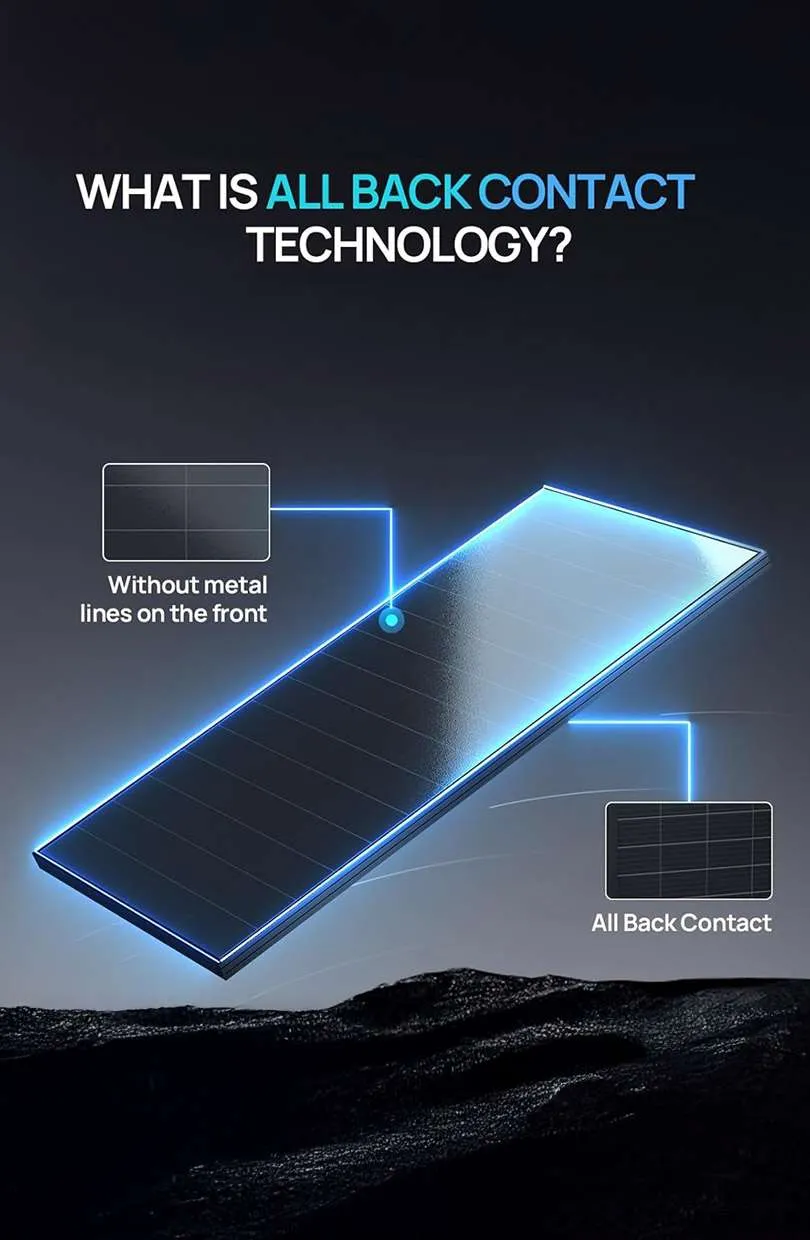
Back contact solar cells are the Formula 1 cars of solar technology. They have achieved efficiency records of 27.30% (confirmed by Germany’s Institute for Solar Energy Research).
These solar cells put all their electrical connections on the back, so the front can capture more sunlight. But this advanced design creates special challenges:
⚡ Unique Challenges
🎯 Concentrated Risk
All the sensitive parts are in one place. If moisture gets to the back contacts, it can damage everything at once.
🔬 Delicate Treatments
They use very delicate surface treatments that make them super-efficient but also super-sensitive to contamination.
✅ What These Panels Need
Back contact solar panels need encapsulants that provide:
- 🛡️Exceptional moisture barriers – Superior protection compared to standard materials
- 🚫Zero corrosive chemicals – No acid formation that could destroy contacts
- ⚡Superior electrical protection – Advanced resistance to power-robbing electrical stress
- 🌡️Reliable heat performance – Must work in demanding temperature conditions
EPE (POE is relatively costly) meets these needs while still being practical for mass production.
📈 Real Results You Can Expect
💡 More Energy Production
Studies show that your choice of encapsulant directly affects how much electricity your panels make over their lifetime:
📊 Research demonstrates:
- Standard EVA protection – Normal energy output with typical aging
- EPE protection – Significant energy production improvements over EVA
- Premium POE protection – Maximum energy output with minimal aging
💰 The Bottom Line
That extra energy really adds up over 25 years. It’s like getting a bonus from every sunny day.
🔧 Fewer Problems, Less Maintenance
Reliability improvements: Research shows EPE-protected panels have much lower failure rates than EVA panels. This means:
- Fewer repairs – Less chance you’ll need to replace panels
- Better uptime – Your system keeps making power consistently
- Easier maintenance – Simpler care and monitoring
Longer life: Advanced encapsulation can help your panels work reliably for 30+ years instead of just 25.
🌤️ Weather Protection
EPE encapsulation protects against:
- 🌡️ Temperature swings – Works well in both hot and cold climates
- 💧 High humidity – Prevents damage in coastal and tropical areas
- ☀️ Intense sun – Keeps working in high-sunlight locations
- 🔄 Thermal stress – Handles repeated heating and cooling cycles
🏭 How EPE’s Made
⚙️ Advanced Manufacturing
EPE uses sophisticated co-extrusion technology. This means all three layers get made at the same time in one continuous process. Think of it like making a layered cake where all layers cook together perfectly.
✅ Consistent Quality
- Even thickness – Each layer is uniform across the entire sheet
- Perfect material mix – The right materials in the right places
- Fewer defects – Advanced processing prevents common problems
🚀 Efficient Production
- Good processing rates – Modern production achieves efficient manufacturing speeds
- High success rate – Very little waste compared to older methods
- Quality checks – Testing happens throughout the process
🔬 Quality Control
Every batch gets tested for:
| Test Type | What It Measures | Why It Matters |
|---|---|---|
| Moisture Barriers | How well it keeps water out | Prevents panel damage |
| Bonding Strength | How well it sticks to panel parts | Ensures long-term adhesion |
| Heat Resistance | How it handles temperature stress | Works in extreme climates |
| Light Transmission | How much sunlight gets through | Maximizes energy production |
🔮 Preparing for the Future
📈 What’s Coming Next
The solar industry keeps advancing. Several trends are driving demand for better encapsulation:
🔬 Better Solar Cells
- Next-generation technology
- Two-sided panels
- Multi-layer cells
📋 Market Changes
- Stricter standards
- Longer warranties
- Sustainability focus
🚀 Innovation in Progress
🔬 Improved EPE formulas:
- Enhanced processing – New versions that work with more efficient manufacturing
- Better light transmission – Designs that let even more sunlight through
- Smart features – Research into materials with built-in monitoring
- Eco-friendly options – Development of recyclable and bio-based materials
🎯 Recommends
🏠 For Different Types of Installations
🏡 Home Solar Systems
POE/EPE gives you the best balance of improved performance and practical installation. Your solar panels will produce more energy consistently.
🏢 Business Projects
Large installations really benefit from EPE’s reliability improvements. Fewer maintenance issues and longer life.
🌊 Challenging Locations
Near the ocean, in high humidity, or extreme temperatures, POE provides essential protection where traditional materials might fail.
⚡ High-Efficiency Panels
POE/EPE is specifically recommended for TOPCon, back contact solar panels, two-sided modules, and other advanced technologies.
✅ Best Practices
🔍 Quality Assurance:
- Choose proven suppliers – Work with ISO9001: 2015 certified manufacturers
- Test everything – Use comprehensive testing to verify material quality
- Follow guidelines – Stick to manufacturer recommendations
🎯 Decision Guide
| Project Type | Recommended Solution | Key Benefits |
|---|---|---|
| Standard Projects | EPE | Excellent improvements over traditional materials |
| Premium Installations | POE | Maximum protection in demanding applications |
| High-Efficiency Focus | EPE or POE | Optimal protection for expensive panels |
| Future-Focused Projects | EPE | Long-term performance and reliability |
🏁 Conclusion: Get the Most from Your Solar Investment
Your choice of encapsulant directly affects how well your solar panels work for the next 25+ years. EVA served the industry well when solar panels were simpler. But today’s high-efficiency solar panels need protection that matches their advanced capabilities.
EPE (POE) encapsulants are the smart choice for modern solar installations. They deliver premium protection while working with existing manufacturing processes. The performance improvements over traditional materials mean more energy production, fewer maintenance headaches, and longer system life.

Built for Custom Integration, OEM/ODM Welcome
🚀 Why Choose Couleenergy?
Couleenergy leads the way in delivering advanced solar solutions designed to maximize energy output and long-term system reliability. With deep expertise in high-efficiency technologies and tailored solar engineering, we help you achieve optimal performance from day one—throughout the entire life of your installation.
As solar technology evolves, protecting it with equally advanced encapsulation is essential. That’s why we use premium materials and precise manufacturing to ensure your system performs at its best for decades, even in the toughest environments.
Looking for a perfect fit? We specialize in custom solar panels designed to match your project’s specific size, power, and aesthetic requirements—whether for rooftops, BIPV, mobile systems, or unique applications.
Get a solution that’s built around your needs—not off-the-shelf limitations.
📧 Email: info@couleenergy.com
📱 Phone: +1 737 702 0119 (WhatsApp)
Sources & Further Reading
This article is based on extensive research from authoritative industry sources, peer-reviewed studies, and leading solar technology institutions. We encourage readers to explore these references for deeper technical understanding and verification.
Technical Research & Scientific Studies
Solar Cell Efficiency & Performance:
- Longi announces 27.30% efficiency for heterojunction back contact solar cell – pv magazine International – ISFH-confirmed efficiency record
Encapsulant Materials Research:
- Enhancing photovoltaic modules encapsulation: Optimizing lamination processes for Polyolefin Elastomers (POE) through crosslinking behavior analysis – ScienceDirect – Scientific analysis of POE processing
- Novel EPE co-extruded encapsulating films with UV down-conversion power gain effect for highly efficient solar cells – ScienceDirect – Advanced EPE research and development
Industry Analysis & Market Research
Solar Technology Trends:
- EPE — Enhancing Solar PV Modules with a Multilayer Encapsulant | RenewSys – Industry perspective on EPE adoption
- The weekend read: Bifacial drives PV encapsulant switch – pv magazine International – Market analysis of encapsulant trends
- Solar modules – POE encapsulated PV modules particularly durable | PV Europe – Independent durability testing results
Manufacturing & Processing:
- EPE: The Two In One Approach For Module Encapsulation | TaiyangNews – Manufacturing process analysis
Specialized Applications
Back Contact Technology:
- EVA vs. POE vs. EPE: The Best Encapsulant for HPBC Solar Cells | Couleenergy – Specialized application analysis
- Classification of Solar Encapsulants – Dr. Hans Werner® Chemikalien – Technical classification and properties
Additional Technical Resources
Solar Cell Efficiency Tables:
- Solar Cell Efficiency Tables (Version 65) – Green – 2025 – Progress in Photovoltaics: Research and Applications – Wiley Online Library – Authoritative efficiency records
- Solar-cell efficiency – Wikipedia – Theoretical limits and current records
Manufacturing Equipment:
- EVA POE EPE Solar Cell Encapsulation Film Extrusion Line | Sheet Co-extrusion – Production technology overview
- EPE solar film extrusion line – China plastic extrusion line manufacture-Gwell – Manufacturing process details


 English
  Español
  Français
  Deutsch
  Русский
  العربية