

Want to power your RV, boat, or cabin with solar? Getting the right size solar panel for your 12V battery is crucial. Too small, and you’ll never fully charge. Too big, and you’re wasting money.
Here at Couleenergy, we’ve helped thousands of customers find their perfect solar match. We specialize in custom solar solutions and flexible panels that work where traditional options can’t. Let’s walk through everything you need to know to pick the right panel for your needs.
Understanding Solar Charging Basics
Before diving into specific recommendations, let’s cover the basics.
Battery Capacity Made Simple
Think of your battery like a fuel tank. Battery capacity is measured in amp-hours (Ah), which tells you how much energy your battery can store.
To figure out the total energy: Total Energy (Wh) = Battery Capacity (Ah) × Voltage (V)
For example:
- A 12V 50Ah battery holds 600 watt-hours of energy
- A 12V 100Ah battery holds 1,200 watt-hours
- A 12V 200Ah battery holds 2,400 watt-hours
This number is your starting point for picking the right size solar panel.
Solar Panel Output
Solar panels for 12V batteries typically put out 16-18V, not 12V. This higher voltage ensures your battery charges even on cloudy days or when the panels aren’t perfectly aligned with the sun.
Keep in mind that the wattage listed on the panel (like 100W) is the maximum output in perfect conditions. Real-world performance is usually 70-80% of the rated output due to factors like temperature, angle, and wire losses.
How to Calculate the Right Solar Panel Size
Let’s walk through finding your perfect PV panel size in four easy steps:
Step 1: Calculate Battery Energy
First, figure out how much energy your battery holds using the formula above.
Step 2: Know Your Sunlight Hours
“Peak sun hours” means the hours per day when solar panels work at full capacity. This varies significantly by location:
- Southwest US: 5-7 hours
- Northern US/Canada: 3-5 hours
- Tropical regions: 4-6 hours
- UK and Northern Europe: 2-4 hours
You can find your specific location’s data online through solar calculators or weather databases. It’s important to use accurate numbers for your region, as this greatly affects system sizing.
Step 3: Figure Out Power Needs
Divide your battery’s energy by available sun hours:
Required Power (W) = Energy Capacity (Wh) ÷ Peak Sun Hours
For example, to charge a 100Ah (1,200Wh) battery with 5 peak sun hours:
1,200Wh ÷ 5h = 240W
Step 4: Account for Real-World Losses
Solar systems lose efficiency through wiring, controller inefficiency, and temperature effects. Most real-world systems operate at 70-80% efficiency rather than the ideal 100%. To compensate:
Adjusted Power (W) = Required Power (W) ÷ Efficiency Factor
Using a conservative 75% efficiency for our example:
240W ÷ 0.75 = 320W
So you’d need a 320W solar panel (or multiple smaller panels totaling 320W, e.g.: 2 pieces of 160-watt solar panels) to properly charge that 100Ah battery under typical conditions.
Charge Controllers Matter – A Lot!
The type of charge controller you use dramatically affects the solar panel size you’ll need.
MPPT vs. PWM Controllers
MPPT controllers (Maximum Power Point Tracking):
- Convert excess voltage into additional charging current
- Improve efficiency by 15-30% compared to PWM controllers
- Allow smaller panels while maintaining performance
- Work well with higher voltage panels charging 12V batteries
- Perform best in colder climates and with panels that have voltage significantly higher than battery voltage
PWM controllers (Pulse Width Modulation):
- Simpler and cheaper but less efficient
- Need solar panels with voltage closer to battery voltage
- Require larger panels for the same charging capacity
- Can perform close to MPPT efficiency in hot climates when panel voltage drops closer to battery voltage
Here’s the difference for charging a 100Ah 12V battery with 5 hours of sun:
- MPPT controller: 300W solar panel
- PWM controller: 380W solar panel
MPPT controllers really shine in cold weather or low-light conditions, where the efficiency gap can widen to 25-30%. However, in very hot climates (above 100°F/38°C), the performance gap narrows as solar panel voltage naturally drops closer to battery voltage. Consider your local climate when choosing between controller types.
Couleenergy’s Panel Recommendations
After testing countless setups, here are our proven recommendations based on real-world performance data:
For 50Ah (600Wh) 12V Batteries
- With MPPT controller and 5 sun hours: 150W solar panel
- With MPPT controller and 3 sun hours: 250W solar panel
- With PWM controller and 5 sun hours: 190W solar panel
Our 150W solar panels work perfectly here. They’re specifically designed for “small solar systems for sheds and mini solar panels with battery storage,” giving you reliable power exactly when needed.
Perfect for: Camping setups, weekend RV use, backup power, trail cameras, gate openers
For 100Ah (1,200Wh) 12V Batteries
- With MPPT controller and 5 sun hours: 320W solar panel
- With MPPT controller and 3 sun hours: 530W solar panel
- With PWM controller and 5 sun hours: 400W solar panel
Our monocrystalline panels can fully charge these batteries in a day under good conditions. They integrate seamlessly with different battery types and work with most charge controllers.
Perfect for: Extended RV trips, small cabins, backup systems, water pumps
For 200Ah (2,400Wh) 12V Batteries
- With MPPT controller and 5 sun hours: 640W solar panel
- With MPPT controller and 3 sun hours: 1,070W solar panel
- With PWM controller and 5 sun hours: 800W solar panel
For these bigger systems, combine our 300W or 400W panels for the ideal setup, or use our space-saving flexible panels when conventional rigid panels won’t fit.
Perfect for: Off-grid living, comprehensive backup systems, workshops, food trucks, remote WiFi
Factors That Affect Real-World Performance
Several factors impact how well your solar charging system actually works:
Panel Placement Tips
To get the most energy:
- In the Northern Hemisphere, face panels south; in Southern Hemisphere, face north
- Set tilt angle at approximately 80% of your latitude for year-round use (e.g., 32° tilt at 40° latitude location)
- For winter optimization, increase tilt to latitude plus 15°
- For summer optimization, decrease tilt to latitude minus 15°
- Avoid even partial shade – it can reduce output by 30-50% across the entire panel
Temperature Effects
Solar panels actually work better in cold weather! Most panels are rated at 77°F (25°C), but:
- Panels lose approximately 0.4-0.5% efficiency for every degree above 77°F
- A panel at 110°F (43°C) might produce 12-15% less power than its rating
- Cooler climates often see better performance despite fewer sun hours
- In hot climates (above 100°F/38°C), PWM controllers can perform closer to MPPT controllers
Seasonal Changes
Don’t forget how seasons affect your system:
- Winter has shorter days with less intense sun (typically 50-70% of summer production)
- Snow can temporarily block panels, but tilted panels shed snow more easily
- Panel angle may need seasonal adjustments for optimal year-round performance
- Size your system for your worst season if you need consistent year-round power
- Consider using a battery monitor to track performance and adjust your system
Using Smaller Solar Panels for Maintenance Charging
Sometimes a full-sized panel is overkill. For maintenance charging or low-power applications, smaller panels can work well, but they require special considerations.
The Energy Balance Rule
For maintenance charging, you just need the panel to generate more energy daily than your system uses. For example:
- A 20W solar panel typically generates 80Wh per day (4 sun hours × 20W)
- If your 12V system uses less than 80Wh daily, this small panel can maintain the charge
However, a proper charge controller is always necessary, even for small panels. Direct connections can damage batteries through overcharging or reverse current flow at night.
Couleenergy’s small 12V solar panels excel at these applications, with enhanced low-light performance and durability for consistent charging in all conditions.
Perfect Uses for Small Solar Panels
- Maintaining stored batteries during off-seasons
- Powering monitoring systems with low power draw
- Running trail cameras and security devices
- Operating marine bilge monitors
- Powering outdoor sensor lights and security systems
Our 5W mini solar panels can power small devices while keeping batteries topped up – ideal when space is tight but reliability matters.
Minimum Size Guidelines by Battery Chemistry
Different battery types have different maintenance charging needs:
- Lead-Acid Batteries: At least 0.5W per Ah of capacity (lower charge acceptance rate)
- AGM/Gel Batteries: Around 0.4W per Ah (moderate charge acceptance rate)
- LiFePO4 Batteries: At least 0.3W per Ah of capacity (higher charge acceptance rate)
For a 100Ah battery, that’s a 50W panel for lead-acid, 40W for AGM/Gel, or 30W for lithium iron phosphate in good conditions.
Couleenergy’s Custom Solutions for Better Performance
As solar panel specialists, we offer unique solutions that outperform standard options for both home and business users:
Higher Efficiency Through Smart Design
Our custom systems deliver 12-25% more energy by:
- Analyzing local sun patterns for optimal panel placement
- Using self-cleaning A-side frameless panels that stay cleaner longer
- Precisely matching panel orientation to your specific location
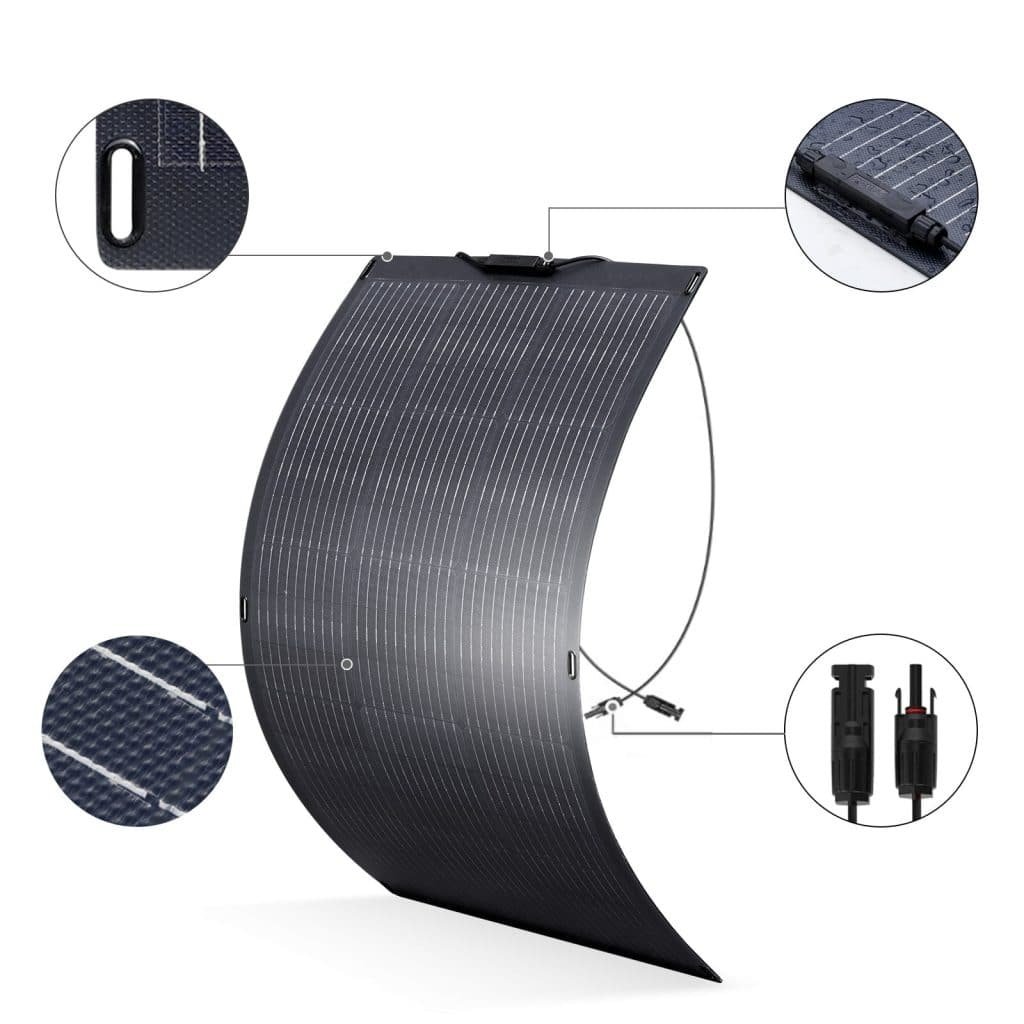
Flexible Panels for Challenging Spaces
Our innovative flexible solar panels let you:
- Install solar on curved surfaces where glass panels won’t work
- Use panels that weigh 75% less than traditional glass models
- Choose sleek all-black designs that blend with your architecture
- Deploy weather-resistant panels that stand up to harsh conditions
Business Benefits
Companies choose our custom solutions because they:
- Can use our OEM/ODM services to create panels under their own brand
- Save on maintenance with our self-cleaning technology
- See ROI in just 3-4 years thanks to higher efficiency
- Can easily expand their systems as their needs grow
Common Mistakes to Avoid
When sizing solar panels for 12V batteries, watch out for these frequent errors:
1. Underestimating Your Power Needs
Many people focus only on current needs without thinking about future expansion or seasonal changes. Always add 20-30% extra capacity to your calculated needs.
2. Forgetting About Efficiency Losses
Wire resistance, controller limitations, and temperature all reduce real-world performance. Use a realistic efficiency factor (70-85%) when calculating.
3. Ignoring Battery Type Differences
Different batteries have different needs:
- Lead-acid batteries: Accept wider charging ranges but can suffer if charging is inconsistent
- LiFePO4 batteries: More efficient but often need minimum charging currents
- AGM batteries: Different charging profiles than flooded lead-acid
4. Not Considering Your Charge Controller
Your panel and charge controller must work together. Picking a panel without thinking about your controller can lead to poor performance or even incompatibility.
Finding Your Perfect Match
Picking the right solar panel for your 12V battery comes down to balancing several factors:
- Your battery’s capacity and energy needs
- How much sun you get at your location
- What type of charge controller you use
- Environmental conditions
- Your budget
- Available space
Here’s a quick rule of thumb:
- For lead-acid batteries: Choose a panel with 1.5-2 times the battery’s Ah rating in watts
- For LiFePO4 batteries: A panel with 1-1.5 times the battery’s Ah rating in watts works well
For most standard 12V deep-cycle batteries, start with these recommendations:
- 50Ah battery: 150W solar panel (with MPPT controller)
- 100Ah battery: 300W solar panel (with MPPT controller)
- 200Ah battery: 600W solar panel (with MPPT controller)
Why Choose Couleenergy for Your Solar Needs
We’re not just another solar company – we’re innovators passionate about custom solar solutions:
- Complete Product Range: From entry-level portable solar panels (5-150W) to premium RV & marine panels (100-250W) and professional flexible options (200-720W)
- Cutting-Edge Technology: Our self-cleaning panels reduce maintenance while our flexible panels work where others can’t
- Custom Solutions: We offer OEM/ODM services for businesses to create solar products under their own brand
- Expert Support: Our team provides personalized assistance with site assessments and technical support
Whether you need a tiny 5W panel for a monitoring system or a complete custom solution for your business, we’ll help you build a reliable, efficient solar charging system that lasts for years.
Couleenergy, your partner in solar power solutions. For personalized help with your solar project, contact our experts at info@couleenergy.com, or call us at +1 737 702 0119.


 English
  Español
  Français
  Deutsch
  Русский
  العربية