

What if your solar panels could produce MORE energy during winter, work perfectly in snow, and generate power during peak morning and evening hours?
- Generate electricity when traditional solar panels are sleeping
- Self-cleaning design saves thousands in maintenance
- Perfect for northern climates and agricultural land
- Proven technology with 34% higher yields in real installations
Stop settling for solar panels that underperform when you need them most. Vertical photovoltaic (VPV) systems are revolutionizing solar energy with a simple but powerful twist—literally. By mounting solar panels vertically, this proven technology delivers 26.91% better morning performance and 22.88% better evening performance exactly when electricity costs peak.
⏱️ 30-Second Assessment: Are Vertical Solar Panels Right for You?
You’re an ideal candidate if you answer YES to 2 or more:
- ☐ Located above 40° latitude (Northern US, Canada, Northern Europe)
- ☐ Experience snow for 2+ months annually
- ☐ Pay higher electricity rates during morning/evening hours
- ☐ Have agricultural land or want dual-use options
- ☐ Limited roof space or structural concerns
If you checked 2+ boxes, vertical solar could significantly outperform traditional panels for your situation.
🌟 Real-World Success Story
“We were skeptical when Over Easy Solar promised better winter performance. But after one year, our vertical solar panels in Oslo generated 1,070 kWh/kWp compared to just 800 kWh/kWp from our neighbor’s traditional rooftop system. That’s a 34% improvement! During the heavy snow last February, our solar panels kept producing while everyone else’s were buried.”
— Norwegian Installation Data, 2022-2023

📊 The Numbers That Matter
+26.91%
Morning Power Boost
When you need it for breakfast
+22.88%
Evening Power Boost
When you’re home from work
89%
Winter Availability
While others are snow-covered
50%
Less Maintenance
Self-cleaning saves money
University of York Research (2024): “Vertical bifacial solar installations significantly outperform traditional systems during peak demand periods, offering a compelling solution for grid stability and consumer savings.”
🔄 Why Vertical Changes Everything
Imagine solar panels that work harder when traditional solar panels give up. That’s the vertical advantage.
The Morning & Evening Advantage
Traditional solar panels are like night shift workers forced to work days—they peak when you don’t need them (noon) and sleep when you do (morning/evening). Vertical panels flip this script:
- 6-10 AM: Producing 26.91% MORE power while you prepare for your day
- 4-8 PM: Generating 22.88% MORE power during dinner and evening activities
- Winter months: Up to 30% better performance when heating needs peak
The Snow & Weather Advantage
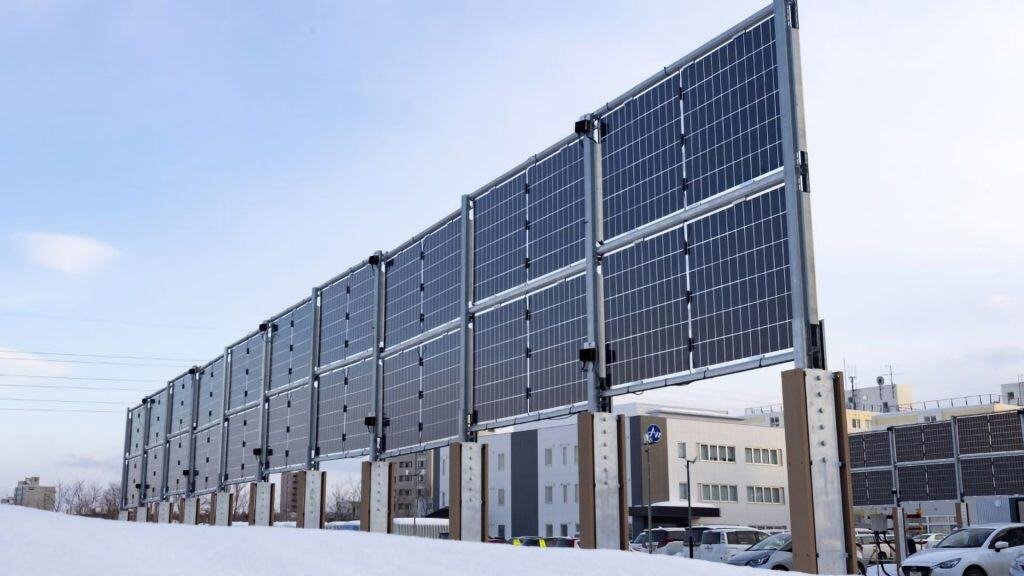
While your neighbor’s panels are buried under snow, vertical panels keep working:
- ❄️ Snow slides right off – No accumulation on vertical surfaces
- 🌧️ Rain cleans both sides – Natural maintenance
- 🌡️ Runs 10-15°C cooler – Better efficiency in summer
- 💨 Less wind resistance – Vertical orientation reduces lift forces
The Dual-Use Advantage
Why choose between solar and other land uses? Vertical panels enable:
- Agriculture: Farm between panels with 90% land availability
- Grazing: Animals can move freely beneath panels
- Parking: Create shaded parking with vertical side panels
- Noise barriers: Replace highway sound walls with energy generators
⚙️ Technology Options: Which Solar Panel Technology Delivers Results?
Not all solar panels work well vertically. Here’s what actually performs:
| Technology | Efficiency | Best For | Investment Level |
|---|---|---|---|
| HJT (Premium) | 24-25% | Maximum performance, cold climates | Higher initial, best ROI |
| TOPCon (Balanced) | 23-24% | Great performance, moderate budget | Moderate, excellent value |
| PERC Bifacial (Budget) | 21-22% | Good performance, tight budget | Lower initial cost |
| Monofacial | 20-22% | ❌ Not suitable for vertical | Don’t waste money here |
⚠️ Important: Only bifacial solar panels make sense for vertical installation. They capture light from both sides, which is essential for the technology to work. Monofacial panels will underperform significantly.
🌍 Is Your Location Suitable? Find Out in 60 Seconds
Location Suitability Checker
✅ EXCELLENT (25-35% advantage)
• Norway, Sweden, Finland, Iceland
• Canada, Alaska
• Northern US (MN, WI, MI, ME, etc.)
• Mountains with snow
⚡ GOOD (10-20% advantage)
• Germany, UK, Poland
• Northern China, Japan, Korea
• Central US states
• Areas with seasonal variation
❌ LIMITED (<10% advantage)
• Tropical regions
• Desert without winter
• Southern US (FL, TX, AZ)
• Areas below 30° latitude
Rule of Thumb: The further north you are, the better vertical panels perform.
Above 45° latitude? You’re in the sweet spot!
🏗️ Installation Requirements (Keep It Simple)
Space Requirements
| Application | Spacing Needed | Your Benefit |
|---|---|---|
| Farm/Agricultural | 8-12m rows | Keep farming while generating power |
| Commercial Rooftop | 1-2m rows | Use weak roofs that can’t support traditional |
| Residential Wall | Zero ground | Perfect for small lots |
| Fence Replacement | Property line | Privacy + power generation |
Structural Requirements
The Good News: Vertical panels are actually EASIER on your structure:
- Less weight per square foot than traditional
- No snow load accumulation
- Lower wind lift forces
- Can use existing walls/fences
❓ Your Top Questions Answered
Q: What’s the catch? This sounds too good to be true.
Vertical solar panels aren’t magic—they’re specialized. They excel in northern climates with distinct seasons but offer minimal benefits near the equator. They produce less at noon but more when you actually need power. Initial costs are higher, but maintenance savings and peak-hour production often deliver better ROI.
Q: How much more expensive are vertical installations?
Installation costs vary by location, scale, and mounting type. While initial investment is typically higher than traditional solar systems, many customers see faster payback due to:
- Higher value electricity generation (peak hours)
- Reduced maintenance costs
- Longer system lifespan
- Dual-use income opportunities
Q: Will vertical solar panels survive severe weather?
Yes. Properly installed vertical panels are rated for 150 km/h (93 mph) winds. Some installations have survived Category 1 hurricanes. The vertical orientation actually reduces stress compared to angled panels.
Q: Can I add vertical solar panels to my existing solar system?
Absolutely! Vertical panels complement traditional installations beautifully by:
- Filling the morning/evening generation gaps
- Boosting winter production
- Using different spaces (walls, fences)
- Balancing your daily generation curve
Q: How do I know if vertical solar makes financial sense for me?
Three key factors determine your ROI:
- Location: Above 40° latitude? Great candidate.
- Electricity pricing: Time-of-use rates? Even better.
- Use case: Agricultural/dual-use? Excellent fit.
Q: What about cloudy days?
Vertical bifacial panels actually perform BETTER in diffuse light conditions than traditional panels because they capture light from multiple angles. Cloudy days reduce all solar production, but vertical panels maintain their relative advantage.
🎯 Ready to Stop Losing Money on Underperforming Solar?
Join hundreds of smart property owners who’ve discovered the vertical advantage.
Get Your FREE Custom Analysis
Our solar experts will analyze your specific situation and show you exactly:
- How much MORE energy you could generate
- Your expected ROI and payback period
- Best technology for your location
- Available incentives and rebates
- Comparison with traditional solar options
Why Industry Leaders Choose Vertical Solar
✓ Proven technology with 30+ years of development
✓ Successful installations from Norway to Australia
✓ University research validated performance
✓ Growing market with major manufacturer support
Performance data based on peer-reviewed research and verified field installations. Individual results vary by location and installation specifics. Contact us for location-specific projections.
© 2025 Couleenergy | Custom Solar Specialists | info@couleenergy.com | +1 737 702 0119


 English
  Español
  Français
  Deutsch
  Русский
  العربية