
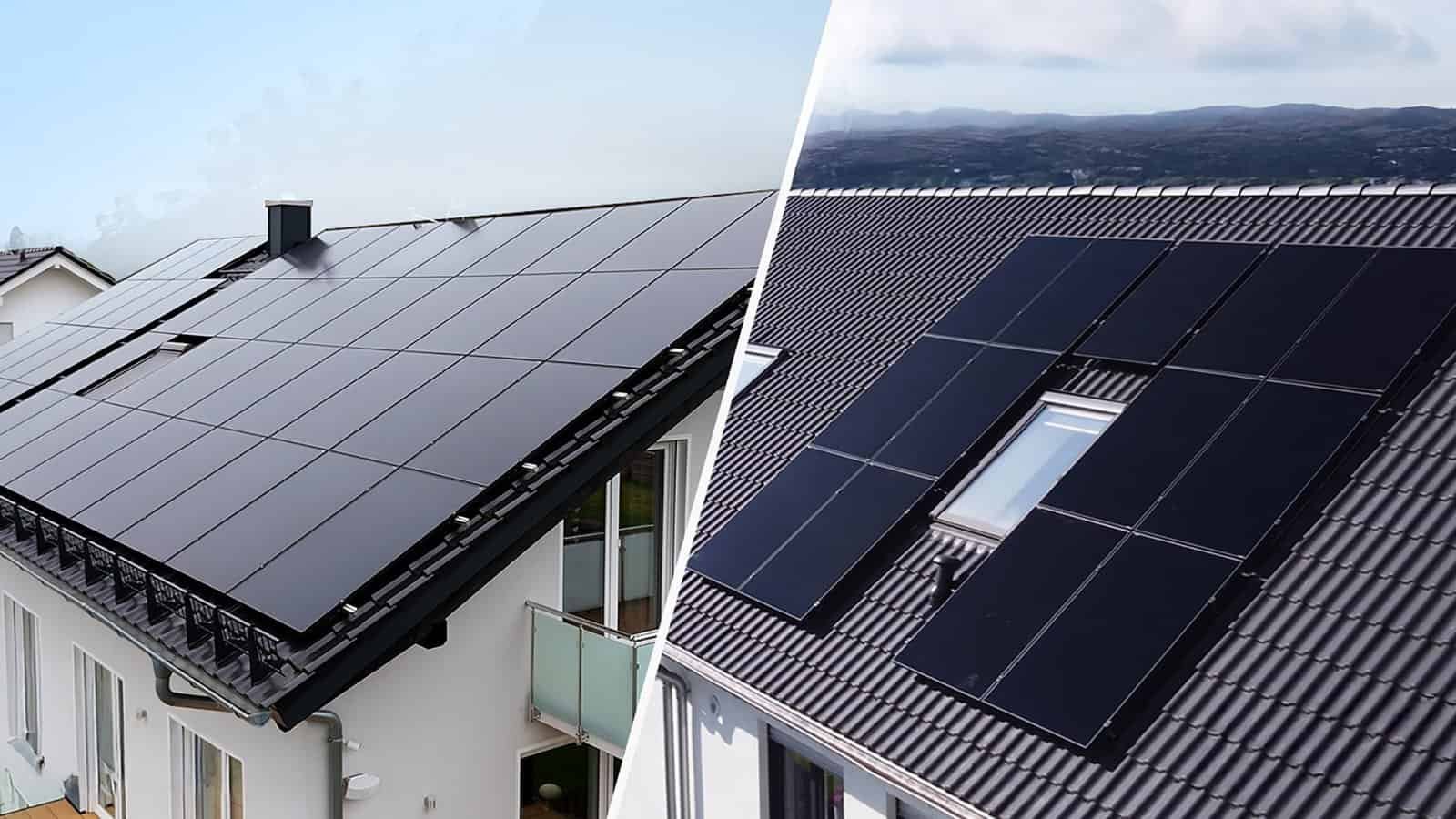
In 2023, back-contact solar panels were barely visible in European markets. By 2025, they held over 50% of Switzerland’s entire solar market. That is not a slow technology shift — it is a tidal wave. And Europe’s residential and BIPV sectors are next.
The question is no longer whether back-contact (BC) technology will reshape the EU market. It is how fast. A perfect mix of regulation, technology, economics, and aesthetics is pushing BC panels toward the centre of European solar. Here is what is driving that shift — and what it means for everyone in the supply chain.
What Makes Back-Contact Solar Different?
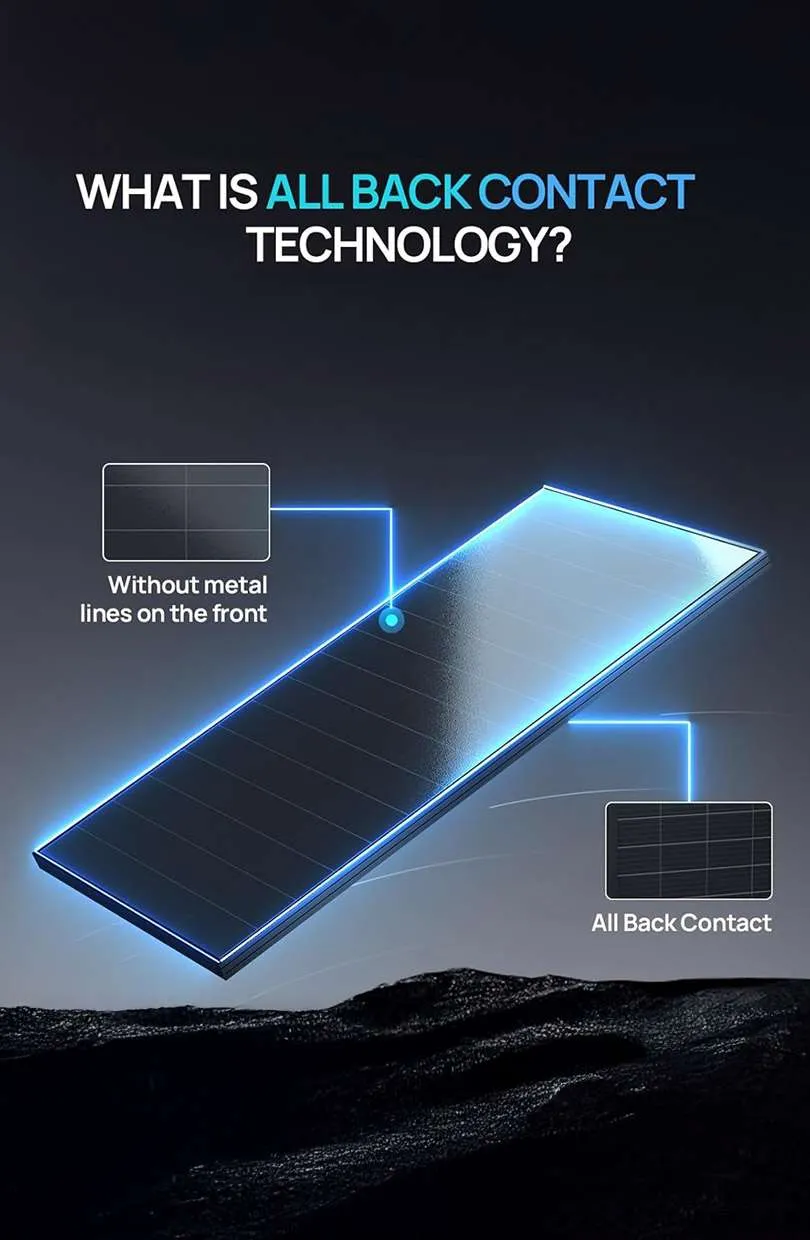
In a conventional solar panel, metal contacts run across the front of each cell. Those silver gridlines and busbars serve an essential function: they collect the current. But they also block sunlight — and they look industrial.
Back-contact technology solves this elegantly. Both positive and negative contacts move to the rear of the cell. The entire front surface is left open to capture light. The result is higher efficiency, a cleaner appearance, and better performance in real-world conditions. There is no compromise — BC panels simply perform better on every dimension that matters for rooftops.
Three types of BC technology are currently scaling commercially: IBC (Interdigitated Back Contact, used by Maxeon and SunPower), HPBC (Hybrid Passivated Back Contact, developed by LONGi), and ABC (All Back Contact, used by Aiko Solar). All share the same front-contact-free architecture. They differ in manufacturing approach and cost structure.
The Switzerland Signal: What 50% Market Share Means
Switzerland is a critical case study. It is almost entirely a rooftop market — residential and commercial buildings, with virtually no utility-scale ground installations. That makes it a near-perfect preview of what BC adoption looks like in an EU residential context.
According to the Photovoltaik Barometer 2026, published by Eturnity and the Bern University of Applied Sciences, Aiko Solar and LONGi together captured over 50% of Switzerland’s solar market in 2025 — both companies selling exclusively back-contact panels. In 2023, neither brand had meaningful Swiss market presence. That transition from near-zero to majority market share happened in roughly two years.
Switzerland BC Market Share — 2023 to 2025
2023: BC panels — negligible market presence. TOPCon and PERC dominate.
2024: LONGi and Aiko gain ground alongside Trina and Jinko.
2025: Aiko + LONGi combined — over 50% of the total market.
Source: Photovoltaik Barometer 2026, Eturnity / Bern University of Applied Sciences[1]
This is not a coincidence. Switzerland’s market is dominated by small rooftops where every square meter of panel space counts. Higher efficiency wins. BC wins.
The EPBD: European Law Is the Biggest Accelerator
The revised Energy Performance of Buildings Directive (EPBD, EU/2024/1275)[2] is the single largest structural driver for BC adoption in the EU. It transforms solar from a voluntary upgrade into a legal requirement — and it unfolds on a tight timeline across all 27 Member States. The directive entered into force on 28 May 2024 and must be transposed into national law by 29 May 2026.[3]
May 2026All 27 EU Member States must transpose the EPBD into national law. All new buildings must be designed to optimize solar energy generation.
Jan 2027: New non-residential buildings must install solar where suitable.
Jan 2028: Existing non-residential buildings over 500 m² must install solar during major renovations.
Jan 2030: All new residential buildings in the EU must have solar installations.
Jan 2031: Existing public buildings over 250 m² must install solar.
This timeline changes the market conversation entirely. When solar becomes mandatory, buyers stop asking “should I install panels?” and start asking “which panels produce the most from my limited roof space?” That question has a clear answer: back-contact.
Each European country is also layering its own incentives on top. Germany’s EEG provides feed-in tariffs for solar projects including BIPV. France and Italy offer tax credits and VAT reductions. Austria subsidises solar installations by up to 50%. The regulatory tailwind is comprehensive and multi-layered.
Efficiency Is the Rooftop Advantage
European residential rooftops are constrained. Unlike ground-mounted utility farms, homeowners cannot simply add more rows. They have a fixed area — often partially taken by chimneys, skylights, and dormers. Every percentage point of panel efficiency translates directly into more electricity from the same footprint.
BC panels lead the efficiency race by a significant margin:
| Technology | Typical Module Efficiency [4] | Key Limitation |
|---|---|---|
| PERC | 20–21.5% | Older architecture, approaching ceiling |
| TOPCon (monofacial) | 22–23% | Front contacts still reduce light capture |
| BC (HPBC / ABC) | 24–25%+ (commercial) | Higher upfront cost, now narrowing |
LONGi’s HPBC 2.0 (Hi-MO X10) delivers commercial module efficiency up to 24.8%, with Fraunhofer ISE independently certifying a laboratory world-record of 25.4% for this platform — a research milestone distinct from the 24.8% available in commercial shipments.[5] At cell level, commercial HPBC 2.0 production achieves 26.6%. Separately, LONGi’s R&D programme holds a laboratory-certified world record of 27.3% for its HBC (Heterojunction Back Contact) architecture — a different cell type, certified by ISFH in 2024.[6] The ITRPV 2025 roadmap, published by Germany’s VDMA engineering association, projects commercial BC modules reaching 25% efficiency in 2026 and approaching 26% by 2028[7] — a trajectory that leaves competing silicon technologies further behind with each passing year.
For a typical 30 m² residential rooftop, the difference between 21% and 25% efficiency can mean 15–20% more annual energy output — without adding a single extra panel.
Shade Tolerance: The Hidden Game-Changer for European Homes
Efficiency figures are measured under perfect lab conditions.[4] Real rooftops in Europe are not perfect. They face chimneys, dormer windows, trees, neighbouring buildings, and low winter sun angles. Partial shading is not an edge case — it is the everyday reality for most residential installations.
This is where BC technology delivers perhaps its biggest practical advantage. In conventional string-wired panels (PERC or standard TOPCon), a single shaded cell can degrade the performance of the entire string. Research shows that just 5% surface shading can cause 15–25% or more total power loss.[8]
BC’s shade advantage in numbers: LONGi’s HPBC 2.0 reduces power loss from partial shading by up to 70% compared to TOPCon modules.[9] In real-world testing with dynamic shading, daily production gains exceed 10%. In one documented project with tree shading, switching to HPBC modules boosted production by nearly 18%.
The reason is architectural. BC cells use a distributed current pathway — shaded areas are effectively bypassed, and current reroutes around the obstruction instead of degrading the whole string. Think of it like traffic automatically diverting around a closed road, rather than backing up and blocking everything behind it.
This matters enormously for urban and suburban European rooftops. It means installers can confidently propose BC systems for north-facing sections, east-west orientations, and rooftops with mixed shading — configurations that would underperform badly with older technology.
The Price Gap Has Closed
Two years ago, BC panels cost meaningfully more than equivalent TOPCon modules. That premium was the main barrier to mainstream adoption. Today, that barrier has largely disappeared.
European module pricing data from early 2026 shows BC panel prices have reached near-parity with bifacial TOPCon. The gap is now narrow enough that the efficiency advantage of BC makes it the economically superior choice for most rooftop applications — even on price alone.
Here is a key insight from the Swiss market that applies across Europe: in a typical residential installation, the module itself often accounts for less than 10% of total project cost.[10] Labor, scaffolding, inverters, wiring, and permitting make up the rest. When the panel is a small share of the total bill, spending slightly more for meaningfully higher efficiency is simply good economics. More watts per panel means fewer panels, fewer fixings, less roof penetration, and faster installation time.
BIPV: Where BC Technology Has No Equal
Building-Integrated Photovoltaics (BIPV) is the market segment where BC panels face virtually no serious competition. BIPV means solar that replaces conventional building materials — roof tiles, glass facades, cladding panels, balcony railings. The panel is the building component.
In this context, aesthetics are not a bonus feature. They are the product. Nobody wants to see silver gridlines and metal busbars on their building facade or heritage roofline. BC panels, with their fully black, contact-free front surface, are the only silicon-based technology that meets the visual demands of premium BIPV applications.
The European BIPV market is growing at a remarkable pace:
Europe BIPV Market at a Glance
2024 market size: approximately USD 9.6 billion
Projected CAGR through 2030: 33.8%
Europe’s share of global BIPV market: over 40%
Fastest-growing segment: glass facades (replacing cladding and windows)
Source: Grand View Research, Fortune Business Insights[11]
Italy’s December 2025 heritage building reform dramatically expanded the market. By relaxing restrictions on solar installations in historic centres — specifically referencing “virtually invisible” integrated panels — Italy unlocked an estimated 200,000+ historic buildings for BIPV retrofits. No other technology can serve these projects. BC is the only option that satisfies both regulatory intent and architectural standards.
Spain’s terracotta-roof market is another example. Curved BC solar tiles that mimic traditional materials can integrate into Mediterranean rooflines without visual disruption. This was technically impossible with front-contact panels.
Balcony Solar Is Booming — and BC Fits Perfectly
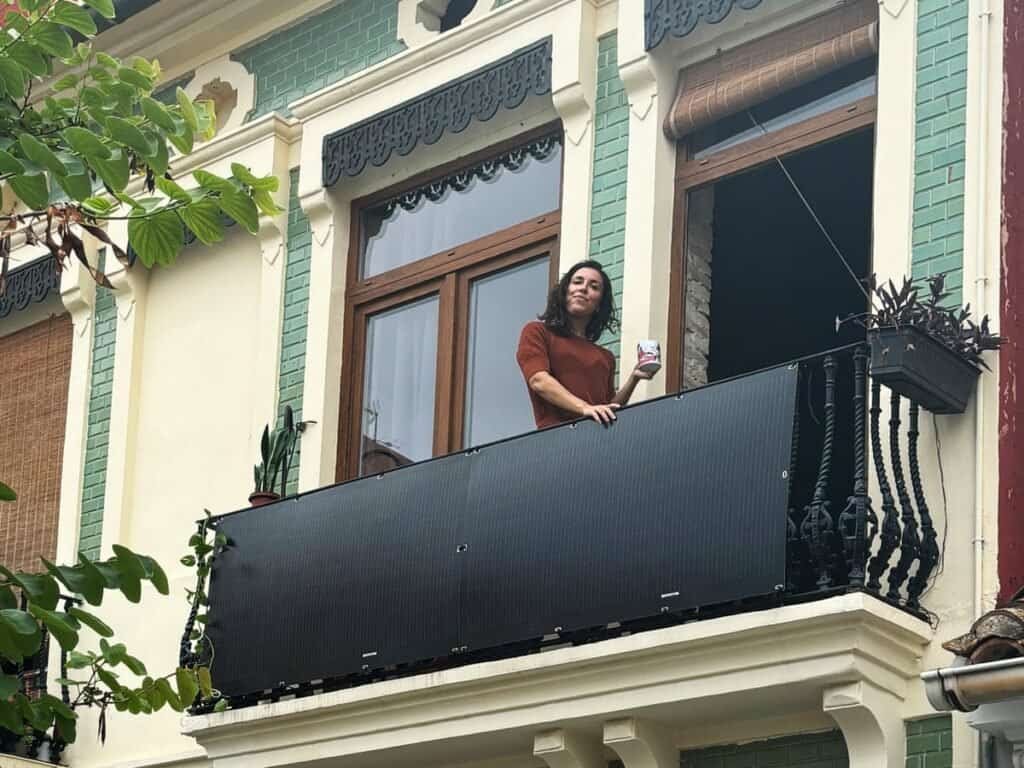
Europe’s balcony solar revolution is another tailgate for BC adoption. Germany alone has over 500,000 plug-in solar systems installed. Around 220,000 new units were added in just the first half of 2024.[13] Countries including Austria, Belgium, France, Italy, and the Netherlands are all streamlining regulations to make small-scale balcony solar faster and simpler to install.
Balcony panels are visible. They are mounted at eye level on building exteriors. Space is tightly constrained. For all three of these reasons, BC panels are the natural fit: maximum power per square meter, all-black aesthetics that blend with any facade, and superior shade tolerance for partially obstructed balconies.
The Untapped Rooftop Opportunity Is Enormous
A 2026 EU-wide analysis by the Joint Research Centre — published in Nature Energy — found that only around 10% of European building rooftops currently have solar installed. Yet rooftop solar alone could supply approximately 40% of Europe’s electricity demand in a fully renewable energy scenario by 2050.[12] The numbers are staggering:
- Residential buildings across the EU could host around 1,800 GWp of solar capacity
- Non-residential buildings could add another 500 GWp
- Total annual potential: approximately 2,750 TWh
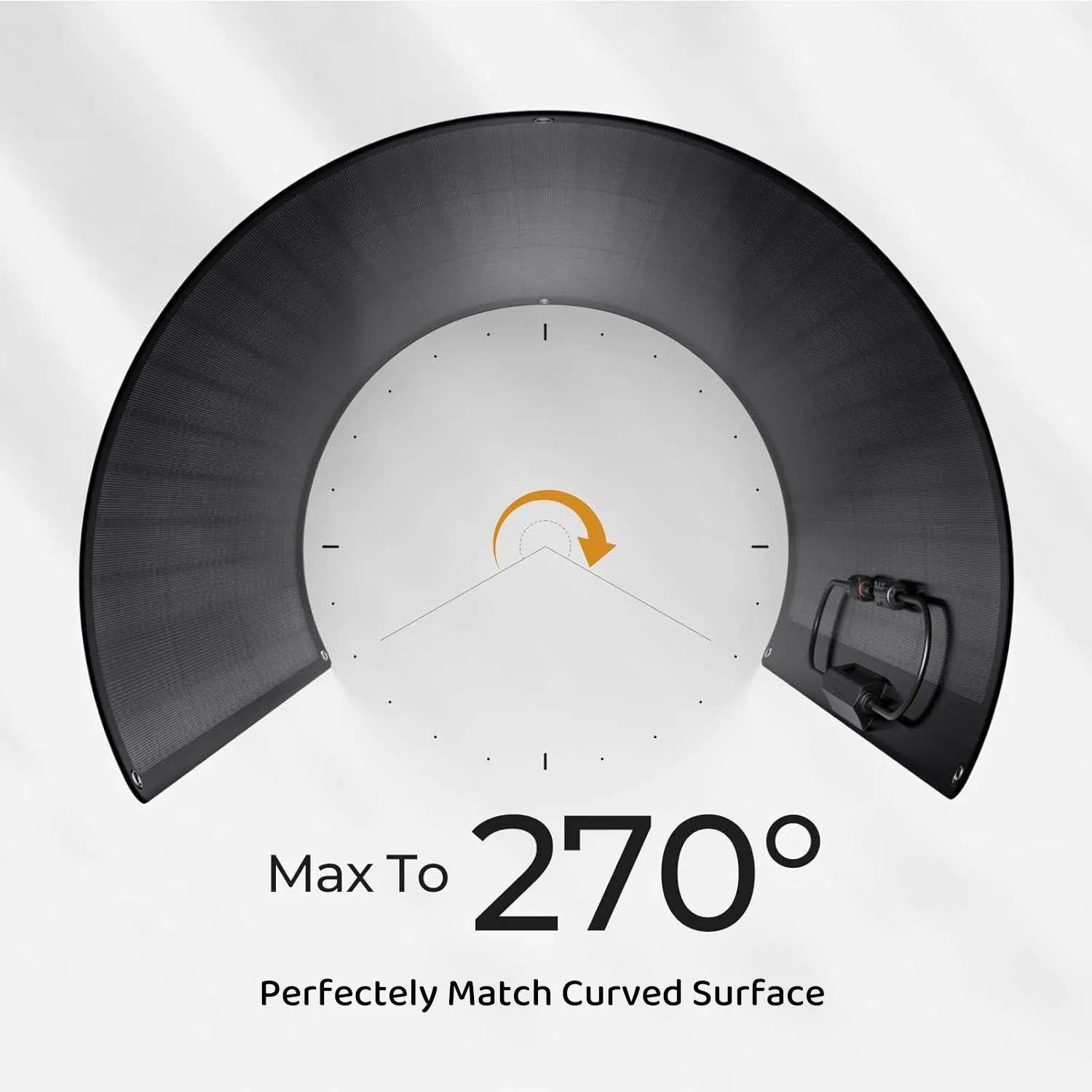
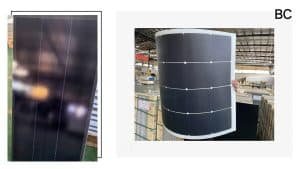
Lightweight BC panels add another dimension. Research estimates that lightweight flexible modules could unlock more than 85 GW of previously inaccessible rooftop potential — buildings whose structures cannot support the weight of conventional glass-glass panels. LONGi’s Guardian Light Design, based on HPBC 2.0 technology, is already 30% lighter than standard single-glass modules. This opens an entirely new category of rooftops to solar generation.
Key EU Markets to Watch
| Market | Why It Matters for BC |
|---|---|
| Germany | Largest EU residential solar market; over 500,000 balcony systems; strong BIPV push; leading regulatory framework |
| Switzerland | Already over 50% BC market share; proof that adoption happens fast in rooftop-heavy markets |
| Italy | December 2025 heritage reform unlocks 200,000+ buildings; high irradiation benefits BC’s temperature performance |
| Portugal | Fastest-growing BIPV market in the EU through 2030 |
| Spain | High irradiation amplifies BC’s temperature coefficient advantage; curved tile innovation opening new rooftop types |
| Austria | Up to 50% subsidies for solar installations; balcony solar policies expanding rapidly |
| UK | BC panels already dominant in the residential segment; Aiko and LONGi leading market share |
What the Technology Roadmap Shows
BC is not near its performance ceiling. The ITRPV roadmap — published annually by Germany’s VDMA engineering association in collaboration with major global producers — projects BC gaining dominant share specifically in rooftops, facades, and distributed generation: exactly the residential and BIPV applications under discussion here.
The 2025 ITRPV edition projects commercial BC modules reaching 25% efficiency in 2026 and approaching 26% by 2028. Within the same period, bifacial BC modules are expected to achieve 80%+ bifaciality, adding meaningful rear-side energy capture on top of the front-surface efficiency advantage. Industry research goes further still: Aiko Solar and LONGi’s joint white paper, presented at Intersolar Europe 2025 in Munich, projects BC cell efficiencies reaching 28%+ within the decade as manufacturing innovations — copper metallisation, advanced passivation, and higher-purity silicon feedstock — continue to mature.[14] As those gains flow into commercial modules, the performance gap between BC and competing silicon technologies will widen — not narrow.
Major manufacturers including LONGi, Aiko Solar, Tongwei, and JA Solar are all ramping BC production capacity. Supply is scaling to meet what will become the primary demand driver: Europe’s mandatory solar push under the EPBD.
What This Means for Solar Businesses
The Switzerland case demonstrates how quickly this shift can happen. From near-zero to majority market share in two years — driven entirely by rooftop market dynamics. The EU residential and BIPV market has the same dynamics, amplified by regulatory mandates that make solar non-optional from 2027 onward.
For solar distributors, installers, and project developers targeting European residential or BIPV segments, the practical implications are clear:
Product lines built around PERC or standard TOPCon will face growing headwinds as BC reaches price parity and buyers become educated on efficiency and shade advantages. BIPV opportunities — particularly heritage buildings, facade applications, and premium residential — already require BC technology to meet aesthetic specifications. Waiting to build BC expertise and supply relationships means entering an increasingly crowded market later.
The window to be early is closing. Switzerland already shows what the EU residential market will look like in two to three years. The combination of the EPBD mandate, near-parity pricing, superior efficiency, shade tolerance, and the BIPV boom makes widespread BC adoption not a question of if — but how fast.
The Verdict
Back-contact solar panels are not simply a premium product for demanding buyers. They are becoming the technically optimal, economically rational, and aesthetically required choice for the EU residential and BIPV markets.
The EPBD creates structural demand. Price parity removes the cost objection. Superior efficiency wins the rooftop space argument. Shade tolerance makes BC the right choice for real European buildings — not just ideal laboratory conditions. And for BIPV, where the panel must look like an architectural element, BC is the only viable silicon-based option.
Switzerland reached 50% BC market share in roughly two years. As EPBD mandates roll out across all 27 EU Member States between 2026 and 2031, the same transition is coming to the whole continent — at a larger scale and with regulatory momentum Switzerland never had.
The EU residential and BIPV market will not gradually drift toward BC technology. It will snap to it.
Related topics: back-contact solar panels, EU solar mandates, BIPV market Europe, EPBD solar requirements, LONGi HPBC, Aiko ABC solar, residential solar Europe, building-integrated photovoltaics, solar roof tiles
Footnotes
- [1]Photovoltaik Barometer 2026 — Annual Swiss PV market report by Eturnity and the Bern University of Applied Sciences. Confirms Aiko Solar and LONGi combined market share exceeded 50% of Switzerland’s solar market in 2025, up from negligible BC presence in 2023.
pv-magazine.com — Is Switzerland going back contact? (March 2026) - [2]EPBD EU/2024/1275 — Energy Performance of Buildings Directive, published in the Official Journal of the European Union on 8 June 2024. Full legislative text governing solar mandates, zero-emission building standards, and renovation targets across all 27 Member States.
eur-lex.europa.eu — EPBD (EU) 2024/1275 Official Text - [3]EPBD Solar Mandate — EU Commission Guidance — Article 10 of the revised EPBD requires progressive solar installation across building types between 2026 and 2031. Transposition deadline for Member States is 29 May 2026.
energy.ec.europa.eu — Solar Energy in Buildings (European Commission) - [4]Standard Test Conditions (STC) — Module efficiency ratings in this article are measured at STC: 1,000 W/m² irradiance, 25°C cell temperature, AM 1.5 solar spectrum, as defined under IEC 61215:2021 (crystalline silicon PV modules). Real-world output varies with temperature, orientation, and shading.
nrel.gov — NREL Champion Photovoltaic Module Efficiencies Chart - [5]LONGi HPBC 2.0 — Commercial and Record Efficiency — Hi-MO X10 commercial module efficiency: 24.8% (26.6% cell). Fraunhofer ISE laboratory world-record module efficiency: 25.4%, certified October 2024 and listed in the NREL Champion Module Efficiency Chart and Martin Green efficiency tables.
eu.longi.com — 25.4% World Record Announcement · longi.com — Hi-MO X10 European Launch - [6]LONGi HBC / HIBC Cell World Record — 27.3% — Now Commercialized — Laboratory PV conversion efficiency of 27.3% for the Heterojunction Back Contact (HBC) architecture, originally certified by the Institute for Solar Energy Research Hamelin (ISFH), May 2024. As of June 2025, LONGi commercialized this architecture in the Hi-MO S10 (EcoLife Pro), achieving 27.3% cell efficiency and up to 25% module efficiency in mass production — the world’s first commercially available HIBC module, launched at Intersolar Europe 2025. This is a distinct architecture from the HPBC 2.0 used in the Hi-MO X10.
eu.longi.com — LONGi Dual World Records (HBC + Tandem) · eu.longi.com — Hi-MO S10 EcoLife Pro Launch (Intersolar 2025) - [7]ITRPV 2025 — BC Module Efficiency Roadmap — International Technology Roadmap for Photovoltaics, 16th edition, published by VDMA (German Mechanical Engineering Industry Association) with contributions from 50+ global producers, research institutes, and equipment suppliers. Projects commercial BC modules reaching 25% efficiency in 2026 and approaching 26% by 2028.
itrpv.vdma.org — ITRPV Official Publication · pv-tech.org — ITRPV 2025 BC Technology Analysis - [8]Partial Shading Power Loss — Conventional Modules — Based on testing by China’s National Photovoltaic Quality Inspection Center, as reported in LONGi’s HPBC 2.0 technical documentation. Conventional series-wired string modules show 15–25%+ output loss under 5% surface shading; severe or single-cell shading can exceed 30–40%.
eu.longi.com — HPBC 2.0 Shade Performance Analysis - [9]HPBC 2.0 Shading Optimizer — 70% Reduction vs. TOPCon — LONGi Hi-MO X10 product specification. The integrated shading optimizer architecture (bipolar low-resistance passivation contacts) reduces shading power losses by over 70% compared to TOPCon modules and lowers hotspot temperatures by 28%.
eu.longi.com — Hi-MO X10 Product & Technical Specification - [10]Module Cost as Share of Total System Cost — Swiss Market — In high-labour-cost markets such as Switzerland, the PV module can account for less than 10% of total installed system cost when factoring in labour, scaffolding, inverter, wiring, grid connection, and permitting. Reported in the Photovoltaik Barometer 2026 analysis.
pv-magazine.com — Swiss Market Cost Structure (March 2026) - [11]European BIPV Market Data — Europe BIPV market size of USD 9.61 billion (2024) and CAGR of 33.8% through 2030 per Grand View Research. Europe’s ~41.8% share of global BIPV market in 2025 per Fortune Business Insights. Figures across research providers vary; these represent mid-range consensus estimates.
grandviewresearch.com — Europe BIPV Market Report · fortunebusinessinsights.com — Global BIPV Market Report - [12]JRC Rooftop PV Potential Study — Kakoulaki, G., Kenny, R., et al. “Mapping Europe’s rooftop photovoltaic potential with a building-level database.” Nature Energy, January 2026. Peer-reviewed analysis of 271 million EU buildings using the Digital Building Stock Model R2025. Residential: 1,822 GWp; non-residential: 519 GWp; annual potential: 2,750 TWh (~40% of demand in a 100% renewable 2050 scenario).
nature.com — Kakoulaki et al., Nature Energy (2026) · JRC Press Release (January 2026) - [13]Germany Balcony Solar Registrations — Plug-in photovoltaic (Stecker-Solar / Balkonkraftwerk) unit data tracked by Germany’s Federal Network Agency (Bundesnetzagentur) via the Marktstammdatenregister (MaStR). The 500,000+ installed units and H1 2024 growth figures are reported by the German Solar Industry Association (BSW-Solar).
bundesnetzagentur.de — Balkonkraftwerke (Bundesnetzagentur) - [14]BC Cell Efficiency Projections — Aiko Solar / LONGi Intersolar 2025 White Paper — At Intersolar Europe 2025 in Munich, Aiko Solar and LONGi jointly presented a white paper on bifacial BC technology, projecting BC cell efficiencies of 28%+ within the decade as copper metallisation, advanced passivation, and higher-purity feedstock standards reduce manufacturing costs and raise cell quality. These projections are also consistent with independent technology trend analysis by TaiyangNews and PV Tech.
taiyangnews.info — Next-gen solar cell technology projections (2025) · pv-tech.org — Bifacial BC technology roadmap analysis
 English
  Español
  Français
  Deutsch
  Русский
  العربية