
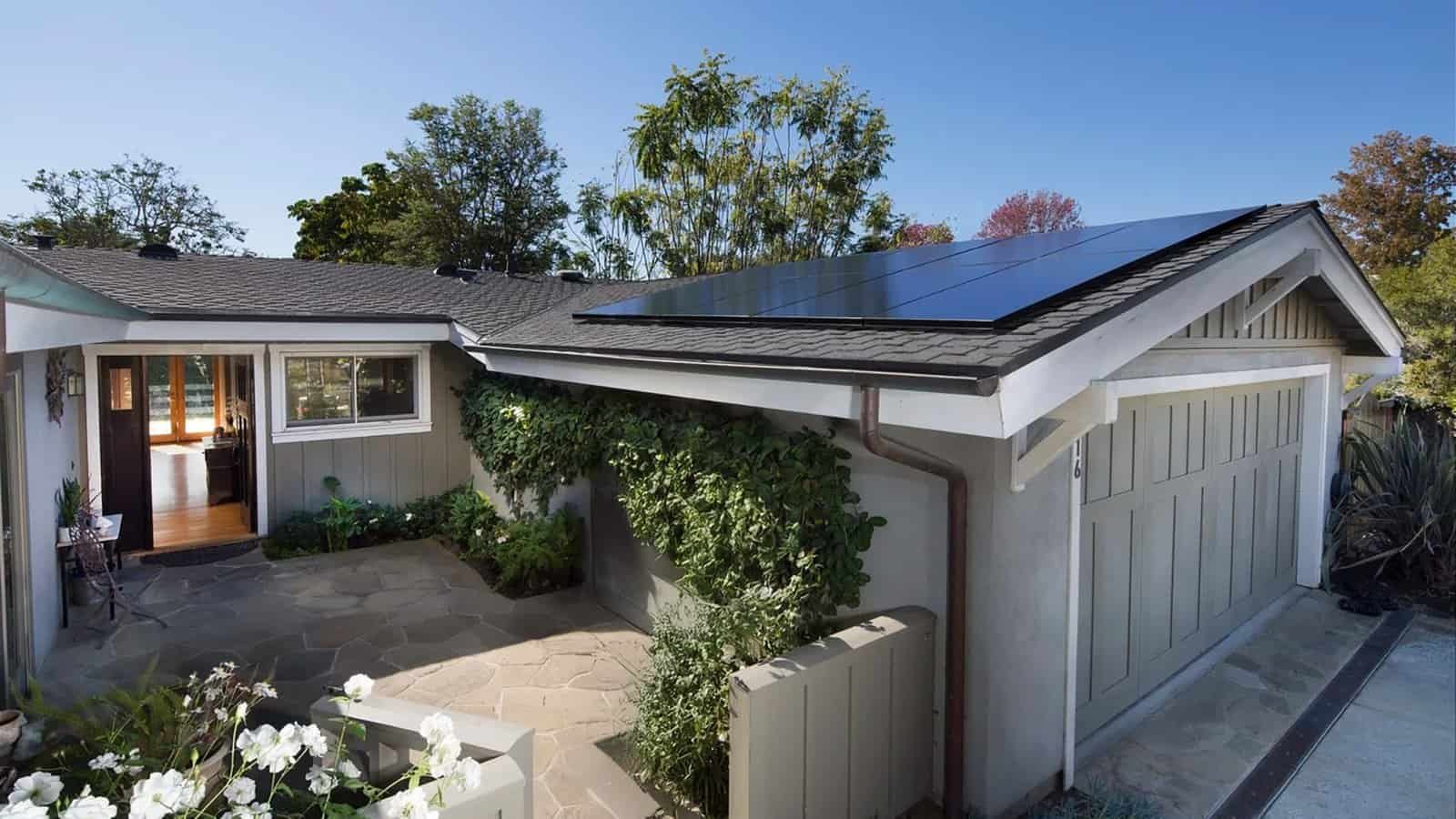
Back-contact (BC) solar panels are becoming the default choice for high-performance solar across European and North American markets — from commercial facades and marine decks to RV rooftops and off-grid applications. Switzerland crossed 50% BC market share in 2025[1]. EU mandatory solar deadlines begin end of 2026. Major cell manufacturers are racing toward 1 TW of BC capacity by 2030. For distributors, integrators, and OEM brands on both sides of the Atlantic, the question has shifted: not whether to source BC, but which manufacturing partner can build exactly what your application requires.
☀️ Back-Contact Technology: What Buyers Need to Know
Traditional solar panels have metal gridlines running across the front surface. They collect current — but they block incoming light. That shading loss is baked into every front-contact design, from PERC to TOPCon. Back-contact technology eliminates it. All electrical contacts are relocated to the rear of the cell. The entire front surface captures light without interruption — and the absence of front gridlines produces a uniform all-black surface that BIPV specifications and premium applications require.
Four BC cell architectures are now commercially active:
- IBC (Interdigitated Back Contact) — developed at Stanford University in the 1970s; commercialised by SunPower, now manufactured by Maxeon.
- HPBC (High-Performance Back Contact) — LONGi’s variant at 50 GW annual capacity; integrates shade management directly into the cell architecture.
- ABC (All Back Contact) — Aiko Solar’s design; current commercial efficiency leader at 25.0% module efficiency.
- HBC (Hybrid Back Contact) — next-generation architecture combining BC structure with HJT passivation and TOPCon tunneling layers. GS-Solar reached 27.62% in lab conditions (November 2024).
BC vs Front-Contact Technologies: Key Performance Metrics
| Technology | Front Gridlines | Best Commercial Module Efficiency | Temperature Coefficient | Annual Degradation | Market Status (2026) |
|---|---|---|---|---|---|
| PERC | Yes | ~21% | −0.35 to −0.40%/°C | 0.5–0.7% | Declining |
| TOPCon | Yes | ~23% | ~−0.30%/°C | ~0.45% | Current peak |
| HPBC (LONGi) | None | 24.8% | −0.26%/°C | ≤0.35% | Scaling fast |
| ABC (Aiko) | None | 25.0% | ~−0.24%/°C | ≤0.35% | Growing rapidly |
| HBC (Hybrid, lab) | None | 27.62% | TBC | TBC | Commercialising |
Sources: LONGi official press releases; Clean Energy Reviews (Feb 2026); PV Magazine; Fraunhofer ISE certification (Oct 2024); TCL Solar product data.
📈 Four Market Forces Accelerating BC Adoption
1. Efficiency Margins Are Pulling Away from TOPCon
Aiko Solar’s ABC modules achieve up to 25.0% efficiency in mass production. LONGi holds the crystalline silicon module world record at 25.4%[2], certified by Fraunhofer ISE in October 2024 under laboratory conditions; commercially shipped HPBC 2.0 modules deliver up to 24.8%. Standard TOPCon sits around 22–23%. The gap is widening. By 2028–2030, BC modules in commercial production are projected to exceed 26%.
2. The World’s Largest Cell Maker Has Committed to BC
In March 2026, Tongwei — nine consecutive years as global cell shipment leader per InfoLink Consulting[3] — signed a mass-production partnership for hybrid HBC cells with GS-Solar and Golden Solar. LONGi has targeted 50 GW of HPBC 2.0 annual capacity. JA Solar is executing a 4 GW HBC upgrade. ISC Konstanz co-founder Radovan Kopecek projects global BC manufacturing capacity could reach 1 terawatt by 2030[4], with most critical BC patents expiring in 2028.
3. Price Parity Has Effectively Arrived in Europe
European BC module pricing reached near-parity with bifacial and monofacial TOPCon in early 2026. The performance premium no longer carries a cost premium. The Swiss market demonstrates the consequence: BC moved from near-zero to over 50% share in two years. In a market where module cost represents less than 10% of total installed project cost, buying comparable rates for materially better output per square metre is straightforward economics.
4. Binding Regulation Is Creating Mandatory Demand
| Deadline | EPBD Requirement |
|---|---|
| May 2026 | All EU member states must transpose EPBD into national law |
| End of 2026 | New public and non-residential buildings >250 m² must have solar |
| January 2027 | All new non-residential buildings must install solar |
| January 2028 | Existing non-residential buildings >500 m² must install solar during major renovation |
| January 2029 | Existing public buildings >750 m² must install solar |
| January 2030 | All new residential buildings must have solar; existing public buildings >250 m² must install |
Source: European Commission — energy.ec.europa.eu (EPBD Solar Energy in Buildings, official timeline).[5]
When installation is mandatory and roof space is constrained, the buyer question shifts from “should I install solar?” to “which panel delivers the most from my limited footprint?” BC wins that question on every technical metric. For North American markets, UFLPA compliance requirements and the growing state-level solar mandate landscape create parallel structural demand — particularly for commercial and industrial building owners.
🔮 BC Adoption Timeline: 2026–2030
Switzerland demonstrated how quickly the shift can happen: near-zero to over 50% BC market share in two years. The UK residential segment is following the same pattern. EPBD mandates will drive the same adoption curve across all 27 EU member states — with mandatory commercial solar requirements starting before the end of 2026.
Bifacial BC modules are projected to dominate the global solar market from 2029/2030, with bifaciality reaching 80%+. Key BC-related patents expire in 2028, further opening competitive manufacturing. Leading analysts, including ISC Konstanz’s Kopecek, project that at full scale BC could eventually achieve an LCOE below one US cent per kWh — a long-term analytical target, not a current commercial figure, but one that signals the technology’s structural cost trajectory.
For sourcing teams: the window to establish custom OEM relationships at favourable terms is narrowing. Specialist flexible and custom BC capacity is more constrained than standard rigid module capacity. Partners building product lines around BC now are positioning ahead of EPBD-driven demand spikes.
⚡ Four Field-Level Technical Advantages
📐 1. Higher Output Per Square Metre
A 2025 white paper presented at Intersolar by LONGi, Aiko Solar, TÜV Rheinland, and the China Electricity Council found BC modules can generate up to 11% more energy over their lifetime[6] versus TOPCon. These authors have commercial interest in BC adoption, and independent long-term field studies are still emerging — but the directional advantage is consistent with BC’s efficiency architecture and corroborated across industry literature.
🌿 2. Better Shade Tolerance for Complex Installations
BC cells have a low breakdown voltage that allows shaded cells to self-bypass, containing loss to the shaded area rather than dragging down the full string. LONGi’s HPBC 2.0 documentation reports up to 70% reduction in partial-shading power loss[7] versus TOPCon, with one real installation recording an 18% production gain after switching from conventional panels.
A 2025 peer-reviewed study by Trina Solar researchers and Nanchang University confirmed BC outperforms TOPCon under partial shading, with the advantage most pronounced when fewer cells per substring are shaded[8] — the typical pattern for tree shadows, masts, chimneys, and antenna mounts in marine, RV, and rooftop environments. In heavy full-row shading, the gap narrows.
🌡️ 3. Superior Temperature Behaviour
Temperature coefficient as low as −0.24%/°C versus −0.40%/°C for older technologies. Annual degradation below 0.35%[9] versus 0.5–0.7% for standard panels. Over a 25–30 year operational life, that compounding difference is significant — and directly affects the LCOE calculation in any serious project model.
🎨 4. Aesthetics That Are a Specification Requirement, Not a Preference
A uniform all-black front surface with no visible gridlines or busbars. For architects specifying BIPV facades, for premium marine installers, and for residential installations in design-regulated markets, visible busbars are disqualifying — not aesthetically undesirable. BC’s clean surface is the specification floor.
🏢 Two Growing Markets Where BC Has No Serious Competitor
BIPV: When the Panel Is the Building Material
BIPV integrates solar into the structure itself — roof tiles, facades, canopies, skylights — replacing conventional materials while generating electricity. When a panel must function as an architectural element and pass planning review, visible gridlines are simply not acceptable. BC’s clean surface is not a stylistic advantage here; it is a qualification criterion.
According to Grand View Research, the European BIPV market was valued at nearly USD 10 billion in 2023, projected to more than triple by 2030 at 20%+ annual growth. Europe holds over 40% of the global BIPV market. Glass facades are the fastest-growing segment. A 2026 EU Joint Research Centre analysis — published in Nature Energy — found only about 10% of European building rooftops currently have solar installed, yet rooftop solar could supply around 40% of Europe’s electricity by 2050, with residential buildings alone hosting approximately 1,800 GWp.[10]
Flexible Panels: Surfaces Rigid Glass Cannot Serve
RV roofs curve. Marine decks flex and face continuous saltwater and UV. Older commercial buildings cannot bear glass module loads. Research by Enerdata and the European Solar Rooftops Initiative estimates 30–40% of commercial and industrial rooftops remain unequipped across Europe because the structures cannot support heavy solar panels.[11] Flexible BC modules — ETFE laminate, IP68 junction boxes, weights up to 70% lower than glass — are engineered precisely for these applications. The BC architecture enables thinner, more uniform front surfaces that support tighter bend radii without performance compromise.
🔧 Why Standard Panels Leave Key Markets Underserved
High-volume manufacturers optimise for standard residential and utility-scale installations. That leaves several B2B segments without viable off-the-shelf options:
- 🚤 Marine and RV manufacturers — need panels built to specific geometries, bend radii, wiring harnesses, weight budgets, and marine certifications. Standard SKUs trimmed to approximate fit are not the same product.
- 🏗️ BIPV integrators and architects — need custom dimensions, colour uniformity across a facade, specific mounting interfaces, and fire-classification documentation for each project.
- 🏷️ Distributors and OEM brands — need products under their own brand, packaged to their standards, documented in their language.
- ⚡ Off-grid and specialty integrators — need wattage, connector, and dimensional configurations that do not exist in standard catalogues.
Custom engineering is not a premium. For these buyers, it is the only path to a panel that actually works in the target application.
🏭 Couleenergy: Custom BC Solar Manufacturing for B2B Partners
Couleenergy is a Zhejiang-based manufacturer focused exclusively on the B2B market — distributors, marine and RV suppliers, BIPV integrators, and OEM brands across Europe and North America. The company specialises in back-contact flexible solar panels, BIPV modules, and fully customised OEM solutions using HPBC, ABC, and TOPCon cell architectures.
Core Product: HPBC ETFE Flexible Panels
Couleenergy’s flagship flexible modules combine shadow-tolerant HPBC back-contact cells with a durable ETFE laminate front sheet — producing an ultra-lightweight, bendable panel rated for marine, RV, curved rooftop, and off-grid applications.
Product Specification Summary
| Parameter | Specification |
|---|---|
| Wattage range | 20 W – 400 W (custom configurations available on request) |
| Cell technology | HPBC, ABC— specified at enquiry |
| Module efficiency | Up to 25% (HPBC/ABC cell configurations) |
| Front sheet | ETFE (standard for marine and outdoor); PET available for lighter-duty |
| Minimum bend radius | Contact engineering team — depends on substrate thickness and wattage |
| Weight | Approximately 70% lighter than glass-glass equivalent wattage |
| Thickness | From 2.6 mm (standard flexible); varies by configuration |
| Junction box rating | IP68 standard for marine configurations; IP65 minimum for all products |
| Connector types | MC4 standard; custom connector types available for OEM integration |
| Operating temperature | −40°C to +85°C |
| Dimensions | Custom — any shape or aspect ratio within production parameters |
| Certifications | IEC 61215[12], IEC 61730[12] |
| Branding / labelling | OEM — your brand, your packaging, your documentation language |
Specifications represent current standard product range. Custom configurations outside these parameters are available — contact the engineering team with your requirements.

Why ETFE Over PET?
Most low-cost flexible panels use PET (polyethylene terephthalate) laminate. ETFE (ethylene tetrafluoroethylene) provides significantly higher UV stability, chemical resistance, and service life in demanding outdoor environments. For marine applications — continuous salt spray, UV, mechanical vibration — ETFE is not a premium upgrade. It is the specification that determines whether a panel survives its warranted lifespan. Couleenergy uses ETFE as the default front sheet on all marine and outdoor flexible module configurations.
📋 The OEM Process: Practical Questions Answered
| What is the minimum order quantity? | MOQ varies by product type and specification complexity. Couleenergy is structured for specialist B2B volumes — not mass consumer scale — so the minimum threshold is lower than typical large-factory custom MOQs. Send your specification and intended annual volume to info@couleenergy.com for a specific MOQ and indicative pricing in the same response. |
| How long does sample development take? | Typically 2–4 weeks from specification sign-off to sample delivery for standard configurations. Custom geometries or novel specifications may require longer. Your engineering contact confirms the timeline after reviewing your spec. |
| How many sample revision rounds are included? | The sample process includes the revisions needed to reach specification confirmation — we do not charge per revision. No production volume discussion begins until the sample is approved by the partner. |
| What is the production lead time after sample approval? | Indicative range: 2–5 weeks from order confirmation for most flexible panel configurations. Confirmed at point of order reflecting your volume and specification. |
| What QC steps happen before shipment? | Every batch undergoes IV curve electrical performance testing, visual inspection, and dimensional verification. Third-party pre-shipment inspection by SGS, Bureau Veritas, or your nominated inspector can be arranged. |
| How are after-sales warranty claims handled? | Claims are handled directly by Couleenergy — no return to China required for evaluation. Contact info@couleenergy.com for the current warranty process applicable to your market. |
🔒 Sourcing with Confidence: Procurement Risk Addressed
European and North American buyers evaluating Chinese solar manufacturers face a consistent set of sourcing concerns. We address them directly.
Supply Chain Compliance — UFLPA & EU
Couleenergy provides EU supply chain traceability documentation where required. Discuss the specific compliance package your project requires before placing an order.
OEM Specification & IP Protection
All OEM specifications — dimensions, branding, technical configuration — remain the exclusive property of the ordering partner. Couleenergy does not share or offer specifications to third parties. NDAs are standard practice for all customisation projects.
Payment Security
Standard OEM orders use staged payment: deposit on order, balance before shipment. Letter of credit available for larger volumes. No production payment is taken until the partner approves physical samples.
Quality Assurance & Inspection
All modules match IEC 61215 and IEC 61730 standards. Third-party pre-shipment inspection by SGS, Bureau Veritas, or your nominated inspector can be arranged. Inspection reports provided with all shipments on request.
🌟 Why Couleenergy
BC panel supply is expanding fast. The right OEM partner is not simply one that has BC capability — it is one that delivers your specific configuration, at your volume, to your certification standard, under your brand, with reliable support after shipment.
- Flexible-first engineering. Most BC manufacturers produce rigid glass modules as their primary product; custom flexible formats are an edge-case offering. Couleenergy’s engineering focus is the reverse — flexible, lightweight, and application-specific configurations are the core business.
- B2B-only supply model. Couleenergy does not sell through retail channels or to end consumers. There is no channel conflict for distributors or OEM brands. Your product does not compete with its own manufacturer’s consumer offering.
- Custom geometry capability. Standard factories produce rectangular panels in fixed aspect ratios. Couleenergy’s production process accommodates irregular dimensions, non-rectangular cutouts, and application-specific shapes — the formats marine, BIPV, and specialty buyers actually need.
- Engineering collaboration, not catalogue selection. The OEM process starts from your CAD drawings, your system architecture, and your end-use environment — not from a fixed SKU list with optional personalisation.
Our role is to manufacture solar panels that fits your application — not to persuade you that your application fits our standard panels.
— Couleenergy Engineering Team
Not Ready to Send Full Specifications Yet?
You do not need a complete technical brief to start. Tell us your application in three lines — application type, approximate panel size or wattage, and the environment the panel will operate in. We will confirm within 24 hours whether we can manufacture it, what a sample would look like, and the indicative lead time. No commitment, no cost, until you have seen and approved a physical sample.
Talk to Couleenergy About Your Application
Distributors, marine & RV suppliers, BIPV integrators, and OEM brands across Europe and North America — contact our engineering team to request samples, discuss specifications, or explore private-label options.
📚 Footnotes & Sources
- [1]BC market share in Switzerland exceeded 50% in 2025, rising from near-zero in 2023 — a two-year adoption cycle. PV Magazine — “Is Switzerland Going Back-Contact?” (March 2026)
- [2]LONGi’s HPBC 2.0 module achieved 25.4% conversion efficiency, independently certified by Fraunhofer ISE (October 2024) — a crystalline silicon module world record, added to NREL’s Champion Module Efficiency Chart. LONGi official press release (October 2024)
- [3]Tongwei Solar retained the No. 1 global solar cell shipment position for the ninth consecutive year in 2025, per InfoLink Consulting’s annual PV cell shipment ranking (February 2026). Tongwei Solar press release citing InfoLink Consulting (March 2026)
- [4]ISC Konstanz co-founder Radovan Kopecek projected global BC capacity could reach 1 TW by 2030, and identified 2028 as a pivotal year when most critical BC-related patents expire. PV Magazine — Kopecek interview (February 2025)
- [5]EU Directive 2024/1275 (recast EPBD) entered into force 28 May 2024. Article 10 establishes the phased solar installation mandate. Full timeline published by the European Commission. European Commission — EPBD Solar Energy in Buildings (official timeline)
- [6]White paper presented at Intersolar Europe 2025 by LONGi, Aiko Solar, TÜV Rheinland, China Electricity Council, and China General Certification Center — the industry’s first authoritative report on BC technology for the PV sector. The paper states BC modules can generate up to 11% more energy over their lifetime than TOPCon, and up to 33% more in shaded conditions. Note: these authors have a direct commercial interest in BC adoption; independent long-term field data is still emerging. LONGi EU — Intersolar 2025 BC White Paper press release (May 2025)
- [7]LONGi Hi-MO X10 (HPBC 2.0) product documentation states the built-in shading optimizer reduces power loss by over 70% versus TOPCon under partial shading and lowers hotspot temperatures by 28%. This is manufacturer-sourced data. LONGi — Hi-MO X10 official product page
- [8]Peer-reviewed simulation study by researchers at Trinasolar’s State Key Laboratory (SKL) and Nanchang University: BC modules outperform TOPCon specifically when fewer than three cells per substring are shaded; advantage narrows under full-row occlusion. Published August 2025. PV Magazine — Trinasolar / Nanchang University shading study (August 2025)
- [9]LONGi Hi-MO X10 spec: temperature coefficient −0.26%/°C; annual linear degradation ≤0.35% (30-year power warranty). TCL Solar BC data confirms comparable degradation figures for IBC/BC architectures. LONGi Hi-MO X10 product specification · TCL Solar BC panel product data
- [10]EU Joint Research Centre study using the Digital Building Stock Model R2025 (271 million buildings): ~10% of EU rooftops currently have PV; total rooftop potential ~2.3 TWp including ~1,822 GWp residential, generating ~2,750 TWh/yr — approximately 40% of EU electricity demand in a 2050 net-zero scenario. Published January 2026 in Nature Energy. EU JRC news release (January 2026) · Nature Energy — Kakoulaki et al. (2026)
- [11]Enerdata executive briefing on the European rooftop solar market identifies 30–40% of C&I buildings as structurally unable to support conventional glass-glass panel loads — a major unserved segment for lightweight module technologies. Enerdata — “European Rooftop Solar Market at Crossroads” (August 2025)
- [12]IEC 61215: Terrestrial PV Modules — Design Qualification and Type Approval. Defines durability and performance tests (thermal cycling, humidity-freeze, UV, mechanical load). Current edition: IEC 61215-1:2021. IEC 61730: PV Module Safety Qualification — requirements for safe electrical and mechanical construction. Current edition: IEC 61730-1:2023. Both administered by the International Electrotechnical Commission. IEC 61215-1:2021 — IEC Webstore · IEC 61730-1:2023 — IEC Webstore
- [13]IEC 61701: Salt Mist Corrosion Testing of PV Modules — defines test procedures for evaluating corrosion resistance in salt-laden environments relevant to marine and coastal installations. Current edition: IEC 61701:2020. IEC 61701:2020 — IEC Webstore · UFLPA (Uyghur Forced Labor Prevention Act, US Public Law 117-78, signed December 2021): establishes a rebuttable presumption that goods produced in Xinjiang involve forced labor; requires importers to provide supply chain documentation to US Customs and Border Protection. US CBP — UFLPA Enforcement
📧 info@couleenergy.com | 📞 +1 737 702 0119 | 🌐 couleenergy.com


 English
  Español
  Français
  Deutsch
  Русский
  العربية