
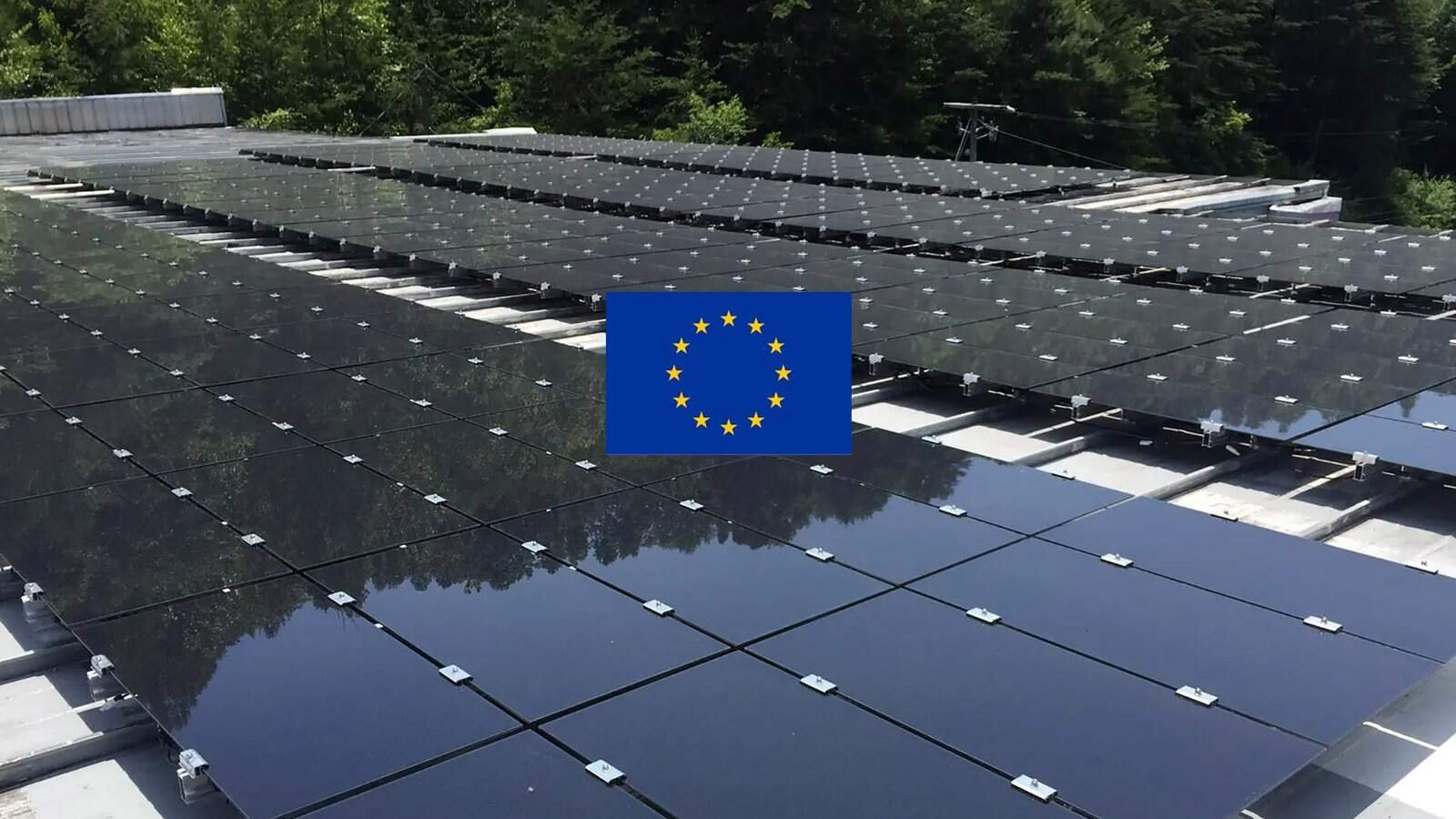
On 4 March 2026, the European Commission formally proposed the Industrial Accelerator Act (IAA) — one of the most significant shifts in EU solar procurement policy in years. If you buy, sell, install, or manufacture solar equipment in Europe, this affects you directly. This analysis is fact-checked against the Commission proposal text (COM(2026) 100) and legal analyses from Mayer Brown, Dechert, Herbert Smith Freehills, Jones Day, and Linklaters.
94–98%
EU solar cells & modules currently from China
~3 Years
Until EU-made solar cell & inverter rules take full effect
20%
EU manufacturing GDP target by 2035
⚡ Five Things You Need to Know
- This is a proposal, not yet law. The IAA was published 4 March 2026 and still needs EU Parliament and Council approval. Enforcement is realistic at 2029–2031 at the earliest. WTO challenge risk means the final text may look quite different.
- Only publicly funded projects are covered. Government procurement, renewable energy auctions, and direct subsidy schemes. Private residential, corporate rooftops, and unsubsidised C&I projects are not affected by origin requirements.
- Solar PV rules are phased and component-specific. From approximately Year 3 after the IAA enters into force (~2030), public-funded solar projects must use EU-made inverters and solar cells. Assembly-only operations will almost certainly not qualify.
- “Made in EU” is broader than the EU itself. EEA countries (Norway, Iceland, Liechtenstein), WTO GPA signatories, and EU FTA partners qualify. The EU–India FTA concluded negotiations in January 2026 — once ratified (earliest: early 2027), Indian-origin solar cells could qualify.
- The window to act is narrower than the enforcement date suggests. Supply agreements, product qualification, and compliance documentation all take 12–24 months to build. Businesses that wait until 2028 will be too late to secure the best EU-qualified partnerships.
📈 What Is the Industrial Accelerator Act — and Why Now?
Europe has been watching its manufacturing base erode for years. In clean technology, the story is stark: between 94% and 98% of the solar cells and modules installed across the EU come from China. Battery supply chains tell a similar story. The EU currently produces less than 20% of its own clean energy equipment.
The Industrial Accelerator Act is the EU’s formal response to that dependency. It is a proposed regulation — part of the broader Clean Industrial Deal — that introduces “Made in EU” requirements for publicly funded clean energy projects. It also restricts large foreign investments in strategic sectors and streamlines industrial permitting through a digital one-stop-shop.
Executive Vice-President Stéphane Séjourné framed the stakes clearly: without action, a growing share of clean technology production will shift away from Europe permanently. The IAA aims to reverse that trend — not by banning imports outright, but by reshaping the rules around public money.
⚠️ Legislative Status — Read Before Sharing
The IAA is a Commission proposal, not yet law. The European Parliament and EU Council must still negotiate, amend, and approve it. A realistic enforcement window is 2029–2031 at the earliest. France is pushing for strict EU-only rules; Germany favours a broader “Made with EU” model including trusted partners. Multiple legal analysts also flag elevated WTO challenge risk — the final scope of the solar provisions remains genuinely uncertain.
📌 The Core Rules: What “Made in EU” Actually Requires
The IAA does not ban Chinese solar products. It does something more targeted: it ties access to public money — government procurement, renewable energy auctions, and public support schemes — to local-origin requirements for key components.
“Made in EU” is not limited to EU member states. It extends to EEA countries (Norway, Iceland, Liechtenstein) and to countries with a free trade agreement or that are signatories to the WTO Agreement on Government Procurement. The EU and India concluded FTA negotiations on 27 January 2026 — once ratified (earliest: early 2027), Indian-origin solar cells could qualify as “Made in EU” equivalent. The UK is also a likely candidate for equivalent-partner status via delegated act — though this is not confirmed in the current draft.

⚡ Solar Photovoltaic: Phased Requirements
Solar PV requirements are component-specific and phased. Dates below assume the IAA enters into force in 2027; actual dates depend on the legislative process.
| Milestone | Approx. Year | Requirement | Source |
|---|---|---|---|
| Year 1 | ~2028 | EU-made inverter plus at least two other main specific components manufactured in the EU | Mayer Brown — Article 34 reading (pending legislative confirmation) |
| Year 3 | ~2030 | Projects awarded through public procurement and auctions must use EU-manufactured solar inverters and solar cells | SolarPower Europe; pv-magazine |
Estimated dates assume IAA enters into force in 2027. If adoption slips, milestones shift accordingly. Assembly-only operations in the EU will likely not qualify — the rules focus on where cells are manufactured, not where modules are assembled.
🔋 Battery Energy Storage Systems: Stricter and Earlier
| Milestone | Approx. Year | Requirement |
|---|---|---|
| Year 1 | ~2028 | Entire BESS must be assembled in the EU. Systems >1 MWh must include an EU-made battery management system (BMS). |
| Year 3 | ~2030 | BESS must additionally include EU-manufactured battery cells and at least one additional EU-made key component. |
SolarPower Europe has described the BESS requirements as “stricter than needed” and warned they could hinder urgently needed storage deployment in Europe.
🏢 Foreign Direct Investment: The “4 of 6” Framework
For large foreign investments in strategic sectors, the IAA introduces a conditional approval regime. It applies when a non-EU investor targets sectors where a single non-EU country controls more than 40% of global manufacturing capacity — in practice, primarily targeting Chinese investment in solar PV, batteries, and EVs. Applies to investments exceeding €100 million. Does not apply to investors from FTA partner countries.
One condition is universally mandatory. Investors must then satisfy at least three of the remaining five — four of six total:
- 🔒 Always Required: At least 50% of all employees must be based in the EU.
- Condition A: Foreign ownership limited to 49% — EU partners must hold majority stake.
- Condition B: Mandatory joint venture with an EU partner.
- Condition C: Technology & IP transfer benefiting the EU investment.
- Condition D: At least 1% of annual EU turnover reinvested in EU-based R&D.
- Condition E: At least 30% of inputs sourced locally within the EU.
💡 Why the “4 of 6” structure matters: An investor could satisfy the 50% EU employment condition plus three others — without necessarily accepting the 49% ownership cap or 30% local sourcing requirement. This gives flexibility, but still sets a high bar. Chinese manufacturers evaluating EU manufacturing routes need specialist legal counsel to model the optimal combination of conditions for their structure.
👥 Who Does This Affect? A Breakdown by Business Type
Exposure to the IAA depends heavily on your position in the value chain and the type of projects you serve. The rules are tied to public money — businesses operating entirely in the private market face far less disruption than those competing for government-funded work.
| Business Type | IAA Exposure | Core Implication |
|---|---|---|
| Utility-scale / auction-linked developer | 🔴 High | Public auction projects require EU-made inverters + cells from ~Year 3. Must restructure supply chain now. |
| EPC focused on public tenders | 🔴 High | Tender bids must prove EU-origin compliance. Chinese-origin equipment disqualified for covered projects. |
| Distributor carrying only Chinese brands | 🔴 High | Risks losing access to public-tender customers post-Year 3. Must add EU brands urgently. |
| C&I installer (mixed projects) | 🟠 Medium | Private C&I is unaffected now. Watch for corporate ESG policies voluntarily adopting EU-origin preferences. |
| Residential installer (no public tenders) | 🟢 Low | Mostly exempt. Standard tax credits and net metering are not “public support schemes” under the IAA. |
| Social / public housing contractor | 🔴 High | Public housing retrofits fall under public procurement. IAA rules apply fully when the act takes effect. |
| BIPV manufacturer or installer | 🟢 Low–Medium | European BIPV supply is already largely EU-based. IAA reinforces the status quo rather than disrupting it. |
🔓 The Escape Valve: When Cost or Delay Provides Exemption
The IAA is not an absolute mandate. A derogation clause allows project developers to bypass Made-in-EU requirements in two specific situations:
- Cost overrun: If compliance increases the final product cost by more than 30%, the requirement can be waived.
- Significant delay: If compliance would cause a project delay exceeding seven months, the requirement is presumed disproportionate and can be waived.
This escape valve matters. In 2026, EU-manufactured battery cells remain substantially more expensive than Chinese equivalents — and the 30% cost threshold may, in practice, be crossed on many BESS projects. The procurement rules could be neutralised precisely in the years when they are supposed to be building demand for EU manufacturing. Industry observers have flagged this as a potential structural weakness in the IAA’s battery provisions.
⚠️ For EPC bid teams: Document your cost and timeline modelling carefully. If EU-origin compliance would push your bid above the 30% cost threshold, you may have grounds to invoke the derogation — and still be eligible for public support. This requires legal and procurement expertise to navigate consistently across 27 member states.
🏠 Residential and Private Projects: Different Rules, Different Timelines
The IAA is tied to public money. Private residential installations, corporate rooftops funded privately, merchant solar farms, and private PPAs are not required to use EU-made components. For most residential installers, day-to-day sourcing decisions remain unchanged.
1. National Subsidy Programmes May Add Origin Rules
Not all government support for residential solar triggers IAA requirements. Generic tax credits, property tax exemptions, and net metering programmes are unlikely to qualify as “public support schemes.” But direct grant programmes are more exposed. Italy offers a telling early example: its 2026 Budget Law introduced an iperammortamento (hyper-depreciation) scheme that theoretically favoured EU-origin modules — but structured the criteria so strictly that virtually no current manufacturer qualifies for the highest-tier benefit. The lesson: national implementation of origin preferences is not always straightforward — and may exclude EU manufacturers as often as it favours them.
2. The EPBD Solar Standard: Mandatory Solar for Buildings
A separate but related development: the revised Energy Performance of Buildings Directive (EPBD) entered into force in May 2024 and must be transposed into national law by May 2026. It includes a mandatory solar installation standard staggered by building category:
| Deadline | Building Type | Requirement |
|---|---|---|
| 31 Dec 2026 | New public and non-residential buildings >250m² | Solar mandatory where technically & economically suitable |
| 31 Dec 2027 | Existing public buildings >2,000m² and non-residential >500m² undergoing major renovation | Solar installation required |
| 31 Dec 2028 | Existing public buildings >750m² | Solar mandatory where suitable |
| 31 Dec 2029 | All new residential buildings | Solar mandatory; all new builds must be solar-ready by design |
| 31 Dec 2031 | Remaining existing public buildings >250m² | Solar mandatory where suitable |
Source: European Commission — Solar Energy in Buildings (EPBD Article 10). All deadlines subject to the “technically, economically, and functionally feasible” qualification. Member States may transpose earlier or add national conditions.
The EPBD’s solar mandate is not an origin rule — it does not specify where panels must be manufactured. But it creates substantial structural demand for rooftop and building-integrated solar. SolarPower Europe projects the EPBD Solar Rooftop Standard could drive 150–200 GW of additional installations between 2026 and 2030 — though this is the industry lobby’s own modelling; independent consensus estimates have not yet been published.

3. Social Housing Is Fully Covered
If a city council or public housing authority retrofits residential buildings using public procurement or EU funds, those projects fall squarely under IAA rules. Social housing projects are public procurement — the residential nature of the end use does not exempt them.
🌃 BIPV and the Dual-Framework Opportunity
Building-integrated solar — roof tiles, façade panels, glass-laminate modules — sits at an unusual intersection of the IAA and EPBD frameworks. Unlike standard PV modules, European BIPV supply has historically been more domestically sourced; the segment was never as dependent on Chinese supply chains as commodity modules. The EPBD’s staggered solar mandate creates sustained demand for architecturally integrated solar solutions from 2026 through to residential new builds by 2029 — opening early conversations between BIPV suppliers and the construction value chain well before IAA enforcement dates arrive.
🇨🇳 What This Means for Chinese Solar Manufacturers in Europe
Chinese solar manufacturers hold a dominant position in the EU today — 94% to 98% of modules and cells come from China. The IAA does not erase that position. It changes the conditions under which it can be maintained and the segments of the market that remain accessible.
The subsidised, auction-linked segment will gradually require EU-origin components. That includes most utility-scale renewable energy development in Germany, France, Spain, and Poland. Without EU manufacturing or assembly, Chinese brands will be excluded from those tenders when the rules take effect. Outside that segment, Chinese brands remain competitive — private C&I and residential projects still reward efficiency, reliability, and delivery speed.
The EU Manufacturing Route
Some leading Chinese manufacturers are already exploring European assembly. The IAA’s FDI framework makes this structurally demanding — the universal 50% EU employment condition is significant for any large operation, and satisfying four of the remaining five conditions requires careful legal structuring. Eastern Europe offers real opportunities: available industrial land, lower labour costs, EU structural fund support, and proximity to key markets. The critical question is whether EU-assembled products will qualify under the rules of origin framework — for solar PV, the focus is on where cells are manufactured, not merely where the module is assembled.
The India Variable
The EU and India concluded FTA negotiations on 27 January 2026 — once formally signed and ratified (earliest: early 2027), this could treat Indian-origin solar cells as “Made in EU” equivalent under the IAA. Chinese manufacturers with production relationships in India may find a more accessible compliance path — but only once the FTA formally enters into force. That remains pending legal vetting and parliamentary ratification on both sides.
Markets Beyond Europe
Geographic diversification remains a sound parallel strategy. Latin America, MENA, Southeast Asia, and Africa offer strong demand growth with lower regulatory friction. A business that depends heavily on EU-subsidised projects should be actively rebalancing its export portfolio — not just restructuring its EU supply chain.
📄 Tendering Gets More Complex — Here’s What to Prepare
For EPCs and project developers participating in European renewable auctions, the IAA adds substantive new layers to an already demanding process. Procurement specifications will increasingly require:
- Certificates of origin for solar cells, inverters, and battery management systems
- Environmental Product Declarations (EPDs) and lifecycle assessment data for carbon footprint scoring in PV tenders
- Supply chain traceability documentation showing component origin at cell, inverter, and BMS level
- Labour compliance records — EU forced labour regulations interact with origin requirements
- Cost justification records if invoking the derogation clause (30% cost threshold or 7-month delay)
Implementation will vary across 27 member states. Some will be strict (France); others more open (Germany). Expect fragmented implementation, at least initially. Budget for documentation, legal counsel, and supply chain auditing — this administrative burden accumulates before the rules are even enforceable, as tenders start asking for origin documentation earlier.
⏰ What Smart Businesses Are Doing Right Now
The IAA will not be enforceable until 2029–2031 at the earliest. But the window to adapt is meaningfully narrower than that. Supply agreements take time to negotiate. Product qualification takes time. Compliance documentation systems take time to build. Businesses that wait until 2028 will be competing for scarce EU-manufactured supply against competitors who locked in relationships years earlier.
🔑 Core Strategic Principle
The most resilient posture is a deliberate dual-track supply strategy: EU-origin products for public and subsidised projects; cost-competitive products for private and residential work. Running both tracks simultaneously requires planning — but it is the only approach that keeps all market segments open. Neither track alone is sufficient for a business with mixed project types.
For Distributors and Wholesalers
The core task is supplier diversification. Carrying only Chinese brands means accepting that a growing share of project types will become inaccessible. Adding EU brands — even in limited initial volume — opens access to public-tender customers and to early-adopter corporate buyers already requesting origin information for ESG reporting. EU manufacturers are actively looking for established distribution partners. Engage now, while the terms of those partnerships are still negotiable.
For EPCs and Developers
Map your pipeline. What share of your projects over the next five years involves public procurement, renewable auctions, or government subsidy schemes? That is your IAA-exposed portfolio. For those projects, begin identifying EU-qualified suppliers now, model the cost impact of sourcing shifts, and investigate whether the derogation clause applies. Build documentation capability early — tender prequalification requirements are already tightening.
For Installers
Segment deliberately. Residential and private C&I customers are largely unaffected — do not let IAA concern disrupt a functioning sourcing model for those projects. Social housing, public buildings, and any work linked to government subsidies require a different approach. Know which bucket each project falls into before you specify equipment. Use the “Made in EU” story as a premium positioning tool for ESG-focused corporate clients — it is a genuine differentiator that some buyers are already actively requesting.
For Chinese Manufacturers Serving Europe
The pure export model faces structural pressure in the subsidised segment. Response options are not mutually exclusive: EU assembly or JV partnerships for accessing covered projects; aggressive positioning in non-subsidised segments using technology differentiation; and active monitoring of the India FTA angle — which, once the agreement enters into force, could create a more accessible compliance route. Advanced products — high-efficiency cells, dual-glass, integrated BESS — support premium positioning that is less exposed to origin-based exclusion in the private market.
📋 The Longer View: How the European Solar Market Restructures
The IAA is a deliberate bet by European policymakers. The argument is that the long-term strategic cost of supply chain concentration outweighs the short-term cost of local-content requirements. Whether the bet is economically sound is genuinely contested. What is not contested is the direction.
Over the next five years, expect the market to bifurcate along a clear line:
- A compliance-premium tier — public projects, subsidised installations, ESG-driven procurement — operating with EU-origin components, complex documentation, and higher landed costs.
- A volume tier — private, residential, and unsubsidised C&I — continuing to reward efficiency, cost competitiveness, and fast delivery.
Consolidation is the likely structural outcome. Managing two supply chains, two compliance frameworks, and two pricing models simultaneously requires scale, capital, and operational sophistication. Smaller installers and distributors that cannot absorb that complexity will be acquired, exit specific segments, or increasingly specialise in one tier or the other.
There is one more variable that industry observers are watching closely but which rarely reaches trade press: WTO dispute risk. Legal analysts including Mayer Brown and Herbert Smith Freehills note that the IAA’s solar PV local-content rules face elevated risk of WTO challenge. The WTO Appellate Body has previously ruled that comparable local-content schemes in renewable energy were discriminatory. The Commission’s own impact assessment acknowledges this litigation exposure. If a WTO challenge succeeds, the IAA’s solar provisions could be significantly amended or unwound — adding another layer of long-term uncertainty to decisions being made today.
The most dangerous thing any solar business can do right now is wait for certainty. The businesses best positioned in 2030 will be the ones that began adapting their supply relationships, compliance capabilities, and customer positioning in 2026 — while competitors were still waiting for the final text.
Navigating the EU Solar Transition?
Couleenergy specialises in advanced solar technology — including HPBC back-contact panels, dual-glass modules, flexible ETFE panels, and BIPV solutions — for European and global markets. If you are rethinking your supplier mix, project strategy, or EU market positioning in light of the IAA, we are ready to talk.


 English
  Español
  Français
  Deutsch
  Русский
  العربية