

An Installer-Focused Industry Analysis for Premium Residential Rooftop Applications
📋 Executive Summary
This report examines back-contact (BC) dual-glass solar panel technology for Norwegian residential solar installers. Back-contact panels represent a premium solution that addresses seven critical pain points in Norwegian installations: partial shading from trees and roof elements, glare complaints, aesthetic restrictions in historic areas, hot-spot failures, limited roof space, poor low-light winter performance, and accelerated degradation in coastal conditions.
👥 Who This Report Is For
- Solar installers seeking to differentiate in the premium residential segment and avoid commodity pricing pressure
- Business planners evaluating Norwegian market opportunities and technology positioning for 2026-2030
- Technical procurement managers requiring detailed quality verification criteria for BC panel suppliers
- Heritage building specialists needing aesthetic-approved solar solutions for historic districts in Oslo, Bergen, and Trondheim
🔑 Key Findings
📊 Norwegian Residential Solar Market:
- Current capacity: 763 MW cumulative by mid-2025 across 28,000+ installations
- Rooftop potential: 30 TWh annually (20% of Norway’s electricity demand)
- Urban opportunity: Oslo rooftops could generate 8.2 TWh (14% of city consumption)
- Government support: NOK 7,500 + NOK 2,000/kW subsidies (up to 20 kW systems)
- 2030 target: 8 TWh annual solar production
🎯 BC Technology Advantages:
- Cell efficiency: 25.4-27.8% (laboratory records)
- Module efficiency: 20-25.2% for commercial products (lower than cell due to CTM losses)
- Shade tolerance: BC panels lose 15-30% output in partial shade vs 30-60% for standard panels
- Glare reduction: 70% less reflectivity (1.7% vs 4-8%)
- Thermal performance: Temperatures 15-25°C cooler in shaded areas, 60°C lower hot-spots
- Space efficiency: 12-15% fewer panels needed vs standard efficiency
- Low-light performance: 10-15% higher winter output in diffuse light conditions
- Degradation rate: BC dual-glass: 1% first year, 0.35% annually years 2-30 vs standard: 2% first year, 0.55% annually years 2-30
🏗️ Manufacturing Quality Foundation:
- Screen-printed glass: Permanent black aesthetic (not polymer film that fades)
- POE encapsulation: 5-7× better moisture protection than EVA, zero acetic acid corrosion
- Butyl edge sealing: Remains flexible from -40°C to +120°C
- Symmetric dual-glass: 3.2+3.2mm construction, 5,400 Pa snow load rating
- Combined durability: These four quality components integrate to guarantee over 30 years of reliable operation
💡 Market Positioning:
- Early adopter advantage: BC costs declining toward parity by 2028-2030
- Premium positioning: Quality-controlled BC for heritage buildings and complex roofs
- Differentiation opportunity: Manufacturing expertise commodity suppliers cannot match
⚡ Key Takeaway for Installers: BC dual-glass panels command premium pricing in Norwegian heritage districts, tree-shaded properties, and glare-sensitive locations where standard panels fail approval or underperform. With 30 TWh rooftop potential and NOK 9,500-47,500 government subsidies per installation, the premium residential segment offers substantial margins for installers who master BC quality verification and positioning.
📈 Norwegian Residential Solar Market Overview
Current Market Status
Norway’s residential solar market has experienced significant growth despite the country’s northern latitude. By mid-2025, Norway reached 763 MW of cumulative solar capacity distributed across more than 28,000 installations, with residential rooftop systems comprising a significant portion.
📊 Recent Installation Trends
| Year | New Capacity | Notes |
|---|---|---|
| 2022 | 150 MW | Strong growth year |
| 2023 | 306 MW | Record year for deployment |
| 2024 | 149 MW | Normalization after subsidy changes |
| H1 2025 | 49 MW | Market adjustment period |
Source: Norwegian Water Resources and Energy Directorate (NVE) via PV Magazine
🏘️ Rooftop Solar Potential
Research from the Norwegian Meteorological Institute and Institute of Energy Technology (IFE) reveals substantial untapped potential for residential solar installations:
- Total rooftop potential: 30 TWh annually (equivalent to 20% of Norway’s current electricity demand)
- Technical capacity: 31 GW could be installed on existing building roofs and walls
- Grid integration: Up to 36% of this potential could be integrated into the national power system
🌍 Regional Opportunities
The best conditions for rooftop solar were identified in coastal areas and southern Norway:
- ✅ Oslo: 8.2 TWh potential (14% of city electricity consumption)
- ✅ Fredrikstad: 1.1 TWh potential (24% of city consumption)
- ✅ Tønsberg: 0.7 TWh potential (26% of city consumption)
- ✅ Outer Oslofjord: Excellent solar radiation and high population density
- ✅ Sørland coast: Strong solar potential in southern coastal regions
IFE research found that rooftop solar in Oslo produces energy comparable to installations in Berlin, Germany—demonstrating that Norwegian solar conditions are more favorable than commonly perceived.
💰 Government Support & Incentives
Norway’s clean energy agency Enova provides substantial support for residential solar installations:
- Base subsidy: NOK 7,500 per installation
- Capacity subsidy: NOK 2,000 per kW installed (increased from NOK 1,250)
- Maximum system size: 20 kW eligible for subsidies (increased from 15 kW)
- Government mandate: All new government buildings require solar installation from 2024
- Energy sharing: New regulations (effective 2026) allow surplus power sharing up to 5 MW in industrial areas
🎯 Market Challenges & Installer Opportunities
Norwegian residential solar faces unique challenges that create opportunities for specialized installers:
⛅ Climate Challenges
- Frequent partial shading from trees, chimneys, dormers
- Heavy snow loads requiring 5,400+ Pa rated panels
- Low sun angles in winter causing neighbor glare complaints
- Coastal humidity requiring superior moisture protection
🏛️ Aesthetic Restrictions
- Historic district regulations in Oslo, Bergen, Trondheim
- Heritage building oversight from Norwegian Directorate for Cultural Heritage
- Municipal planning departments requiring aesthetic integration
- Neighbor approval processes in dense urban areas
🏗️ Installation Constraints
- Limited roof space on compact urban properties
- Steep roof pitches reducing usable area
- Complex roof layouts with multiple orientations
- Weight restrictions on older buildings
These challenges create demand for premium solar solutions that maximize performance in difficult conditions—precisely where BC dual-glass panels excel.
🔬 Understanding BC (Back-Contact) Solar Technology
What Makes BC Different?
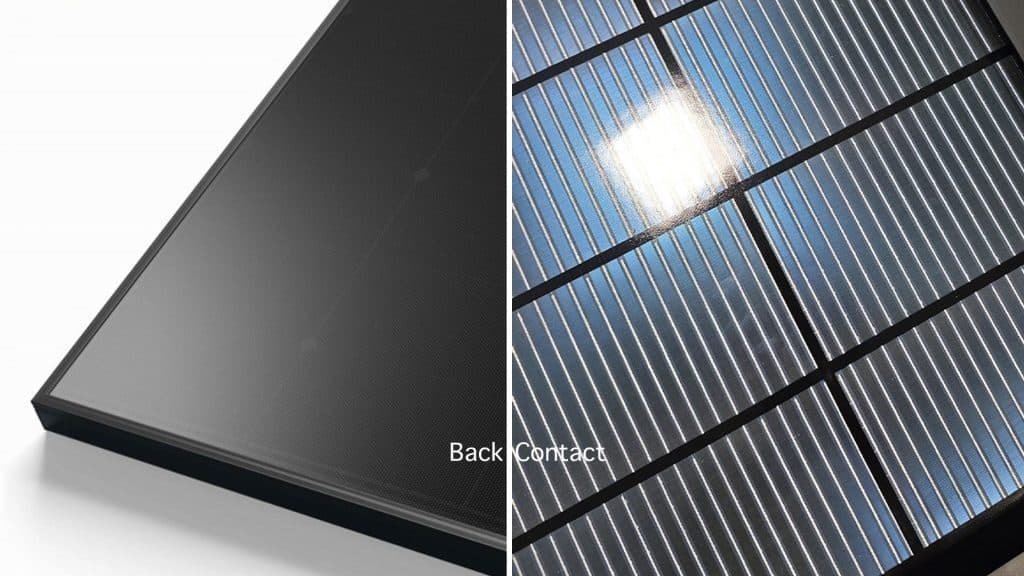
Back-contact solar cells place both positive and negative electrical contacts on the rear of the cell in an interdigitated (finger-like) pattern. This fundamental design change eliminates the front-side metal grid lines found on standard solar panels.
Key architectural advantage: The entire front surface captures sunlight without any shadowing from metal contacts, while the rear-side interdigitated contacts collect current through multiple pathways rather than a single series connection.
Technical reference: Interdigitated Back Contact Technology as Final Evolution for Industrial Crystalline Single-Junction Silicon Solar Cell (MDPI Solar Journal, 2023)
⚡ Cell Efficiency vs Module Efficiency
Important distinction: Solar cell efficiency and module efficiency are different metrics that residential installers must understand when evaluating panel specifications. Module efficiency is always 1.5-3% lower than cell efficiency due to Cell-to-Module (CTM) losses.
🔬 BC Cell Efficiency (Laboratory & Mass Production)
- Laboratory records: 27.81% efficiency achieved
- LONGi HPBC: 27.81% (world record, certified)
- Aiko ABC: 27.0% (certified record)
- Mass production cells: 25-26.2% cell efficiency commercially available
- Premium BC cells: 25.6-26.2% (current production)
- Standard BC cells: 25.0-25.6% (current production)
📐 Module Efficiency (Real Commercial Products)
Module efficiency is always lower than cell efficiency due to Cell-to-Module (CTM) losses that occur during manufacturing and assembly. Understanding CTM losses is critical for setting realistic customer expectations.
Current BC Module Performance:
- Module world record: 25.2% (Aiko ABC commercial module, mid-2024)
- Current commercial modules: 24.4-24.8% (mass production, December 2025)
- Typical CTM loss: 1.5-2.5% (from cell to module)
What Causes CTM Losses?
When individual cells are assembled into modules, efficiency drops due to:
- Optical losses (2-4%): Front glass reflection, encapsulant absorption, multiple interface reflections
- Electrical resistance (1-2%): Interconnection ribbons, solder joints, series resistance (I²R losses)
- Cell mismatch (1-2%): No two cells are identical; weakest cell limits string current
- Mechanical stress (0.5-1%): Micro-cracks from soldering, lamination pressure, thermal cycling
- Temperature effects (0.5-1%): Encapsulation traps heat; operating temps 50-70°C vs 25°C lab conditions
- Inactive area (0.5-1%): Gaps between cells, frame borders, junction boxes don’t generate power
- Encapsulation losses (0.3-0.5%): EVA/POE light absorption, material degradation over time
Premium manufacturers like Aiko and LONGi achieve CTM ratios of 97-98%, meaning only 2-3% loss from cell to module—industry-leading performance.
📊 Real-World Example: Tile-Sized BC Module (All-Black)
Here’s how to calculate actual module efficiency from specifications:
- Dimensions: 1200mm × 600 mm = 0.72 m²
- Rated power: 140W
- Module efficiency: 140W ÷ 0.723 m² = 194.4 W/m² = 19.4%
- Cell efficiency: 25.6% (individual cells before assembly)
- CTM loss: 5.4 percentage points (25.6% – 19.4%)
- CTM ratio: 75.9% (19.4% ÷ 25.6%)
Why the larger loss? Tile-sized modules with all-black aesthetic have additional losses:
- Black screen-printed glass absorbs ~0.5-1% more light than clear glass
- Frameless design with black edge sealing prioritizes seamless aesthetic appearance
- Smaller module size means higher proportion of inactive edge area
- Custom dimensions may have less optimized cell layout
This is normal and expected for aesthetic-priority products. The key is that all-black BC modules still deliver 19-22% module efficiency—comparable to or better than standard panels—while solving seven critical Norwegian installation challenges.
💡 Key Installer Guidance
Always compare module-to-module efficiency when evaluating manufacturers, never cell efficiency claims. A manufacturer advertising “27% cell efficiency” but delivering 22% module efficiency (5% CTM loss) is inferior to one with “25% cell efficiency” delivering 23% module efficiency (2% CTM loss).
What matters to customers: Module efficiency determines real-world power output and roof space requirements. Cell efficiency is a laboratory metric.
🎯 Seven Critical Pain Points BC Panels Solve
Pain Point #1: Partial Shading Performance
❌ The Standard Panel Problem
Standard solar panels connect cells in series like holiday lights. When one cell is shaded, it restricts current flow through the entire string. Field data shows standard panels can lose 30-60% of output when even small portions are shaded by:
- 🌲 Tree branches and leaves
- 🏠 Roof dormers and chimneys
- ❄️ Snow accumulation on panel edges
- ☁️ Passing cloud shadows
✅ The BC Solution: Superior Shade Tolerance
Back-contact architecture fundamentally changes how shade affects performance. The rear-contact design allows current to flow around shaded cells rather than being blocked by them.
Real-world testing shows BC panels can maintain significantly higher output under partial shade. Industry studies document BC panels losing 15-30% of output in partial shade while standard panels can lose 30-60% under similar conditions—a meaningful performance advantage that varies by specific shading patterns.
Norwegian application: Morning tree shadows, dormer shading, snow sliding patterns
Pain Point #2: Glare Complaints
❌ The Standard Panel Problem
Standard solar panels reflect 4-8% of incident light. In Norwegian winter with low sun angles (15-20° in December), this creates intense glare that triggers:
- 👥 Neighbor complaints and conflicts
- 🚫 Planning authority objections
- ⏱️ Installation delays during approval processes
- 💰 Expensive mitigation requirements
✅ The BC Solution: Ultra-Low Reflectivity
BC panels with anti-reflective coatings and no front-side metallization reflect only 1.7% of incident light—a 70% reduction compared to standard 4-8% reflectivity.
| Panel Type | Reflectivity | Winter Glare Risk |
|---|---|---|
| Standard panels | 4-8% | High (neighbor complaints common) |
| BC low-glare | 1.7% | Minimal (70% glare reduction) |
Norwegian application: Dense urban neighborhoods, properties with south-facing roofs near neighbors
Technical reference: LONGi Hi-MO X6 Anti-Glare Technology
Pain Point #3: Aesthetic Rejection
❌ The Standard Panel Problem
Standard panels have visible front-side features that create an industrial appearance:
- Silver busbars creating grid patterns
- Visible cell borders and gaps
- Reflective metal frames
- Inconsistent color across panel surface
Heritage boards and municipal planners frequently reject standard installations in historic districts including Oslo’s Gamle Oslo, Bergen’s Bryggen area, and Trondheim’s city center.
✅ The BC Solution: Pure Black Aesthetic
BC panels naturally have no visible grid lines or busbars. Combined with screen-printed black glass and black frames, they create a seamless, pure-black surface that disappears into roof architecture.
The difference is striking:
- ❌ Standard panel: Industrial look with visible wiring and frames
- ✅ BC all-black: Monolithic black surface like slate or dark metal roofing
- ✅ Heritage approval: BC panels receive significantly higher approval rates from heritage boards and municipal planners
- ✅ Property value: Premium aesthetic commands 2-5% home value increase
Norwegian application: Protected buildings, historic districts, premium residential areas
Regulatory reference: Norwegian Directorate for Cultural Heritage – Solar Energy Guidelines
Pain Point #4: Hot-Spot Failures
❌ The Standard Panel Problem
When standard panels experience partial shading, shaded cells become reverse-biased and generate heat instead of electricity. Research documents standard PERC panels reaching hot-spot temperatures of 130-170°C under stress conditions.
Consequences include:
- 🔥 Fire risk in extreme cases
- ⚡ Accelerated panel degradation
- 📞 Warranty callbacks and customer complaints
- 💰 Reputation damage for installers
✅ The BC Solution: Anti-Hot-Spot Design
Back-contact architecture dramatically reduces hot-spot formation through better current distribution. When a cell experiences stress, current redistributes across rear contacts rather than concentrating heat.
The thermal benefits are measurable:
- ✅ Temperature distribution: More uniform across panel surface
- ✅ Hot-spot reduction: Studies show BC panels maintain temperatures 15-25°C cooler in shaded areas, with hot-spot temperatures averaging 60°C lower than conventional technologies
- ✅ Safety margin: Reduced fire risk and improved long-term reliability
- ✅ Warranty costs: Significantly fewer hot-spot-related callbacks
Norwegian application: Snow accumulation patterns, tree shade, coastal fog conditions
Pain Point #5: Limited Roof Space
❌ The Standard Panel Problem
Norwegian urban homes face severe space constraints:
- Compact lot sizes in Oslo, Bergen, Trondheim
- Steep roof pitches reducing usable area
- Heritage restrictions limiting installation zones
- Complex layouts with dormers and chimneys
Standard 19-21% efficiency panels require more panels to reach target capacity, often exceeding available space.
✅ The BC Solution: Maximum Conversion Efficiency
BC module efficiency of 20-25.2% (compared to 19-22% for standard panels) means 12-15% fewer panels needed for the same system capacity.
Real-world example:
| Roof Area | Standard Panels (20%) | BC Panels (22%) | Advantage |
|---|---|---|---|
| 25 m² | 5.0 kW capacity | 5.5 kW capacity | +10% capacity |
| 35 m² | 7.0 kW capacity | 7.7 kW capacity | +10% capacity |
| 50 m² | 10.0 kW capacity | 11.0 kW capacity | +10% capacity |
Norwegian application: Constrained urban roofs, maximizing subsidy value (20 kW cap)
Pain Point #6: Poor Low-Light Performance
❌ The Standard Panel Problem
Norwegian winters bring unique challenges that devastate standard panel performance:
- ☁️ Frequent overcast conditions: Diffuse light dominates coastal areas October-March
- ❄️ Short daylight hours: Oslo receives only 6 hours daylight in December
- 🌅 Low sun angles: Winter sun reaches only 10-15° elevation at noon
- 🌫️ Coastal fog: Reduces direct beam radiation by 40-60%
Standard panels with front-side metallization lose significant efficiency in diffuse light conditions. The metal grid lines that block 5-7% of direct sunlight have an even greater impact when light arrives from multiple angles during overcast conditions.
✅ The BC Solution: Superior Low-Light Harvesting
BC panels excel precisely in Norwegian winter conditions due to their gridless front surface:
- ✅ No front metallization losses: 100% of front surface captures diffuse light
- ✅ Omnidirectional light capture: Back-contact design collects light from all angles equally
- ✅ Low-angle optimization: Performs better at 10-30° sun angles typical of Norwegian winter
- ✅ Reduced temperature coefficient impact: Cold winter temps actually boost BC panel efficiency above rated output
Real-world winter advantage: During November-February when electricity demand peaks for heating, BC panels maintain 10-15% higher output than standard panels in identical diffuse light conditions. This advantage stems from the elimination of front-side metallization losses (5-7% direct benefit) which amplify under omnidirectional Nordic winter lighting conditions—precisely when Norwegian households need power most.
Norwegian application: Coastal installations, winter heating season optimization, year-round energy security
Pain Point #7: Degradation and Reliability Concerns
❌ The Standard Panel Problem
Norwegian climate creates accelerated degradation challenges for standard panels:
- 💧 Coastal humidity: Moisture ingress corrodes front-side metallization
- 🌡️ Thermal cycling: -20°C to +30°C annual range stresses solder joints
- ❄️ Freeze-thaw cycles: 40-80 cycles annually in southern Norway
- 🧊 Snow loading stress: Repeated 5,400+ Pa loads bend standard backsheet panels
- 🌊 Salt spray: Coastal areas accelerate frame and contact corrosion
Standard panels with backsheet construction, EVA encapsulation, and front metallization typically degrade 0.5-0.7% annually in Norwegian coastal conditions—losing 12-17% capacity over 25 years.
✅ The BC Solution: Superior Long-Term Reliability
BC dual-glass construction with quality components delivers industry-leading durability:
- ✅ Dual-glass structure: No backsheet to delaminate, crack, or allow moisture ingress
- ✅ Symmetric construction: Thermal expansion matched on both sides eliminates warping
- ✅ Protected rear contacts: All metallization sealed between glass layers, immune to environmental exposure
- ✅ POE encapsulation: Zero corrosive byproducts, 5-7× better moisture barrier than EVA
- ✅ Reduced degradation: BC dual-glass: 1% first year, 0.35% annually years 2-30 vs standard: 2% first year, 0.55% annually years 2-30
Note: Customized small-sized modules (tile formats) may experience slightly higher degradation rates due to higher edge-area-to-surface ratio, but still significantly outperform standard panels.
30-Year Output Comparison:
- Standard panel: Year 1: 98%, Years 2-30: declining to ~83.5% remaining = Significant long-term capacity loss
- BC dual-glass: Year 1: 99%, Years 2-30: declining to ~89.5% remaining = Superior capacity retention
- End-of-life advantage: ~6 percentage points higher capacity after 30 years, translating to measurably more cumulative lifetime energy production
Norwegian application: Maximizing 30-year return on investment, reducing maintenance costs, ensuring reliable winter performance for decades

🏗️ Manufacturing Quality Control: The 30-Year Foundation
For BC dual-glass panels to deliver their performance advantages over decades in Norwegian coastal humidity and temperature cycling, four manufacturing quality components must work as an integrated system. When properly combined, these components guarantee over 30 years of reliable operation.
Component 1: Screen-Printed Glass (Not Polymer Film)
Why it matters: The pure-black aesthetic that enables heritage approval must remain black for 30+ years.
- ❌ Polymer films: Fade to gray/brown after 5-8 years from UV exposure
- ✅ Screen-printed ceramic: Ink fused into glass surface, permanent black color
Quality verification: Confirm “screen-printed black glass” specification, not “black backsheet”
Component 2: POE Encapsulation (Not EVA)
Why it matters: BC panels have electrical contacts on the rear that are vulnerable to moisture-induced corrosion.
- ❌ EVA encapsulant: Allows 25-35 g/m²/day moisture, produces acetic acid that corrodes contacts
- ✅ POE encapsulant: Allows only 5-10 g/m²/day moisture (5-7× better), zero corrosive byproducts
Quality verification: Demand “POE encapsulation” in specifications, not generic “premium encapsulant”
EVA vs. POE vs. EPE: The Best Encapsulant for HPBC Solar Cells
Component 3: Butyl Edge Sealing (Not Adhesive Tape)
Why it matters: Frameless dual-glass panels rely entirely on edge sealing to prevent moisture ingress.
- ❌ Basic adhesive tape: Becomes brittle below -10°C, fails after 8-12 years
- ✅ Butyl rubber sealing: Remains flexible from -40°C to +120°C, proven 60+ year field performance
Quality verification: Confirm “butyl edge seal” specification for frameless construction
Component 4: Symmetric Dual-Glass Construction
Why it matters: Norwegian building codes require panels to withstand heavy snow loads (up to 5,000 Pa in some regions).
- ✅ 3.2+3.2mm tempered glass: Symmetric construction eliminates thermal stress
- ✅ 5,400 Pa load rating: Exceeds Norwegian snow load requirements
- ✅ Thermal cycling resistance: Glass expands/contracts uniformly, no warping
- ✅ Impact resistance: Dual-layer protection against hail and debris
Quality verification: Confirm “3.2+3.2mm symmetric dual-glass” and “≥5,400 Pa front load rating”
🔗 The Integrated Quality System
Critical point: These four components work as an integrated system. Removing any single component compromises the entire 30-year durability guarantee:
- Screen-printed glass without POE → Corrosion destroys BC contacts despite permanent color
- POE without butyl sealing → Moisture enters through edges, overwhelming POE protection
- Butyl sealing without symmetric glass → Thermal stress breaks glass, exposing edges
- Symmetric glass without screen-printing → Aesthetic fading defeats heritage approval advantage
When all four quality components integrate properly, BC dual-glass panels deliver over 30 years of reliable operation in Norwegian coastal conditions.
📐 Tile-Like Dimensions: Space Optimization
BC panels can be custom-manufactured in tile-like dimensions that optimize space utilization on complex Norwegian roofs.
📏 Common Tile Specifications (Custom Available)
- Dimensions: 1200×600 mm formats
- Weight: 12-13 kg (one-person handling)
- Power output: ~140W per panel (varies by cell efficiency)
- Module efficiency: 20-22% (calculated from dimensions and power)
- Thickness: 8mm total (3.2+3.2mm glass + cells + encapsulant)
✅ Space Optimization Benefits
- 🏘️ Dense layouts: Smaller panels fit around dormers, chimneys, roof penetrations
- ⚖️ One-person installation: 12-13 kg weight eliminates crane requirements
- 🏠 Complex roofs: Multiple orientations and angles accommodated
- 💰 Reduced waste: Custom cutting minimizes material loss
📝 Conclusion
BC dual-glass solar panels represent a premium solution specifically suited to Norwegian residential solar challenges. The technology delivers measurable advantages in seven critical areas where standard panels struggle:
- ✅ Superior shade tolerance – BC panels lose 15-30% output in partial shade vs 30-60% for standard panels
- ✅ Ultra-low glare – 70% less reflectivity eliminates neighbor complaints and permitting issues
- ✅ Pure black aesthetics – Significantly higher heritage board approval compared to standard panels
- ✅ Anti-hot-spot protection – Temperatures 15-25°C cooler in shaded areas, 60°C lower hot-spots reduce thermal failures
- ✅ Maximum efficiency – 12-15% fewer panels needed for same system capacity
- ✅ Superior winter performance – 10-15% higher output in Norwegian diffuse light conditions when heating demand peaks
- ✅ Long-term reliability – Superior degradation profile (1% year 1, 0.35% years 2-30) maintains ~6 percentage points higher capacity after 30 years
The manufacturing quality foundation—screen-printed glass, POE encapsulation, butyl sealing, and symmetric dual-glass construction—must integrate properly to deliver over 30 years of reliable Norwegian performance.
With Norway’s rooftop solar potential at 30 TWh (20% of electricity demand) and government subsidies supporting residential installations up to 20 kW, the market opportunity is substantial. Installers who position themselves as BC quality verification specialists will capture the premium segment: heritage buildings, complex roofs, tree-shaded properties, and aesthetic-restricted urban locations.
The timing is optimal. BC costs are declining toward parity with standard technologies by 2028-2030, creating a window for early adopters to establish expertise before BC becomes mainstream.
📞 Get Quality-Controlled BC Dual-Glass Panels
Couleenergy specializes in custom BC dual-glass panel manufacturing with verified quality components for residential installations.
✉️ Email: inquiries@couleenergy.com
📞 Phone: +1 737 702 0119



 English
  Español
  Français
  Deutsch
  Русский
  العربية