

⚠️ Warning: Your solar panels are falling apart from the inside, and you might not even know it.
Picture your solar panel as a carefully made sandwich. The glass “bread” protects the solar cell “filling.” When these layers start separating, that’s delamination – and it’s silently destroying solar systems worldwide.
This invisible problem can slash your energy production by up to 50% in severe cases. It can turn your money-saving investment into a potential safety hazard. Yet most solar owners don’t discover it until significant damage is already done.
Jump to Your 90-Day Action Plan →
What Solar Panel Delamination Really Means (And Why You Should Care)
Delamination happens when the protective layers inside your solar panels pull apart. Think of it like wallpaper peeling off a wall, except it’s happening inside your expensive solar equipment.
Your solar panel contains multiple layers bonded together:
- Protective tempered glass on top
- EVA (ethylene-vinyl acetate)/EPE/POE encapsulant – a clear plastic material
- Solar cells arranged in the middle
- Another EVA/EPE/POE layer beneath the cells
- Protective polymer backsheet on bottom
When these layers separate, moisture and air sneak in. This creates a domino effect of problems that gets worse every single day.
The Real Impact on Your Investment
A typical residential system with moderate delamination loses 15-20% of its capacity. That’s significant money lost in reduced energy production every year. But here’s the kicker – delamination accelerates over time.
| Panel Condition | Annual Degradation Rate | Expected Lifespan |
|---|---|---|
| Healthy PV Panels | 0.3-0.7% | 25-30 years |
| Delaminated PV Panels | 1.5-4% | 10-15 years |
For commercial systems, the losses multiply dramatically. Large installations can experience substantial revenue losses from reduced production, especially when multiple solar panels are affected.
Note: Degradation rates and timelines vary based on climate, panel quality, and installation conditions. Consult local professionals for system-specific assessment.
How to Spot Delamination Before It Ruins Your Investment
Visual Warning Signs You Can Check Today
Walk outside and look at your solar panels. Here’s what delamination looks like:
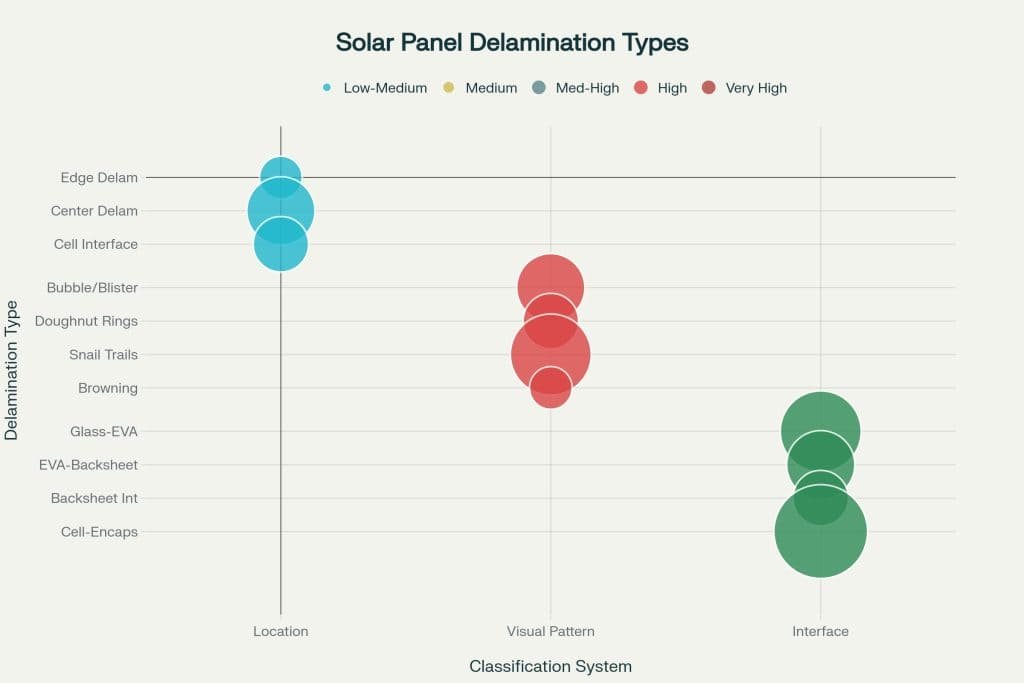
- Bubbles and Blisters: Raised areas or bubbles on the panel surface indicate trapped air or moisture between layers. Small bubbles grow into big problems fast.
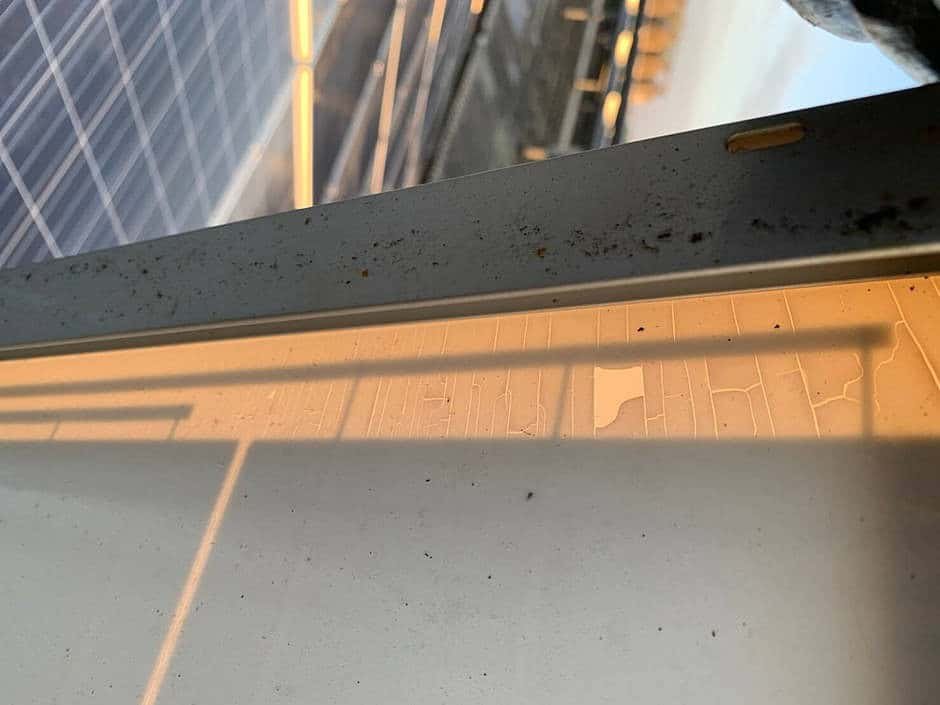
- Edge Separation: Visible lifting or gaps where the solar panel meets its frame. This “gateway” delamination lets moisture creep deeper into your panel.
- Discoloration Patterns: Yellow or brown tinting means the EVA material is breaking down. Healthy solar panels stay crystal clear.
- Snail Trails: Dark, winding streaks across your solar panels aren’t dirt. They’re signs of internal chemical reactions caused by moisture and microcracks.
- Doughnut Rings: Circular patterns around individual cells indicate UV damage. The protective materials are failing.
Performance Clues Your System Gives You
Your monitoring system tells the story before visual signs appear:
- Sudden 5-10% drop in power output
- One solar panel is producing less than its neighbors
- Increased performance drops on humid days
- Hot spots showing up in thermal imaging
- Inverter error messages about string imbalances
💡 Pro Tip: Set monitoring alerts on your specific platform for any 5% performance drop:
- Enphase Enlighten: Settings → Alerts → System Production
- SolarEdge: Admin → Site Alerts → Performance Ratio
- SMA Sunny Portal: Configuration → Event Reports → Yield Monitoring
The 7 Main Culprits Behind Solar Panel Delamination
1. Manufacturing Quality Issues
Poor quality control creates PV panels destined to fail. During lamination, EVA typically needs heating to 135-150°C for 15-30 minutes, depending on the specific formulation and manufacturer specifications. Rush this process, and bonds stay weak.
The critical factor? EVA gel content must reach 70-90% for strong bonds according to industry standards. Lower-quality manufacturers often achieve only 50-60%. These PV panels may delaminate within 5 years instead of lasting 25.
2. Thermal Cycling Stress
Your solar panels experience significant temperature swings. In extreme climates, they can heat to 85°C on summer days and drop to -40°C on winter nights. This constant expansion and contraction weakens layer bonds.
After thousands of these cycles, even quality solar panels develop stress fractures. Poor-quality solar panels fail much faster, especially in regions with dramatic seasonal temperature variations like the northern United States or mountain regions.
3. Moisture: The Silent Destroyer
Water is your solar panels’ worst enemy. Once inside, moisture:
- Corrodes metal components and solder joints
- Weakens adhesive bonds between layers
- Creates conductive paths for electrical shorts
- Accelerates all other degradation processes
PV panels in humid climates (Southeast US, tropical regions, coastal areas) face 3-5 times higher delamination rates than those in arid environments like the Southwest US.
4. UV Radiation Damage
Ironically, sunlight damages solar panels. UV rays break down the encapsulant materials over 10-15 years. The EVA turns yellow, then brown, losing its protective properties.
High-UV environments like deserts, high-altitude locations, and equatorial regions see faster degradation. Without proper UV stabilizers, panels may fail in half their expected lifetime.
5. Installation Mistakes
Even great solar panels fail with poor installation. Common errors include:
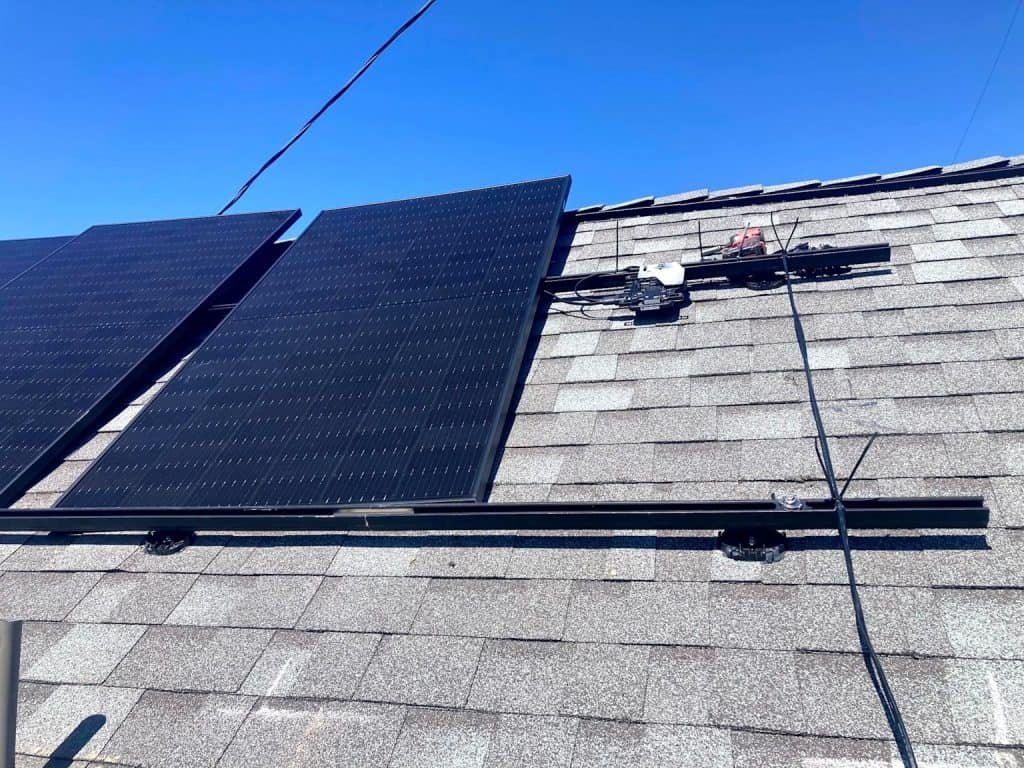
- Over-tightening mounting hardware – creates stress points and microcracks
- Poor edge sealing – allows moisture infiltration
- Inadequate support spacing – causes panel flexing
- Rough handling during installation – creates invisible microcracks
NABCEP-certified installers (North American Board of Certified Energy Practitioners) understand these risks and use proper techniques to prevent them.
6. Chemical Breakdown
As EVA ages, it produces acetic acid (vinegar smell) as a byproduct. This acid gradually corrodes your solar panel from inside, attacking metal connections, weakening polymer bonds, and accelerating all other damage mechanisms.
Once chemical breakdown starts, it can’t be reversed – only slowed with proper maintenance and environmental protection.
7. Mechanical Damage
Physical impacts create weak points:
- Hail damage (even small dents matter)
- Falling branches or debris
- Installation accidents
- Walking on panels during maintenance
These might look minor but become entry points for moisture. A small crack today becomes major delamination within 1-2 years.
Types of Delamination: Know Your Enemy
| Type | Location | Visual Signs | Impact | Action Needed |
|---|---|---|---|---|
| Edge Delamination | Panel perimeter | Visible separation at edges | Gateway for moisture | Monitor closely, seal if minor |
| Center Delamination | Over solar cells | Doughnut rings, discoloration | Immediate 10-20% power loss | Professional assessment urgently |
| Interface Delamination | Between specific layers | Cloudiness, bubbles | Variable impact | Testing required |
| Junction Box Delamination | Box attachment point | Box lifting, gap visible | Electrical hazard | Immediate repair |
Severity Levels Classification
- Cosmetic (0-5% power loss): Minor edge separation, slight discoloration – Monitor quarterly but don’t panic
- Performance-Affecting (5-20% loss): Bubbles, snail trails, center delamination – Time for warranty evaluation and professional assessment
- Critical (>20% loss): Extensive bubbling, hot spots, electrical irregularities – Replace immediately due to safety risks
Proven Prevention Strategies That Actually Work
Before You Buy: Choose Quality or Pay Later
✓ Current Tier 1 Manufacturers (2025):
- Jinko Solar, JA Solar, Trina Solar, LONGi Solar
- Panasonic, Canadian Solar, Qcells, REC Group
- Note: SunPower filed for bankruptcy in 2024 – verify warranty support if considering
- Verify EVA Gel Content: Request certificates showing a minimum of 70% gel content. This single factor predicts delamination risk better than price.
- Essential Certifications: IEC 61215 (durability testing) and IEC 61730 (safety) are mandatory. These mean panels passed tests simulating 25 years of weather.
- Climate-Specific Selection:
- Humid climates: Enhanced moisture barriers, marine-grade aluminum frames
- Desert/high-UV: Advanced UV stabilizers, heat-resistant backsheets
- Cold climates: Flexible encapsulants for thermal cycling
- Technology advances: Consider newer bifacial panels with glass-glass construction – inherently more resistant to delamination
Installation: Do It Right or Do It Twice
Quality edge sealing can prevent approximately 80% of edge delamination cases according to field studies. NABCEP-certified installers understand proper techniques including appropriate sealant selection, correct torque specifications, and thermal expansion allowances.
Critical Installation Requirements:
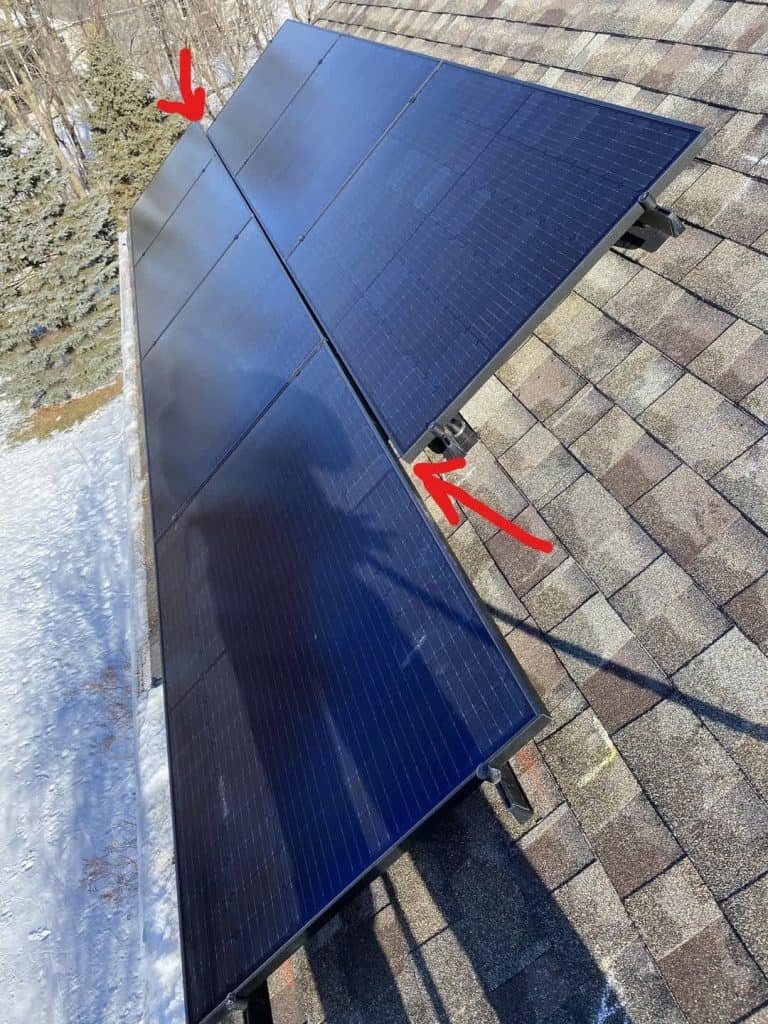
- Proper clearance: Typically 4-6 inches between solar panels and roof (varies by mounting system and local codes)
- Edge sealing: Specialized silicone sealants rated for 25+ years of outdoor exposure
- Mounting pressure: Follow manufacturer torque specifications exactly – over-tightening causes microcracks
- Grounding and bonding: Proper electrical connections prevent corrosion-accelerating electrical issues
Ongoing Protection: Small Steps, Big Rewards
- Monthly Visual Checks (5 minutes): Look for bubbles, discoloration, edge lifting, unusual patterns
- Quarterly Performance Review: Check monitoring data for trends, compare solar panel outputs
- Bi-Annual Cleaning: Use mild soap, soft brushes, deionized water when possible. Never use pressure washers
- Annual Professional Inspection: Include thermal imaging and electrical testing when available
- Post-Storm Assessments: Check after hail, high winds, or extreme weather events
Advanced Detection Methods Worth the Investment
Electroluminescence (EL) Testing
Reveals invisible microcracks and internal delamination before visual symptoms appear. Schedule every 5 years or when unexplained performance drops occur. This technology catches problems years before they become visible.
Infrared Thermography
IR cameras identify hot spots and temperature anomalies indicating delamination or electrical issues. Many professional inspection services include this. Temperature differences of 10°C or more between cells indicate problems.
UV Fluorescence Imaging
Shows EVA degradation patterns under UV light. Particularly effective for detecting early-stage chemical breakdown before performance impacts occur.
I-V Curve Testing
Measures electrical characteristics to identify performance degradation patterns consistent with delamination. Provides quantitative data for warranty claims.
When Delamination Strikes: Your Action Plan
Immediate Steps (First 48 Hours)
- Safety First: If you see exposed wiring or smell burning, shut off the system immediately
- Document Everything: Photograph all angles, record serial numbers, note weather conditions
- Check System Data: Download performance history before and after issue appeared
- Review Documentation: Locate warranty papers, installation records, previous inspection reports
Week 1: Assessment and Contact
- Contact manufacturer first – Many offer free assessment for potential warranty claims
- Notify your installer – Workmanship warranties may cover installation-related delamination
- Check homeowner’s insurance – Some policies cover solar panel damage
- Get professional inspection – Independent assessment strengthens warranty claims
Decision Matrix: Repair vs. Replace
| Consider Repair When: | Consider Replacement When: |
|---|---|
| • Edge delamination only • Less than 10% power loss • Panels under 5 years old • Warranty covers repairs • Isolated to 1-2 panels • No safety concerns | • Power loss exceeds 20% • Safety hazards present • Multiple panels affected • Panels over 15 years old • Repair costs exceed 50% of replacement • Technology significantly outdated |
Cost-Effective Solutions
Temporary Protective Measures:
- Transparent laminating film for minor edge delamination (temporary fix while arranging warranty replacement)
- Silicone sealant for small edge gaps (professional application recommended)
- Protective covers during severe weather if delamination detected
Professional Repair Options:
- Edge resealing: Professional technicians can reseal panel edges if caught early
- Panel restoration: Specialized services for high-value panels outside warranty
- Selective replacement: Replace only critically damaged panels if electrically compatible
The Long-Term Impact: Why Every Day Counts
Delamination doesn’t stay small. Here’s an example progression scenario showing how problems compound:
Typical Delamination Progression (Example):
- Year 1: Minor edge delamination noticed, 5% power loss
- Year 2-3: Moisture spreads inward, 10-15% power loss
- Year 4-5: Center delamination begins, hot spots form, 20-30% loss
- Year 6-7: Multiple panel failure, safety hazards emerge, system replacement needed
Note: This is an illustrative example. Actual progression varies based on climate, panel quality, and maintenance.
Early intervention when problems are minor costs significantly less than waiting until major damage occurs. The key is catching delamination in Year 1, not Year 5.
Your 90-Day Action Plan for Delamination Prevention
📅 Days 1-30: Assessment Phase
- Conduct thorough visual inspection of all panels
- Review last 12 months of performance data
- Document any concerns with detailed photos
- Check warranty terms and coverage periods
- Verify homeowner’s insurance includes solar coverage
- Join online solar owner communities for your panel brand
📅 Days 31-60: Professional Evaluation
- Schedule professional inspection if any issues found
- Request thermal imaging during inspection
- Get written assessment of system condition
- Contact manufacturer about any identified concerns
- Obtain quotes for any recommended repairs
- Research local NABCEP-certified service providers
📅 Days 61-90: Implementation
- Address any immediate safety issues
- Complete recommended repairs or maintenance
- Set up automated monitoring alerts (5% threshold)
- Create maintenance calendar with reminders
- Schedule annual professional inspection
- Document baseline performance for future comparison
Frequently Asked Questions About Solar Panel Delamination
❓1. Can delaminated solar panels be repaired?
Minor edge delamination can sometimes be repaired through professional resealing, especially if caught within the first year. However, extensive delamination affecting the center of panels or multiple layers typically requires panel replacement. Success rates are highest when delamination covers less than 10% of panel area.
❓2. How long do solar panels last before delamination occurs?
Quality panels from Tier 1 manufacturers with proper installation rarely experience delamination within their 25-year warranty period. Lower-quality panels may show delamination within 5-10 years. Environmental factors play a major role – panels in harsh climates may delaminate faster regardless of quality.
❓3. Does solar panel warranty cover delamination?
Most manufacturer warranties DO cover delamination caused by manufacturing defects for 10-12 years. Product warranties typically cover this if it’s not caused by external factors. However, delamination from environmental damage, improper installation, or physical impacts usually isn’t covered. Always review your specific warranty terms.
❓4. What causes solar panels to delaminate?
Primary causes include: poor manufacturing quality (especially EVA gel content below 70%), thermal cycling stress from temperature extremes, moisture ingress through poor sealing, UV radiation breaking down materials, installation errors creating stress points, and mechanical damage from impacts. Multiple factors often combine to accelerate the process.
❓5. Is solar panel delamination dangerous?
While solar panel fires remain extremely rare, severe delamination can create safety hazards including electrical shock risks, arc faults, and ground faults. The combination of moisture ingress and electrical current poses the greatest risk. Proper maintenance virtually eliminates these dangers. Any visible electrical damage requires immediate professional attention.
❓6. How can I prevent solar panel delamination?
Prevention starts with choosing quality solar panels from Tier 1 manufacturers with proper certifications (IEC 61215, IEC 61730). Use NABCEP-certified installers who understand proper edge sealing and mounting techniques. Maintain 4-6 inch clearance for ventilation, conduct monthly visual inspections, monitor system performance, and schedule annual professional assessments.
❓7. Can weather cause solar panel delamination?
Yes, extreme weather significantly accelerates delamination. Temperature cycling (repeated heating/cooling), high humidity (especially above 85%), intense UV radiation, and physical impacts from hail or debris all contribute. Panels in tropical climates, deserts, or areas with large temperature swings need extra monitoring. Climate-specific panel selection helps prevent weather-related delamination.
❓8. Should I buy a house with delaminated solar panels?
Request a professional solar inspection to assess severity and estimate repair costs. Check if warranties are transferable and still valid. Minor cosmetic delamination on older systems might be acceptable with price adjustment. However, extensive delamination or safety concerns should be addressed before purchase or factored significantly into negotiations. Get written estimates for all necessary repairs.
Take Action Today Before It’s Too Late
Delamination is attacking solar panels right now. Maybe yours. The difference between minor repairs and total system failure is early detection and swift action.
✓ Start Your Inspection Today:
- Walk outside and visually inspect each panel
- Look for bubbles, discoloration, or edge lifting
- Check your monitoring app for performance drops
- Take photos of any concerns you find
- Compare current output to last year’s data
If you spot warning signs, don’t wait. Document everything, check your warranty, and get professional help. Every day of delay increases repair costs and safety risks.
Remember: Quality panels, proper installation, and regular monitoring prevent most delamination. But when problems appear, fast action makes the difference between a minor fix and a major disaster.
Your solar investment should provide 25+ years of clean energy and savings. Don’t let delamination steal that future. Take control today, protect your panels tomorrow, and ensure decades of reliable solar power.
The sun will keep shining. Make sure your solar panels can keep up.
Disclaimer: This guide provides general information based on industry standards and best practices. Specific recommendations may vary based on your location, climate, system configuration, and local regulations. Always consult qualified solar professionals for system-specific advice. Technology and industry standards continue to evolve – verify current information with manufacturers and certified installers.


 English
  Español
  Français
  Deutsch
  Русский
  العربية