

What if your solar panels could retain 95% of their power after 15 years in the harshest environments?
That’s not a fantasy—it’s the reality with EPE encapsulation technology, and it’s transforming the economics of solar energy forever.
26% LOWER
lifetime cost of energy with EPE-protected solar panels
Solar panel disappointment is real. You invest thousands expecting decades of reliable power, only to watch your panels degrade year after year. Yellowing materials, moisture damage, and efficiency loss turn your green investment into a financial burden. At Couleenergy, we’ve solved this problem with breakthrough EPE encapsulant technology—the invisible shield that’s revolutionizing solar panel durability and performance.
What’s an EPE Encapsulant and Why Should You Care?
Think of an encapsulant as your solar cells’ protective shield. It’s the material that seals and protects the delicate parts inside your solar panel.
EPE (which stands for EVA-POE-EVA) is like the premium version of this shield. It combines three layers of protection:
- Two outer layers of EVA (a material that sticks well to glass)
- A middle layer of POE (a material that blocks moisture and heat damage)
This sandwich design gives you the best of both worlds – strong adhesion to keep everything in place, plus superior protection against the elements that damage solar panels. Typically, these layers are arranged in a 1/2/1 or 1/1/1 ratio (EVA/POE/EVA), creating a balanced protective structure.
The Problems with Traditional Solar Panel Protection
You might be wondering, “What makes my current solar panels wear out so quickly?” Most PV panels use one of two materials:
EVA Encapsulants: The Old Standard with Big Flaws
Many solar panels use EVA encapsulants, but they have serious problems:
- They let in moisture that corrodes the cells (EVA’s water vapor transmission rate is 25-35 g/m²/day)
- They turn yellow after a few years in the sun, reducing power output
- They produce acetic acid as they break down, which damages cell metallization and solder connections
- They don’t handle heat well, leading to bubbles and peeling
These issues explain why older solar panels lose so much power over time. If your existing panels are degrading faster than expected, this could be why.
POE Encapsulants: Better Protection but Too Expensive
Some premium panels use POE encapsulants, which solve many of EVA’s problems. However:
- They don’t stick well to glass and cells (requiring primers that add cost)
- They’re harder to manufacture properly (often forming bubbles during lamination)
- They cost a lot more than EVA
- They require slower production speeds (10-13m/min vs. 12-15m/min for EPE)
How EPE Solves Your Solar Panel Problems
EPE encapsulants combine the best qualities of both materials, giving you superior protection without the downsides.
EPE encapsulants fix these issues by combining the best qualities of both materials:
- Your solar panels will last much longer
EPE blocks 50-70% more moisture than EVA, preventing the most common cause of panel failure. Its water vapor transmission rate of 7-12 g/m²/day provides significantly better protection. - Your power output stays higher for years
While EVA-protected panels typically lose 0.7% power each year, EPE-protected panels typically lose only 0.2% annually. This means your solar panels will produce more electricity over their lifetime. - Significantly reduced yellowing
EPE shows much better resistance to yellowing, maintaining a yellowness index (ΔYI) of ≤4 after extensive UV exposure, compared to EVA’s ΔYI of 8-12. This means better light transmission and efficiency over time. - Better performance in tough weather
EPE provides exceptional adhesion strength (70 N/cm to glass and 45 N/cm to backsheets) that persists even after years of exposure. This strong bond keeps moisture and contaminants out, even in extreme conditions. - Superior electrical insulation
EPE’s volume resistivity exceeds 1×10¹⁶ Ω·cm, creating an excellent electrical barrier that protects against potential-induced degradation (PID) – a common cause of performance loss in large solar installations.
EPE + TOPCon: The Perfect Match for High-Performance Solar
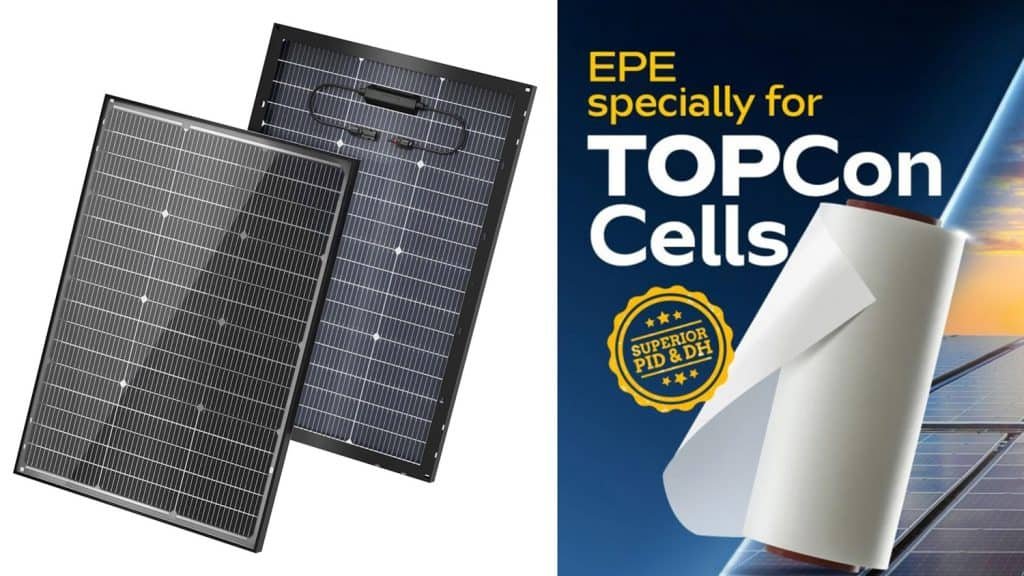
If you’re looking at premium solar panels with TOPCon cells (the newest high-efficiency technology), EPE protection is even more important.
TOPCon cells are more efficient but also more delicate. Their ultra-thin polySi passivation layers (≤150 nm) are about 10 times more sensitive to moisture than older cell types. Without proper protection, these high-tech cells can degrade quickly.
We installed Couleenergy’s EPE-protected TOPCon panels at our desert facility two years ago. Even with daytime temperatures regularly exceeding 110°F, we’ve seen almost no degradation in performance. These solar panels significantly outperform our older installations.
— Robert Rodriguez
Real-world testing shows the difference (after standard IEC 61215 qualification tests):
| Climate | EPE-TOPCon Panels (After 5 Years) | Regular EVA Panels (After 5 Years) |
|---|---|---|
| Coastal (salt spray) | Still producing 96% of original power | Down to 88% of original power |
| Desert (high UV + thermal) | Still producing 94% of original power | Down to 82% of original power |
| Tropical (high humidity) | Still producing 95% of original power | Down to 85% of original power |
The Financial Benefits of Choosing EPE Panels
Yes, EPE-protected PV panels typically cost a little bit more upfront than basic EVA panels (though prices vary by manufacturer). But they’re actually cheaper in the long run:
- They produce more electricity over their lifetime
EPE-TOPCon systems generate about 27% more energy over their life than standard EVA-PERC systems (1.4 GWh/MW vs. 1.1 GWh/MW). - They need fewer replacements
You’ll replace EPE solar panels approximately 40% less often than standard panels, reducing maintenance costs and disruptions. - Your cost per kilowatt-hour drops
The electricity from EPE-TOPCon systems costs about 26% less over time.
Think of it this way: Would you rather buy cheap tires that wear out quickly or premium tires that last much longer and perform better? Most people find the premium option saves money over time.
Better for the Planet Too
Choosing EPE-protected panels isn’t just smart for your wallet – it’s better for the environment:
- Less waste since you replace panels less often (approximately 40% fewer replacement cycles)
- More clean energy from the same number of panels (a 1 GW solar farm using EPE-TOPCon modules offsets approximately 1.2 million tons of CO₂ over 30 years—about 15% more than conventional systems)
- No acetic acid release unlike EVA panels, which can release this corrosive byproduct as they degrade
Protection Against Specific Environmental Stressors
EPE encapsulants provide excellent protection against multiple environmental challenges:
Hail Impact Resistance
EPE’s energy absorption (≥30 J/m²) exceeds EVA’s 15-20 J/m², reducing microcrack formation during hailstorms. Modules using EPE exhibit about 60% fewer microcracks after standard hail impact tests.
Salt Spray Protection
For coastal installations, EPE’s closed-cell structure blocks salt mist penetration and resists electrochemical corrosion, whereas EVA’s porous structure allows contaminant accumulation at cell edges.
PID Prevention Mechanism
EPE’s high volume resistivity and specialized additives immobilize sodium ions from glass substrates, preventing them from migrating to cell surfaces under voltage bias. This keeps PID losses below 2% even in high-voltage systems.
Why Choose Couleenergy’s EPE-Protected Solar Panels
At Couleenergy, we’ve embraced EPE technology in our premium solar panel line. Here’s what makes our implementation special:
- IEC 61215 and IEC 62788 Certified: Our EPE-encapsulated panels exceed international testing standards for reliability and durability.
- Custom EPE formula specifically designed for maximum protection and performance, with optimal layer ratios for different climate applications.
- Advanced manufacturing using precision lamination cycles (450-500 seconds) that prevent bubbles and ensure perfect adhesion.
- Industry-leading 30-year linear warranty backed by accelerated aging tests showing <0.3% annual degradation rates.
- Continuous improvement from our research team to make our panels even better, including enhanced UV stabilizers and anti-PID additives.
After installing Couleenergy’s EPE-TOPCon panels on our coastal property, we’ve seen consistent performance through hurricane season and intense summer heat. Our previous panels degraded noticeably after just two years, but these remain like new after two years of operation.
— Charles Wilson, Residential Customer, Miami, FL
Maintenance Considerations for EPE-Protected Panels
While EPE-protected solar panels are more durable, proper maintenance still matters:
- Annual inspections are recommended to check for any signs of edge sealing issues
- Regular cleaning helps maintain optimal performance, though EPE panels are more resistant to soiling effects
- Professional evaluation after extreme weather events is still advised, though EPE provides superior protection
Ready to Upgrade Your Solar Experience?
If you’re planning a new solar installation or upgrading an existing system, EPE-protected solar panels offer significant advantages. They cost slightly more upfront but deliver much greater value through:
- Longer lifespan (30+ years versus 20-25 for standard panels)
- Higher power output maintained over decades
- Better performance in challenging environments
- Lower lifetime cost per unit of electricity
At Couleenergy, we’re committed to bringing you the most advanced, reliable solar technology available. Our EPE-protected solar panels represent the future of solar – available today.
Want to learn more about how EPE-protected panels can improve your solar investment?
- 📞 Call us today: +1 737 702 0119
- 📧 Email: info@couleenergy.com
Frequently Asked Questions About EPE Encapsulants
How much longer will EPE-protected panels last compared to standard solar panels?
EPE-protected panels typically last 30-35 years while maintaining over 80% of their original power output, compared to 20-25 years for standard EVA-protected panels. This extended lifespan is due to EPE’s superior moisture barrier, UV resistance, and chemical stability.
Do EPE-protected PV panels perform better in extreme climates?
Absolutely. EPE-protected solar panels maintain 94-96% of their power output after 5 years in desert, coastal, and tropical environments, while standard panels drop to 82-88%. The moisture barrier, salt spray resistance, and thermal stability of EPE make it ideal for extreme climate conditions.
How does EPE improve TOPCon cell performance?
TOPCon cells have ultra-thin polySi passivation layers (≤150 nm) that are highly sensitive to moisture. EPE’s exceptional moisture barrier (50-70% better than EVA) protects these delicate layers, preserving the cell’s high efficiency. EPE also provides better PID resistance, critical for TOPCon’s high-voltage operation.
The information provided is based on laboratory testing and field observations. Individual results may vary depending on specific installation conditions.


 English
  Español
  Français
  Deutsch
  Русский
  العربية