
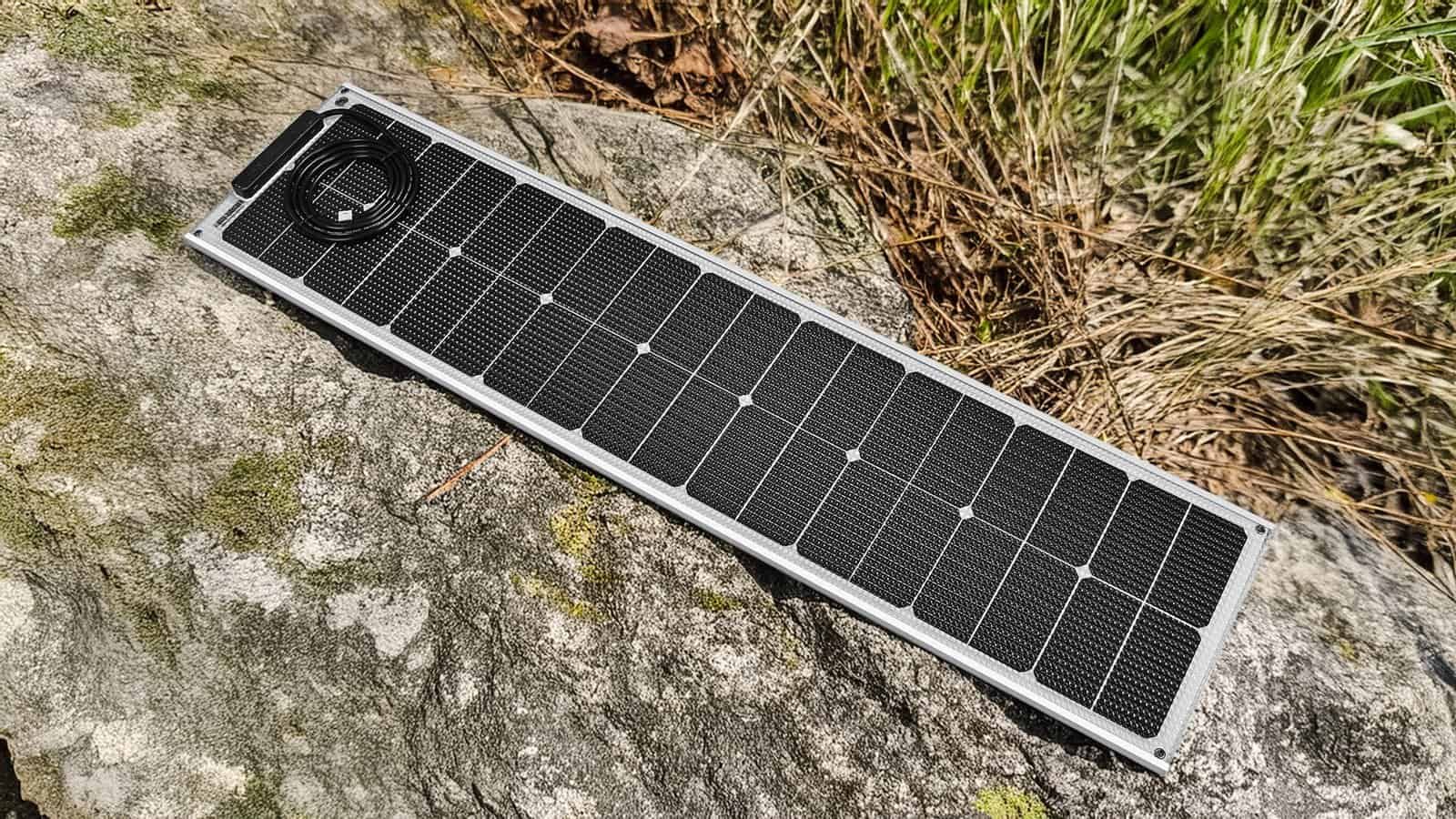
Un módulo transitable de contacto posterior de 990 × 407 × 4 mm para cubiertas marinas, techos de furgonetas, balcones y productos OEM, y cómo leer correctamente su hoja de datos antes de especificarlo.
Los paneles solares estándar están diseñados para techos estándar. No hay nada de malo en eso, hasta que la superficie disponible es estrecha, curva o ya está ocupada con otra cosa.
Las cubiertas de los barcos y los techos de las furgonetas no son simples rectángulos vacíos. Están repletos de escotillas, rejillas de ventilación, barandillas y antenas, y la gente camina sobre ellos. Si se coloca un módulo de vidrio enmarcado en ese espacio, se crean huecos que jamás se podrán rellenar.
Esto hace que la cuestión de la compra sea más compleja de lo que parece a primera vista. Casi cualquiera puede venderte un panel de 80 W.
Pocos pueden decirte si 80 W cabrán en tu espacio y si tu controlador realmente podrá aprovechar esa potencia.
El módulo en resumen
Aquí está la especificación de trabajo, designación de referencia CLM-080ME.
| Potencia nominal (Pmax) | 80 W |
| Dimensiones | 990 × 407 × 4 mm |
| Voltaje a máxima potencia (Vmp) | 25,2 V |
| Corriente a máxima potencia (Imp) | 3.18 A |
| Voltaje de circuito abierto (Voc) | 28,8 V |
| Corriente de cortocircuito (Isc) | 3.38 A |
| Tecnología celular | Contacto posterior de tipo N, eficiencia de celda superior a 25,2% |
| Diseño de celdas | 40 celdas cortadas en cuartos en una serie de cadenas |
| Superficie frontal | Laminado de ETFE texturizado |
| Construcción | Semirrígido, transitable, con soporte de placa de refuerzo |
| Montaje | Pasacables de esquina; opciones adhesivas, con soporte o de riel. |
La designación del modelo, el peso, la longitud del cable y las condiciones de la garantía se confirman en el presupuesto. Estas dimensiones describen una configuración, no un límite del catálogo.
Los vatios no son comparables. Los vatios por metro cuadrado sí.
Los compradores ordenan los paneles según su potencia. Sobre el papel, 80 W supera a 65 W y la decisión parece tomada. En la práctica, esa comparación resulta prácticamente irrelevante.
Prueba con los cálculos. Nuestro módulo ocupa 0,99 m × 0,407 m, es decir, unos 0,403 m². Divide 80 W entre eso y obtendrás aproximadamente 198 W/m².
Ahora, apliquemos el mismo cálculo a un panel solar transitable de 65 W, ampliamente vendido en el mercado náutico norteamericano. Su superficie de 920 × 360 mm es de 0,331 m², lo que equivale a unos 196 W/m², una diferencia de tan solo un uno por ciento con respecto a nuestro resultado.
Un panel más grande no significa que sea mejor. Simplemente es más grande.
La regla práctica: La densidad de potencia indica las capacidades de la tecnología. Las dimensiones indican la capacidad de tu embarcación, furgoneta o balcón. Solo el segundo valor varía de un proyecto a otro.
Por lo tanto, consideramos 80 W como un punto de partida, nunca como un producto terminado. Dos proveedores pueden cotizar la misma densidad y aun así ofrecer resultados muy diferentes en el mismo techo.
¿Por qué las células 25% le proporcionan un panel de 20%?
Las descripciones de productos suelen incluir titulares que destacan la eficiencia de las celdas. Verás 25% o 26% en negrita, y luego descubrirás que el módulo se sitúa más cerca de 20%. Los compradores, con razón, se preguntan dónde está el resto.
Ambas cifras son veraces. Simplemente miden objetos diferentes: una, una célula desnuda bajo una lámpara; la otra, un panel completo, incluyendo cada milímetro que no contiene ninguna célula.
Nuestros 198 W/m² corresponden a una eficiencia del módulo cercana 19.9%. En comparación con una celda superior a 25,2%, esto representa una proporción de aproximadamente 79%. Y casi toda la diferencia se debe a la geometría, no a la física.
- Margen del borde. Todo laminado necesita un borde sellado, y allí no hay células.
- Espacio entre celdas. Las estructuras semirrígidas necesitan espacios para que el laminado pueda flexionarse sin sobrecargar la silicona.
- Zona de la caja de conexiones. El área debajo y alrededor de la caja permanece inactiva.
Si se suman todos esos factores, las celdas activas cubren aproximadamente 82% de la superficie del módulo. Ese factor explica la mayor parte de la disminución de 25% a 20%.
En términos eléctricos, se pierde muy poca corriente, y la razón es el formato de la celda. Cada celda se divide en cuatro partes antes de la laminación, por lo que cada pieza transporta una cuarta parte de la corriente.
La pérdida resistiva aumenta con el cuadrado de la corriente, lo que hace que el corte sea inusualmente eficaz. Fraunhofer ISE ha construido módulos de media celda que alcanzan una relación de potencia de celda a módulo de 104%. — mayor producción que la suma de las células que las componen. Las células cortadas en cuartos empujan en la misma dirección.
Una auditoría de 60 segundos que puedes realizar en cualquier hoja de datos.
Antes de fiarte de una hoja de especificaciones, comprueba que sea coherente consigo misma. Tres pruebas permiten detectar la mayoría de las cifras inventadas.
| ¿Vmp × Imp es igual a Pmax? | 25,2 V × 3,18 A = 80,1 W. Coincide con la potencia nominal de 80 W. |
| ¿Es creíble el factor de llenado? | 80,1 W ÷ (28,8 V × 3,38 A) = 82%. Saludable para una celda de contacto posterior. |
| ¿Coincide el recuento celular? | 28,8 V ÷ 40 celdas = 0,72 V cada una. Corrección para silicio de contacto posterior. |
Esa tercera línea esconde una trampa. La mayoría de los compradores optan por 0,69 V por celda, lo cual es razonable para los tipos de celdas más comunes, pero erróneo en este caso.
El contacto posterior funciona a mayor velocidad. LONGi informa que el voltaje de circuito abierto alcanza 745 mV por celda en su plataforma HPBC 2.0.
Aplicando la cifra genérica, se calculan 42 celdas. Aplicando la cifra de contacto posterior, se obtiene el valor real de 40. Al realizar una comprobación cruzada a máxima potencia, la misma cadena da 0,63 V por celda, lo cual coincide.
¿Tienes una ficha técnica de otro proveedor? Envíanosla. Realizaremos esta auditoría antes de que confirmes la compra.
Lea el voltaje antes de leer los vatios.
Aquí es donde los proyectos de paneles transitables pierden energía silenciosamente, y casi nunca sale a la luz en la etapa de cotización.
Nuestro módulo funciona a 25,2 V a máxima potencia. Ese único valor determina el controlador de carga y descarta por completo una opción popular.
Este no es un panel PWM
Un controlador PWM se comporta como un interruptor, reduciendo la tensión del panel hasta el nivel de la batería. Victron Energy describe el mecanismo en su informe técnico sobre controladores..
Conecte este módulo a una batería de 12 V mediante PWM y verá que su voltaje baja de 25,2 V a aproximadamente 13,6 V, mientras que la corriente se mantiene cerca de 3,4 A.
3,38 A × 13,6 V ≈ 46 W
Compraste 80W. Recoges unos 46W. Aproximadamente 40% del panel desaparece dentro del controlador equivocado.
Eso va mucho más allá de la ventaja del MPPT 25% frente al 30% que se suele mencionar, y la razón es aritmética más que de marketing.
La prueba de referencia habitual presupone un panel con Vmp cercano a 18 V. Si se reduce la tensión de 18 V a 13,6 V, se pierde aproximadamente una quinta parte. Si se reduce la tensión de 25,2 V a los mismos 13,6 V, la pérdida se duplica con creces.
En pocas palabras: cuanto mayor sea el voltaje de su panel, más caro le resultará un controlador PWM.
Tampoco es un panel de 24 V.
Con 25,2 V, este módulo se asemeja tentadoramente a un sistema de 24 V. Sin embargo, es una trampa, ya que el voltaje disminuye a medida que el panel se calienta.
Los coeficientes publicados permiten estimar la caída de tensión. Los módulos de contacto posterior pierden aproximadamente 0,26% de potencia máxima por °C, mientras que la corriente de cortocircuito gana aproximadamente 0,05%. Si se resta una de la otra, Vmp disminuye aproximadamente 0,31% por °C.
Un panel adherido a la cubierta puede estar 40 °C por encima de las condiciones de prueba en una tarde de verano. Eso es una caída de 12%, lo que coloca a Vmp cerca 22 V — por debajo de los 28,8 V que absorbe un banco de 24 V. Los controladores MPPT comunes de tipo reductor reducen el voltaje, nunca lo aumentan, por lo que nada lo recupera.
Comprueba también el extremo frío.
El invierno provoca un cambio en la tensión. La tensión en circuito abierto aumenta aproximadamente 0,20% por cada °C por debajo de las condiciones de prueba en celdas con contactos posteriores, por lo que a -10 °C nuestros 28,8 V se convierten en aproximadamente 30,8 V. Si conectamos cuatro módulos, nos acercamos a los 124 V. Confirme el límite de entrada de su controlador antes de realizar el pedido.
Lo que realmente funciona
- Sistema de 12 V: Un módulo conectado a un controlador MPPT. Encaja a la perfección, con margen de sobra incluso en altas temperaturas.
- Sistema de 24 V: dos módulos en serie, que proporcionan unos 50 V a máxima potencia.
- Sistema de 48 V: cuatro módulos en serie, contrastados con la cifra para clima frío que aparece arriba.
Y si su producto realmente necesita un panel de 12 V compatible con PWM, modificamos la cadena en lugar de seguir las recomendaciones. Un Vmp cercano a 18 V requiere una cantidad diferente de celdas, por lo que lo diseñamos de esa manera.
Semirrígido no es flexible ni endeble.
Tres formatos, una confusión interminable. La diferencia radica en una sola capa.
Un panel totalmente flexible es un laminado delgado sin placa estructural detrás. Si se dobla mucho, resiste; si se pisa, no.
Un módulo de vidrio enmarcado resiste todo y no se dobla en nada, a costa de unos 30 mm de altura y una gran cantidad de masa.
La parte semirrígida se sitúa entre ellos añadiendo un placa de soporte detrás de las celdas. La placa distribuye una carga puntual a lo largo del laminado en lugar de permitir que el talón presione sobre una sola celda.
La elección de la placa determinará el carácter del panel final.
| Placa de soporte | Rigidez | Peso | Más adecuado para |
| compuesto de fibra de vidrio | Bien | Moderado | Superficies curvas y trabajos generales en el sector náutico o de vehículos recreativos. |
| fibra de carbono | Muy alto | Bajo | Cubiertas de peso crítico y embarcaciones de alto rendimiento |
| Lámina de aluminio | Alto | Más alto | Montaje plano donde la disipación del calor ayuda |
| Placa de núcleo compuesto | Moderado | Bajo | Programas de volumen sensibles al costo |
Debido a que una placa reemplaza el marco, toda la estructura se mantiene en 4 mm. Los módulos transitables de este tipo suelen pesar entre 6 y 7 kg/m², frente a los 10 a 12,5 kg/m² de los de vidrio con marco.
Una advertencia sincera. “El término "transitable" no tiene una definición común en la industria, por lo que no existe un único valor de prueba que se pueda citar. Pregunte sobre la carga, la superficie de contacto y el tipo de sustrato. Las respuestas vagas indican que se trata de una estrategia de marketing.
Nuestra guía para paneles solares semirrígidos sobre los que se puede caminar profundiza en la pila de capas y puede ver un formato más grande en nuestro Módulo transitable de 290 W.
¿Qué hace la superficie frontal de ETFE?
El ETFE sustituye al vidrio en la parte frontal. Se trata de una película de fluoropolímero y cumple su función por cuatro razones.
- Se mantiene despejado. AGC publica la transmisión de luz por encima de 90%. En toda su gama de ETFE, con espesores de 12 a 250 µm.
- Resiste los rayos UV. AGC informa de 16.000 horas de envejecimiento acelerado sin degradación visible; se trata de una prueba del proveedor que conviene leer como tal, y no como una garantía de campo.
- Elimina la suciedad. La superficie es resistente a la adherencia, lo cual es importante para evitar la acumulación de sal y excrementos de pájaros.
- Se dobla. El vidrio no puede adaptarse a una cubierta curva. El ETFE sí.
Ese acabado texturizado no es un detalle estético. Proporciona agarre bajo los pies y suaviza los reflejos, algo más importante en una embarcación de lo que suelen admitir las fichas técnicas.
Ahora viene la parte que merece sinceridad. Un laminado sin vidrio no tiene una verdadera barrera contra la humedad como la tiene un módulo de vidrio-vidrio; la humedad se filtra lentamente a través de ambas caras en lugar de solo por los bordes.
Por lo tanto, la durabilidad a largo plazo depende del encapsulante, del margen del borde y del proceso de laminación, no solo del ETFE. Esa es una cuestión de fabricación, y es precisamente ahí donde los proveedores se diferencian.
El tipo de montaje determina su temperatura de funcionamiento.
Dos paneles idénticos pueden generar cantidades de energía notablemente diferentes a lo largo de una temporada. Generalmente, la variable es el aire.
La temperatura del panel depende de la irradiancia, el aire ambiente, el viento y la instalación, factores que interactúan entre sí. Solo este último está bajo tu control.
Si se adhiere un panel plano a una cubierta, la convección posterior desaparece. El calor se disipa entonces principalmente a través de la superficie a la que está adherido.
Las celdas de contacto posterior funcionan mejor que la mayoría en este caso. LONGi publica un coeficiente de temperatura de potencia máxima de −0,26% por °C para módulos HPBC 2.0, aproximadamente 0,03 puntos mejor que el TOPCon convencional. Aun así, eso todavía significa aproximadamente 2,6% menos producción por cada aumento de 10 °C.
| Totalmente adherido a una cubierta | Perfil más bajo y la mejor opción para una superficie transitable. Genera más calor y su remoción es difícil. |
| Soporte o riel de montaje | Mantiene una cámara de aire y funciona a menor temperatura. Aumenta la altura, pero el mantenimiento es sencillo. |
| Arandela fijada con separadores | La opción intermedia: cierta ventilación, altura moderada, fácil de retirar. |
No existe una solución universalmente correcta. Díganos cómo se fijará el panel y diseñaremos los elementos de montaje en función de esa decisión, en lugar de tener que descubrirla después.
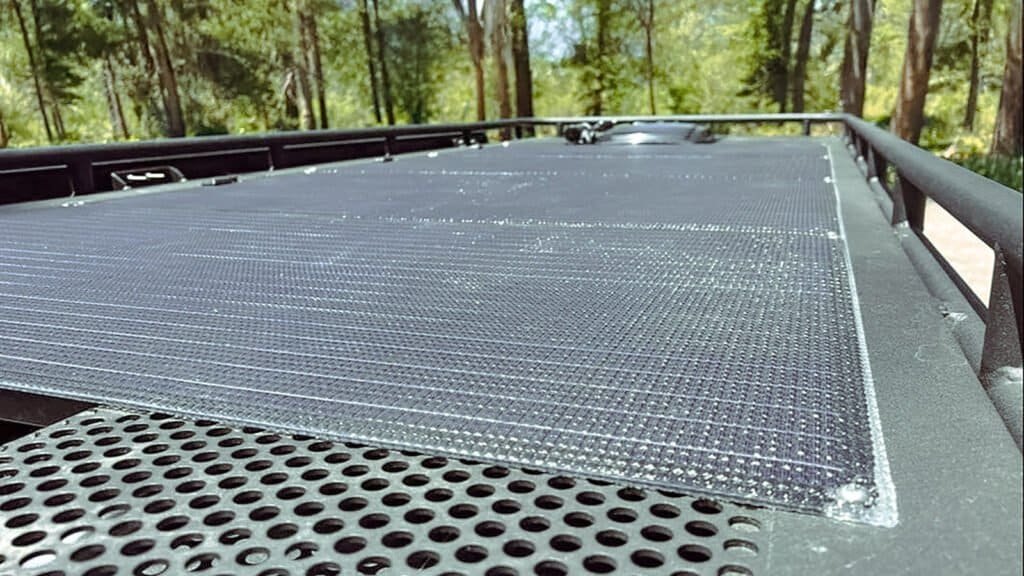
En un barco, la sombra es la condición normal.
Los paneles solares en azoteas están diseñados para disfrutar del cielo abierto. Las terrazas nunca tienen ese privilegio. Un mástil, una botavara, un estay, una antena o una baca proyectan una sombra en movimiento sobre el panel desde el amanecer hasta el anochecer.
Las celdas de contacto posterior son útiles, y el mecanismo es real. Se degradan gradualmente bajo polarización inversa, por lo que una celda sombreada sigue permitiendo el paso de corriente en lugar de bloquear el circuito.
LONGi informa que este método reduce la pérdida de potencia por sombreado en aproximadamente 70% en comparación con TOPCon, con una disminución de la temperatura del punto caliente de 28%. Estas son cifras del fabricante, por lo que la pregunta interesante es qué dicen los estudios independientes sobre los límites.
Resulta que bastante, y la respuesta es inusualmente específica.
El umbral es aproximadamente de tres células. Un estudio revisado por pares en Energía solar Investigadores de Trina Solar y la Universidad de Nanchang descubrieron que los módulos de contacto posterior superan a los de TOPCon. solo cuando hay menos de tres celdas sombreadas en una subcadena. En condiciones de sombreado de fila completa, ambas tecnologías convergen.
Simulaciones separadas por TÜV NORD alcanzó el mismo umbral.La ventaja se mantiene con tres celdas sombreadas o menos, y luego desaparece con cuatro, donde ambas tecnologías pierden alrededor de la mitad de su producción.
Considérese esto como una regla de diseño, más que como una decepción, porque se ajusta perfectamente a la realidad marina.
Sombras tenues —una driza, un estay, una antena, un cable de barandilla— tocan una o dos celdas a la vez. Ese es precisamente el momento en que el contacto inverso se impone, y sucede durante todo el día.
Un brazo extendido sobre el panel es un problema diferente, y ninguna tecnología de celdas lo resuelve. El recuento de diodos de derivación y la disposición de la cadena soportan esa carga, razón por la cual tratamos ambos como variables de diseño en lugar de características fijas. Nuestra comparación de rendimiento de sombreado en diferentes tipos de celdas Analiza las pruebas en su totalidad.
Donde un panel de 990 × 407 mm se gana su lugar
Su diseño alargado y estrecho hace que sea ideal para superficies anchas en una dirección y estrechas en la otra.
- Marina. Techos de superestructura, cubiertas laterales, techos rígidos de catamarán y cubiertas de cabina por las que camina la tripulación.
- Furgonetas y autocaravanas. Tiras de techo entre las rejillas de ventilación, los aires acondicionados y las barras portaequipajes.
- Balcón y fachada. Paneles de barandilla y repisas estrechas donde el peso del vidrio se convierte en un problema estructural.
- Vehículos especiales. Carrocerías, remolques y equipos móviles con techos curvos o con poco espacio entre ellos.
- Productos OEM. Armarios para exteriores, unidades de alimentación portátiles y equipos con energía solar integrada.
El patrón se repite siempre: primero existía la superficie y el panel tuvo que adaptarse a ella.
Un ejemplo resuelto. Supongamos que el techo de una cabina ofrece un espacio libre de 1020 × 420 mm.
Un panel estándar de 1100 × 450 mm tiene una clasificación superior. Además, no encaja, lo que hace que su rendimiento una vez instalado sea exactamente cero.
Un módulo de 990 × 407 mm cabe con margen y entrega 80 W. El panel más pequeño gana, y no hay comparación.
El producto no es el panel. Es el proceso.
La mayoría de los proveedores preguntan qué modelo desea. Nosotros preferimos preguntar qué necesita la aplicación y, a partir de la respuesta, trabajar a la inversa.
Todo lo que se describe a continuación es variable, no una característica fija.
| Dimensiones | El tamaño se ajusta al espacio disponible para la instalación, no a un catálogo. |
| Fuerza | Configurado según la disposición de las celdas y la cobertura dentro de su área de influencia. |
| Voltaje | Adaptable a su ventana MPPT o banco de baterías. |
| Forma | Contornos no rectangulares para cubiertas y techos curvos. |
| Placa de soporte | Elegidos por su rigidez, peso o prioridad en cuanto al coste. |
| Características de montaje | Posiciones de ojales, bordes adheridos o disposiciones de soportes. |
| Caja de conexiones y cables | Posición de salida, longitud, tipo de conector y perfil de la caja. |
| Diodos de derivación | Conteo y división de cadenas, configurados según su patrón de sombreado. |
| Apariencia | Fondo completamente negro o blanco, con o sin marca. |
El voltaje merece una atención especial, ya que los compradores lo dejan al azar más que cualquier otro parámetro. El número de celdas determina el Vmp, y el Vmp decide qué controladores funcionarán con su panel.
Indíquenos el voltaje de la batería y el modelo del controlador. Nosotros fabricamos el circuito a medida, en lugar de pedirle que compre componentes adicionales para un panel que ya tiene.
Diez preguntas que debe enviar a cualquier proveedor de paneles transitables.
Incluye esto en tu próxima consulta. La respuesta del proveedor te dirá mucho más que la ficha técnica.
- ¿Qué es el? módulo ¿Eficiencia, en W/m² o en porcentaje?
- ¿Cuántas celdas hay en la cadena y están cortadas? ¿En cuántos pedazos?
- ¿Qué material utiliza para la placa de soporte y qué grosor tiene?
- ¿Bajo qué carga, superficie de contacto y sobre qué tipo de sustrato se puede transitar por el panel?
- ¿Cuál es el espesor de la película de ETFE y quién la suministra?
- ¿Qué encapsulante se utiliza y cuál es el margen del borde?
- ¿Cuántos diodos de derivación se instalan y cómo dividen la cadena?
- ¿Cuáles son los coeficientes de temperatura para Pmax, Voc e Isc?
- ¿Podrías compartir imágenes de la prueba de destello y de electroluminiscencia de un lote de producción real?
- ¿Se puede cambiar Vmp para que coincida con mi controlador, y en qué cantidad?
La pregunta nueve permite diferenciar a los proveedores con mayor rapidez. Un informe de prueba rápida describe el panel que realmente está comprando, y una imagen de electroluminiscencia revela grietas que ninguna inspección visual detectaría.

Preguntas frecuentes
¿De verdad puedo caminar sobre este panel?
Sí, dentro de los límites establecidos por el montaje. Apoyada uniformemente sobre una plataforma sólida, la placa de soporte distribuye el peso entre varias celdas. Si se coloca sobre un espacio, esa misma pisada se convierte en una carga de flexión. Indíquenos siempre el tipo de sustrato.
¿Puede cargar directamente una batería de 12 V?
No sin un controlador MPPT. A 25,2 V, el voltaje está muy por encima de los 12 V, por lo que la modulación por ancho de pulsos (PWM) desperdiciaría aproximadamente 401 TP3T de la salida. Un controlador MPPT convierte ese voltaje excedente en corriente de carga adicional.
¿Por qué utilizar células cortadas en cuartos en lugar de células enteras?
Hay dos razones que se refuerzan mutuamente. Las piezas más pequeñas se ajustan a un módulo estrecho con mucha más eficiencia, y cada pieza transporta una cuarta parte de la corriente. Dado que la pérdida resistiva aumenta con el cuadrado de la corriente, el corte elimina la mayor parte de la pérdida de cableado.
¿Cómo se compara con un panel flexible?
Un panel flexible se dobla mucho más y pesa menos, pero no tiene placa para resistir una carga puntual. Donde nadie se para sobre la superficie, un panel flexible suele ser la opción más inteligente. Nuestra guía para módulos de contacto posterior flexibles cubre ese formato.
¿Puedes hacerlo de otro tamaño?
Sí, y esa es la principal razón por la que los clientes nos eligen. Envíenos las dimensiones exactas de su área de instalación y diseñaremos la distribución de las celdas para que se ajusten a ella.
¿Cómo es posible que 4 mm sobrevivan al aire libre durante años?
El grosor no es lo que protege las células. El encapsulante, el margen del borde y el proceso de laminación son los que cumplen esa función, por lo que un laminado de 4 mm bien fabricado dura más que uno de 6 mm mal fabricado.
¿Suministran los accesorios de montaje?
Diseñamos los elementos de montaje del panel, incluyendo la posición de los pasacables y los bordes para soportes o rieles. El suministro de herrajes se gestiona según el proyecto, por lo que conviene mencionarlo durante la consulta, no después.
No rediseñe su producto en torno a un panel estándar.
Envíanos tres datos: el espacio disponible, el voltaje de la batería que necesitas y cómo se instalará el panel. Te enviaremos un diseño de las celdas, una configuración eléctrica y un plano de ejemplo.
¿Ya tienes un presupuesto de otra empresa? Envíanos la hoja de datos. Realizaremos la auditoría basada en este artículo y te diremos qué significan realmente esas cifras.
Couleenergy — OEM y ODM · Cantidad mínima de pedido baja · Tamaño, potencia y forma personalizados · Muestreo rápido
couleenergy.com | +1 737 702 0119 | info@couleenergy.com


 Español
  English
  Français
  Deutsch
  Русский
  العربية