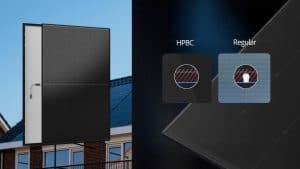
الألواح الشمسية المخصصة

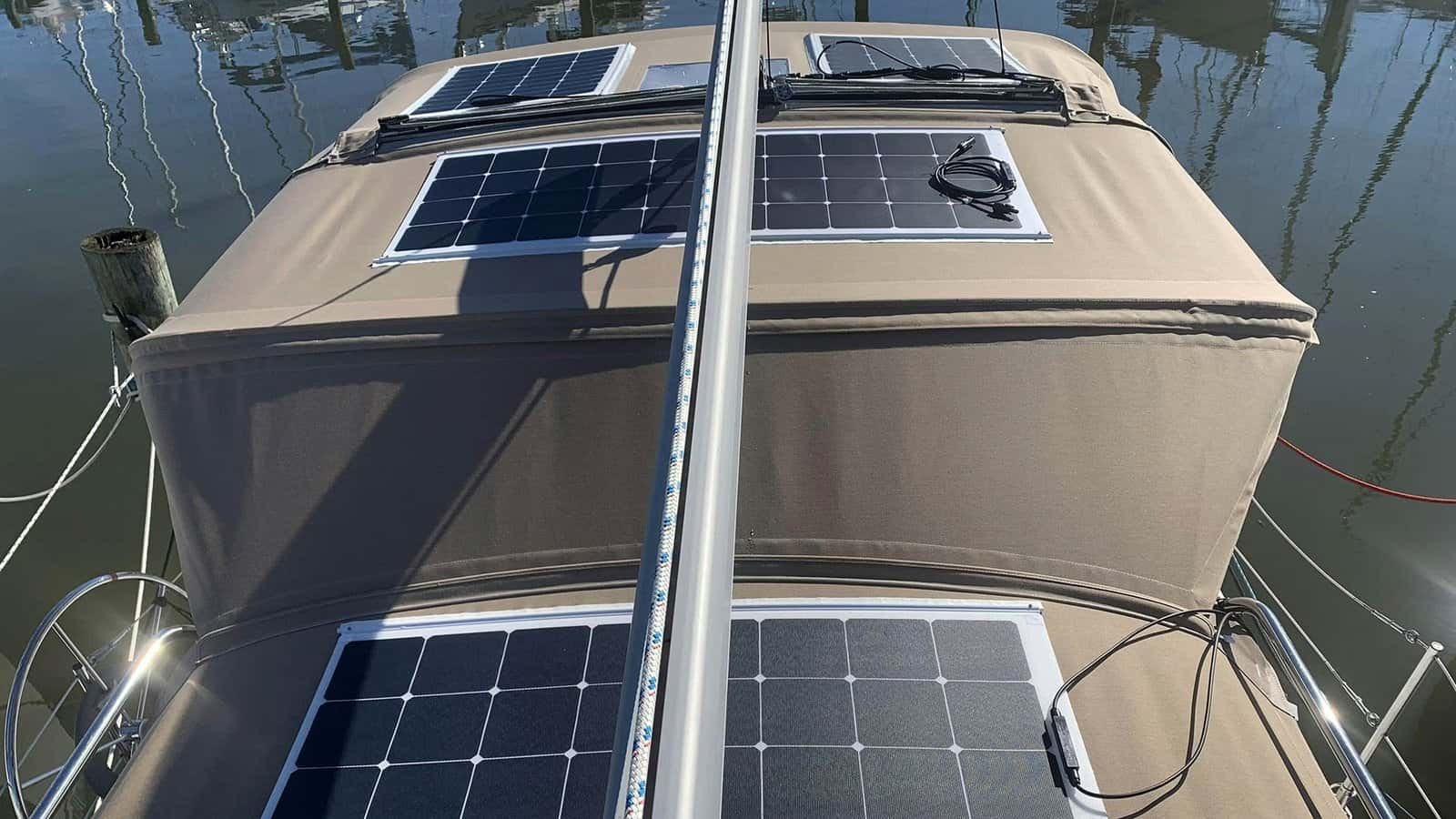
Most flexible solar panels fail long before they should. The encapsulation yellows. The cells crack from flex fatigue. Output drops 15% in year two and never recovers. The manufacturer’s warranty expires in six months — which tells you, in commercial language, exactly how much confidence they had in the product. Couleenergy’s HPBC and ABC flexible panels carry a 3–5 year product warranty — three to ten times longer than the industry norm — because the 9-layer architecture underneath earns that confidence. This article explains exactly what drives real flexible panel performance, and why the engineering difference between a 5-layer and a 9-layer module is the difference between a product your customers return and one they reorder.
Modern flexible solar panels achieve between 14% and 25% module efficiency — a range determined almost entirely by the solar cell technology inside. Two panels both labelled “100W” can produce radically different real-world results: a 100W mono PERC panel might deliver 60–68W on a hot summer day, while a 100W back-contact (BC) panel in the same conditions delivers 72–80W.
These figures are measured at شروط الاختبار القياسية (STC) — 25°C cell temperature, 1,000 W/m² irradiance, zero shading.[1] In real-world conditions, expect 60–80% of rated output on a typical sunny day. The gap between those two numbers is what this article unpacks.
| تكنولوجيا الخلايا | Module Efficiency (STC) | معامل درجة الحرارة | التدهور السنوي | LID Risk |
|---|---|---|---|---|
| Mono PERC (P-type) | 17.5%–21% | –0.35 to –0.40%/°C | ~0.5–0.8%/yr | ⚠️ Yes |
| TOPCon من النوع N | 21%–23.8% | –0.29 to –0.32%/°C | ~0.4–0.5%/yr | ✅ No |
| BC (ABC & HPBC) | 22%–25% | –0.26 to –0.30%/°C | <0.35%/yr | ✅ No |
مصادر: Clean Energy Reviews Feb 2026; LONGi; Aiko Solar. All figures at STC.
أحادي بيرك uses a P-type monocrystalline silicon wafer with a rear passivation layer that reflects unused light back through the cell. Module efficiency: 17.5%–21%.
توبكون uses N-type silicon with an ultra-thin tunnel oxide layer at the rear contact. Module efficiency: 21%–23.8%. Better heat tolerance (–0.29 to –0.32%/°C), no LID, ~0.4–0.5%/yr degradation. The best value-to-efficiency ratio for most flexible panel applications today.
تقنية الاتصال الخلفي (BC) moves all metal contacts to the rear. Zero front-side shading, best thermal coefficient, lowest degradation. Module efficiency: 22%–25%.
HPBC 2.0 (LONGi): Production cell efficiency exceeds 26.6%. Commercial Hi-MO X10 modules ship at 24.8%. LONGi holds the crystalline silicon module world record of 25.4%, certified by Fraunhofer ISE in 2024.[2]
⚠️ HPBC vs HIBC: LONGi’s separately developed هيبك (Heterojunction Interdigitated Back Contact) achieved a lab cell record of 27.81% (ISFH Germany, April 2025). HIBC is a distinct architecture from HPBC and is not yet a commercial flexible panel product.
ABC (Aiko Solar): حتى 25.2% commercial module efficiency (INFINITE series, Intersolar Munich 2024). Gen 3 modules use copper electroplating instead of silver paste — improving joint strength and eliminating silver price exposure. Temperature coefficient: –0.26%/°C.
Cell temperatures reach 45°C–65°C on sunny days — hotter still for flush-mounted flexible solar panels with no air gap. Here’s what each technology’s published coefficient costs you in practice:[6]
| درجة حرارة الخلية | Mono PERC (–0.38%/°C) | TOPCon (–0.30%/°C) | BC (–0.27%/°C) |
|---|---|---|---|
| 25°C (STC) | 100% | 100% | 100% |
| 35°C | 96.2% | 97.0% | 97.3% |
| 45°C | 92.4% | 94.0% | 94.6% |
| 55°C | 88.6% | 91.0% | 91.9% |
| 65°C | 84.8% | 88.0% | 89.2% |
At 65°C, a mono PERC panel delivers 84.8% of rated output. A BC panel in the same conditions: 89.2% — nearly 5 percentage points more from thermal management alone.
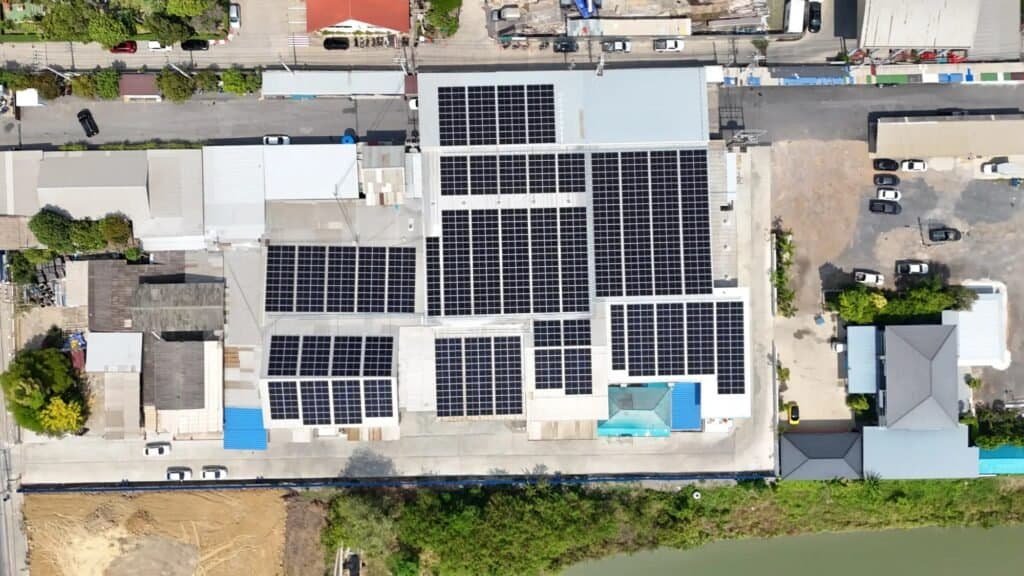
Standard solar panels wire cells in series — a single shaded cell can trigger a bypass diode that shuts down a full third of the module: 33% power loss from a shadow covering less than 1% of the surface. BC technology’s internal ‘weak conduction’ design lets current bypass shaded cells without activating bypass diodes. CPVT independent testing (September 2025)[4] و TÜV Rheinland testing (June 2025) confirm:[7]
| حالة الاختبار | TOPCon Module | HPBC 2.0 (Hi-MO X10) |
|---|---|---|
| Single cell 50% shaded (CPVT, Sept 2025) | 36.48% فقدان الطاقة | 10.15% power loss (–72%) |
| Hotspot temp (TÜV Rheinland, June 2025) | >160°C | ~100°C (77°C lower) |
| ~5% surface area shaded | 15–25% power loss | ~5–8% power loss |
| Moderate partial shade | 30–40% power loss | ~10–15% power loss |
مصادر: CPVT Three-Proof certification; LONGi EU shading blog
| ملكية | إثيلين تيريفثالات الإيثيلين | حيوان أليف |
|---|---|---|
| نفاذية الضوء | ~90–95% | ~85–88% (degrades with UV yellowing) |
| مقاومة الأشعة فوق البنفسجية | ✅ Stable 20+ years | ❌ Yellows within 1–3 years |
| التنظيف الذاتي | ✅ Micro-textured; water beads off | ❌ Smooth; retains soiling |
| Cold Flexibility | ✅ To –40°C | ❌ Cracks or hardens |
| Water Vapour Permeability | ✅ Very low — protects N-type cells | ❌ High — accelerates degradation |
| Expected Outdoor Life | 10-20+ سنوات | من سنة إلى ثلاث سنوات |
Standard solar glass transmits 90–92% of light; AR-coated low-iron glass reaches 93–96%. High-quality ETFE sits at 90–95% — competitive with glass, decisively better in weight, flexibility, and self-cleaning. For any outdoor application lasting more than one season, ETFE is the only encapsulation worth specifying.
A flat-mounted panel at 30° latitude loses roughly 10–15% of potential annual energy versus an optimally tilted one. Soiling costs 10–25% on unmaintained panels — ETFE self-cleaning mitigates this significantly. Use MPPT controllers (95–98% efficient), keep cable runs short, and specify IP67 junction boxes for marine or exposed installations.
| طلب | Key Constraints | Recommended Cell | التغليف | Priority Spec |
|---|---|---|---|---|
| 🚢 Marine / Offshore | Salt spray, UV, flex fatigue, weight | HPBC or ABC | ETFE 50μm+, Japanese-sourced | IP68 junction box; IEC 61701 salt mist rating |
| 🚐 RV / Caravan | Roof heat, vibration, curved surface | HPBC or TOPCon | ETFE 50μm | Max bend radius; ribbon-free interconnection; low temp. coefficient |
| 🏗️ BIPV / Facades | Aesthetics, curved integration, partial shade | ABC or HPBC (all-black) | إثيلين تيريفثالات الإيثيلين | Fire rating; IEC 61215 & 61730; CE marking; custom dimensions |
| 🏭 C&I Rooftop | Structural load limits, cost-per-watt | TOPCon or HPBC | إثيلين تيريفثالات الإيثيلين | Watt-per-kg ratio; IEC 61215; wind/snow load rating |
| ⛵ Leisure / Portable | Budget, portability, moderate durability | Mono PERC (shingled) | ETFE 25μm | Weight per watt; connector compatibility |
| 📡 IoT / Remote | Ultra-compact, custom voltage, low MOQ | ABC or IBC (small format) | إثيلين تيريفثالات الإيثيلين | Custom dimensions; voltage tolerance; IP rating |
China accounts for over 80% of global flexible solar panel production. The supply chain — silicon wafers, encapsulant films, junction boxes, ETFE coatings — is concentrated in Zhejiang, Guangdong, and Jiangsu. That proximity drives both cost efficiency and rapid technology adoption. But the quality gap across manufacturers is wider than most buyers realise, and photos on a listing cannot show the difference.
These manufacturers use the latest N-type back-contact cells with premium ETFE lamination, multi-layer module construction, and genuine OEM/ODM capability. They hold شهادات IEC 61215 وIEC 61730[5] with verifiable certificate numbers — not logos on a brochure.
Reliable solar panels with decent efficiency (18–22%), reasonable 5–10 year durability, and basic customisation. Good for high-volume RV and camping applications where cost-per-watt is the primary driver.
Standard 5-layer structure (PET/ETFE-EVA-PERC-EVA-TPT) with the lowest-grade materials. Module efficiency 14–18%. PET outdoor lifespan: typically 1–3 years. These look identical to Tier 1 products in photos — you can only tell the difference by scrutinising cell type, encapsulation, and actual test documentation.
| سؤال | 🚩 Red Flag | ✅ Green Flag |
|---|---|---|
| What cell type? | “Monocrystalline” (vague) | “N-type TOPCon” or “HPBC/ABC back-contact” |
| Temperature coefficient? | No data or generic number | –0.26 to –0.32%/°C with datasheet reference |
| ETFE or PET front layer? | “Plastic film” or “PET coated” | “Vacuum heat-laminated ETFE, 50–100μm, Japanese-sourced” |
| EVA or POE encapsulant? | “Standard” or no answer | “POE for N-type cells” (no acetic acid, lower moisture permeability) |
| Layer count and structure? | “Standard construction” | Specific sequence (e.g. ETFE-POE-Composite-POE-BC-POE-Composite-POE-TPT) |
| IEC 61215/61730? | “We are applying” or unverifiable logos | Certificate number + lab name (TÜV, SGS, Intertek) |
| EL testing? | “What is EL testing?” | “Yes — at cell sorting, post-lamination, and final inspection” |
| Product warranty? | 6 months or “1 year” | 3–5 years with written terms |
| Custom order lead time? | “Depends” or no answer | Prototype: 2–4 wks; Production: 2–6 wks |
| Minimum custom order? | 1,000+ units; no samples | 100 units; evaluation samples available |
🔑 A note on cell technology credibility: Couleenergy manufactures its 9-layer flexible solar panels using LONGi’s HPBC 2.0 cells و Aiko Solar’s ABC cells — the exact cell platforms independently validated by Fraunhofer ISE, TÜV Rheinland, and CPVT throughout this article. The third-party performance data cited here — the 25.4% world record, the 77°C hotspot advantage, the 10.15% vs 36.48% shading loss comparison — applies directly to the cells in Couleenergy’s modules. What Couleenergy adds is the 9-layer lamination architecture around those certified cells: Japanese ETFE, four POE encapsulant layers, composite film reinforcement, and ribbon-free interconnection. The cells carry the industry’s most rigorous independent validation. Couleenergy’s contribution is engineering that protects and sustains them.
The industry-standard flexible panel uses a 5-layer structure: ETFE or PET → EVA → PERC cells → EVA → TPT backsheet. It works — until the PET yellows, the EVA releases acetic acid, or solder ribbon micro-cracks from repeated flex. These are not edge cases; they are the scheduled failure sequence of a panel sold with a six-month warranty.
Couleenergy’s 9-layer architecture eliminates each failure mode by design:
| # | طبقة | مادة | Failure Mode Prevented |
|---|---|---|---|
| 1 | ETFE Front Film | ETFE الياباني | UV yellowing & transmission loss. 90–95% transmission stable 20+ years. Micro-texture sheds water, dust, and salt. |
| 2 | Front POE Encapsulant | POE (إلاستومر البولي أوليفين) | Acetic acid corrosion of cell metallisation. POE produces no acetic acid during thermal ageing — unlike EVA.[3] |
| 3 | Composite Film | Structural polymer composite | Uncontrolled flex stress. Distributes mechanical load across the module; prevents stress concentration at cell edges during bending cycles. |
| 4 | Inner Front POE | POE (إلاستومر البولي أوليفين) | Front-side moisture ingress. Low water vapour transmission rate at the cell face. |
| 5 | BC Solar Cells | HPBC or ABC back-contact (LONGi / Aiko) | Front-side shading (zero busbars) and solder ribbon fatigue. Ribbon-free conductive resin paste interconnection[8] survives thousands of flex cycles. Temp. coefficient: –0.26 to –0.29%/°C. |
| 6 | Inner Rear POE | POE (إلاستومر البولي أوليفين) | Moisture ingress from cell rear. Seals and cushions through bending cycles. |
| 7 | Composite Film | Structural polymer composite | Warping and dimensional instability. Provides rear rigidity and puncture resistance under thermal cycling. |
| 8 | Rear POE | POE (إلاستومر البولي أوليفين) | Final moisture pathway from the rear. Continuous barrier before the backsheet. |
| 9 | TPT Backsheet | Tedlar-Polyester-Tedlar | Weathering, electrical faults, rear UV. Rated –40°C to +85°C.[5] Marine anti-corrosion. |
Source: Couleenergy module specifications — CLM-160M-BC, CLM-260M-BC, CLM-180MF series.
| سيناريو | Standard 5-Layer (PET-EVA-PERC-EVA-TPT) | Couleenergy 9-Layer (ETFE-POE×4-Composite×2-BC-TPT) |
|---|---|---|
| 2 years on an RV roof | PET yellowing; 10–15% output loss; possible edge delamination | ✅ ETFE clear; self-cleaning surface; <1% degradation |
| Marine salt spray exposure | EVA moisture ingress; cell corrosion; busbar oxidation | ✅ 4× POE barriers; no front busbars; TPT rear seal intact |
| Partial shading (antenna, mast) | 15–40% power loss; hotspot from bypass diode | ✅ 10.15% vs 36.48% loss (CPVT 2025); hotspot 77°C lower |
| Peak summer heat (65°C cell temp) | Mono PERC: ~15–16% output loss | ✅ HPBC: ~10–12% output loss |
| After 1,000 flex cycles | Solder ribbon fatigue; micro-cracks; progressive decline | ✅ Conductive resin paste; no ribbon fatigue |
| 10-year energy production | ~8–10% total degradation (0.8–1%/yr + PET yellowing) | ✅ <3.5% total loss (<0.35%/yr; ETFE stable) |
| ضمان المنتج | Typically 6 months – 1 year | ✅ 3–5 years — the engineering earns it |
💬 Seen enough to evaluate? Send your panel dimensions, application, and system voltage to info@couleenergy.com — specification, pricing, and warranty terms returned within 24 hours. No volume commitment required.
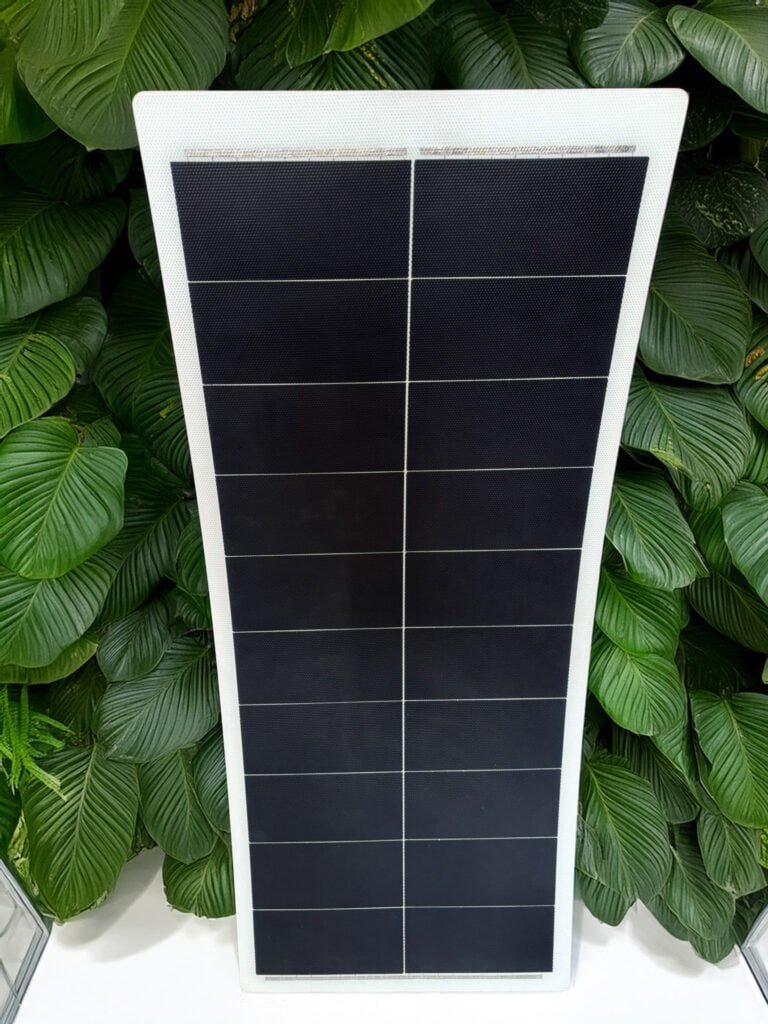
⚠️ Transparency notice: This is a calculated performance projection, not a measured field result. All figures are derived from published cell specifications, verified solar irradiance data for the Whitsunday Islands region, and documented degradation literature. Each assumption is stated explicitly so readers can apply the same methodology to their own location and application. A site-specific projection for your installation is available on request.
A sailing catamaran based out of Airlie Beach, Whitsunday Islands, Queensland. Ten flexible panels mounted flush across the coach roof — no air gap, exposed to salt spray, tropical UV, and dynamic partial shading from rigging and sails. Two panel options evaluated at identical rated wattage.
| المعلمة | قيمة | مصدر |
|---|---|---|
| موقع | Airlie Beach, QLD (20.27°S, 148.71°E) | — |
| Annual avg. peak sun hours | 5.5 h/day | Solar Choice Airlie Beach |
| Annual avg. ambient max temperature | 25.7°C | beach-weather.com / BOM data |
| Cell operating temp (flush-mounted, no gap) | ~54°C (ambient + ~28°C) | NOCT methodology; IEC 61215 |
| Panel A: Couleenergy CLM-160M-BC | 160W rated; HPBC; temp. coeff. –0.27%/°C; degradation <0.35%/yr | Couleenergy datasheet; Aiko ABC platform published specs |
| Panel B: Generic 160W flexible (PET+PERC) | 160W rated; mono PERC; temp. coeff. –0.38%/°C; degradation ~0.70%/yr | Representative mid-market spec; NREL degradation rates |
| System derate (MPPT + cabling) | 4% loss applied to both panels | Standard industry assumption |
Applying the temperature coefficient formula P(T) = P_STC × [1 + γ × (T − 25)][6] at the annual average cell operating temperature of 54°C:
| CLM-160M-BC (HPBC) | Generic PERC (PET) | |
|---|---|---|
| Rated output (STC, 25°C) | 160 واط | 160 واط |
| Temperature derating at 54°C | 160 × [1 + (–0.0027 × 29)] = 147.5W | 160 × [1 + (–0.0038 × 29)] = 142.4W |
| After system derate (×0.96) | 141.6W effective | 136.7W effective |
| Daily energy output (× 5.5 PSH) | 778 Wh/day | 752 Wh/day |
| Year 1 annual yield per panel | 284 kWh | 274 kWh |
BC flexible panels are a relatively new commercial format with approximately two years of real-world deployment history. This projection covers that 2-year window — the period for which real application data exists — and accounts for: (A) published cell degradation rates; (B) PET encapsulation UV yellowing and additional transmission loss, a well-documented failure mode in tropical environments with sustained high UV index and heat.[9]
| سنة | CLM-160M-BC Annual Yield | Generic PERC (PET) Annual Yield | Annual Advantage | Cumulative Advantage |
|---|---|---|---|---|
| 1 | 284 kWh | 274 kWh | +10 kWh (+3.6%) | +10 kWh |
| 2 | 283 kWh | 264 kWh (PET: +3% tx loss begins) | +19 kWh (+7.2%) | +29 kWh |
| Total (2 yr) | 567 kWh | 538 kWh | +29 kWh (+5.4%) | — |
PET yellowing rates: conservative estimates based on published UV degradation literature for PET polymer films under tropical UV/heat exposure (UV index 7–12, ambient >25°C). Real-world tropical observations frequently show higher rates from year 2 onward. CLM-160M-BC degradation: <0.35%/yr per Couleenergy datasheet / Aiko ABC platform published warranty. PERC degradation: ~0.70%/yr per NREL Photovoltaic Degradation Rates review.
| 10× CLM-160M-BC (HPBC) | 10× Generic PERC (PET) | Difference | |
|---|---|---|---|
| 2-year cumulative yield | 5,670 kWh | 5,380 kWh | +290 kWh (+5.4%) |
| Year 2 annual yield | 2,830 kWh/yr | 2,640 kWh/yr | +190 kWh/yr (+7.2%) |
| Year 2 output vs Year 1 | 99.6% (minimal cell degradation; ETFE stable) | 96.4% (cell degradation + PET yellowing onset) | ETFE panel holds output; PET panel already declining |
📌 How to read this projection: In Year 1, the BC panel’s thermal advantage accounts for most of the gap — a direct result of the –0.27%/°C coefficient versus –0.38%/°C for PERC at a real operating temperature of 54°C in the Whitsundays climate. The 3.6% Year 1 advantage is conservative and purely physics-based; it would be measurable from the first charge cycle. In Year 2, PET encapsulation yellowing begins compounding the deficit in the tropical UV environment — the generic panel’s output drops to 96.4% of its Year 1 figure, while the ETFE panel holds at 99.6%. By the end of Year 2, the 10-panel HPBC array has produced 290 kWh more than its PET-PERC equivalent — with the gap widening every subsequent year as PET degradation accelerates. These projections are conservative; real-world tropical salt-spray conditions typically push PET yellowing faster than the rates modelled here. BC flexible panels are a new commercial format — this 2-year projection reflects the current deployment window. As real-world data accumulates, longer-horizon projections will follow.
In the flexible solar panel market, warranty length is the single most honest indicator of manufacturing confidence. A manufacturer who ships PET-encapsulated PERC panels with solder ribbon interconnection and offers a six-month warranty is telling you, in commercial language, what they expect to happen to that product in the field.
Couleenergy provides a 3–5 year product warranty on its ETFE + BC flexible modules — three to ten times longer than the 6-month to 1-year warranty typical of most Chinese flexible panel manufacturers. That gap is not a marketing position. It is the direct consequence of building a 9-layer module with Japanese ETFE, four POE encapsulant layers, composite film reinforcement, ribbon-free interconnection, and IEC-certified construction — using LONGi HPBC 2.0 and Aiko ABC cells whose degradation rates are independently certified — and being sufficiently confident in that engineering to warrant it.
| Manufacturer Tier | Typical Product Warranty | What It Signals |
|---|---|---|
| Budget commodity (PET + PERC) | 6 months – 1 year | Manufacturer expects delamination, yellowing, or output loss before then. |
| Mid-tier (ETFE + PERC/TOPCon) | 1–2 years | Better materials — but limited confidence in long-term lamination stability or cell flex durability. |
| Couleenergy (ETFE + BC, 9-layer) | 3-5 سنوات | Engineering confidence. The 9-layer structure with LONGi HPBC / Aiko ABC cells, POE encapsulant, composite film, and ribbon-free interconnection is built to last — and warranted to prove it. |
ضمان الأداء: Couleenergy’s BC flexible modules carry a performance warranty covering annual degradation rates from year two, based on the <0.35%/yr degradation rates of the LONGi HPBC 2.0 and Aiko ABC platforms. BC flexible solar panels are a relatively new commercial format — approximately two years in volume deployment — and longer-horizon projections will be extended as independently verified field data accumulates.
🚢 A marine equipment distributor in Northern Europe sourcing for sailing charter operators specified the CLM-160M-BC for flush-mounted coach roof installations — the brief required extra lightweight, resistance to salt spray and UV, shade tolerance from rigging and sails, and a minimum 3-year product warranty for end-customer confidence. The HPBC back-contact format met all four criteria without compromise.
🏗️ A BIPV integrator in Germany selected the ABC all-black format for a curved commercial facade project. Key requirements: custom panel dimensions to match the facade module grid, zero visible busbar aesthetics. Couleenergy provided prototype panels within two weeks of specification confirmation.
| نموذج | تكنولوجيا الخلايا | كفاءة الوحدة | وزن | Max Bend | ضمان | الأفضل لـ |
|---|---|---|---|---|---|---|
| CLM-160M-BC | HPBC (LONGi) | 20.21% | ~2.8 kg | 240° | 3–5 yr | Marine, RV, BIPV — all-black, shade-tolerant |
| CLM-260M-BC | BC back-contact | ~21% | ~4.6 kg | 240° | 3–5 yr | C&I rooftop; higher power; 40V system voltage |
| CLM-180MF | Mono PERC shingled | 19.5% | ~2.6 kg | 30°+ | On request | Budget; portable off-grid |
| Custom designs | HPBC, ABC, TOPCon | 19–22% | Custom | Custom | On request | Any size, shape, voltage — IoT to commercial |
Because the 9-layer architecture earns it — and because the cells inside it are backed by the most rigorous public validation in the industry. Couleenergy uses LONGi HPBC 2.0 and Aiko ABC cells — platforms independently certified by Fraunhofer ISE, TÜV Rheinland, and CPVT for efficiency, degradation rate, and thermal performance. Around those cells, Couleenergy’s 9-layer construction — Japanese ETFE, four POE layers, composite film reinforcement, ribbon-free interconnection — prevents every known failure mode of standard flexible panels. Manufacturers offering six-month warranties are pricing in the probability that their product will delaminate, yellow, or lose output before then. Couleenergy’s warranty is offered because the engineering is expected to outlast it by a significant margin.
Yes. Evaluation samples are available to qualified distributors, OEM brands, and system integrators — no volume commitment required. Standard samples dispatch within 2–3 weeks. Custom-dimension samples for BIPV or marine integration projects are available within 2–4 weeks. Contact info@couleenergy.com أو +1 737 702 0119 with your application details and shipping address.
Whether you’re sourcing for marine, RV, BIPV, or C&I rooftop — send us your surface dimensions, system voltage, target wattage, and installation location. Our engineering team will return a panel specification, bend-radius confirmation, warranty terms, and indicative site yield projection within one business day. No volume commitment required to start.


 العربية
  English
  Español
  Français
  Deutsch
  Русский